
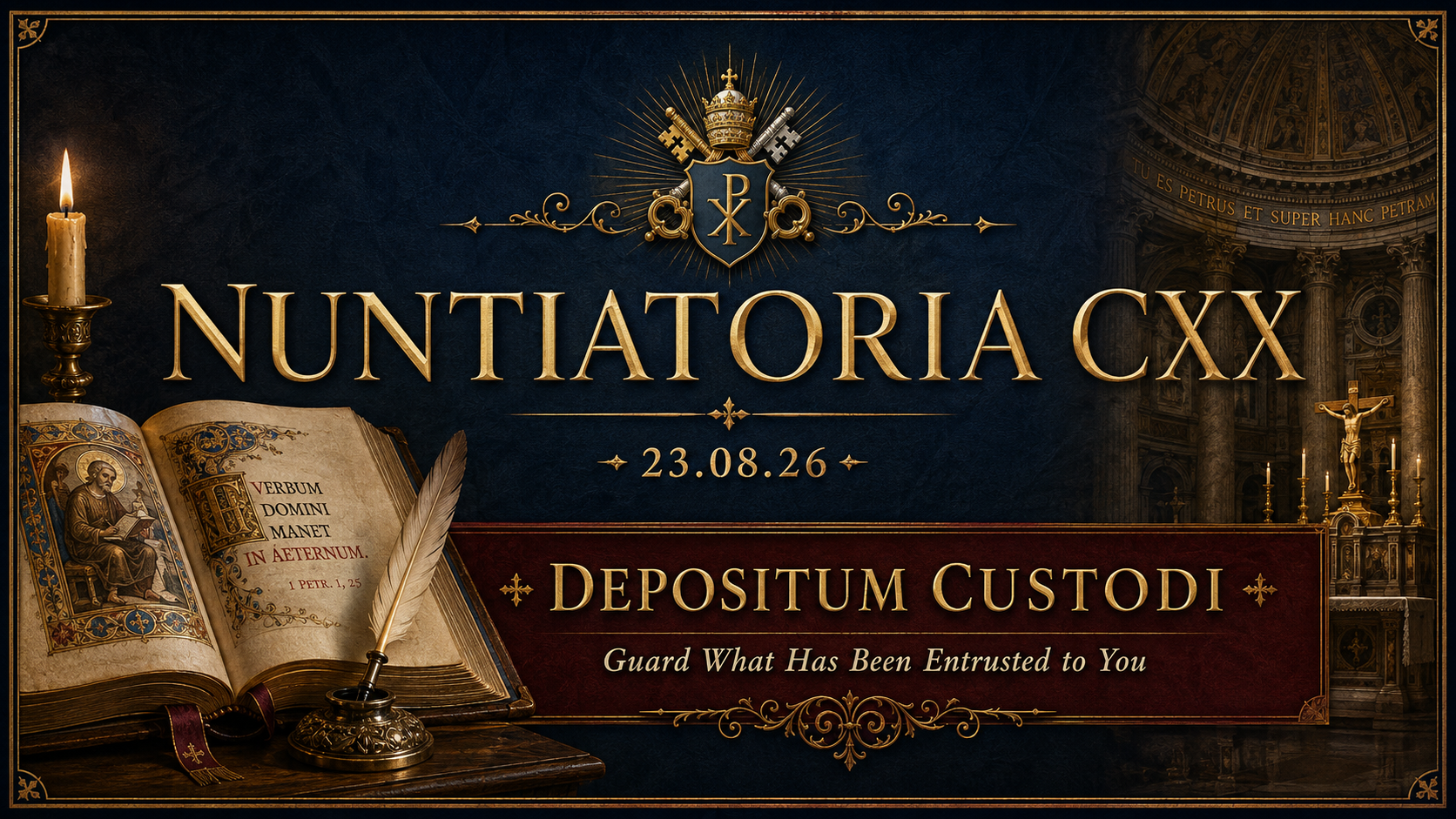
Editorial: GuArd what has been entrusted to you

“O Timothy, keep that which is committed to thy trust.”
— I Timothy 6:20
There are moments when the Church’s task can be expressed in a single command: Depositum custodi. Guard the deposit. St Paul’s words to Timothy are not a counsel of timidity. They do not ask the Church to bury the Faith, freeze it in time, or retreat from the world. They establish something more fundamental: Christianity is first received before it is interpreted, preached, developed or applied. What has been entrusted to the Church is not raw material placed at her disposal. It is a deposit to be believed, worshipped, defended and faithfully handed on.
That principle follows naturally from the motto of our previous edition, Accipere, non fingere — receive, do not invent. Reception is the first obligation; custody is the second. What has not been received faithfully cannot be guarded faithfully, and what is not guarded will eventually cease to be transmitted. Thus the question running through Nuntiatoria CXX is not whether the Church should change, develop, govern or respond to new circumstances. Of course she must. The deeper question is whether those entrusted with Catholic things still understand themselves principally as their custodians, or whether the modern ecclesiastical imagination has gradually persuaded them that they are also their authors.
That distinction matters because authority within the Church is not absolute possession. A bishop does not own the Faith of his diocese. A priest does not own the liturgy he celebrates. A theologian does not own revelation. A religious superior does not own the charism entrusted to a community. A Catholic university does not own the meaning of “Catholic”. A synodal assembly cannot manufacture what the sensus fidelium is permitted to believe. Even the Roman Pontiff does not stand above the deposit of Faith as though able to redefine what has been handed down. His authority is supreme precisely because his obligation to guard, confirm and transmit is supreme.
This is why “The Most Clerical Revolution in Modern Catholic History” occupies a central place in this edition. One of the great ironies of post-conciliar Catholicism is that a transformation repeatedly described as the emancipation of the laity was overwhelmingly conceived, interpreted and implemented by a professional clerical and ecclesiastical class. Ordinary Catholics did not spontaneously decide to abandon Latin, marginalise Gregorian chant, remove communion rails, redesign sanctuaries, suppress familiar devotions, reconstruct seminaries or reconceive religious formation. Bishops, priests, theologians, liturgists, religious superiors, seminary professors and ecclesiastical bureaucracies largely did that for them.
The accompanying consideration of the latest Old Romans Unscripted discussion places that historical development within the formation of clergy and religious. It is not enough to ask what official documents said. One must also ask what seminarians, young priests, religious and laity were taught those documents were supposed to mean. The “spirit of Vatican II” became powerful precisely because it functioned less as a definable conciliar proposition than as an ecclesiastical culture: an assumption that theology had “moved on”, that older devotional instincts indicated immaturity, that traditional liturgical preferences revealed deficient pastoral formation, and that resistance to reconstruction demonstrated failure to understand the Council. What was transmitted was therefore not merely legislation but an attitude.
The distinction between legitimate development and reconstruction also illuminates our reconsideration of the 1983 open letter of Archbishop Marcel Lefebvre and ✠Antonio de Castro Mayer to Pope John Paul II. Written five years before the 1988 consecrations, the letter matters because it complicates the convenient retrospective narrative in which opposition to the post-conciliar settlement began with a rejection of Roman authority. Lefebvre and de Castro Mayer appealed precisely to the Pope, invoking his responsibility to confirm his brethren in the Faith and presenting what they believed to be grave doctrinal, liturgical and disciplinary problems. One may dispute their diagnoses or conclusions, but the historical record cannot fairly be reduced to obstinacy without engagement. The unresolved question is why arguments raised respectfully within the Church over decades so often appeared to receive administrative answers before receiving theological ones.
The same concern reappears in the present Synodal project. Archbishop Gilbert Garcera, president of the Catholic Bishops’ Conference of the Philippines, has warned that synodality cannot be reduced to meetings, consultations, reports and assemblies. That warning deserves to be taken with complete seriousness. If synodality becomes a permanent institutional process whose success is measured by the continuation of the process itself, it risks developing the same pathology which has afflicted other ecclesiastical programmes: machinery is mistaken for fruit. Conversion, holiness, doctrinal clarity, sacramental life, evangelisation and salvation remain the ends against which Catholic pastoral initiatives must ultimately be judged.
The point is sharpened by the question raised elsewhere in the edition: when listening already has an answer, what exactly is being discerned? The sensus fidelium is not manufactured consensus. It cannot be reduced to questionnaires, facilitated conversations, diocesan syntheses or the judgement of specialists who decide which contributions express the movement of the Spirit. The faithful participate in the sensus fidei because they participate in a Faith already received. Synodality can help the hierarchy listen; it cannot make revelation negotiable, and it cannot convert a predetermined ecclesiastical programme into the voice of the Holy Ghost merely by describing the process as discernment.
The developing situation at the Cistercian Abbey of Heiligenkreuz gives this argument an unexpectedly concrete expression. Abbot Maximilian Heim is to step down after two terms, but the monks have been prevented from proceeding immediately to the ordinary exercise of electing his successor. Instead, Roman intervention provides for an administrator for three years. Heiligenkreuz is not an insignificant house: it is one of the most visible centres of vigorous Catholic monastic life in Europe, associated with numerous vocations, traditional liturgical culture, theological formation and an international reputation far beyond Austria. Precisely for that reason, the case raises the uncomfortable juxtaposition captured by our treatment of “synodality at the cloister door”: an ecclesial culture extolling participation, subsidiarity and listening simultaneously demonstrates a remarkable willingness to suspend the ordinary self-government of a flourishing religious community. Synodality becomes difficult to understand if participation is praised most loudly where authority already approves the probable outcome.
That tension between professed openness and actual exclusion appears with still greater force in Lourdes, where the Society of Saint Pius X has found itself prevented from organising public liturgical worship at the shrine while groups belonging to ecclesial communities outside full Catholic communion may be welcomed and accommodated. Our editorial “Open to Canterbury, Closed to Écône” does not require anyone to pretend that the canonical situation of the SSPX is simple. It is not. But neither is the contradiction escaped by repeating the word “schism” while practising expansive ecumenical hospitality towards bodies whose separation from Rome is undisputed. If Anglicans and other Christians may gather visibly at Lourdes without anyone imagining that Catholic doctrine has thereby collapsed, the refusal of comparable space to Catholics attached to the traditional Roman Rite inevitably looks less like principled ecclesiology than selective severity. Ecumenism becomes difficult to defend when generosity increases with theological distance while suspicion intensifies towards those closest to Catholic doctrinal and sacramental inheritance.
A similar question of proportionality arises from the suppression of the Children of Mary in Columbus, Ohio. The Diocese of Columbus has judged matters sufficiently serious to suppress the community, yet the publicly available explanations have remained strikingly imprecise. A source close to the women has attributed the conflict principally to their traditional approach to formation and catechesis. That allegation cannot simply be accepted as established fact because it comes from a sympathetic source. But the seriousness of suppression creates a corresponding obligation of clarity. If there were identifiable canonical, moral, financial, safeguarding or disciplinary offences, they should be stated. If, however, what has become intolerable is substantially a traditional pattern of religious formation, devotional discipline or catechesis, then a still more troubling possibility presents itself: the custodian has begun to suspect the deposit itself.
A smaller controversy in the Philippines exposes the same inversion almost perfectly. A recently ordained priest appeared in recognisably traditional Roman vesture: Roman chasuble, lace alb, maniple and biretta. This was apparently sufficient to provoke criticism suggestive of liturgical impropriety. There is something revealingly absurd about the episode. The Church has endured decades of improvised texts, theatrical liturgies, invented gestures, secular music, anthropocentric experimentation and real departures from liturgical law. Yet vestments indisputably belonging to the Roman tradition can now attract suspicion precisely because they look too traditionally Catholic. When ecclesiastical memory weakens sufficiently, inheritance begins to look more radical than innovation. Hence our deliberately pointed title: “Apparently, the Vestments Are the Emergency.”
The contrast is especially telling because the issue is not aesthetic preference. Catholic worship is itself part of the deposit entrusted to the Church. Rubrics may legitimately develop and vesture may vary, but there is something profoundly disordered when inherited Catholic forms must continually justify their existence while novel practices are granted an almost automatic presumption of pastoral legitimacy. The priest is not the proprietor of the liturgy, but neither is the liturgical bureaucrat. Both receive something which preceded them.
That custodial obligation extends naturally to Catholic anthropology. In Hamburg, parents challenging Archbishop Stefan Hesse’s LGBT guidance for Catholic schools received a response from the Dicastery for Culture and Education directing attention back to the Holy See’s 2019 document Male and Female He Created Them. That document rejects theories which reduce sexual difference to cultural construction and defends the prior rights of parents and an anthropology grounded in created reality. The Roman reply may be brief, and critics are right to ask whether stronger intervention is required, but its underlying principle cannot be confined to Germany. If Catholic education in Hamburg must conform itself to Catholic anthropology, then dioceses, episcopal conferences and Catholic schools elsewhere — including in Britain — cannot claim a parallel freedom to adopt fundamentally contradictory premises. Male and female are not regional doctrines.
Catholic education is therefore another act of custody. A school does not merely transmit information. It forms the intellectual and moral imagination through which a child encounters reality. If Catholic institutions teach an anthropology fundamentally at odds with the Faith while retaining Catholic branding, the problem is not merely inconsistency in one policy area. It is an institutional failure to guard what has been entrusted.
Questions about Catholic institutional identity also arise in our consideration of Pope Leo XIV’s appointment of twelve new consultors to the Dicastery for Promoting Integral Human Development, including two professors from the University of Notre Dame. The appointments themselves are not simply reducible to ideological labels, and a consultor is not a legislator of doctrine. Yet appointments matter because institutions teach partly through whom they choose to advise them. The Dicastery concerns itself with human development, migration, ecology, health, peace and social questions precisely where Catholic social teaching must resist absorption into fashionable political categories. “Integral” human development cannot mean the aggregation of contemporary causes. It means development according to the whole truth about the human person, his social nature and his supernatural destiny.
That question — whether Catholic institutions remain governed by the content of the adjective “Catholic” — recurs throughout the edition. It applies to universities and schools, diocesan structures and Roman dicasteries, formation houses and religious communities. Institutional identity is not preserved by retaining vocabulary after changing the assumptions beneath it. A Catholic body may collaborate widely; it may learn from specialists who are not Catholic; it may engage sympathetically with the modern world. But it cannot remain meaningfully Catholic if its own tradition ceases to determine the principles by which that engagement is judged.
The same obligation of fidelity applies to the Holy See itself. Our treatment of unresolved questions addressed to Rome insists upon a discipline frequently absent from contemporary ecclesiastical polemic. Serious canonical or historical questions cannot be answered by ridicule, but neither do dramatic allegations become true merely because their consequences would be dramatic. Whether the subject is the interpretation of a historical Roman intervention, the legal meaning of an ecclesiastical act, or disputed claims about the exercise of papal authority, extraordinary conclusions require evidence proportionate to their magnitude. Depositum custodi means guarding truth against credulity as well as against institutional convenience.
The controversy over Pachamama and Pope Leo XIV, considered in the edition against the memory of the Amazon Synod, places the custodial obligation directly before the First Commandment. Authentic inculturation belongs to Catholic missionary history. The Church has never required every people to surrender everything culturally distinctive in order to become Christian. But inculturation requires discernment precisely because cultures contain things which may be purified and assumed, and things which cannot. After the scandal and confusion generated by the Pachamama ceremonies under Pope Francis, imagery associated with indigenous ceremonies and Leo XIV inevitably reopens questions which were never satisfactorily resolved. Describing something as “cultural” does not by itself settle whether its symbolism is religious. Where ambiguity touches divine worship, clarity is a duty.
The analysis of Christopher Manion’s “Fauci and the Bishops” applies the same principle of custody to the Covid period. Whatever one concludes about particular public-health measures, the retrospective question is legitimate: did Catholic bishops sufficiently distinguish the authority of scientific and governmental expertise from their own responsibility for supernatural goods? Experts could advise bishops concerning infection and epidemiological risk; they could not assign the value of the Mass, determine the spiritual necessity of access to the Sacraments, or decide the place of priestly presence at sickness and death. Bishops faced extraordinary circumstances and some restrictions may have been justified, but the closure of churches, curtailment of sacramental access and restriction of pastoral ministry are too significant simply to pass into history without serious examination.
Custody of the moral law is more explicit in the United States bishops’ new initiative concerning abortion pills. Chemical abortion increasingly moves the destruction of unborn life from clinic to home, mediated by tablets, telemedicine and postal delivery. The phenomenon has an obvious British parallel in “pills by post”, introduced under emergency Covid conditions and subsequently made permanent by Parliament despite continuing medical and safeguarding concerns. Technology changes the mechanism; it does not change the moral object. An unborn child does not become less human because death arrives through the letterbox. One of the Church’s simplest but most indispensable duties is to refuse language which hides reality.
This is why the issue of public Catholic witness cannot be separated from episcopal teaching. Prayer initiatives and pastoral resources are good, but the Church also has to make intelligible what she means when she calls something gravely evil. A moral vocabulary without practical consequence eventually becomes merely rhetorical. The deposit is not guarded by repeating propositions which ecclesiastical practice simultaneously teaches the faithful need not be taken very seriously.
Beyond ecclesiastical structures, this edition turns to the increasingly fraught relationship between Christianity, Islam and public speech in Britain. Rowan Williams’s accusation that Nigel Farage has used Christian language to channel anti-Muslim sentiment provides one point of entry. Christianity must never become camouflage for racial hatred or collective hostility towards Muslims. Every Muslim is owed justice, charity and the protections of law. But the distinction between persons and propositions remains indispensable. Islam may be criticised as a religion. Islamist ideology may be opposed. Immigration, integration, demographic change and the Christian inheritance of Britain may be debated. To collapse all such argument into hostility towards Muslims is not charity; it is the evacuation of rational public discussion.
The problem becomes more serious in “The State Erased the Case File”, our examination of the Government’s proposed definition of so-called “anti-Muslim hostility” and the revelation that responses submitted to the relevant Working Group’s Call for Evidence were deleted. The issue is not whether anti-Muslim hatred exists; plainly it does and should be opposed. The issue is whether a state-backed definition can be employed as a functional blasphemy restriction, chilling legitimate criticism of Islamic beliefs and institutions, particularly when questions have been raised about the affiliations of those involved in drafting it and when the evidential record upon which consultation supposedly depended has disappeared. Britain abolished its formal blasphemy laws. It should not recreate them indirectly through equality terminology whose practical boundaries citizens cannot confidently know.
Here depositum custodi takes on a civilisational dimension. Britain cannot have a serious conversation about social cohesion if Christianity is permitted chiefly as a sentimental vocabulary while Islam is increasingly insulated from theological, historical or political criticism. Christian charity does not demand dishonesty. A society confident in religious liberty protects Muslims from discrimination while equally protecting Christians, ex-Muslims, secular critics and others in their right to question Islamic claims. Free speech means very little if it extends only to opinions which institutions consider socially harmless.
The edition’s ecclesiastical reporting makes the same demand for transparency closer to home. Whether dealing with suppressed religious communities, constrained traditional apostolates, intervention in monasteries, synodal governance or Roman decision-making, authority cannot answer only to itself. Secrecy is sometimes necessary; confidentiality may be a duty; prudential government cannot be conducted by plebiscite. But none of those truths means that the governed lose all legitimate claim to reasons. Authority which continually demands trust while declining to explain serious decisions eventually exhausts the trust upon which its own effective exercise depends.
Against these disputes over institutional authority stands one of the starkest pieces in this edition: the account associated with ✠Matthew Hassan Kukah of the young Nigerian seminarian murdered after continuing to call his kidnappers to repentance. The young man was confronted not with a synodal questionnaire, a chancery directive or an argument about ecclesiastical positioning, but with death. According to the testimony concerning his final captivity, he continued to tell armed men that they must repent and return to God. They killed him. Whatever complexities surround violence in Nigeria, that witness reduces the meaning of depositum custodi to its most elemental form. He had received the Faith. He believed it true. He would not behave as though its truth ceased when fidelity became dangerous.
The martyrs remind comfortable Christianity that custody is not preservation for its own sake. The Faith is guarded so that it can be proclaimed. The martyrs do not defend the deposit by hiding it from danger; they defend it by refusing to alter it when danger arrives. Their witness makes much Western ecclesiastical anxiety look desperately small. Where we worry that traditional vestments may seem unfashionable, Christians elsewhere risk death for the name of Christ. Where institutions fear doctrinal clarity because somebody may feel excluded, martyrs proclaim repentance to those who can kill them.
The traditional liturgical material of this edition provides the supernatural horizon against which all these controversies must be read. The Thirteenth Sunday after Pentecost, with the cleansing of the ten lepers, distinguishes the reception of a gift from recognition of the Giver. All ten are cleansed; only one returns. Our Lord’s final words to the grateful Samaritan — “Thy faith hath made thee whole” — reveal why the Church guards sacramental, doctrinal and liturgical forms at all. Catholicism is not an archive of inherited religious commodities. Every grace exists to restore man to God.
The feast of St Philip Benizi makes the same point through ecclesiastical authority. The Servite superior, theologian and peacemaker is remembered not for treating office as self-expression but for humility before it. Catholic memory associates him with flight from the possibility of elevation to the papacy itself. Whatever distinctions must be made between history and later hagiographical detail, the spiritual lesson is unmistakable: Catholic authority is something received for service, not possessed for self-projection. Office exists within a reality greater than the office-holder.
Even the edition’s reflections upon inherited Christian phrases and customs belong within this meditation upon memory. Not every claim that a familiar saying has medieval or devotional origins survives historical scrutiny, and pious etymology should never be substituted for evidence. Yet the larger phenomenon remains important: cultures often continue using linguistic and behavioural fragments of a Christian civilisation after forgetting the world which gave them meaning. Languages remember what societies forget.
Church institutions can suffer the same fate. A school may continue calling itself Catholic after becoming embarrassed by Catholic anthropology. A university may retain a chapel while allowing an entirely different philosophy of man to dominate its intellectual life. A liturgy may retain Catholic vocabulary while its ceremonial instincts move steadily away from inherited sacrificial consciousness. A synodal structure may speak endlessly about the People of God while an expert class determines what the People of God are understood to have said. A shrine may celebrate ecumenical welcome while treating Catholics attached to the Church’s traditional liturgy as uniquely problematic. A monastery may hear much about participation while being deprived of the ordinary exercise of electing its own superior.
Memory is therefore not an ornament of Tradition. It is one of the conditions of identity.
Without memory, every innovation can present itself as inevitable because there is no inherited standard against which to measure it. Without custody, Catholic development becomes indistinguishable from substitution. Without a deposit, “discernment” becomes merely the sanctification of contemporary preference.
This is not an argument that nothing may change. The Church has developed doctrine, discipline, law, institutions and liturgical forms throughout her history. But authentic development possesses an indispensable characteristic: the thing developing remains recognisably itself. St Vincent of Lérins used the analogy of bodily growth. The adult differs enormously from the infant, yet remains the same person. Development enlarges identity; it does not abolish it.
The crisis begins when novelty is defended not as growth from the inheritance but as liberation from it: when Catholic anthropology must be corrected by contemporary ideology; when inherited worship becomes an embarrassment; when traditional formation becomes suspicious merely for being traditional; when consultation acquires conclusions before the consultation begins; when flourishing monasteries discover that subsidiarity has limits invisible in synodal rhetoric; when ecumenical hospitality appears broader than Catholic tolerance; when government defines acceptable criticism while destroying part of the evidential record by which its decision might be judged; when bishops speak gravely about moral evil while the surrounding culture perceives no corresponding seriousness in ecclesiastical practice; when Catholic institutions preserve the word while surrendering the thing the word once described.
At that point St Paul’s command becomes urgent: Depositum custodi.
The priest receives before he celebrates. The bishop receives before he governs. The theologian receives before he speculates. The religious receives before he forms another generation. The university receives before it educates. The Catholic school receives before it adapts. The synod receives before it discerns. The Roman dicastery receives before it regulates. The Pope receives before he commands. And because each has received, each must guard.
This is not traditionalism.
It is Tradition.
The deposit must be guarded not because it belongs to us, but because it does not. Not because the past was perfect, but because truth is not ours to replace. Not because the Church must fear the present, but because she possesses something the present desperately needs. Not because every inherited custom is immutable, but because the realities those customs express may be. Not because Catholics are called to retreat from the world, but because there can be no genuine mission unless there remains something definite to proclaim to it.
A Church uncertain of what she has received cannot evangelise. She may advertise herself, accommodate herself, restructure herself, consult herself and perpetually analyse herself, but she cannot convincingly tell the world, “Thus saith the Lord.” The young seminarian in Nigeria understood that. So did the martyrs before him. So did the saints whose Faith we inherited. So must every generation which hopes to hand that Faith to another.
Last week the command was Accipere, non fingere — Receive, do not invent.
This week comes its necessary consequence:
DEPOSITUM CUSTODI.
Guard what has been entrusted to you — in doctrine and worship, in formation and education, in authority and conscience, in the Church and in the public square — so that what we received may be handed on unchanged in truth, undiminished in courage, and alive in the souls of those who come after us.
IN THIS EDITION
- DEPOSITUM CUSTODI – Guard What Has Been Entrusted to You: A Spiritual Conference for Nuntiatoria CXX
 The spiritual conference, titled “Depositum Custodi,” encourages individuals to guard what God has entrusted to them, including the Catholic Faith and personal responsibilities. It emphasises the importance of preserving and transmitting this inheritance with gratitude, vigilance, and humility, urging personal reflection on one’s relationship with faith and practice in daily life.
 - 23.08.26 Nuntiatoria CXX: Depositum Custodi
 The editorial underscores the Church’s duty to safeguard the Faith, emphasising that it must be received and protected, not altered or created anew. It critiques contemporary ecclesiastical trends that risk undermining this custodial responsibility, urging faithful adherence to tradition while engaging with modernity. The overarching message is to guard the entrusted deposit of Faith.
 - ORDO w/c 23.08.26
 The content outlines a liturgical calendar for a series of days in August, detailing specific saints’ commemorations, masses, and associated rituals. It highlights variations in the mass types and colours assigned for these days, including references to the Assumption of Mary and other significant feasts, while also noting a prior occurrence affecting scheduling.
 - The Most Clerical Revolution in Modern Catholic History
 The post highlights the contradiction within modern Catholicism, where reforms post-Vatican II, framed as laity empowerment, are largely managed by an ecclesiastical elite. Despite claims of liberation from clericalism, authority remains concentrated, with new structures controlling participation and liturgical interpretations, undermining genuine engagement from the faithful.
 - Apparently the Vestments Are the Emergency
 The controversy surrounding a Filipino priest’s traditional vestments highlights a misunderstanding of Second Vatican Council decrees. Critics confuse personal taste with liturgical law, mistakenly suggesting that traditional attire reflects a rejection of Vatican II. The debate underscores the need to differentiate between genuine liturgical abuse and legitimate tradition, advocating for fidelity over fashion.
 - Christian Britain Is Not Anti-Muslim: Rowan Williams, Nigel Farage and the increasingly dangerous confusion between Christian identity and hostility to Islam
 Rowan Williams criticises Nigel Farage for allegedly using Christianity to express anti-Muslim sentiments, cautioning against confounding religious identity with hostility. While acknowledging Britain’s Christian heritage, Williams’s speculative judgement of Farage’s motives raises concerns. The article argues for a nuanced understanding of Christianity that accepts public discourse while ensuring interfaith respect and coexistence.
 - After Dobbs, Abortion Moved to the Mailbox — Now the Bishops Are Responding
 In response to the changing landscape of abortion post-Dobbs, US bishops have initiated a campaign to address the rise of chemical abortions through prayer and education. They highlight concerns surrounding safety and oversight in remote abortion services, drawing parallels with the UK experience where temporary measures became permanent, raising significant ethical issues.
 - When Authority Answers Only to Itself: Fauci, the Bishops and the Clericalism of Managed Accountability
 Christopher Manion’s essay compares Anthony Fauci and the Catholic bishops to critique how institutions demand trust while resisting accountability. Both examples illustrate a clericalist tendency where authority avoids scrutiny, raising fundamental questions about decision-making during crises like Covid-19. Ultimately, the Church must confront its failures to maintain credibility and ensure genuine accountability.
 - The Seminarian Who Preached to His Murderers: Michael Nnadi, the Blood of Martyrs, and the Christianity That Refuses to Be Afraid
 Michael Nnadi, an eighteen-year-old seminarian, was kidnapped and murdered in Nigeria for preaching Christ to his captors. His relentless call for repentance, even in the face of death, exemplifies true Christian martyrdom. Nnadi’s witness challenges contemporary Christians, reminding them of the importance of courage and the need for conversion amidst fear.
 - Touch Wood: The Faith We Forgot We Remember
 The article explores how modern secular practices, like “touch wood,” retain connections to Christian traditions, albeit stripped of their original meanings. Despite the decline of direct Christian expression, remnants of faith persist in language. These phrases reflect a longing for sacredness, highlighting the need to reclaim their spiritual significance in contemporary culture.
 - A Priest at the Helm: What St Mary’s Must Now Be
 Fr Dr Øystein Lund has begun his role as Vice-Chancellor at St Mary’s University, Twickenham, marking a significant moment for its Catholic identity. His unique background as a married priest and theologian brings a blend of experience essential for navigating the challenges of growth while maintaining the university’s foundational Catholic principles amidst contemporary secular pressures.
 - The State Erased the Case File: Blasphemy Law by Stealth
 The UK government’s definition of “anti-Muslim hostility,” claimed to be based on substantial evidence, faces scrutiny after the department responsible deleted crucial submissions from its evidence-gathering process. This raises serious concerns about public accountability and the potential for non-statutory definitions to influence institutional behaviours surrounding freedom of expression and criticism of religions.
 - Pachamama Returns — On the Road to Leo XIV
 The ceremony in Cusco, linked to Pope Leo XIV’s upcoming Peru visit, involved Catholic representatives participating in a “pago a la tierra” ritual dedicated to Pachamama. Disputes arise regarding the appropriateness of such inculturation within Catholicism, highlighting tensions between respecting indigenous traditions and maintaining the integrity of Christian worship.
 - When Synodality Stops at the Cloister Door: Rome suspends the abbatial election at Heiligenkreuz
 The Heiligenkreuz Abbey, a historic Cistercian monastery, faces a suspension of its abbatial election for three years, preventing the electors from choosing a new abbot due to concerns about inexperience among younger monks. This decision by Rome raises questions about synodality and the balance of authority, sparking debate over community governance and participation.
 - When Listening Has a Predetermined Answer
 Archbishop Gilbert Garcera asserts that true synodality requires the Church to listen receptively rather than to discover new directions. He warns against viewing synodality merely as processes, emphasising the need for adherence to established Catholic doctrine over personal opinions. Listening should reinforce traditional faith, not alter it.
 - Open to Canterbury, Closed to Écône: Lourdes
 The Bishop of Tarbes and Lourdes has prohibited the Society of Saint Pius X from conducting public worship at Lourdes, yet allows Anglican pilgrimages and Eucharistic celebrations there. This contradiction highlights inconsistencies in the Church’s approach to ecumenism and raises questions about genuine hospitality and the pastoral care extended to traditional Catholics.
 - What, Exactly, Did the Children of Mary Do?
 The Bishop of Columbus has announced the suppression of the Children of Mary, a traditional Catholic community, citing ongoing formation issues and alleged abuses without specifying details. This decision raises questions about the nature of the alleged misconduct and the justification for disbanding a community known for its traditional practices, leaving many unanswered concerns regarding transparency and accountability.
 - Receive, Do Not Invent: Old Romans Unscripted confronts the crisis of Catholic transmission
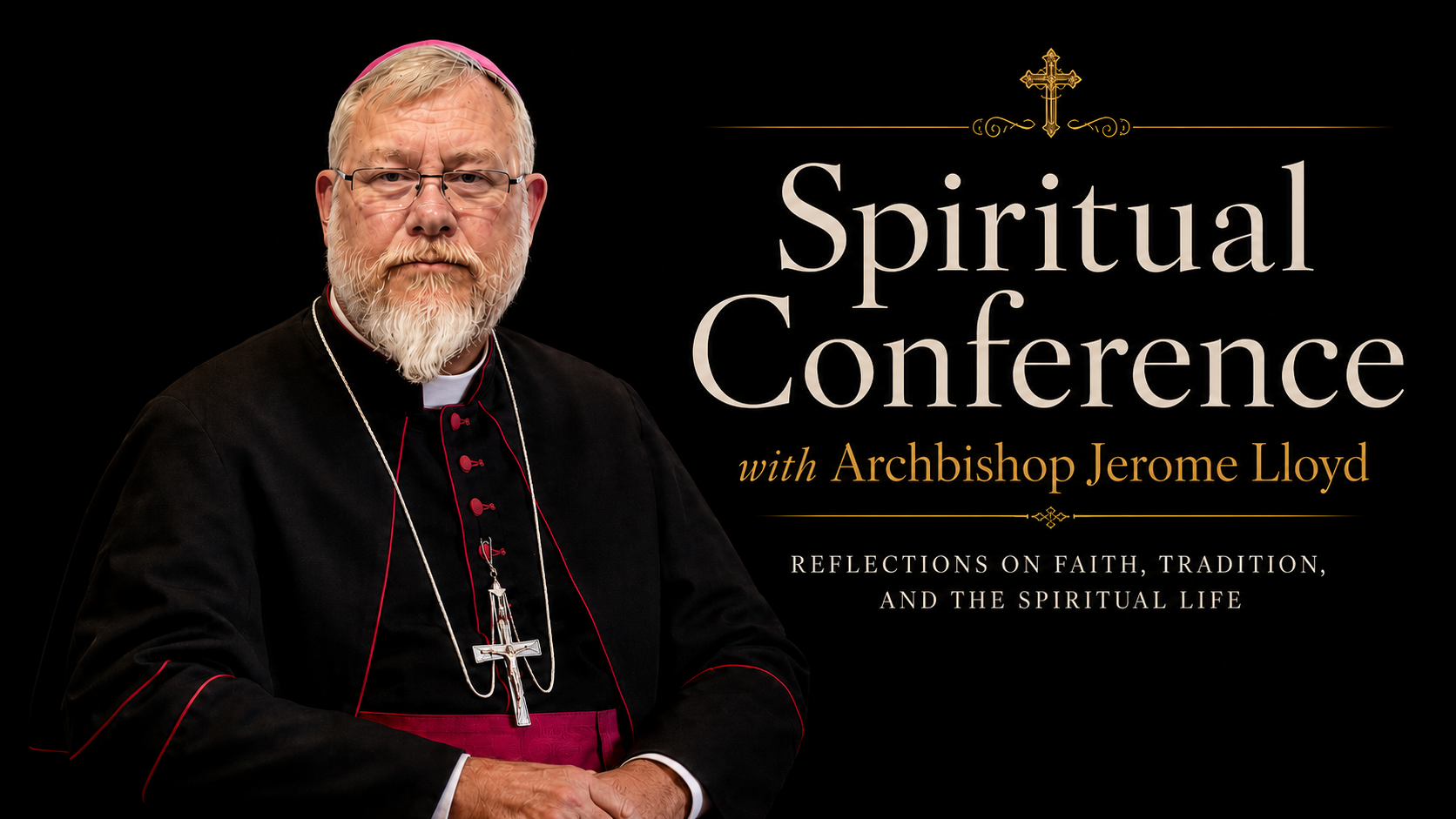
 In the sixth episode of Old Romans Unscripted, HE ✠Jerome Lloyd and Fr Stanislaus explore the Catholic transmission crisis, emphasising the need to receive rather than invent Christian teachings. They discuss the importance of continuity in tradition, the relationship between liturgy and life, and urge a deeper commitment to Catholic identity amidst contemporary challenges.
 - Rome Has Set the Test: Hamburg’s Gender Dispute Now Raises an Unavoidable Question for Britain’s Catholic Schools
 The Vatican’s recent communication regarding Hamburg’s educational framework poses critical implications for Britain’s Catholic schools. It reaffirms the anthropological principles outlined in “Male and Female He Created Them” for sexual education, challenging UK institutions to ensure their policies reflect this standard, thus shaping the future of Catholic education in England and Wales.



Leave a Reply