

Pachamama Returns — On the Road to Leo XIV
The ceremony in Cusco was not the Pope’s doing. There is no evidence that Leo XIV ordered it, approved it or even knew that it would take place. But it occurred at an ecclesially supported gathering which Vatican News itself describes as part of the preparation for his forthcoming visit to Peru. More significantly still, it comes only five months after evidence resurfaced of Robert Prevost’s participation in a 1995 Augustinian symposium whose own published proceedings explicitly describe a “Rite of Pachamama (Mother Earth)”. Thirty-one years later, the same theological question has arrived at his door — this time as Pope.

Sometimes the facts make the argument. On 13 and 14 August, representatives of the Catholic Church, indigenous communities, social organisations and human-rights groups assembled in Cusco for the Southern Macroregional Meeting Entrelazando Voces por la Dignidad: por los derechos humanos y el bien común. Vatican News reported the gathering approvingly, naming among its ecclesiastical participants ✠Lizardo Estrada Herrera, Auxiliary Bishop of Cusco and Secretary General of CELAM, and ✠Miguel Ángel Cadenas, Bishop of Iquitos. At the conclusion of its account came the detail which gives everything else its significance: the initiative, Vatican News said, formed “part of the path of preparation” for Pope Leo XIV’s forthcoming visit to Peru.¹ That establishes the context, but it does not establish papal responsibility. Leo XIV was not at the ceremony, and there is presently no evidence that he commissioned it, approved its contents or knew beforehand that it would occur. It would therefore be inaccurate to call what happened in Cusco “Leo XIV’s Pachamama ceremony”. Accuracy, however, cuts both ways.
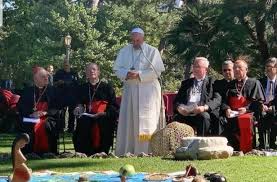
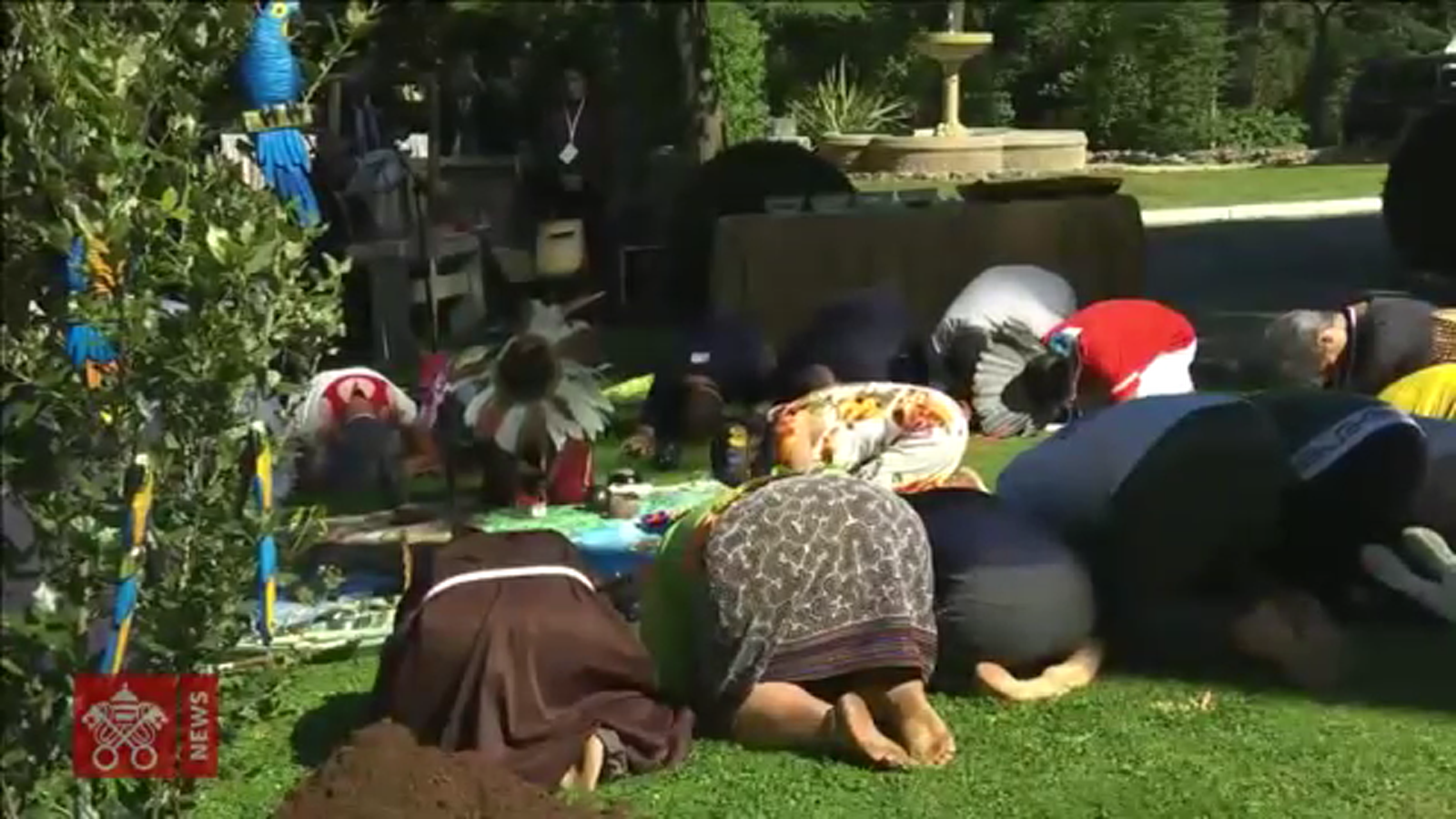
This was not an unrelated indigenous festival occurring somewhere beyond the orbit of the Church. It took place within a gathering prominently involving Catholic representatives, publicised by the Vatican’s own news service and explicitly situated by that service within the preparation for the Pope’s visit. The gathering opened with an Andean pago a la tierra — a “payment to the earth”. The recorded ceremony involved coca leaves, food offerings placed upon the ground, guided ritual actions and language directed towards “Mother Earth”. Footage subsequently publicised shows Mgr Jordi Bertomeu, an official of the Dicastery for the Doctrine of the Faith and Apostolic Commissioner charged with the liquidation of the Sodalitium Christianae Vitae and associated bodies, depositing his coca leaves in the offering. ✠Estrada likewise appears to participate in the ritual action.²
This is not a dispute created merely by translating an innocent Peruvian folk custom into alarmist European terminology. The pago a la tierra is explicitly identified in Peruvian sources as a religious or spiritual offering to Pachamama. The Regional Government of Cusco has formally described the annual Pago y Ofrenda a la Santa Tierra Pachamama as belonging to “Andean spiritual religion”, while contemporary official and cultural descriptions speak openly of offerings, rituals, gratitude and tribute to Pachamama, Mother Earth.³ That does not answer every theological question about every contemporary performance of the rite, but it does make one response untenable: pretending that there is no religious question to answer.
More curious still is what Vatican News did not say. Its report describes dignity, justice, peace, reconciliation, indigenous communities, environmental concerns, territorial grievances and the contributions of the participating bishops. It quotes ✠Estrada extensively, explains the purpose of the encounter and makes the connection with Leo XIV’s journey. It does not mention the Mother Earth ceremony. A reader relying entirely upon the official Vatican account would have no idea that Catholic ecclesiastics had participated in an offering of coca leaves during an Andean ceremony immediately before the formal proceedings. That omission matters because one of the recurring difficulties of contemporary ecclesiastical communication is not necessarily the publication of falsehood, but the construction of a narrative from which inconvenient facts simply disappear. Everything reported may be true while the fact most likely to trouble Catholics remains unreported.
Had this been an isolated episode, it would already deserve an explanation. For Leo XIV, however, it carries an additional resonance. Earlier this year a controversy erupted over photographs from an official Augustinian theological symposium held in São Paulo between 23 and 28 January 1995. The future Pope — then Fr Robert Francis Prevost OSA, an Augustinian missionary working in Peru — was among the participants. The images were not extracted from an anonymous internet archive. They appear in the published proceedings of the symposium, Ecoteología: Una Perspectiva desde San Agustín, issued in 1996 by the Organisation of Augustinians of Latin America. The caption beneath the relevant photograph is remarkably unambiguous: “Celebration of the Rite of Pachamama (Mother Earth), which is an agricultural rite offered by the cultures of the South-Andean region in Peru and Bolivia.”⁴ Those are not words supplied thirty-one years later by Leo XIV’s opponents; they are the words in the Augustinians’ own published record of the event.
The subsequent debate has actually clarified the evidence rather than disposed of it. ✠Reinaldo Nann, himself an Augustinian and former bishop in Peru, defended Leo XIV against accusations of idolatry in March, but his defence did not depend upon claiming that Prevost was absent or that the photograph was fraudulent. On the contrary, as reported by the Catholic Herald, Nann acknowledged that the young missionary participated in the congress and knelt during a ceremony to Mother Earth. His argument was that neither kneeling nor presence establishes idolatrous intention and that the ceremony must be understood within the context of Andean culture and inculturation. Then came testimony from someone who was actually there. Juan Alberto Perez, an Augustinian participant in the 1995 symposium who was involved in proposing the ceremony, confirmed Prevost’s participation while strongly rejecting the allegation that the rite constituted pagan worship. He maintained that the intention was Christian: an attempt to employ indigenous cultural forms in reverence for creation while directing worship ultimately towards the Creator.⁴

That defence deserves to be represented fairly, but notice what it means. The serious argument is no longer about whether Robert Prevost attended the gathering, whether the published photographs are authentic or whether some hostile commentator invented the word Pachamama. The Augustinians’ own proceedings identify a “Rite of Pachamama (Mother Earth)”. Prevost’s presence is acknowledged by defenders as well as critics. A participant defends the event as Christian inculturation. The dispute is therefore exactly where it ought to be: can a religious rite directed towards Pachamama be incorporated into Catholic practice by assigning it a Christian intention?
That question did not begin in 2026. It exploded before the whole Church in Rome in 2019. During the Amazon Synod, indigenous figures associated with ceremonies in the Vatican Gardens and subsequently displayed in a Roman church became the centre of an international controversy. After some of those figures were removed and thrown into the Tiber, Pope Francis himself referred to them as “statues of the pachamama”, while adding that they had been present “without idolatrous intentions”.⁵ That qualification was intended to close the controversy, but in reality it identified the very issue that had never been resolved. Intention matters. Catholic moral theology has never suggested otherwise, and it would therefore be irresponsible to look at a photograph of Fr Robert Prevost kneeling in 1995 and declare, without more, that he had consciously worshipped a pagan goddess. But intention is not the only moral category known to Catholicism.
Acts possess an objective character. Signs communicate meaning. Religious gestures are not infinitely malleable simply because the participant privately intends something different. Scandal can be given without an intention to scandalise, and an objectively ambiguous act does not become unambiguous merely because those performing it say that their intentions are orthodox. This is precisely where the invocation of inculturation requires considerably more care than it has lately received. The Church has never taught that evangelisation consists in suppressing everything indigenous and replacing it with European forms. Christianity has always entered cultures, received what was good within them, purified what was imperfect, rejected what was incompatible with Revelation and transformed what could be elevated in Christ. St John Paul II taught that inculturation involves the integration of authentic cultural values into Christianity, but insisted that the process “must in no way compromise the distinctiveness and integrity of the Christian faith”. He gave two governing principles: compatibility with the Gospel and communion with the universal Church, and warned specifically against an uncritical overvaluation of culture because culture, being human, itself sometimes requires healing, ennobling and perfection.⁶
Inculturation is therefore not a theological solvent. It does not transform every pre-Christian religious act into Christian worship merely by changing the intention of the Christian participant. There remains a difference between blessing the earth and making an offering to it; between thanking God for creation and addressing thanksgiving to creation; between taking coca leaves into a Christian blessing and depositing coca leaves in a rite whose inherited and contemporary meaning is an offering to Pachamama. Those distinctions do not express contempt for indigenous peoples. Quite the opposite. Genuine respect does not require pretending that another religious tradition means nothing.
The Catholic tradition already possesses a magnificent theology of the earth. The Church blesses fields, crops, animals, seeds and wells. She processes through the countryside during the Rogation Days asking divine protection upon the fruits of the earth. She gives thanks for harvests, prays for rain and asks deliverance from tempest and famine. She sees creation sacramentally: not as divine, but as something which reveals the wisdom, generosity and beauty of its Maker. Christianity can therefore speak of the earth with enormous tenderness without ever becoming confused about its status. Domini est terra, et plenitudo eius — “The earth is the Lord’s, and the fulness thereof.” That possessive matters. The earth is sacred to us because it is His. We cherish it because He made it, receive its fruits because He provides them, and when we give thanks the direction of Christian prayer remains unmistakable: towards God.
This is why the events of 1995 and 2026 cannot simply be separated as two curiosities divided by thirty-one years. The ceremony in Cusco was not Leo XIV’s doing, but he knows this road. He has travelled it before. As Fr Robert Prevost he took part in an Augustinian gathering at which a ceremony was performed which the proceedings themselves called the “Rite of Pachamama (Mother Earth)”. Those who defend his participation say that what occurred was not idolatry but inculturation. Thirty-one years later, as Roman Pontiff, he is preparing to return to Peru while an ecclesially supported gathering connected by Vatican News to that very papal journey opens with another Mother Earth offering, this time with the visible participation of an official of the Dicastery for the Doctrine of the Faith and an auxiliary bishop.
The parallel proves no conspiracy. It requires no accusation of secret paganism and needs no embellishment at all. It simply presents Leo XIV with a question which has followed the Latin-American Church for decades and which the Francis pontificate conspicuously failed to settle. Where is the boundary? What may Catholic inculturation receive from an indigenous religious tradition, and at what point does reception become syncretism? Can an offering historically and contemporaneously addressed to Pachamama be rendered Christian merely because Catholics participating in it understand “Mother Earth” as God’s creation? Or must evangelisation sometimes do what evangelisation has always done and say: this much we can receive; this we must transform; this we cannot do?
Leo XIV is unusually well placed to answer. He knows Peru, its peoples and the missionary context. He knows the Augustinian tradition, and, as the 1995 episode demonstrates, he knows the precise argument being made in defence of such ceremonies from personal experience. That gives him an opportunity greater than the one available to a Pope approaching the matter from a distance. He could honour the indigenous peoples of Peru without flattering them, praise their profound sense of humanity’s dependence upon the natural world, defend their lands against exploitation, their communities against injustice and their cultural inheritance against contempt, and encourage the Church to receive everything in Andean culture that is true, good and beautiful. He could then say, with equal warmth and equal clarity, that religious offerings belong to God alone.
No insult would thereby be offered to Peru. No legitimate culture would be erased. No genuine inculturation would be impeded. The only thing excluded would be ambiguity about the First Commandment. That is why the silence of Vatican News concerning the ceremony matters, why Mgr Bertomeu’s participation matters, why the resurfaced photographs from 1995 matter, and why Leo XIV’s response now matters. The Church does not need another assurance that nobody intended idolatry. She needs a principle by which Catholics can recognise when inculturation has crossed its proper boundary.
Leo XIV did not organise the ceremony in Cusco. He did not attend it, and there is no evidence that he authorised it. Those facts should be stated whenever this story is told. But there is another fact which should be stated with equal clarity: he knows this road because he has travelled it before. Precisely because he has, he now possesses an exceptional opportunity to show the Church where that road must end: respect the peoples, receive the culture, protect the earth, purify what must be purified, but worship God alone. For the earth is not our goddess; it is our Father’s creation. That distinction is not the enemy of inculturation. It is the beginning of evangelisation.
¹ Vatican News, “Perú. Iglesia y organizaciones del sur en defensa de la dignidad y los DDHH”, 14 August 2026.
² InfoVaticana, report on the Southern Macroregional Encounter in Cusco and the pago a la tierra, 18 August 2026; L’Osservatore Romano, communiqué identifying Mgr Jordi Bertomeu Farnós as an official of the Dicastery for the Doctrine of the Faith and Apostolic Commissioner, 3 April 2026.
³ Diario Oficial El Peruano, Regional Government of Cusco ordinance establishing the annual Pago y Ofrenda a la Santa Tierra Pachamama as part of Andean spiritual religion; Municipalidad Provincial del Cusco, “Mes de la Pachamama”, 1 August 2026; Canal IPe, “El pago a la tierra: respetar a nuestra Pachamama”.
⁴ Ecoteología: Una Perspectiva desde San Agustín, Organisation of Augustinians of Latin America, 1996, photographic material from the IV Simposio-Taller Lectura de San Agustín desde América Latina, São Paulo, 23–28 January 1995; Niwa Limbu, “Former bishop defends Pope Leo XIV over Pachamama allegations”, Catholic Herald, 25 March 2026; UCCR, “The Pachamama and the Pope? ‘I was there: no pagan ritual’”, interview with Juan Alberto Perez, 15 May 2026.
⁵ Vatican News, “Pope Francis announces retrieval of indigenous statues”, 25 October 2019.
⁶ St John Paul II, Encyclical Redemptoris Missio, 7 December 1990, nn. 52–54.
RELATED ARTICLES


Latest ARTICLES
- Today’s Mass: October 09 St Dennis, Bishop with Rusticus & Eleutherius, MartyrsGregory of Tours states that Denis was bishop of the Parisii and was martyred by being beheaded by a sword. The earliest document giving an account of his life and martyrdom, the “Passio SS. Dionysii Rustici et Eleutherii” dates from c. 600, is mistakenly attributed to the poet Venantius Fortunatus, and is legendary.
- Today’s Mass: October 08 St Bridget of SwedenSaint Bridget of Sweden, born around 1302, was a noblewoman renowned for her piety and prophetic revelations. After marrying Prince Ulpho and raising eight children, she led a life of austerity and charity, founding the Order of the Holy Saviour. She died in Rome in 1373 and was canonised in 1391.
- Today’s Mass: October 07 Pope St Mark, ConfessorSt Mark’s brief pontificate teaches that God measures fidelity, not duration or worldly achievement. Christ alone possesses the everlasting priesthood; His servants are stewards of what they have received. With the commemorated martyrs, St Mark reminds us to persevere faithfully, so that when the Lord comes, He finds us “so doing.”
- Omnia autem probate: quod bonum est tenete ~ Prove all things; hold fast that which is good: Spiritual Conference for Nuntiatoria CXXVIThe conference reflects on St Paul’s assertion to “prove all things” in relation to self-judgement and the Church. It explores themes of synodality, ecumenism, and the importance of discernment, emphasising the need for humility in understanding truth and the challenge of maintaining genuine holiness in the midst of contemporary ecclesiastical crises.
- FROM PERMISSION TO PRESUMPTION: Fort Worth and the Chalice Vatican II never made the NormBishop Michael Olson has implemented strict limitations on the distribution of Communion under both species in the Diocese of Fort Worth, prompting a discussion on the historical evolution of liturgical practices following Vatican II. This decision aims to reaffirm the doctrine of the Eucharist, emphasising that Christ is fully present under either species, while addressing misconceptions surrounding modern practices.



Leave a Reply