
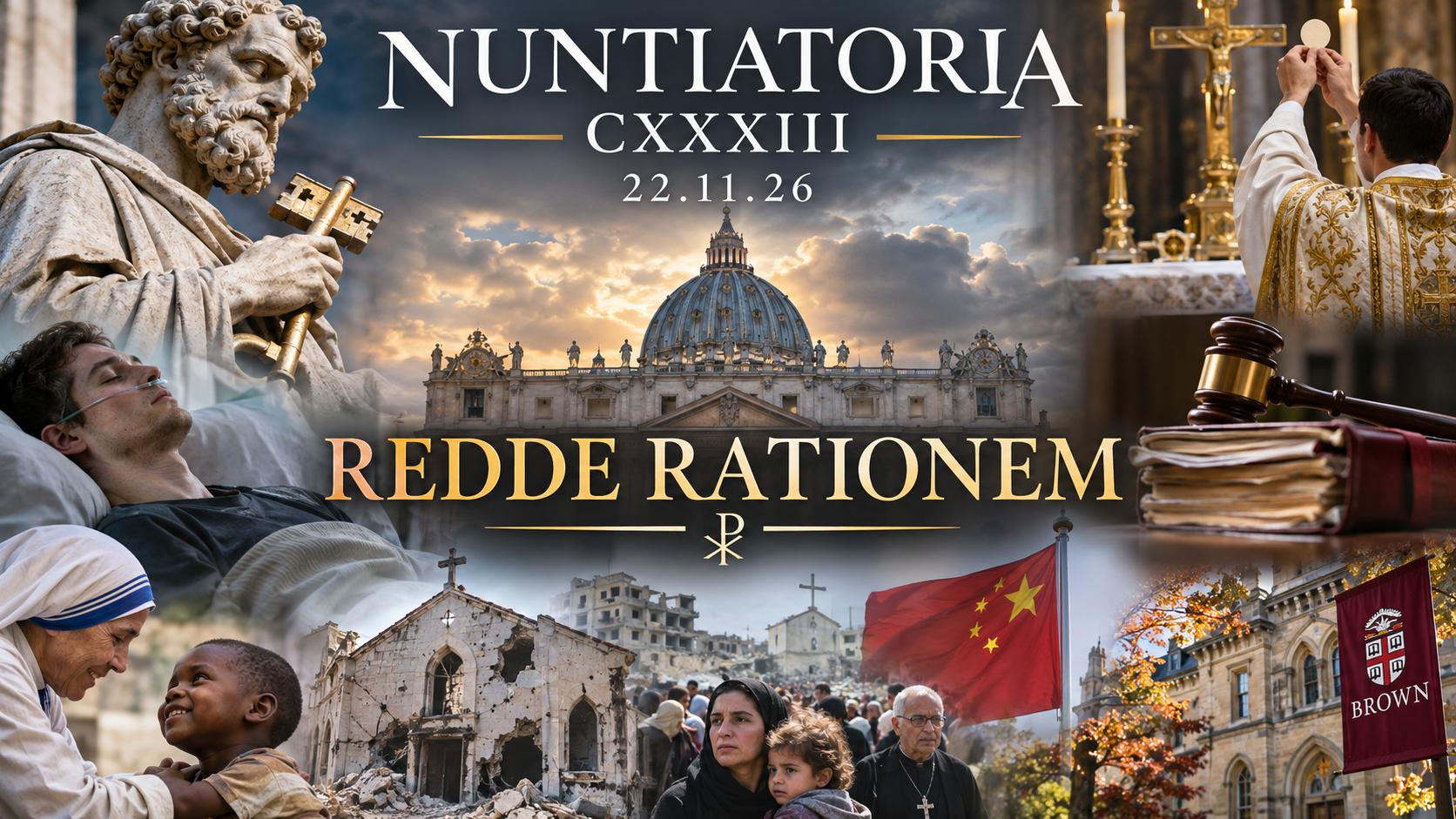
Redde rationem — “Give an account of thy stewardship” (St Luke 16:2) — provides the governing theme of this edition. As the ecclesiastical year draws to its close, the Church reminds us that authority, influence and responsibility are entrusted to men who must ultimately answer for their exercise. From episcopal government and ecclesiastical justice to the care of the vulnerable, the defence of the persecuted and the transmission of the Faith, this week’s Nuntiatoria examines what happens when those entrusted with the welfare of others are called to account for their decisions and their consequences.
EDITORIAL: The Account We Shall Have to Give
Samuel Prinz-Reiterer was twenty-one when he appealed publicly for people to understand what had happened to him. He suffered from an exceptionally severe form of ME/CFS, a condition which had reduced his existence to a darkened room, where even hearing his mother’s voice could be more than he could bear. He had tried to draw attention to the inadequacy of medical provision and the desperate circumstances endured by those with the most severe forms of the disease. On 30 January 2026, his twenty-second birthday, he died through assisted suicide.¹
I have been thinking about Samuel whilst considering the subjects brought together in this week’s Nuntiatoria, because his circumstances expose a question which ought to trouble anyone entrusted with responsibility for other human beings. Austria possessed a legal procedure through which Samuel could obtain assistance to end his life. What, by comparison, had been made available to help him continue living? This is a question about medical provision and social responsibility, certainly, but it is also a moral question which cannot be answered simply by invoking personal autonomy. The Catholic understanding of human dignity does not depend upon a person’s ability to enjoy life, contribute economically or exercise independence. Indeed, the obligations of charity become especially demanding when someone is deprived of those things which the healthy ordinarily take for granted.²
Nor should Samuel’s suffering be reduced to an argument in a public controversy. His illness was real, his circumstances exceptionally distressing, and the inadequacy of available treatments is itself a matter deserving sustained investigation. Yet there is something profoundly disquieting about a society which becomes increasingly confident in its ability to facilitate death whilst those struggling to remain alive continue to campaign for adequate care. Other sufferers assembled near the Austrian Parliament in March under the declaration Weil wir leben wollen: because we want to live. One hopes that those responsible for public policy noticed the distinction.
The same difficulty arises, in different circumstances and with different responsibilities, when ecclesiastical authorities speak about listening to victims of abuse. Pope Leo XIV’s recent appeal for the Church to hear survivors, acknowledge wrongdoing and pursue justice expresses an obligation which no Catholic ought to dispute. But the experience of those who have already given their testimony presents a more exacting measure of the Church’s response. Our examination of the unresolved questions surrounding Marko Rupnik and the complainants associated with Chiclayo returns to a subject which Nuntiatoria has pursued for some time: the distance between institutional assurances and the actual administration of justice. The faithful should be able to expect more than an eloquent explanation of the Church’s commitment to safeguarding. They are entitled to ask what happened to the evidence, which authority exercised jurisdiction, what decisions were reached and whether those affected were informed. Confidentiality has a legitimate place in canonical procedure; indefinite uncertainty cannot become its ordinary substitute.³
There is an unhappy resemblance here to the plight of Christians in Jaranwala, Pakistan, where the destruction of churches and homes in August 2023 has been followed by years of proceedings whose deficiencies have themselves become part of the story. The conviction of one man for his involvement in the violence matters, as does the court’s criticism of investigative failures. But those who lost their churches and property require justice which extends beyond the occasional successful prosecution. In Gaza, meanwhile, the surviving Christian community continues to endure conditions in which the reduction of fighting has yet to restore the ordinary necessities of life. Families must be able to obtain water, shelter, medical attention and some reasonable prospect of remaining in the land where their Christian forebears worshipped long before the present conflict. We ought to be particularly attentive to these communities because their continued existence is so easily treated as incidental to the larger political narratives imposed upon them.
The comparison is neither casual nor intended to diminish the differences between these cases. Their legal circumstances, political settings and the powers available to those responsible are quite distinct. What brings them into the same examination is the obligation to consider the consequences of decisions upon the people who must live with them. A ceasefire requires more than diplomatic congratulations. A safeguarding policy requires more than an anniversary address. A criminal prosecution ought to establish responsibility where the evidence permits it. These are reasonable expectations, and the Church herself is bound to uphold them.
There are comparable questions within ecclesiastical government, although here we must take particular care to distinguish questions of doctrine, jurisdiction, discipline and prudential judgement. The consecration of Joseph Liu Hengping as Bishop of Xiamen, with papal approval, provides a useful example. The restoration of episcopal government to a diocese is a pastoral good, and the Holy See has understandable reasons for seeking an arrangement with Beijing which might secure it. Yet the candidate’s prior responsibilities within the state-supervised Catholic Patriotic Association deserve examination. The issue concerns the freedom of a Catholic bishop to fulfil the office received through episcopal consecration, teaching and governing according to the Faith of the Church. The extent to which civil authorities may influence episcopal appointments, and the conditions under which a bishop may exercise his ministry, are matters upon which earlier popes spoke with considerable precision. Diplomatic accommodation cannot itself settle those theological questions.⁴
Nor can the difficulties surrounding the Society of St Pius X be understood simply by counting priests who depart from, or arrive within, the Society. The departure of a priest may involve serious questions of conscience and canonical standing. Equally, the arrival of others suggests that the attraction of the Society’s doctrinal and liturgical position has hardly disappeared. The fundamental disagreements concerning the interpretation of the Council, the Roman liturgy and the obligations of ecclesiastical obedience remain. Rome may possess procedures by which individual priests can be received into institutions enjoying regular canonical standing; the existence of those procedures does not resolve the underlying dispute. Indeed, one might reasonably ask why so much administrative energy can be expended upon managing the consequences of a division whose principal causes remain insufficiently addressed.
The faithful at Ramberge in France, who have worshipped according to the older Roman liturgy for more than forty years, have rather less interest in the intricacies of these controversies than in being able to attend Mass, receive the sacraments and have their children instructed in the Catholic Faith. Their bishop has authority to regulate public worship within his diocese. The exercise of that authority, however, cannot be assessed adequately without considering what arrangements he has made, or attempted to make, for the pastoral needs of an established congregation. The dispute involving Fr Daniel Ciucci in Denver raises different questions about priestly leadership, doctrinal preaching and the relationship between a pastor and his parishioners. In neither case is it satisfactory to substitute a familiar slogan about obedience or pastoral sensitivity for an examination of what occurred.
These matters bring us back to the altar, which remains the centre of Catholic life regardless of the increasingly elaborate arrangements by which it is administered. On the four-hundredth anniversary of the dedication of St Peter’s Basilica, Pope Leo XIV recalled the confession of Faith upon which the Apostle’s ministry rests and the religious purpose for which that extraordinary sanctuary was built. The building is an achievement of Christian civilisation, certainly, but its grandeur exists for the worship of Almighty God. The ancient arrangements of the sanctuary, including the relationship between service at the altar, the minor orders and the priesthood, were likewise expressions of a particular theological understanding. Contemporary legislation may alter disciplinary provisions; it does not make the reasons for earlier practice historically irrelevant. Our examination of female altar service and the continuing controversy over Communion at altar rails therefore concerns something rather deeper than a preference for one arrangement of church furniture over another.
It is especially revealing that this edition also examines the decisions of the American bishops concerning their investments. Catholic moral teaching has consequences for the financial arrangements of ecclesiastical institutions, including decisions which may prove commercially inconvenient. If bishops determine that certain investments are incompatible with their responsibilities, the application of that judgement to their own accounts is proper and necessary. There is no reason why those who scrutinise secular governments, employers and charitable organisations should exempt ecclesiastical administrations from comparable questions about how their resources are managed. Financial prudence is a virtue, but prudence properly understood must serve the ends for which money is held.
And money brings us to another matter which I think deserves considerably more attention than it usually receives. Christianity is frequently accused of having inflicted incalculable harm upon humanity, and its detractors sometimes suggest that religion has become unnecessary because human beings are perfectly capable of compassion without it. The proposition sounds plausible until one examines the scale of Christian charitable provision across the world. Schools, hospitals, hospices, residential care, international relief agencies and countless local works of mercy have arisen through recognisably Christian convictions and continue to depend upon them. The question posed in our investigation, If the Churches Disappeared Tomorrow, is therefore a serious one. Where are the equivalent institutions established and sustained expressly through organised atheism or secular humanism, and what would happen to those currently dependent upon Christian provision if that religious inheritance simply vanished? Humanists UK itself acknowledges that relatively few charitable institutions are explicitly humanist, explaining that its supporters generally prefer to assist existing secular organisations. That may be their preference, but it leaves the original question substantially unanswered.⁵
None of this means that a charitable institution becomes virtuous merely by carrying the Christian name. The Church has endured more than enough scandals to demonstrate the danger of assuming that religious profession guarantees moral conduct. Nevertheless, it is equally unreasonable to describe Christianity as an historical burden upon human welfare whilst discounting the enormous institutional contribution which Christian belief has made to its provision. The Faith has inspired generations to dedicate their lives and resources to people they would otherwise never have encountered. One cannot fairly assess Christianity’s public consequences by carefully recording every abuse committed in its name whilst omitting the hospitals, schools and charitable foundations which the same religious civilisation produced.
The manner in which a civilisation understands the human person is also reflected in the education it provides. The disturbing exchanges recorded at Brown University concerning the assassination of Charlie Kirk raise questions about the willingness of students to discuss political violence without first calculating the social acceptability of their answers. Universities ought to cultivate the capacity to reason from principles, including principles which may prove inconvenient to prevailing opinion. The same concern appears in the apparently more cheerful subject of Christmas and what we are teaching our children about giving. A child raised to regard Christmas chiefly as the satisfaction of personal expectations may find the Christian meaning of the feast remarkably difficult to understand. Gratitude, generosity and a sense of obligation towards others require formation. They rarely emerge spontaneously from the possession of an increasingly impressive collection of presents.
This is why the approach of Advent matters to the domestic Church. Parents possess responsibilities which no school, charitable organisation or ecclesiastical department can entirely discharge on their behalf. The family prayer said faithfully, the preparation of the crib, the teaching of the Christmas Gospel, the remembrance of the Holy Souls and the ordinary habit of making room for those who have less all belong to the transmission of the Faith. They may seem modest beside the affairs of Rome, Beijing or Washington, but the Church’s history has always depended upon the fidelity of households in circumstances which official institutions could neither anticipate nor control.
The liturgical year is drawing to its conclusion. This Sunday, 22 November, brings the feast of St Cecilia, Virgin and Martyr, whilst the Church also commemorates the final Sunday after Pentecost and its solemn warning concerning the end of earthly things. A week later we shall begin Advent, preparing to commemorate the Nativity of Our Lord whilst awaiting His return in glory. There is an appropriate seriousness about that transition. The Christian does not believe that history can be understood entirely through the survival of institutions, the success of policies or the judgements of public opinion. Our Lord’s teaching concerning the Last Judgement places every human responsibility within an eternal order of justice and charity.
It is worth remembering that the offices of the Church, her charitable enterprises, schools, hospitals, liturgical arrangements and structures of government exist because the salvation and sanctification of human beings matter. Their proper purposes cannot be altered by the administrative convenience of those responsible for them. The people affected by their decisions are seldom abstractions. They are the ill awaiting treatment, the abused awaiting justice, the persecuted awaiting protection, the faithful seeking the sacraments, and the children whose understanding of God and neighbour is still being formed.
When we stand before the judgement of Christ, there will be no opportunity to refer difficult questions to another committee, nor to reassure Him that improvements are under consideration. That prospect ought to give a certain sobriety to everyone who exercises authority, myself included. We shall be required to answer for what was entrusted to us, and for what we did with it. The consequences of those decisions are already being borne by others.
✠ Jerome Lloyd, Titular Archbishop of Selsey
¹ Pia Kruckenhauser, Samuel, 21: Wie schlimm es sich anfühlt, wenn man an ME/CFS leidet, Der Standard, 23 January 2026.
² Holy See, Catechism of the Catholic Church, §§2276–2283.
³ Dicastery for the Doctrine of the Faith, Vademecum on Certain Points of Procedure in Treating Cases of Sexual Abuse of Minors Committed by Clerics, Version 2.0, 5 June 2022; Nuntiatoria, Who Investigates the Bishop? The Safeguarding Crisis That Better Communication Cannot Solve, 30 October 2026.
⁴ Benedict XVI, Letter to Chinese Catholics, 27 May 2007, §§8–9.
⁵ Humanists UK, Good Causes and Charities.
IN THIS EDITION
- Forgotten Rubrics: The Altar Server and the Priesthood — What Rome Changed, and Why It Matters
 From the 1917 prohibition to the reforms of 1972, 1994 and 2021, Rome changed the relationship between altar service and clerical formation. What does this mean for priestly vocations?
- ORDO w/c 22.11.26
 The traditional Roman Ordo for 22–29 November 2026, with the weekly table, corrected Vespers and English, Scottish, Irish and other particular-calendar observances.
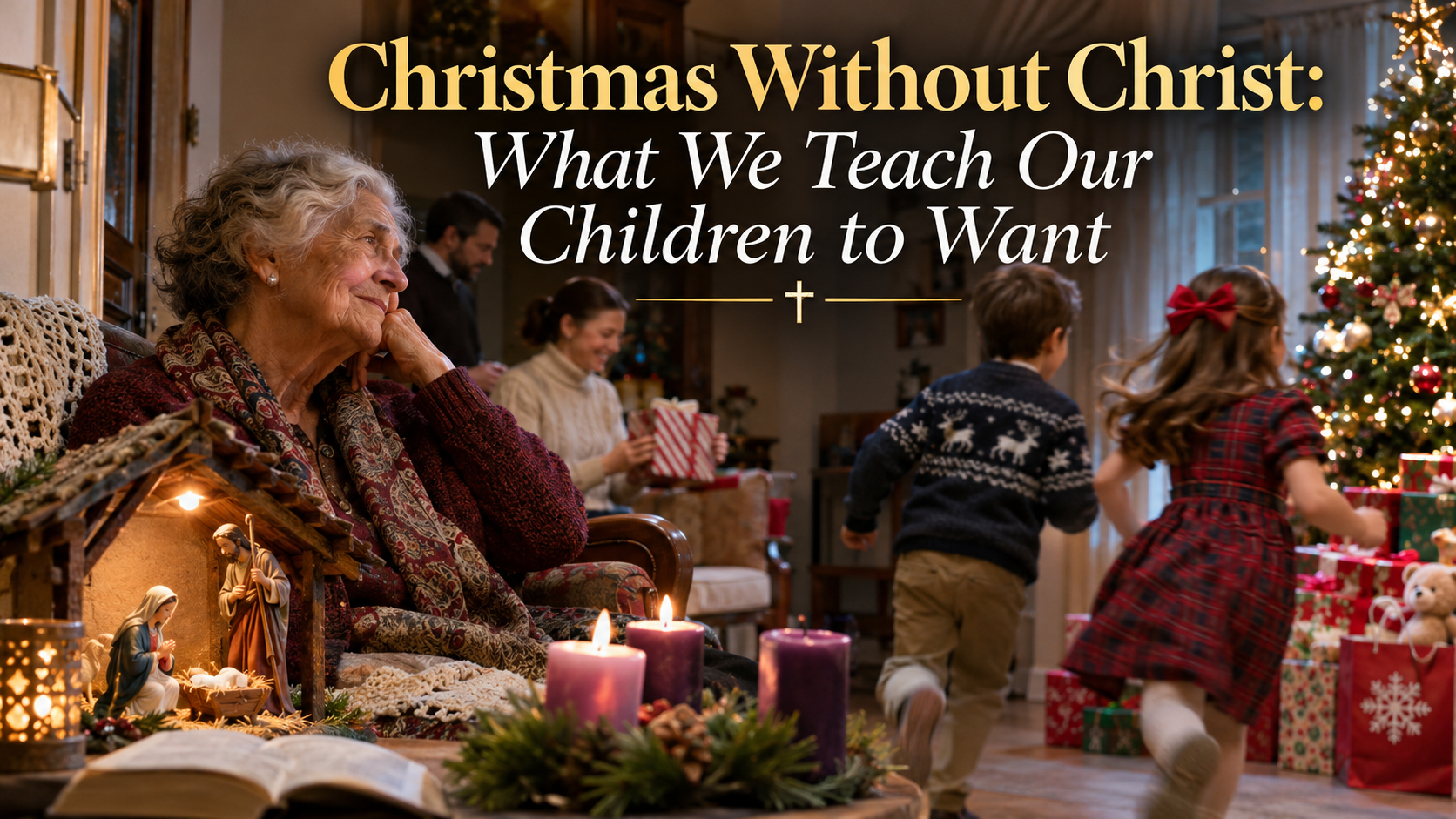
- The Christmas We Are Teaching Our Children
 The commercial Christmas offers families endless ways to give gifts. Catholic parents must also teach children gratitude, charity and the meaning of Christ’s Nativity.
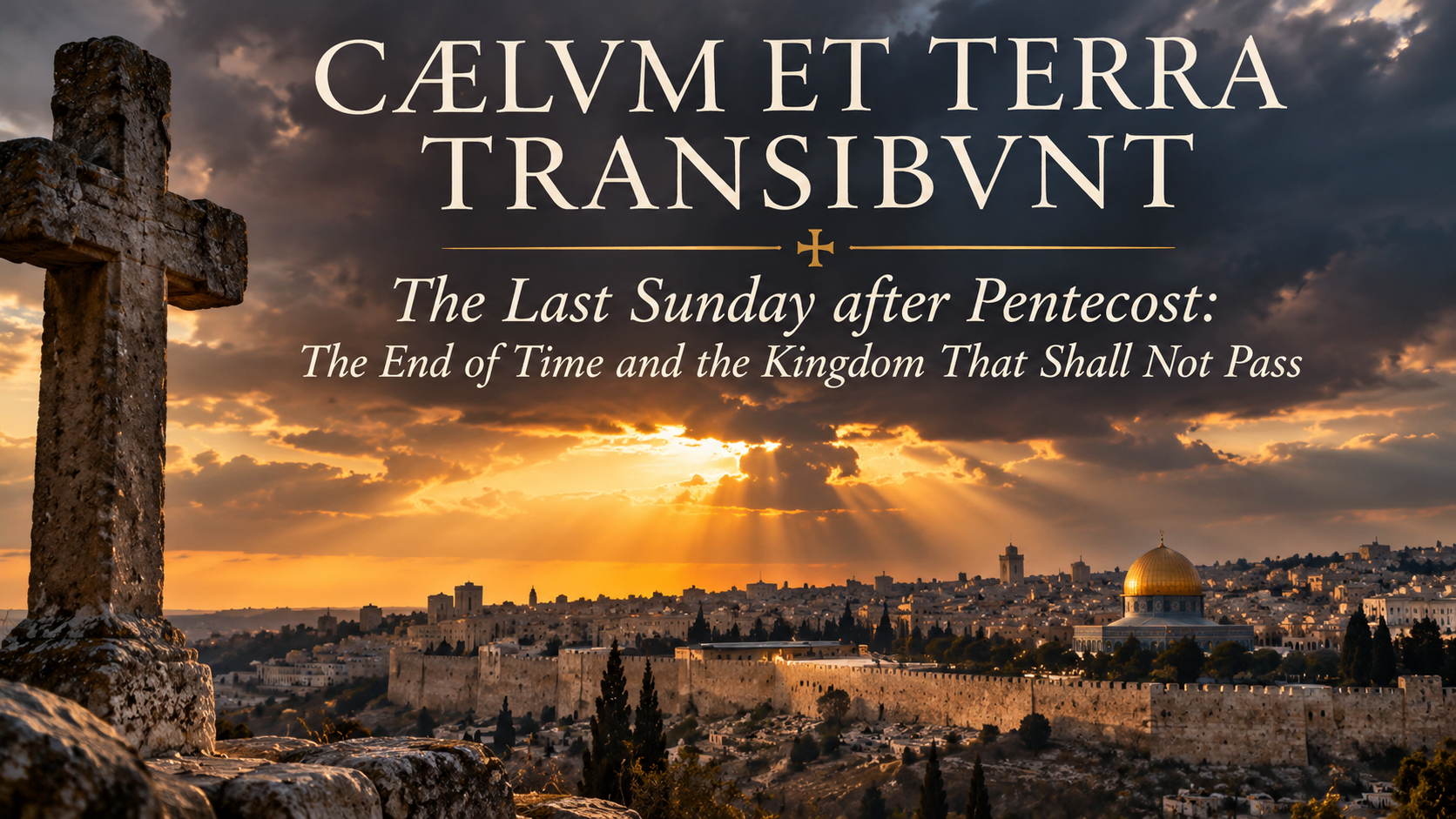
- Cælum et Terra Transibunt: The Last Sunday after Pentecost
 The final Sunday of the Roman liturgical year directs the faithful towards Christ’s return, judgement and everlasting Kingdom. Reflecting on Jerusalem’s destruction, future tribulation and the permanence of Christ’s words, it calls for vigilance, repentance and cooperation with grace. Through the sacraments, prayer and charity, Christians prepare for both death and final consummation.
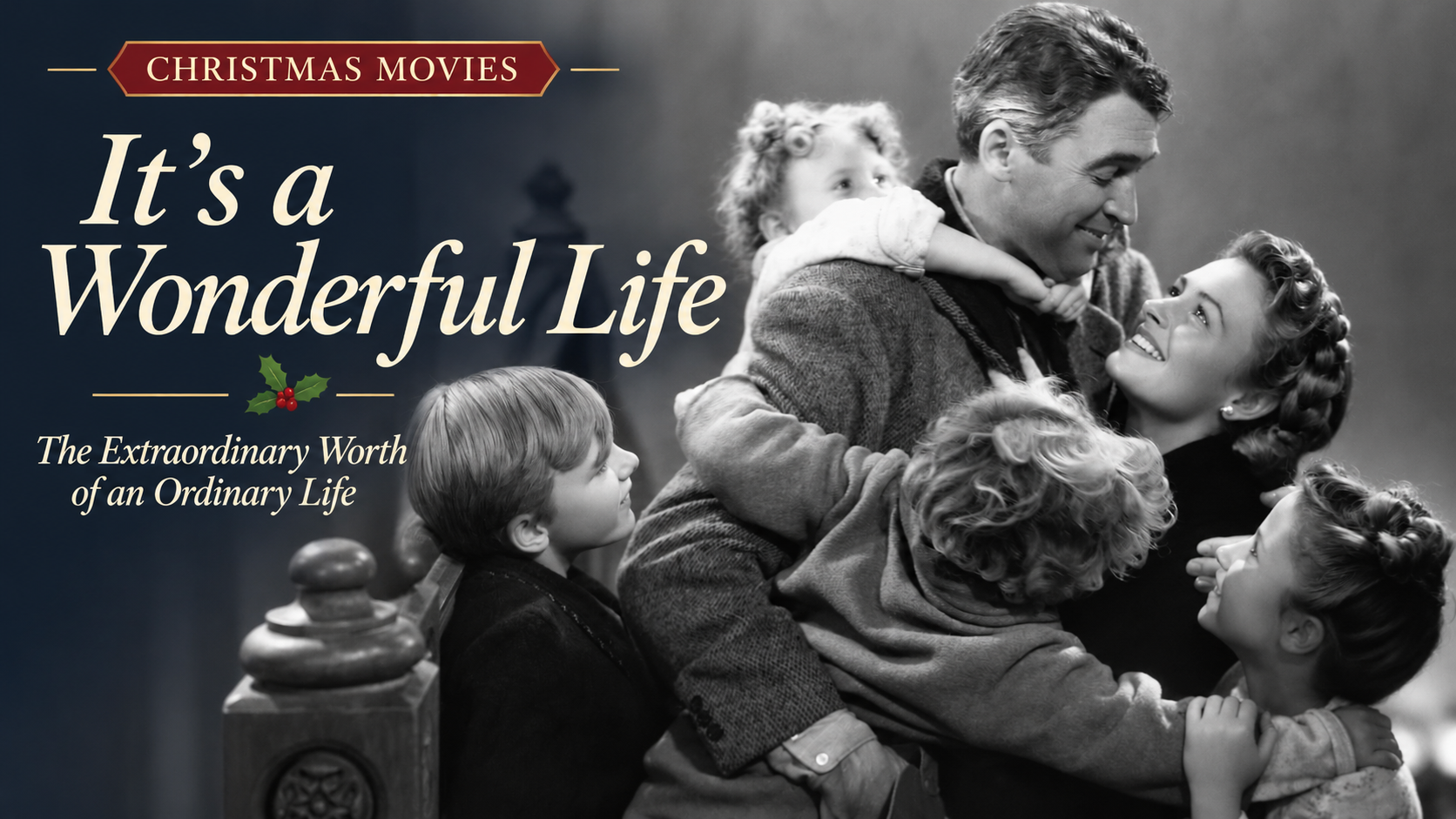
- CHRISTMAS MOVIES: It’s a Wonderful Life
 Frank Capra’s It’s a Wonderful Life presents George Bailey’s frustrated ambitions, family responsibilities and service to his community as evidence that ordinary lives can possess profound worth. Through Catholic themes of duty, charity, human dignity, subsidiarity and hidden holiness, the film encourages gratitude for family life while acknowledging despair, moral weakness and the need for practical support.
- THE DOMESTIC CHURCH: 22–29 November 2026
 The final days of November bring St Catherine’s Cattern cakes, the last suffrages for the Holy Souls and practical preparations for Advent: a day-by-day guide to Catholic family life.
- Gaza’s Christians: What the Ceasefire Has Failed to Secure
 Gaza’s remaining Catholics still face serious dangers and shortages despite the ceasefire. Cardinal Gugerotti’s visit exposes the difference between reduced fighting and actual security.
- The Bishops, the Balance Sheet and the Price of Principle
 The US bishops’ investment guidelines exclude private detention operators and address AI and emerging markets. The next test is what the accounts reveal.
- The Price of Speaking Freely: Charlie Kirk, Brown University and the Fear of Dissent
 Warren Smith’s encounters at Brown and documented campus reactions to Charlie Kirk’s murder raise questions about free speech, moral judgement and the purpose of higher education.
- Écône’s Departures and Arrivals: Rome Still Has a Larger Problem
 New reports identify SSPX priests leaving after the Écône consecrations, while other clergy continue to enter. The larger canonical and pastoral dispute remains unresolved.
- JARANWALA: ONE CONVICTION, THOUSANDS ACCUSED AND THREE YEARS OF UNANSWERED QUESTIONS
 One conviction followed the 2023 attacks on Christian churches in Jaranwala. Court records and Pakistan’s Senate investigations expose unresolved questions about prosecutions, policing and compensation.
- Ramberge and the gradual suppression of the traditional Mass
 At Ramberge, a stable congregation and a successor priest face a bishop’s refusal. Across France, changes of clergy and permissions reveal the gradual suppression of the traditional Mass—and the limits of the promised listening Church.
- The Bishop Beijing Chose: Rome’s Approval and the Patriotic Association at Xiamen
 Official Chinese records show that Joseph Liu Hengping was elected Bishop of Xiamen before the papal appointment and held senior offices in the Catholic Patriotic Association. What freedom will he have to govern?
- Samuel Was Offered Assistance to Die. What Assistance Was He Given to Live?
 The death of a 22-year-old Austrian with severe ME/CFS raises questions about assisted suicide, deficient care, and the obligations of the state towards seriously ill patients.
- The Basilica Was Built for the Altar: Leo XIV and the Meaning of St Peter’s
 Leo XIV’s fourth-centenary homily for St Peter’s Basilica places apostolic succession and the Eucharist at the heart of the sanctuary’s purpose.
- Listening That Heals? Leo XIV and the Justice Still Owed to Abuse Survivors
 Leo XIV’s appeal to listen to abuse survivors raises the question whether the Church’s canonical procedures can provide answers and justice.
- THE PRIEST WHO PREACHED HELL: Denver’s Petition, the Archbishop and Fr Daniel Ciucci
 Nearly 900 supporters challenged a Denver priest’s leadership. The evidence raises questions about preaching, pastoral government and episcopal accountability.
- RED WEDNESDAY AT TEN: THE ARRESTS, THE LAWS AND THE UNPUNISHED ATTACKS
 As Red Wednesday marks ten years, the latest Aid to the Church in Need country reports reveal contrasting patterns of violence, legal repression and prosecution. What has changed, and what remains unpunished?
- DEFENDER OF WHICH FAITH? King Charles III and the Quiet Recasting of the Established Church
 King Charles III increasingly presents the Church of England as protecting religious pluralism, while affirming his personal Christian faith. The article questions whether this emphasis risks obscuring Christianity’s distinctive truth claims and missionary purpose. Drawing on Anglican history and Catholic teaching, it distinguishes defending religious liberty from treating religions as equally valid paths to salvation.
- When Obedience Becomes a Wound: Traditionis Custodes and the Question of Spiritual Abuse
 Pope Leo XIV has confirmed that restrictions on the traditional Roman Mass will continue, while acknowledging the dangers of spiritual abuse. The article argues that lawful authority must still be prudent and pastorally responsible, questioning whether traditionalist Catholics are unfairly treated as disloyal. It also stresses that Vatican II never explicitly mandated the comprehensive liturgical changes later introduced.




Leave a Reply