
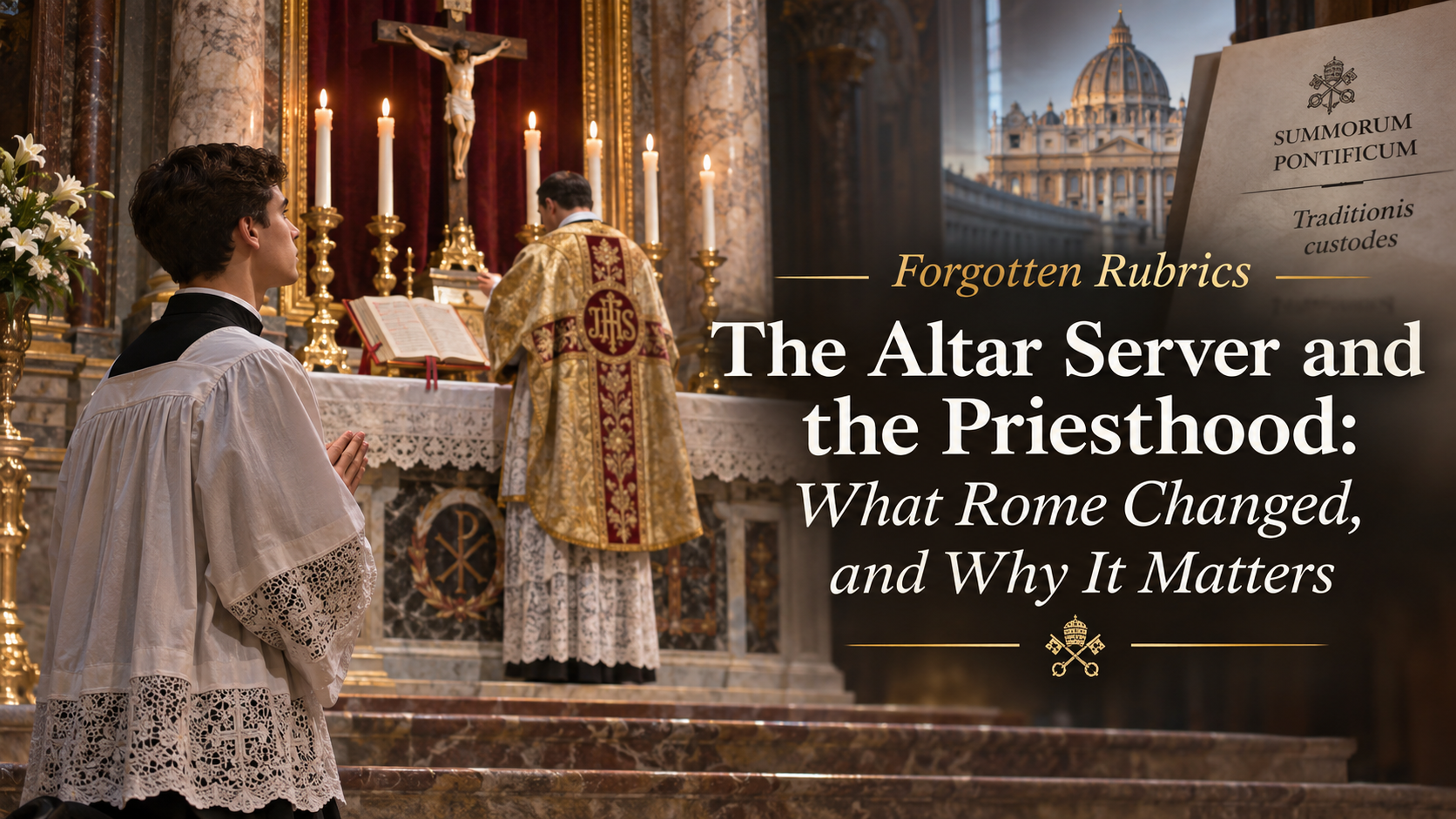
The admission of girls to service at the altar is permitted under contemporary Roman discipline. Yet the Church’s earlier practice expressed a relationship between the sanctuary, the minor orders and the formation of future priests. The successive changes made by Rome, particularly those of 1972, 1994 and 2021, deserve examination for their theological meaning and pastoral consequences.
On 3 April 1980, the Sacred Congregation for the Sacraments and Divine Worship issued an instruction concerning the proper celebration of the Eucharist. Among its provisions was a straightforward prohibition: women were not permitted to act as altar servers. The instruction, Inaestimabile Donum, was approved by Pope John Paul II and expressly directed towards correcting practices which had arisen during the implementation of the revised liturgy. Fourteen years later, under the same pontificate, Rome authorised diocesan bishops to admit girls and women to precisely that service.1
The change is generally explained by reference to the Church’s authority over liturgical discipline. That authority is real, and the distinction between immutable doctrine and alterable ecclesiastical regulation must be maintained. Nevertheless, an appeal to competence does not explain the reasons for exercising it. The same authority which prohibited female altar service in 1980 permitted it in 1994. What had changed in the understanding of the office, and what did Rome believe would be gained by modifying a practice which it had so recently reaffirmed?
The question becomes more interesting when the earlier tradition is considered on its own terms. For centuries, service at the altar formed part of a recognisable arrangement of sacred ministry. The priest offered the Holy Sacrifice, assisted according to the solemnity of the celebration by ministers exercising their proper orders. At Low Mass, where the fuller complement of ministers was ordinarily absent, a boy fulfilled by custom and ecclesiastical permission certain duties historically belonging to the acolyte. His presence was a practical necessity in many circumstances, although its significance extended beyond practical assistance.
The minor orders of porter, lector, exorcist and acolyte formed part of the Church’s traditional preparation for sacred orders. Their development was historical, and their precise canonical status differed from that of the sacramental grades of Holy Orders. They nevertheless established a progression towards the sanctuary and its ministry. The young boy who served Mass was not a cleric merely because he wore a cassock and surplice. He was participating in a form of service whose institutional ancestry lay within that progression.
The distinction is important because it explains why the older discipline concerned more than the ability to perform particular actions. There is no difficulty in establishing that a girl can carry candles, present the cruets or make the responses correctly. The same may be said of almost anyone who has been properly instructed. But liturgical offices have never been determined exclusively by the physical abilities of those who might perform them. Sacred ceremonial conveys meaning through the identity, position and function of its ministers, as well as through the actions themselves.
The 1917 Code of Canon Law makes the former arrangement particularly clear. Canon 813 required a minister to assist the celebrating priest and make the responses. Its second paragraph prohibited women from serving at Mass, except where no male was available and a just cause existed. Even then, the woman was to make the responses from a distance and was not to approach the altar.2
Here was a law which permitted a limited practical accommodation while preserving the ordinary distinction. A woman could provide the necessary responses without assuming the place of an altar server within the sanctuary. Whether one agrees with the prudence of that arrangement today, its purpose cannot reasonably be dismissed as mere uncertainty about women’s ability to follow the liturgy.
The more consequential change began before 1994.
On 15 August 1972, Paul VI promulgated Ministeria Quaedam, reforming the discipline of first tonsure, the minor orders and the subdiaconate in the Latin Church. In the revised system, the former minor orders were replaced by the instituted ministries of lector and acolyte, while entry into the clerical state was henceforth attached to ordination to the diaconate rather than first tonsure. The new instituted ministries remained reserved to men, and their reception continued to have a particular place in preparation for Holy Orders.3
This reform deserves attention because it altered the institutional framework within which service at the altar had traditionally been understood. Acolytes in the revised system were no longer clerics by virtue of their institution. The ministry was formally distinguished from the sacrament of Holy Orders, even though it retained a close relationship with the functions of the sanctuary and with preparation for ordination.
The distinction between an instituted acolyte and a lay altar server also remained. Not every boy serving Mass had been instituted as an acolyte; indeed, most had not. The ordinary server exercised certain functions associated with the ministry without receiving its formal institution. Yet the existence of an exclusively male instituted ministry preserved something of the older relationship between the service of the altar and the formation of future clergy.
The 1983 Code did not reproduce the prohibition formerly contained in Canon 813 §2. That omission, however, should not be mistaken for an immediate and universal authorisation of female altar servers. The prohibition of Inaestimabile Donum remained part of the relevant Roman discipline until the subsequent interpretation and directives changed the position.
On 30 June 1992, the Pontifical Council for the Interpretation of Legislative Texts answered affirmatively a question concerning whether the liturgical functions which could be entrusted temporarily to lay persons under Canon 230 §2 included service at the altar by women as well as men. John Paul II confirmed the interpretation on 11 July 1992. The Congregation for Divine Worship communicated the practical directives to episcopal conferences on 15 March 1994.4
The resulting permission was carefully qualified. Each diocesan bishop was to make a prudential judgement concerning the practice within his territory, having heard the opinion of the episcopal conference. One bishop’s decision did not oblige another to follow it.
More significantly, the Congregation expressly maintained the value of the traditional practice of boys serving Mass. It referred to the encouragement of priestly vocations arising from that custom and insisted that the obligation to support groups of altar boys would continue.
There is something revealing about this language. Rome acknowledged that the older institution had produced an identifiable pastoral benefit, considered that benefit worth preserving, and nevertheless authorised a change which could alter the character of the institution itself. The documents supplied a legal mechanism for admitting girls. They offered considerably less explanation of how the specifically vocational character of male altar service would be maintained where mixed serving became the ordinary parish arrangement.
The question was not entirely resolved by the passage of time.
On 27 July 2001, the Congregation for Divine Worship responded to a bishop who had raised further questions concerning the application of the permission. Its letter confirmed that even where a diocesan bishop had authorised female altar servers, individual priests could not be required to employ them. The Congregation again affirmed the duty to support groups of altar boys and warned of the need to explain the innovation properly, lest confusion arise which might hinder the development of priestly vocations. It also maintained that lay persons possess no inherent right to exercise service at the altar.5
These were substantial qualifications, although they have seldom featured prominently in ordinary parish explanations of the practice.
The same distinction appeared in Redemptionis Sacramentum, issued in 2004. Paragraph 47 permitted girls and women to serve at the altar at the discretion of the diocesan bishop and in accordance with the established norms. The permission was neither expressed as a universal requirement nor presented as a judgement that exclusively male altar service had become undesirable.6
The subsequent development of Roman discipline has, however, gone further. On 10 January 2021, Pope Francis promulgated Spiritus Domini, amending Canon 230 §1 so that women could be formally instituted into the ministries of lector and acolyte. This was a different canonical development from the permission granted to female altar servers in 1994. It concerned stable institution into the ministry itself, rather than the temporary performance of some of its functions.7
Francis explained the change by reference to the baptismal priesthood and the recognition of the contribution made by women to the Church’s liturgical and apostolic life. His account treated the instituted ministries as properly lay offices which could be exercised by either sex without confusing them with sacramental ordination.
Within the revised canonical framework, that explanation has an intelligible basis. Institution as an acolyte does not confer the sacrament of Holy Orders, and the Catholic doctrine reserving priestly ordination to men is not itself changed by admitting women to a non-ordained ministry.
Nevertheless, the historical development deserves to be followed in its entirety. The former minor order of acolyte belonged to the traditional clerical progression. The reformed instituted ministry of 1972 remained reserved to men. In 1994, women were permitted to undertake certain functions of service at the altar without formal institution. In 2021, the reservation of the instituted ministry itself to men was removed.
Each stage was presented as a disciplinary development. Taken together, they demonstrate a considerable alteration in the institutional relationship between the sanctuary and preparation for the priesthood.
That alteration is the proper subject of the present enquiry.
The relationship between altar service and priestly vocations is sometimes treated as little more than a sentimental recollection of an earlier parish culture. There are, however, contemporary figures which make such a dismissal difficult to sustain.
The Center for Applied Research in the Apostolate at Georgetown University, in its survey of the American priestly ordination class of 2026, found that 79 per cent of responding ordinands had served at the altar before entering the seminary. The survey received 334 responses from 428 men approached, a response rate of 78 per cent. The same study found that 92 per cent had received encouragement to consider the priesthood from someone in their lives, most frequently a parish priest.8
These figures do not establish that altar service causes priestly vocations, still less that mixed serving arrangements reduce their number. The survey concerns men who had already reached the point of ordination; it does not provide a controlled comparison of different parish serving arrangements or isolate the influence of each form of early religious formation.
What it does establish is that service at the altar remains a remarkably common element in the backgrounds of men entering the priesthood. The connection acknowledged by Rome in 1994 and again in 2001 has certainly not disappeared.
Its practical importance is easy enough to understand. A boy who serves Mass regularly becomes familiar with the priest’s responsibilities in a manner unavailable through occasional observation from the congregation. He learns the order of the sacred rites, the discipline required in their celebration, the care owed to sacred vessels and vestments, and the importance of quiet attention. He also encounters the priest in circumstances which may encourage questions about vocation and the possibility of offering his own life in the same service.
There was once a natural progression from the sanctuary to the seminary, even if most altar boys never pursued it. The serving group provided a distinct company of boys gathered around a form of service closely associated with a vocation open to males alone. Such an arrangement gave the parish priest opportunities to recognise and encourage potential candidates. It also enabled younger boys to observe older servers developing in responsibility and, occasionally, entering religious formation.
The question is whether that particular character survives unchanged when the serving group is reorganised as an undifferentiated activity for children of both sexes.
Mixed groups may be well trained, disciplined and devout. Girls who serve can take their responsibilities seriously and derive genuine spiritual benefit from their proximity to the sacred rites. None of this answers the separate question of what happens to an institution which formerly provided a specifically male environment for vocational discernment.
Where serving becomes understood chiefly as an opportunity for children to participate visibly, its historical relationship to the priesthood may become less apparent. That does not mean every mixed serving group has lost its vocational purpose. It means that the purpose can no longer be presumed merely from the existence of the group.
There is a related difficulty in the contemporary understanding of liturgical participation. Much pastoral practice has come to attach considerable importance to the distribution of visible functions. The more opportunities provided for lay people to undertake tasks, the more participatory a celebration may appear. Yet such an approach risks confusing the external manifestations of participation with its proper spiritual substance.
Pius XII addressed precisely this distinction in Mediator Dei in 1947. Explaining the participation of the faithful in the Eucharistic Sacrifice, he distinguished the priest’s unique sacrificial action from the participation of the faithful, who unite themselves with Christ’s offering through prayer and interior devotion. Their participation does not depend upon performing a visible liturgical function.9
The woman praying in the congregation, the elderly man unable to kneel, the mother attending to a restless child and the contemplative religious assisting at Mass without any ceremonial office are not consequently lesser participants in the Holy Sacrifice. Their union with Christ is not measured by their visibility.
Nor does the Church’s reservation of priestly ordination to men imply that women possess a lesser supernatural dignity. John Paul II reaffirmed in Ordinatio Sacerdotalis in May 1994 that the Church has no authority to confer priestly ordination upon women. That teaching concerns the sacramental constitution of the Church, whereas altar service concerns ecclesiastical discipline. The two questions must be distinguished, even though the symbolism and historical organisation of the sanctuary bring them into contact.10
The example of the Blessed Virgin Mary ought to be sufficient to disabuse Catholics of any notion that ministerial office is a measure of sanctity. Her dignity exceeds that of every priest and bishop, yet she did not receive the ministerial priesthood. The distinction between holiness and office is embedded in Catholic theology and cannot be adequately understood through contemporary assumptions about personal recognition and the allocation of functions.
It is therefore misleading to suppose that a prohibition on female altar service necessarily expressed a judgement about women’s spiritual worth. The former discipline arose within an understanding of sacred ministry which distinguished between the priest, those preparing for orders and the wider body of the faithful. One may question how successfully that understanding was embodied in particular periods or places. Its theological and institutional foundations nevertheless deserve more serious consideration than the observation that the Church possesses authority to change a rule.
There is also a practical question for those responsible for the formation of Catholic children. If a parish wishes to encourage girls in their spiritual lives, there are substantial possibilities in catechesis, devotional associations, charitable work, sacred music and other appropriate forms of ecclesial service. The Catholic tradition has never lacked examples of women exercising profound influence upon the Church’s life without holding liturgical office.
If, at the same time, a parish wishes to cultivate priestly vocations among boys, an exclusively male serving group offers an institution with a clear historical purpose and an established connection to that end. It is reasonable to ask why such an institution should be relinquished unless demonstrable pastoral advantages justify the change.
That is a question of prudential judgement, and it is precisely the sort of judgement which the Roman documents of 1994 and 2001 entrusted to ecclesiastical authority. Their provisions acknowledged that pastoral circumstances, the sensibilities of the faithful and the encouragement of priestly vocations were relevant considerations. They did not suggest that permission rendered those considerations obsolete.
The difficulty is that the Church’s later pastoral practice has not always retained the careful distinctions found in the original permissions. Where female altar service has become customary, the older discipline can be treated as an eccentric preference requiring explanation, while the innovation is assumed to possess an authority extending beyond what the relevant legislation actually required. An exclusively male serving group may consequently be regarded as an unjustified exclusion, even though the Holy See expressly defended its value when authorising an alternative.
This reversal deserves scrutiny. The burden of explanation should not fall exclusively upon those who preserve a practice which Rome itself associated with priestly vocations. It also belongs to those who have changed it, particularly where the claimed advantages are expressed in terms of inclusion or participation without corresponding evidence of spiritual or vocational benefit.
None of this makes the contemporary permission unlawful. Girls and women serving under the applicable Roman discipline are exercising functions which the competent authority has authorised. The argument for restoring or encouraging exclusively male service should therefore be made on its proper grounds: the nature and purpose of liturgical ministry, the symbolism of the sanctuary, and the pastoral importance of cultivating priestly vocations.
The older practice remains intelligible because the reasons for its existence remain intelligible. The priesthood is still reserved to men. Boys still require encouragement to consider that vocation. The sanctuary remains a place in which the Church’s understanding of sacred ministry is expressed through visible actions and distinctions. Whatever canonical arrangements now govern the ministry of acolyte, these facts have not altered.
What has changed is the institutional language through which Catholics encounter them.
The legislation of 1994 permitted something new while expressly acknowledging the worth of what already existed. The 2021 reform carried the revision of the instituted ministries further. The responsibility now lies with those exercising ecclesiastical authority to consider whether the vocational purpose repeatedly defended in the Roman documents has been adequately preserved in ordinary parish life.
The evidence from the 2026 ordination survey supplies a sufficient reason to take that responsibility seriously. At the very least, it establishes that altar service continues to feature prominently in the formation of future priests. It does not establish that every arrangement for providing that service is equally conducive to their encouragement.
A Church concerned about the diminishing number of men presenting themselves for the priesthood ought to be especially attentive to institutions which have helped young men recognise the possibility of such a vocation. The altar is an obvious place to begin.





Leave a Reply