
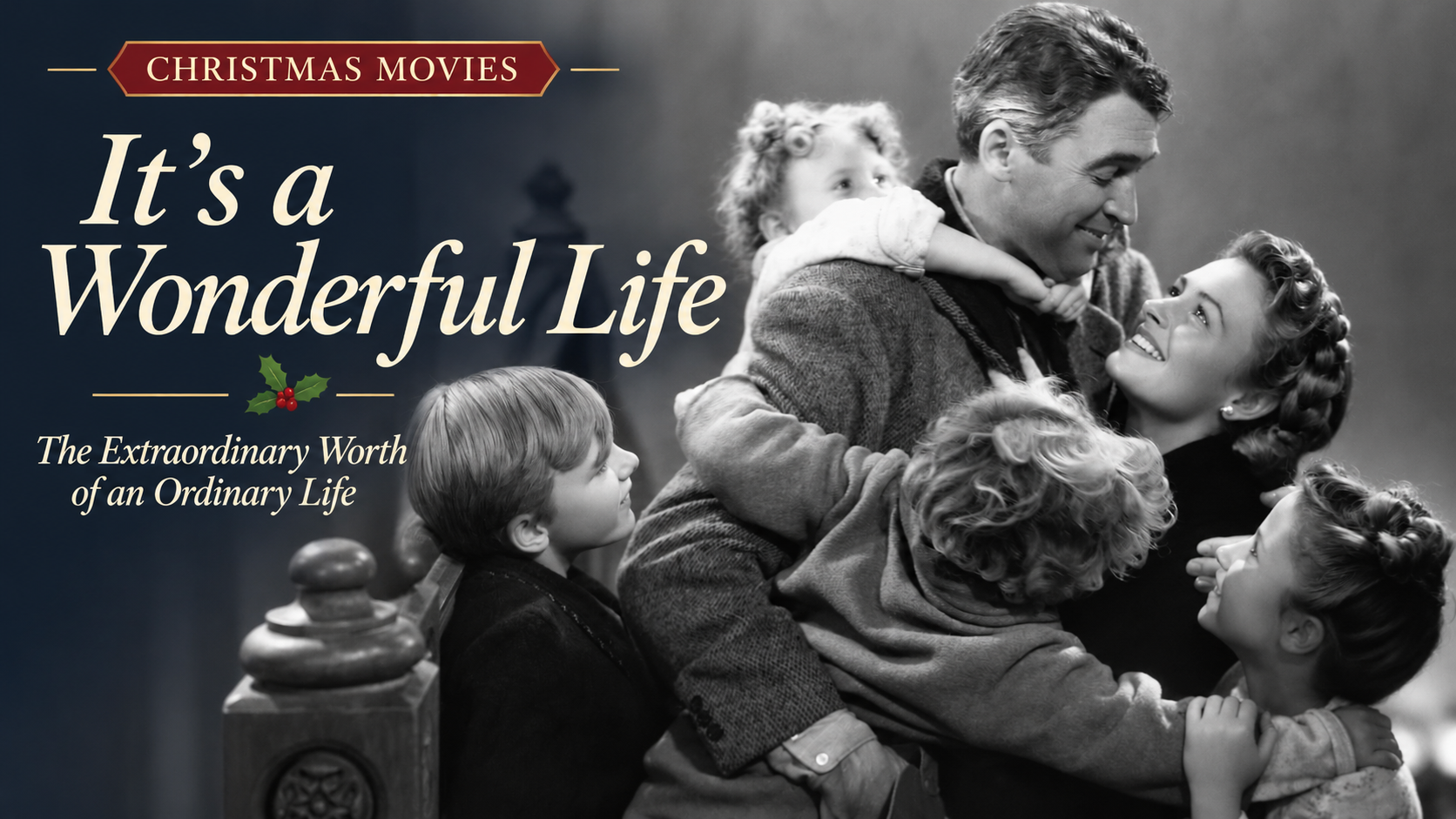
The Extraordinary Worth of an Ordinary Life
Frank Capra’s much-loved Christmas film has been moving audiences for eighty years, although its story is considerably darker than its reputation for seasonal sentiment might suggest. Behind the familiar scenes of Bedford Falls lies a perceptive account of duty, frustrated ambition, marriage, neighbourly charity and the value of human life. For Catholic families, it offers a particularly worthwhile opportunity to consider the obligations of love and the often unrecognised worth of an ordinary Christian existence.
There is something curious about the affection in which It’s a Wonderful Life is held. Its central character spends much of the film regretting the course his life has taken, his principal adversary is a thoroughly disagreeable financier, and the crisis upon which the story turns concerns a decent man driven to the brink of suicide. Yet Frank Capra’s 1946 masterpiece has become almost inseparable from the celebration of Christmas, its final scenes capable of moving even those who have watched it many times before. Perhaps its appeal lies partly in the fact that, beneath the familiar seasonal trappings, it deals with disappointments and anxieties which are common enough, but seldom resolved as happily as they are in Bedford Falls. The film understands that goodness may be costly, that duty can become burdensome, and that people who have given much of themselves to others are sometimes the least capable of recognising what their sacrifices have accomplished.
James Stewart plays George Bailey, an ambitious young man determined to leave his small American town and make something of his life. He dreams of travelling the world, designing great buildings and achieving the sort of success which will distinguish him from the ordinary inhabitants of Bedford Falls. Unfortunately, his plans are repeatedly frustrated by circumstances which demand his assistance. He saves his younger brother Harry from drowning, losing the hearing in one ear as a consequence. He prevents a grieving pharmacist from accidentally dispensing poison to a child. Following his father’s death, he abandons his own education to preserve the family Building and Loan association, eventually financing his brother’s university studies instead. When Harry marries and accepts an attractive professional opportunity, George remains at the business he had expected his brother to inherit. Even his honeymoon is surrendered when a financial panic threatens the institution’s survival.
The film opened in New York on 20 December 1946, with its wider American release following in January 1947. Adapted from Philip Van Doren Stern’s The Greatest Gift, it was the first production of Liberty Films, established by Capra and fellow filmmakers after their wartime service. Stewart, returning to the screen after his distinguished military career, brings to George a remarkable combination of youthful enthusiasm, impatience and growing disillusionment.¹ By the time we encounter him on Christmas Eve 1945, the young man who once wanted to explore the world has become a husband and father struggling to keep a modest financial institution solvent. He has contributed considerably to the welfare of his community, yet believes himself an almost complete failure.
George’s predicament is recognisable because life rarely develops according to the arrangements we make for it in our youth. Ambition is natural, and the desire to exercise one’s talents is entirely legitimate. There is no particular virtue in lacking initiative, nor does Catholic teaching require men to abandon worthwhile aspirations merely because they might bring prosperity or distinction. Nevertheless, most people eventually discover that the pursuit of personal ambitions must accommodate obligations which cannot honourably be neglected. Marriage changes the direction of a life. Children require sacrifices which no prospective parent can fully anticipate. Illness, financial difficulty and the needs of elderly relatives may alter plans which once seemed perfectly reasonable. Some accept these circumstances with remarkable generosity; others find themselves periodically wondering what might have happened had their lives taken another course.
George has spent years entertaining precisely such thoughts. His brother’s success is a source of genuine pride, but it also reminds him of opportunities he surrendered. His childhood friend Sam Wainwright has made money and enjoys the freedom which George once expected for himself. Even the prosperity of those he has helped seems occasionally to mock his own limited circumstances. What makes Stewart’s performance so convincing is that George never becomes entirely reconciled to these disappointments. He does the right thing repeatedly, but he does not always do it cheerfully, and his resentment occasionally breaks through the cheerful confidence with which he ordinarily conducts himself.
There is something spiritually instructive in this. Catholic teaching has never supposed that the faithful discharge of duty will necessarily be accompanied by agreeable feelings. Charity may require real sacrifice, and perseverance sometimes consists in continuing to fulfil one’s obligations when the consolation which once accompanied them has disappeared. St Francis de Sales, in his Introduction to the Devout Life, insisted that devotion must be adapted to the duties of one’s particular state of life. The married man, the tradesman, the widow and the religious cannot all exercise devotion in precisely the same manner, because their responsibilities differ. Holiness is pursued within these circumstances, through the virtues appropriate to them.² George Bailey might have understood his existence very differently had he recognised that service to his family and neighbours was already giving him opportunities to practise generosity which a more glamorous life might never have offered. It is no guarantee that Bedford Falls was the only place in which he could have fulfilled God’s will. The good he has actually accomplished there, however, is beyond dispute.
His relationship with Henry F. Potter, magnificently portrayed by Lionel Barrymore, introduces a second theme which deserves particular attention. Potter is the wealthiest man in Bedford Falls, accustomed to exercising financial power over his neighbours and contemptuous of their efforts to improve their circumstances. The Bailey Building and Loan is an irritant to him because it enables working families to purchase homes without remaining dependent upon his property interests. George’s father established the institution upon principles which his son continues to defend, sometimes at considerable personal cost. It is an ordinary commercial enterprise, dependent upon prudent management and the confidence of its customers, but its purpose extends beyond the accumulation of profit. George knows the people to whom its money is lent, understands their circumstances and appreciates the importance of their acquiring homes of their own.
The confrontation during the run on the Building and Loan is among the film’s most revealing scenes. The frightened customers demand their savings, apparently imagining that the money is waiting in a vault to be collected. George explains that their deposits have enabled other families to purchase houses, and that the institution cannot immediately return everybody’s money without destroying the arrangement upon which they have all depended. He appeals to their sense of community and persuades them to accept what they actually require for the moment. Mary provides the savings intended for their honeymoon, and by the close of business the association has survived with just two dollars remaining. Capra manages to make an explanation of mortgage finance unexpectedly dramatic, helped by the simple fact that the audience has come to know these people and understands what the closure of the institution would mean for them.
The Catholic viewer may recognise here several principles articulated in the Church’s social teaching. Leo XIII’s Rerum Novarum defended the natural right to private property while insisting upon justice towards working people and the importance of enabling families to enjoy a reasonable degree of material security. Pius XI subsequently developed the principle of subsidiarity in Quadragesimo Anno, defending the proper responsibilities of smaller communities and associations against their unnecessary absorption by more powerful institutions.³ ⁴ The Bailey Building and Loan belongs to precisely that intermediate sphere of social life in which neighbours cooperate for their mutual benefit. It enables families to acquire property, preserves a measure of local independence and prevents Potter from dominating the town’s housing. One need not imagine that every small financial institution is virtuous, or that large enterprises are necessarily harmful, to appreciate the merits of George’s undertaking.
There is an obvious contemporary application. The difficulty experienced by younger families in obtaining secure housing, the decline of locally owned businesses and the growing distance between financial institutions and the communities they serve are familiar concerns. Catholic social doctrine does not regard commercial success as inherently suspect; indeed, legitimate enterprise and the prudent employment of capital can contribute considerably to the common good. Potter’s conduct is objectionable because he is willing to profit from the dependence and misfortune of others, and because his pursuit of advantage eventually leads him into deliberate dishonesty. The contrast is brought home when he offers George a lucrative position in his own organisation. For a moment, George is tempted by the prospect of escaping his financial anxieties and enjoying the life he once desired. He then recognises the price which would be paid by those whose independence the Building and Loan has helped preserve. His refusal is one of the film’s most significant moral decisions, although it leaves him personally little better off.
The other person who repeatedly saves George from himself is his wife Mary, played by Donna Reed. Her contribution to the story is easily overlooked because she has none of her husband’s grand ambitions and appears content with a future which he once regarded as intolerably dull. Yet Mary possesses a practical wisdom which George frequently lacks. She understands the worth of their life together, recognises the good in the familiar circumstances of Bedford Falls and refuses to allow the family’s happiness to depend upon wealth which they do not possess. When the honeymoon money disappears into the Building and Loan, she accepts the sacrifice without reproach. When George discovers that she has acquired the dilapidated old house which he had once dismissed with contempt, she has already begun making it into a home.
The Bailey household is one of the most convincing achievements of the film. Its staircase banister is perpetually coming loose, the children interrupt everything, and there are enough domestic inconveniences to make the place thoroughly recognisable to anyone who has raised a family. George is not always delighted by these circumstances. Mary, however, understands that a home is made through the lives of the people who inhabit it, and she approaches the business of family life with an affection and resourcefulness which gradually transform what George regards as an inadequate substitute for his dreams into something of enduring value. Her importance becomes especially apparent during the final crisis, when it is Mary who gathers the friends and neighbours whose generosity will save her husband from disaster.
There is a charming earlier scene in which George and Mary welcome the Martini family into their new house at Bailey Park. Mary presents them with bread, salt and wine, accompanied by traditional wishes for freedom from hunger, a life well seasoned and happiness within the home. The little ceremony expresses an understanding of domestic life which Catholics should readily appreciate. A house is valuable because it shelters a family and provides the circumstances in which the obligations of love may be fulfilled. The home is also the place where children first learn the Faith, where prayer becomes familiar and where the virtues are practised long before anyone has thought to give them impressive names. The dignity of these responsibilities has sometimes been obscured by a culture which is far more comfortable discussing professional achievement than the patient labour involved in bringing up a family.
The hidden life of Our Lord at Nazareth gives the Christian household a significance greater than anything which can be derived from human sentiment alone. The Eternal Son of God chose to spend most of His earthly life within a family, subject to Our Lady and St Joseph, sharing the ordinary conditions of domestic existence and labour. He who had come to redeem mankind remained for so many years unknown to the wider world. There can scarcely be a more effective correction to the modern assumption that the worth of a life depends upon recognition or achievement. The mother caring for her children, the father providing for his household and the family whose circumstances attract little notice possess opportunities for sanctification which are no less real because they remain hidden from public view.
It would nevertheless be a mistake to portray George as the model husband whose sacrifices excuse every failing. His disappointment sometimes makes him difficult company, and when disaster threatens the Building and Loan he allows his anger to fall upon Mary and the children. These scenes are painful precisely because they concern a man whose generosity towards others has been established throughout the story. George has spent years protecting his neighbours, yet in his moment of greatest distress he wounds those who love him most. Capra does not conceal the inconsistency, and Catholic families might profitably recognise the warning. It is entirely possible to become so preoccupied with responsibilities outside the household that one’s patience is exhausted before returning home. The claims of spouse and children are not less binding because other people also require our assistance.
The immediate cause of George’s collapse is the disappearance of $8,000 from the Building and Loan’s accounts. His absent-minded Uncle Billy has accidentally left the money in a newspaper which comes into Potter’s possession. Discovering the cash, Potter deliberately conceals it, leaving George to face the prospect of ruin and possible prosecution. When George appeals to him for help, Potter responds with calculated cruelty, suggesting that his life insurance makes him worth more dead than alive. It is an appalling remark, delivered with the contempt which has characterised Potter’s dealings with his less fortunate neighbours. George has already begun to think of himself in much the same terms, measuring his worth by his financial position and his apparent failure to provide the security which he believes his family deserves.
His despair culminates at the bridge, where he contemplates taking his own life. This part of the film is considerably darker than the cheerful Christmas imagery with which it is usually associated, and it deserves careful treatment when viewed with children. George is a fundamentally decent man, but his suffering has become so acute that he can no longer recognise either the love surrounding him or the possibility that his circumstances might improve. The Church teaches that human life is entrusted to man by God, who remains its sovereign Lord, and that suicide is gravely contrary to the moral law. She also recognises that profound psychological suffering, fear and anguish may diminish personal responsibility. Those experiencing such distress require compassion and effective assistance, and Catholics ought never to presume to judge the eternal destiny of a person who has died in these circumstances.⁵
Capra’s handling of George’s recovery is moving, although the film’s explanation of his worth must be understood within the limits of its dramatic purpose. Clarence shows George how extensively his actions have influenced the lives of others. Harry would have drowned without his brother’s intervention. The pharmacist would have faced disgrace and imprisonment. Families who received help from the Building and Loan would have remained subject to Potter’s influence. George begins to see that his life has accomplished far more than he supposed, and that his absence would have deprived others of benefits which he had scarcely considered important at the time.
The danger for a Christian interpretation lies in supposing that George’s life is valuable because he has done so much good. His generosity certainly deserves recognition, but the dignity of the human person cannot depend upon the quantity of assistance he has rendered to others. A man who has been unable to work because of serious illness, an elderly person who has become entirely dependent upon others, or a child born with profound disabilities possesses no less dignity than George Bailey. Each is created in the image of God, endowed with a spiritual soul and called to an eternal destiny. The same is true of the lonely person whose death may appear to leave little public consequence. The worth of human life belongs to the person, and its inviolability does not require proof of social usefulness. At a time when questions about disability, dependence and the ending of human life are increasingly discussed in terms of personal autonomy and perceived quality of life, this is an essential distinction.
George’s crisis also raises a practical question which families would do well to consider. How often do we recognise the needs of those who have become accustomed to supporting everyone else? A father struggling with debt, a carer exhausted by years of responsibility, or an elderly relative reluctant to admit that ordinary life has become difficult may conceal considerable suffering from the people around them. George’s friends respond magnificently once they understand his situation, but it is Mary who recognises the need and organises their assistance. Christian charity requires attention to such circumstances, together with the willingness to offer practical help. The film may encourage viewers to look rather more carefully at the people whose apparent competence has led everyone to assume that they are managing perfectly well.
Clarence Oddbody, the angel sent to rescue George, is among the film’s most endearing creations. Played by Henry Travers, he is gentle, slightly bewildered and anxious to earn the wings which have so far eluded him. His heavenly superiors appear to operate through an administrative arrangement which owes considerably more to the conventions of comedy than to the writings of St Thomas Aquinas. Catholics will recognise the underlying belief in angelic guardianship, which belongs to the Church’s revealed doctrine, while understanding that angels are pure spirits and do not acquire wings through successful earthly assignments. The wings familiar from sacred art symbolise their ministry and readiness to execute God’s commands.⁶ Capra’s imaginative treatment need present no difficulty to families who understand the difference between religious doctrine and fictional storytelling. Children have always enjoyed tales involving angels, provided that the details of such tales are not confused with what the Church actually teaches.
The device by which Clarence restores George’s hope is borrowed from a much older tradition of moral storytelling. Charles Dickens had shown Ebenezer Scrooge what would follow from his continued selfishness in A Christmas Carol; Capra allows George to see a world in which his generosity had never existed. Bedford Falls becomes Pottersville, a place dominated by the influence of Henry Potter. Harry Bailey is dead, Mr Gower has suffered ruin, and the relationships which once gave the town its character have disappeared or developed very differently. The contrast is deliberately exaggerated. Capra wants his audience to recognise the consequences of George’s apparently unremarkable decisions, and a gradual explanation would scarcely possess the dramatic force of showing him a familiar world from which every trace of his existence has been removed.
The sequence raises interesting questions about Divine Providence, although it should not be mistaken for a theological account of how God governs human affairs. Catholic doctrine teaches that Providence embraces the whole of creation while allowing genuine freedom to rational creatures. Our actions have consequences, and God is able to order even the effects of human sin towards the fulfilment of His designs. We are seldom permitted to understand that ordering in any comprehensive fashion. A kindness performed many years earlier may bear fruit which we shall never see; a sacrifice undertaken in fidelity to duty may appear entirely unproductive; an injustice may remain uncorrected during the lifetime of those who suffered from it. The Christian has no promise that he will eventually be shown a reassuring alternative history in which everything he did was vindicated. Such certainty belongs to the imaginative world of Capra’s film. Faith rests upon the goodness and wisdom of God, even when the reasons for particular events remain hidden.
One element of Clarence’s alternative Bedford Falls is less satisfactory. Mary appears as an unhappy unmarried librarian, a characterisation which assumes rather too readily that her failure to marry George must have left her life impoverished. The dramatic intention is clear enough, but the suggestion reflects the conventions of its period and is difficult to reconcile with the Catholic understanding of the unmarried state. The Church has always honoured consecrated virginity, and there is no reason to suppose that a woman who does not marry must thereby be condemned to an unhappy existence. Mary might have enjoyed a fulfilling life in circumstances entirely different from those which the film permits us to imagine. The criticism hardly destroys Capra’s argument, but it is a useful reminder that even a morally serious film may reproduce assumptions which deserve examination.
The story’s most explicitly religious element is perhaps its opening, when the prayers of those concerned for George are heard in heaven. Long before the audience understands his difficulties, people who love him are already asking God to help him. The prayers of his family and friends frame the narrative, and their eventual assistance becomes the means by which his immediate financial difficulties are overcome. There is a recognisably Christian understanding of neighbourly responsibility here, although the film does not distinguish between natural benevolence and the supernatural virtue of charity. The latter, infused by God, directs the soul towards Him as its ultimate end. George’s generous conduct is admirable in itself, and the story offers many opportunities to reflect upon Christian virtue, but Capra is concerned with the human consequences of love rather than the precise theological conditions of supernatural merit.
The celebrated conclusion is sufficiently familiar to require little description. George returns home, delighted to find himself alive, and discovers that Mary has gathered their neighbours to provide the money necessary to save the Building and Loan. Contributions arrive from every direction. Some are substantial, others evidently represent sacrifices by people who have little to spare. Harry Bailey returns and acknowledges his brother as the richest man in town. George, who has spent much of his life envying the success of others, finally recognises the affection and loyalty which his own generosity has inspired. Capra’s sentimentality is frequently criticised, but it is difficult to begrudge him this ending. The audience has watched George’s sacrifices accumulate throughout the story and understands why the people of Bedford Falls should wish to repay him.
One detail deserves rather more attention than it usually receives. Potter retains the missing $8,000 and is never exposed. George’s friends replace the money, but the man responsible for the immediate crisis escapes punishment. It is an unusual conclusion for a story in which the moral distinctions have otherwise been drawn so clearly. The generosity of the townspeople saves George from ruin, yet Potter’s obligation to make restitution remains. Charity does not dispense with justice, and forgiveness cannot be used to excuse deliberate wrongdoing. Nevertheless, Capra seems content to allow the villain his ill-gotten gains while George recovers something which Potter cannot comprehend. The audience may reasonably wish that someone had examined the contents of Potter’s newspaper, but the film has made its point without requiring the customary humiliation of the wicked.
There is something particularly appropriate about watching this story during the Christmas holiday. The season has become so closely associated with consumption that families may find themselves under considerable pressure to provide an experience whose expense bears little relation to its spiritual significance. Gifts, decorations and hospitality have their proper place, and there is no reason to regard the innocent enjoyment of material things as incompatible with Christian life. Yet the anxiety generated by excessive expectations can obscure the domestic happiness which the season ought to encourage. George spends years imagining the life he might have acquired while overlooking the good already entrusted to him. It is a failing which the commercial celebration of Christmas does little to discourage.
The Nativity itself provides a more searching perspective. The faithful commemorate the birth of the Incarnate Word in circumstances of remarkable poverty, followed by years of hidden life within the household of Mary and Joseph. The Christian family sees in Bethlehem and Nazareth the dignity of domestic responsibility and the extraordinary significance which God has conferred upon ordinary human existence. The Holy Family possessed none of the material advantages which contemporary advertising presents as necessary for happiness. Their holiness arose from perfect fidelity to the divine will and from the charity which governed their life together. George Bailey’s story offers a modest human illustration of these principles, particularly in its treatment of responsibility and the importance of those relationships which are easily taken for granted.
The film also has the advantage of being genuinely enjoyable. Stewart’s performance combines considerable emotional depth with an appealing gift for comedy, while Donna Reed gives Mary a warmth and intelligence without which the story would be considerably poorer. Lionel Barrymore makes Potter a villain whose very presence seems to lower the temperature of every room he enters. The supporting characters are equally memorable, and Capra’s direction gives Bedford Falls the character of a real community whose inhabitants have known one another for years. There are delightful moments of humour, particularly in the scenes of George’s courtship, and the film’s ability to move from comedy to serious drama without losing the audience’s sympathy remains impressive.
Its merits were recognised in the 1995 selection of forty-five important films prepared in connection with the Pontifical Council for Social Communications and the Vatican Film Library. It’s a Wonderful Life appeared in the category devoted to human values, a judgement which acknowledged its moral and cultural qualities without conferring any special doctrinal authority upon the film.⁷ Catholic families should be able to appreciate works of art on precisely these terms, recognising what is admirable while remaining capable of identifying those aspects which are less satisfactory.
For family viewing, some discretion is advisable. The British Board of Film Classification has awarded the film a U certificate, but its treatment of suicidal despair and certain scenes of distress may trouble younger children. The episode in which the grieving pharmacist strikes the young George is particularly uncomfortable, while the later scenes of his desperation are emotionally intense. The film also contains occasional violence and references to drinking. With a running time of approximately 130 minutes, it is likely to be appreciated most fully by older children and teenagers, although younger members of the family may enjoy the story with parental guidance.⁸
There is plenty here for conversation afterwards, should the family wish to pursue it. George’s disappointment with his life may be particularly familiar to older children beginning to consider their own futures, while his treatment of Mary and the children during his crisis offers an opportunity to discuss the way frustration can damage those nearest to us. The Building and Loan introduces questions about property, fair dealing and responsibility towards neighbours. Clarence provides an opening for discussing the guardian angels and Divine Providence, and the conclusion invites reflection upon gratitude, generosity and the obligations of friendship. None of this need turn an enjoyable evening into a formal lesson. A good film is capable of raising worthwhile questions without requiring the audience to abandon the pleasure of watching it.
Perhaps its greatest service to Catholic families is the invitation to reconsider what constitutes a successful life. George Bailey has accomplished little of what he expected when he was young. He has never travelled to the places he dreamed of visiting, nor has he built the great structures which once occupied his imagination. His business remains modest, his house requires repairs and his family responsibilities are considerable. Yet his life has been spent providing for those dependent upon him, defending the interests of his neighbours and exercising a generosity which has brought tangible good into the lives of others. He has been impatient, occasionally resentful and sometimes unjust towards those who love him. His weaknesses make his eventual recovery all the more convincing, because the audience is being asked to recognise the goodness of an imperfect man.
For Christians, the assurance that an ordinary life may possess enduring worth rests upon something greater than the affection of friends or the gratitude of neighbours. Every human being has an eternal destiny, and the duties of one’s state of life provide opportunities for sanctification which may remain almost entirely unnoticed. The world seldom knows what has been accomplished through years of fidelity within a family, a parish or a small community. Many sacrifices receive no public acknowledgement, and some are scarcely recognised by those for whom they have been made. Their value before God does not depend upon such recognition.
It’s a Wonderful Life deserves its place among the films which families return to at Christmas. Its religious imagination is sometimes fanciful, and its resolution belongs to the generous conventions of Hollywood rather than the more complicated circumstances of ordinary existence. Yet it has something worthwhile to say about the responsibilities we assume, the sacrifices we make and the people whose lives are affected by our presence. The Christmas season, with its celebration of the Saviour born into the obscurity of Bethlehem and raised in the humble household of Nazareth, provides an especially appropriate occasion to consider these things. George Bailey required an angel to help him understand the worth of the life he had been given. Most of us must learn that lesson through the more familiar means of faith, experience and gratitude, attending faithfully to the duties which God has placed before us.
Family viewing recommendation: Highly recommended, especially for families with older children and teenagers. Its treatment of angels and the afterlife should be understood as imaginative fiction, while the darker passages concerning despair and suicide merit parental discretion.

FOOTNOTES
¹ American Film Institute, It’s a Wonderful Life (1946), AFI Catalog.
² St Francis de Sales, Introduction to the Devout Life, Part I, Chapter III.
³ Leo XIII, Rerum Novarum, 15 May 1891.
⁴ Pius XI, Quadragesimo Anno, 15 May 1931, §§78–80.
⁵ Catechism of the Catholic Church, §§2280–2283.
⁶ St Thomas Aquinas, Summa Theologiae, Prima Pars, q. 113.
⁷ Pontifical Council for Social Communications, Some Important Films (1995).
⁸ British Board of Film Classification, It’s a Wonderful Life, Classification and Content Advice.



Leave a Reply