
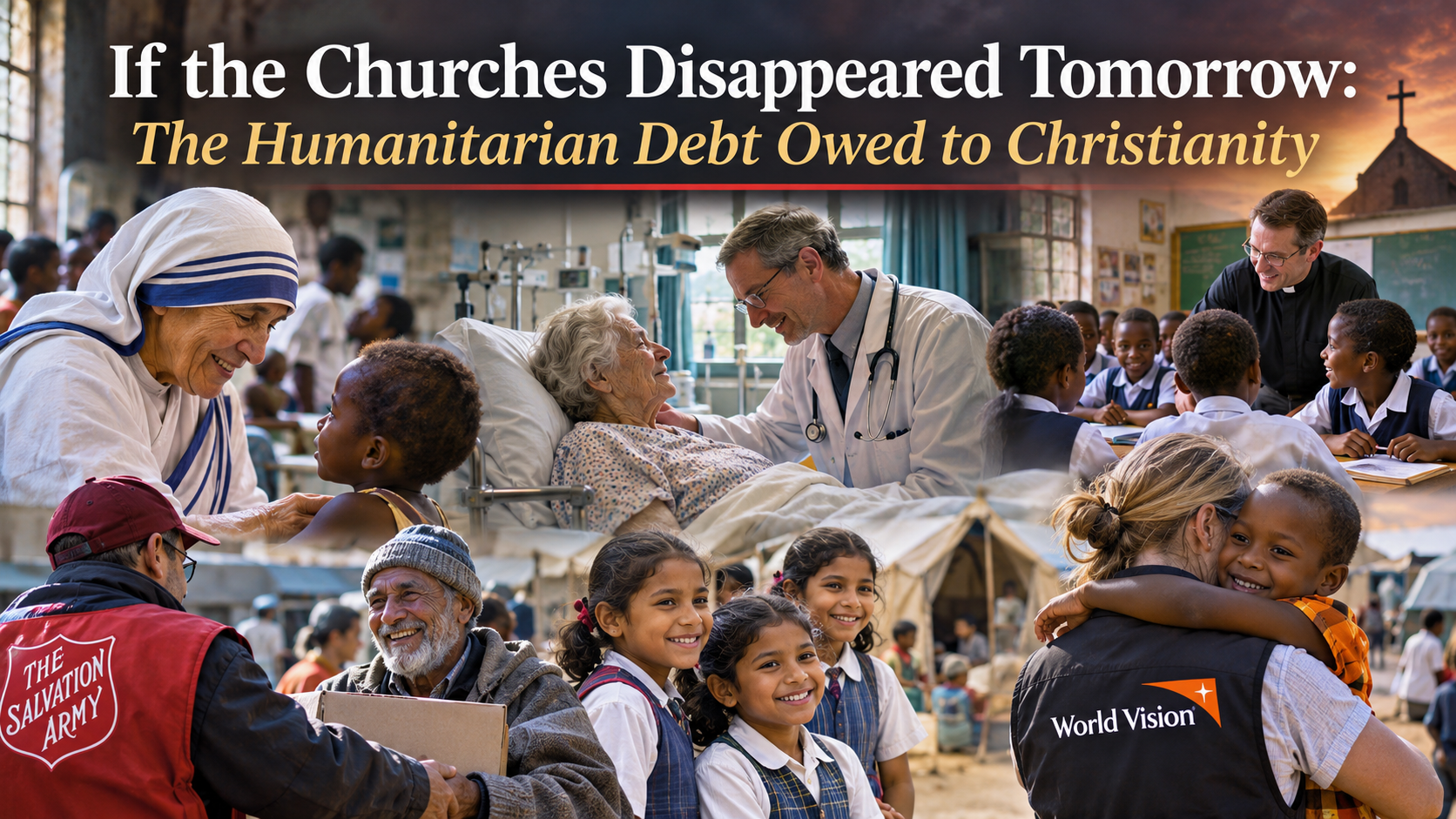
Christianity’s detractors have long argued that religion causes more harm than good, and that humanity possesses sufficient compassion to dispense with it. Yet Christian institutions educate tens of millions of children, maintain hospitals and residential homes, and deliver humanitarian assistance across the world. If organised atheism and secular humanism offer an adequate substitute for the religious motivation behind these enterprises, where is their comparable institutional inheritance?
The Anglican evangelist Canon J. John recounts an encounter with a fellow passenger on a flight from Heathrow. Asked what he did for a living, he described himself as working for a global enterprise. Its activities included education, healthcare, assistance to the poor, care for the elderly and support for those in distress. His fellow passenger was impressed by the apparent breadth of its operations and wanted to know its name. “It’s called the church … have you not heard of it?”1
The story is amusing because it describes something familiar in terms that render it almost unrecognisable. Christian charitable institutions are so thoroughly embedded in the ordinary provision of education, healthcare and social assistance that their collective scale is easily overlooked. Hospitals founded by religious communities, schools established by missionaries, homes for the elderly maintained by Christian organisations and international relief agencies operating through ecclesiastical networks seldom appear together in public discussion. Their denominational differences and administrative independence make the common religious motivation less immediately apparent.
Yet that motivation deserves attention when Christianity is subjected to the familiar accusation that it has inflicted more suffering upon humanity than it has relieved.
Christopher Hitchens gave the accusation its most memorable modern expression in God Is Not Great: How Religion Poisons Everything (2007). His criticism encompassed religious violence, political coercion, intellectual dishonesty and the corruption of human relationships through supernatural belief. In the Intelligence Squared debate on whether humanity would be better off without religion, he defended the proposition while acknowledging that religion was not the sole cause of the conflicts under discussion.2
Richard Dawkins, in The God Delusion (2006), pursued his criticism partly through the effects of religious upbringing. He argued that teaching children to fear eternal punishment could constitute psychological abuse, subsequently comparing certain consequences of such teaching with experiences of childhood sexual abuse. His own later explanation acknowledged the need for systematic research into the psychological comparison. The allegation remains his contention rather than an established clinical judgement, but its significance lies in the extension of his criticism from particular abuses of ecclesiastical authority to the transmission of religious belief itself.3
Sam Harris has advanced a related argument concerning the moral sufficiency of unbelief. In a 2007 PBS interview, he maintained that compassion provides a sufficient reason to assist those in need without invoking divine commandments. He also questioned the moral quality of assistance undertaken primarily because the benefactor believes God requires it.4
The three writers differ in their reasoning and should not be made responsible for one another’s arguments. Nevertheless, their criticisms converge upon a proposition which deserves rather more examination than it ordinarily receives: that religion’s humanitarian benefits can be obtained without religion, while its alleged dangers would thereby be avoided.
There is no difficulty in establishing that Christians, including those exercising ecclesiastical authority, have committed grave offences. The sexual abuse of children by clergy and religious, together with the concealment of crimes and protection of perpetrators by certain superiors, represents a betrayal of the obligations attached to their office. Victims are owed justice, protection and appropriate reparation. The charitable achievements of other Christians do not diminish those obligations, and the existence of hospitals cannot be offered as compensation for the suffering of an abused child.
But the judgement that particular institutions have failed grievously differs from the claim that humanity would be better without Christianity. The latter requires consideration of what Christian belief has actually produced, what its institutions presently accomplish and whether the proposed alternatives possess the capacity to replace them.
According to the worldwide Catholic statistics published by Agenzia Fides on 16 October 2026, the Catholic Church maintains 101,110 healthcare and charitable institutions. These include 5,397 hospitals, 13,646 dispensaries, 16,263 homes for elderly, chronically ill or disabled people, 8,138 orphanages and 10,352 crèches. The remaining establishments include institutions caring for those affected by leprosy, marriage counselling centres, social rehabilitation centres and other charitable facilities.5
The educational returns are equally substantial. The Church operates 75,448 kindergartens attended by 7,480,373 children, 103,666 primary schools educating 36,314,935 pupils and 51,810 secondary schools with 20,340,808 students. Together, these amount to 230,924 educational establishments serving 64,136,116 children. More than 21 million pupils attend Catholic primary schools in Africa alone.5
The figures principally reflect returns from the end of 2024 and describe institutions and enrolments rather than the number of patients treated annually. Catholic establishments also operate under varied financial arrangements, including public funding. These distinctions matter for statistical accuracy, although they do little to diminish the practical significance of the institutions concerned. Hospitals must be staffed and maintained; schools require teachers and continuing administration; residential homes undertake responsibilities which persist long after their founders have died.
The Catholic charitable network also includes Caritas Internationalis, comprising 162 member organisations working in more than 200 countries and territories. Its agencies undertake emergency relief, assistance to displaced populations, programmes addressing poverty and support for vulnerable families. Its activities overlap with the wider Catholic institutional network, and its beneficiaries cannot responsibly be added to the preceding figures as though they represented an entirely separate population.6
The humanitarian contribution of other Christian traditions is similarly extensive. World Vision International, an explicitly Christian organisation, reported reaching 43.9 million children through its relief and development programmes in 2025. Its emergency responses assisted approximately 35.6 million people across 70 countries, including 18.6 million children. These activities encompassed nutrition, healthcare, education, clean water, child protection and assistance to communities affected by conflict and disaster.7
The Salvation Army provides an especially revealing example because its familiar public identity scarcely conveys the extent of its worldwide institutional responsibilities. Founded in nineteenth-century England as an evangelical Christian movement, it maintains substantial medical, educational, residential and social services. Its international statistical returns, recorded at 1 January 2024 and reproduced in its 2025 report, include 10,873,524 recipients of general relief and 596,155 recipients of disaster relief. Its healthcare provision includes 27 general hospitals, 40 maternity hospitals, 66 specialist hospitals, 107 general clinics and health centres, and 1,704 mobile clinics or community health posts. The same returns record 134,228 inpatients, more than 1.3 million outpatient attendances, 1,703 feeding centres and 494 day nurseries.8
Its educational responsibilities are also considerable. The returns record 709 pre-primary institutions, 1,217 primary schools and 464 secondary schools, together with 560,193 pupils across its educational programmes. These are not occasional charitable collections undertaken by sympathetic individuals. They are institutions established and maintained through an explicitly Christian movement whose religious commitments have continued across generations.8
The Lutheran World Federation’s World Service reported assisting approximately 2.8 million people across 26 countries in 2025, including refugees, internally displaced people and vulnerable host communities. ACT Alliance, incorporating Protestant and Orthodox organisations, reported 164 member agencies operating across 127 countries. Its international activities encompass humanitarian assistance, development and responses to emergencies.9
These returns measure different things. School enrolments, institutional counts, relief recipients and organisational membership cannot be combined into one impressive but meaningless total. The figures nevertheless establish the geographical reach and institutional substance of Christian humanitarian provision. Catholics, Lutherans, evangelicals, Orthodox Christians and Salvationists possess considerable theological differences, but their respective traditions have generated enduring charitable commitments through a shared conviction that service to those in need belongs to Christian duty.
The question raised by the modern atheist critique is whether that religious conviction makes any appreciable difference.
If compassion is sufficient to sustain humanitarian endeavour, and if religious belief introduces dangers which humanity would be better without, one might reasonably expect organised atheism and secular humanism to have established a substantial charitable infrastructure of their own. Particularly in societies where religious affiliation has declined and secular moral convictions are widely expressed, there should be identifiable institutions founded and maintained through those convictions: hospitals, schools, residential homes, international relief agencies and permanent organisations assuming responsibility for vulnerable communities.
Their existence would provide a concrete answer to the claim that Christian charitable achievements depend upon religious motivation. Their absence, or their comparatively limited scale, would suggest that the relationship between belief and institutional commitment deserves closer examination.
Where, then, is the comparable network?
Humanists UK offers an unusually revealing explanation. Its published discussion of charitable activity acknowledges that relatively few charities are expressly humanist, explaining that humanists generally prefer to support existing secular organisations rather than establish parallel institutions. It refers to earlier humanist initiatives in sheltered housing and adoption, together with educational work associated with the Uganda Humanist Schools Trust.10
That explanation may describe the preferences of its members accurately, but it leaves the institutional comparison unanswered. Christians also support charities which are independent of religious organisations. They contribute to public appeals, volunteer for secular agencies and assist humanitarian programmes whose personnel represent many different convictions. The additional fact requiring explanation is that Christian communities have established and maintained an enormous network of specifically Christian institutions.
Nor can religiously neutral humanitarian organisations simply be counted as achievements of organised atheism. Médecins Sans Frontières, Oxfam and WaterAid operate independently of ecclesiastical authority, but their supporters and personnel include religious believers and unbelievers alike. Their humanitarian work is valuable in its own right. It does not become an expression of atheism merely because the organisation itself does not profess a religion.
This is the weakness in the familiar reply that atheists can be charitable. Of course they can. Catholic theology has never required the denial of natural virtue among unbelievers, and the moral capacity of individuals is not the issue under examination. The question concerns the institutions established through the organised expression of a particular worldview, and the willingness of successive generations to maintain obligations towards people with whom they have no personal connection.
Christianity has repeatedly supplied that motivation. Its doctrine of charity has encouraged believers to found institutions whose responsibilities endure beyond the lives of their benefactors. Hospitals require continued staffing, schools must be maintained through successive academic years, and residential institutions cannot suspend their obligations because public enthusiasm has diminished. The foundation of such establishments requires resources and initiative; their survival requires a conviction sufficiently durable to persuade others to assume the same responsibilities.
For the Catholic, charity is a theological virtue, infused by God, through which man loves God above all things and his neighbour for God’s sake. Its supernatural character distinguishes it from philanthropy understood as natural benevolence, although the latter remains a genuine moral good. The corporal works of mercy give practical expression to the obligations of neighbourly love: feeding the hungry, giving drink to the thirsty, clothing the naked, sheltering the homeless, visiting the sick and imprisoned, and burying the dead.
The Gospel leaves little room for treating these obligations as optional expressions of personal kindness. The Good Samaritan is commended for assisting a stranger whose need places a claim upon him. In Matthew 25, Our Lord identifies Himself with the hungry, the stranger, the sick and the imprisoned, placing their treatment within the judgement of souls. The Christian who neglects the poor therefore fails in a duty which his religion expressly imposes.
The institutional consequences were apparent from the earliest Christian communities. The Acts of the Apostles records the organisation of assistance following complaints that widows were being neglected in the daily distribution. By the fourth century, St Basil the Great’s charitable establishment at Caesarea had become a notable example of organised provision for the sick and destitute. Monasteries, hospitals, hospices and confraternities subsequently developed forms of assistance suited to the needs and circumstances of their respective ages.
Christianity did not invent human compassion, and organised charity was certainly known within other religious traditions. Its distinctive historical achievement was to make the works of mercy a continuing obligation within an extensive religious and institutional life. The medieval hospital differed considerably from its modern counterpart, but the religious foundations which sheltered travellers, assisted the poor and cared for the sick contributed to the development of organised social provision. Later religious congregations and missionary societies extended that work internationally, frequently establishing institutions where other provision was inadequate or absent.
The modern welfare state subsequently assumed and expanded many forms of assistance, sometimes incorporating institutions which had originated within religious communities. Christian organisations also receive public funds and cooperate with governments, and their achievements cannot all be attributed to private religious generosity. Yet financial cooperation does not erase the religious origins of an institution or the continuing contribution of its founders, administrators, volunteers and personnel. Public money may help maintain a hospital without explaining why a religious congregation established it in the first place.
This historical inheritance presents a difficulty for Harris’s argument concerning the moral sufficiency of compassion without divine commandments. His proposition may be philosophically coherent as an account of individual motivation. But its institutional consequences cannot simply be assumed. If religious belief is unnecessary to the sustained charitable enterprise, the comparatively limited expressly humanist infrastructure identified in the evidence examined requires explanation. The fact that an atheist may contribute to an existing charity does not establish that organised atheism has generated an equivalent worldwide network of institutions.
The same distinction applies to Dawkins’s criticism of religious upbringing. Harmful teaching, psychological coercion and abuses of authority must be examined on their merits, and parents and educators have serious obligations towards children. Yet the existence of objectionable practices does not establish that the transmission of Christian belief is itself an injury, still less that the schools educating tens of millions of pupils constitute a humanitarian liability. Any judgement about their contribution must examine the education actually provided and the circumstances of the communities they serve.
Hitchens’s sweeping indictment encounters a related difficulty. Religious persecution, violence and coercion belong to the historical record, and their victims deserve recognition. But the language of religion poisoning everything becomes difficult to reconcile with the institutions established to treat disease, relieve hunger, educate disadvantaged children and care for those whom society has neglected. If religious conviction is considered relevant when Christians commit offences, it cannot be declared irrelevant when Christians establish institutions expressly because they believe their faith requires them to do so.
The Church does not teach that her members are incapable of sin or that ecclesiastical office confers personal impeccability. The crimes of Christians are especially scandalous because they contradict the obligations of their vocation. Catholic doctrine requires justice and the correction of abuses; it supplies no warrant for protecting wrongdoing merely because its perpetrator holds religious office. The moral failure of an individual Christian must therefore be judged according to the duties he has violated, while the institutions founded in fulfilment of those duties remain part of the same historical record.
None of this establishes the supernatural truth of Christianity by counting hospitals. The Incarnation, Resurrection and divine institution of the Church require their own theological and historical defence. The present question is narrower and concerns the accusation that Christianity has been a predominantly destructive influence whose disappearance would improve humanity’s condition. Its documented humanitarian achievements are directly relevant to that accusation.
Nor can anyone reconstruct with certainty a world in which Christianity never existed. Other religious, philosophical or political traditions might have developed institutions meeting some of the same needs. Historical counterfactuals cannot establish what would have happened under circumstances which never occurred. The actual historical record is less accommodating to speculation: Christianity existed, its doctrines repeatedly inspired charitable institutions, and those institutions became part of the development of healthcare, education and organised social assistance.
The question posed by Christianity’s disappearance tomorrow is more immediate. The hospitals, schools, residential homes and relief programmes exist now. Their beneficiaries are alive, and their needs will remain whether or not the institutions which presently assist them survive. Some establishments could undoubtedly continue under public or independent administration. Others, particularly in poorer regions, would be considerably harder to replace. The disappearance of Christian organisations would remove networks of personnel, funding, administration, local knowledge and voluntary commitment which have often developed over generations.
A community whose only accessible hospital is maintained by a Christian mission cannot treat its closure as a philosophical improvement. Parents whose children attend a Christian school because no adequate alternative exists would have good reason to question the practical wisdom of celebrating its disappearance. A refugee family receiving assistance through a Christian agency has an immediate interest in the continued availability of food and shelter, whatever the convictions of those providing them.
The churches themselves exist for purposes considerably greater than humanitarian assistance. Their primary concern is the worship of God, the proclamation of the Gospel and the salvation of souls; in the Catholic understanding, this includes the sacramental life instituted by Christ. Their charitable institutions arise within that supernatural mission. To reduce Christianity to its usefulness as a provider of social services would misunderstand the very convictions which have inspired so much of its charitable work.
But those who claim that humanity would be better without Christianity cannot reasonably disregard the humanitarian inheritance which those convictions have produced. The offences committed by Christians require justice, and institutional failures require accountability. The hospitals, schools, orphanages, residential homes and relief agencies must also be included in any serious assessment of Christianity’s contribution to human welfare.
The evidence examined identifies no worldwide humanitarian infrastructure established expressly by atheist or humanist movements comparable in scale to that maintained through organised Christianity. This is a finding about the documented institutional record, rather than a claim to have completed an exhaustive census of every humanist organisation. It nevertheless presents a substantial challenge to those who regard religious motivation as unnecessary to the charitable enterprise.
Canon J. John’s fellow passenger was surprised to discover the identity of the organisation he described. The surprise is understandable. Christianity’s humanitarian institutions have become so thoroughly integrated into ordinary social provision that their religious origins and continuing purposes are easily overlooked.
Yet their disappearance would be anything but inconspicuous. The people who depend upon them would still require treatment, education, shelter and care. Those who insist that the world would be better without the churches must therefore explain who would assume those responsibilities, through which institutions, and with what resources. The assertion that compassion requires no belief in God may describe an individual’s moral convictions. It does not provide a replacement for the humanitarian inheritance which Christian conviction has already built.






Leave a Reply