
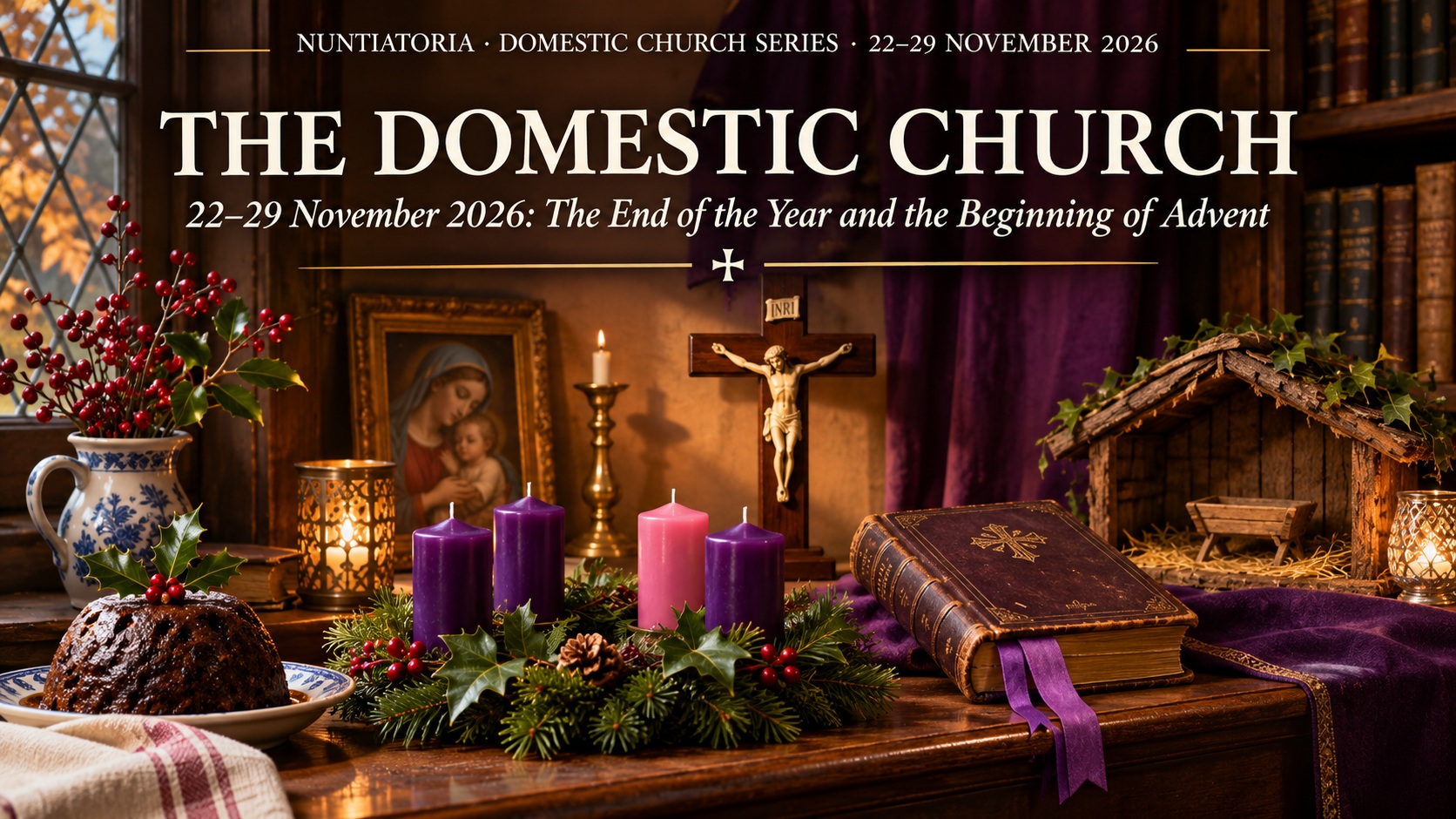
The final week of the ecclesiastical year brings St Cecilia, the early Roman martyrs, St Catherine’s traditional English customs and the last days of November’s remembrance of the Holy Souls. Families complete their Christmas preparations, establish a household rule for Advent and welcome the new liturgical year on Sunday 29 November.
The week between two beginnings
There is something rather satisfying about the last Sunday before Advent. Christmas preparations have begun in earnest, the pudding is steaming, the cake is safely put away to mature, and somewhere in the house there is probably a collection of ribbons, candles and coloured paper which has yet to become anything recognisable. The children are anticipating Christmas. Their parents may be wondering whether there are enough weekends left to accomplish everything.
The Church, meanwhile, has other matters in mind. The final Sunday after Pentecost recalls Our Lord’s warnings concerning the end of earthly history. The liturgical year closes with the certainty that the present world will pass away and every soul must answer to God. A week later Advent begins with a cry for the coming of the Redeemer. The Child whose Nativity we shall celebrate at Christmas is the eternal Son of God, Who will return in glory to judge the living and the dead.
A Catholic household can use these final November days to finish practical preparations while making some more important arrangements: when its members will make their Confession, what prayers they will say together, how they will keep Advent and how the coming Christmas may include those who are forgotten.
Last week’s Domestic Church supplied instructions for Christmas cake, Stir-Up Sunday pudding, the homemade Advent calendar, Jesse Tree and family crib.1 Those projects continue this week. There is no reason to begin them again. The principal task now is to bring them into use while maintaining the Family Rosary and November suffrages. The longer activities are reserved for the weekend.
The family’s plan for 22–29 November
This calendar follows the Apostolate’s established older Roman Ordo. On 22 November it gives St Cecilia precedence with a commemoration of the Last Sunday after Pentecost. Some other implementations of pre-1955 rubrics give the Sunday precedence, so the local published Ordo should be observed consistently.2
| Day and observance | Family Rosary intention | Household activity |
|---|---|---|
| Sun 22 Nov · St Cecilia; Last Sunday commemorated | Departed musicians, singers and relatives | Complete the pudding; sing a hymn together |
| Mon 23 Nov · St Clement I; St Felicity commemorated | Deceased popes, bishops, priests and godparents | Draw an apostolic succession chart |
| Tue 24 Nov · St John of the Cross; St Chrysogonus commemorated | The lonely and those who endured spiritual trials | Family silence and spiritual reading |
| Wed 25 Nov · St Catherine of Alexandria | Deceased teachers, scholars and young people | Bake English Cattern cakes |
| Thu 26 Nov · St Sylvester Gozzolini; St Peter of Alexandria commemorated | Departed religious and benefactors | Agree the Advent rule; finish calendars |
| Fri 27 Nov · Feria; Miraculous Medal apparition anniversary | Forgotten souls and those who died without sacraments | Friday abstinence and charitable supper |
| Sat 28 Nov · Anticipated Vigil of St Andrew | Deceased missionaries and apostles | Complete wreath, prayer corner and Jesse Tree |
| Sun 29 Nov · First Sunday of Advent | Sanctification of family, living and departed | Mass, first violet candle and Advent devotions |
The daily Family Rosary remains the centre of the programme. During the last days of November it is particularly offered for the Holy Souls. Announce the day’s intention before beginning, then conclude with the De profundis and Requiem aeternam. The Family Book of the Departed should remain near the crucifix. Prayer for the dead continues throughout the year.
Sunday 22 November: St Cecilia and Stir-Up Sunday
Red — St Cecilia, Virgin and Martyr; commemoration of the Last Sunday after Pentecost in the Apostolate Ordo.
The Mass of St Cecilia is Loquebar. The Gospel of the Last Sunday after Pentecost, Matthew 24:15–35, concerns the tribulation preceding the consummation of history and the permanence of Our Lord’s words. St Cecilia’s feast gives the afternoon a musical character. Honoured as patroness of sacred music, she reminds families that the hymns and chants of the Church have their place at home.
After Mass, complete the Christmas pudding begun on Saturday. The preceding instalment gave the method by which the flour is added on Sunday before the pudding is covered and steamed for eight hours. Let everybody stir the mixture, offering a prayer for the living or the dead.
Stir-Up Sunday takes its name from the Collect of the Last Sunday after Pentecost, Excita, quaesumus, Domine, tuorum fidelium voluntates. The words ask God to stir up the wills of His faithful. The prayer subsequently passed into the English Book of Common Prayer, from which the popular British name became familiar. The pudding custom is domestic folklore and not a liturgical ceremony.
Later, gather around the crucifix to sing a Catholic hymn such as Ave Maris Stella or Faith of Our Fathers. Older children might be asked what they have learnt about the Faith during the year, which devotions have helped them, and whether there are duties or relationships that need putting right.
Family Rosary: For deceased relatives, musicians, singers and all who taught the family to pray.
Monday 23 November: St Clement and the Faith received from the Apostles
Red — St Clement I, Pope and Martyr; St Felicity commemorated.
St Clement belongs to the earliest Roman generation after the Apostles. His letter to the Corinthians, generally dated near the end of the first century, witnesses to the order of the primitive Church and the appointment of ministers through the Apostles.3
Draw a simple chart beginning with Our Lord Jesus Christ, followed by the Apostles and their episcopal successors. Place St Clement among the early Roman pontiffs and identify the family’s own bishop. Explain that apostolic succession means the transmission of episcopal office through valid consecration and is accompanied by the duty to preserve the doctrine handed down by the Apostles. It is neither a family pedigree nor a guarantee that every individual bishop will be personally holy.
Younger children might illustrate the chart with St Peter’s keys, a mitre and palm branches. Older children can read an extract from Clement’s letter.
Family Rosary: For departed priests, bishops, godparents and those who handed on the Catholic Faith.
Tuesday 24 November: St John of the Cross and a little silence
White — St John of the Cross, Confessor and Doctor; St Chrysogonus commemorated.
Ten minutes of quiet in a household can be difficult to achieve. Between school, work, meals and telephones, silence sometimes seems the privilege of monasteries. St John of the Cross taught that progress towards God requires detachment from disordered desires and fidelity through trial. His mystical theology is far more than a technique for relaxation, yet it gives families reason to recover a little recollection.
After supper put away telephones, turn off the television and light a safe candle before the crucifix. Read Romans 13:11–14, the Epistle for the coming Advent Sunday, and keep five minutes of quiet. With young children, one or two minutes is sufficient. The Rosary follows at its ordinary hour.
Family Rosary: For those who died after prolonged illness, loneliness, bereavement or spiritual distress.
Wednesday 25 November: St Catherine and the English Cattern cakes
Red — St Catherine of Alexandria, Virgin and Martyr.
St Catherine’s cult was widespread in medieval Europe. She was invoked as a patroness of learning, young women and trades associated with wheels. Her customary emblem comes from the traditional account of her martyrdom; elements of the surviving narrative are legendary and not all can be established historically.4
In the English Midlands, 25 November was kept as Cattern Day by lacemakers. The festivities involved hospitality, a pause from work and distinctive spiced cakes. Later tradition associated the custom with Catherine of Aragon and her reputed generosity to lacemakers. Nottingham Industrial Museum preserves the recipe and explains how the spiral shape recalls St Catherine’s wheel.
Traditional English Cattern cakes
Ingredients: 275g self-raising flour; ½ teaspoon ground cinnamon; 25g currants; 50g ground almonds; 2 teaspoons caraway seeds; 200g caster sugar; 100g butter, melted and cooled; one large beaten egg; a little extra caster sugar and cinnamon.
Heat the oven to 200°C (180°C fan or Gas Mark 6). Sift the flour and cinnamon into a bowl, stir in the currants, ground almonds, caraway seeds and sugar, then add the cooled butter and beaten egg. Work into a soft dough. Roll on a lightly floured surface to a square approximately 30cm across, brush with a little water and sprinkle with extra sugar and cinnamon. Roll as for a Swiss roll, cut into slices around 2cm thick and place apart on a lined baking tray.
Bake for approximately 10–15 minutes until the centres are cooked, allowing the cakes to settle briefly before moving to a wire rack. If the dough is sticky, chill it for 10–15 minutes; if it is too dry, use a little milk. Approximately sixteen cakes result, depending on size.5
Children can measure and mix ingredients under suitable supervision. A plate of the cakes, accompanied by a handwritten card, would make a welcome gift to an elderly neighbour or someone who might otherwise be forgotten.
Family Rosary: For departed teachers, scholars and young people, and for those persecuted for the Faith.
Thursday 26 November: St Sylvester and the household rule
White — St Sylvester Gozzolini, Abbot; St Peter of Alexandria commemorated.
St Sylvester Gozzolini founded the Sylvestrine monastic congregation in thirteenth-century Italy, with a community at Monte Fano near Fabriano ordered according to the Rule of St Benedict.6 A family is not a monastery. Nevertheless, monasteries teach the value of regular observance, and the daily repetition of prayer has its own importance in domestic life.
Agree upon a simple rule for Advent. When will the Angelus be said? Can the Family Rosary remain at its established hour? Which evening is suitable for spiritual reading? What charitable work will the household undertake? Arrange Confession now rather than leave it until Christmas week.
Finish the Advent calendar begun last week. There should be twenty-six envelopes, one for each date from Sunday 29 November through Christmas Eve. In each place a prayer, a verse of Scripture or a modest act of charity: pray for a priest; offer help unasked; read the Annunciation; write to an absent relative; make a little sacrifice without telling anyone.
Do not multiply devotions to the point that none can be sustained. A modest rule faithfully observed will do more good than an ambitious timetable abandoned by the second week.
Family Rosary: For departed monks, nuns, religious founders and benefactors.
Friday 27 November: Our Lady and the final November penance
Green — Feria; Friday abstinence.
On 27 November 1830, according to the account preserved at the Rue du Bac chapel in Paris, the Blessed Virgin Mary appeared to St Catherine Labouré with the design now known as the Miraculous Medal. The date is observed devotionally but is not a feast of this older universal Roman calendar.7
Teach the children the inscription, O Mary, conceived without sin, pray for us who have recourse to thee. A blessed medal is a sacramental, not a magical object; the faithful seek God’s mercy through the intercession of His Mother.
Keep the penitential character of Friday according to the applicable discipline. For supper, prepare leek and potato soup: soften two chopped leeks and an onion in butter or oil, add about 500g diced potatoes and 750ml vegetable stock, simmer until tender and blend or mash. Serve with bread. Deliver the family’s charitable parcel if convenient.
At the evening Rosary read names from the Family Book of the Departed and remember those who died without friends, family or the consolation of the last sacraments.
Family Rosary: For forgotten souls and the unprovided dead.
Saturday 28 November: the Vigil of St Andrew and the home prepared for Advent
Violet — Anticipated Vigil of St Andrew.
In the older calendar the Vigil of St Andrew is anticipated on Saturday 28 November because its usual day, 29 November, is occupied by the First Sunday of Advent. Pray for the missions, the conversion of nations and all who labour to transmit the Catholic Faith.
Complete the Advent wreath with three violet candles and one rose candle, reserved for Gaudete Sunday on 13 December. Arrange the household crucifix and a suitable violet cloth, finish the Jesse Tree and put the empty manger in the crib. The Christ Child is reserved for Christmas.
Children can make a paper inscription for the prayer corner: AD TE LEVAVI ANIMAM MEAM — To Thee, O Lord, have I lifted up my soul, the opening of Advent’s Introit. Prepare Christmas decorations if desired, but there is no need to put them all up before the season begins. Saturday is also a suitable day for Confession.
Family Rosary: For deceased missionaries and all those who brought the Faith to their families.
Sunday 29 November: the First Sunday of Advent
Violet — First Sunday of Advent.
The Mass opens with Ad te levavi animam meam from Psalm 24. The Epistle, Romans 13:11–14, exhorts the faithful to cast aside the works of darkness; the Gospel, Luke 21:25–33, concerns the coming of the Son of Man. The Redeemer whose Nativity is approaching shall also return to judge the living and the dead.8
Parents can explain the violet vestments, omission of the Gloria and the restrained character of the season. Ancient Advent fasting traditions should not be confused with universal present obligations. The wreath is a domestic custom and not a prescribed ceremony of the Roman liturgy.
After Mass, gather at the wreath, read a few verses of the Epistle and light the first violet candle. Then open the first Advent calendar envelope and complete its prayer or act of charity.
Prayer at the lighting of the first Advent candle
V. Our help is in the name of the Lord.
R. Who hath made heaven and earth.
V. O Lord, hear my prayer.
R. And let my cry come unto Thee.
The first violet candle is lit.
O Lord Jesus Christ, eternal Son of the Father, Who didst come into this world for our salvation and Who shalt come again in glory, grant that this household may prepare faithfully for the celebration of Thy holy Nativity.
Awaken in us sincere repentance, strengthen our charity, preserve our children in the Catholic Faith, and teach us to await Thy coming with vigilance and hope.
May the light of this candle remind us of the true Light Who enlighteneth every man, and may our home be governed by Thy peace.
Who livest and reignest with the Father and the Holy Ghost, God, world without end. Amen.
This is a suggested household devotion, not an official liturgical blessing of the wreath.
The Family Rosary and the Holy Souls
November’s conclusion does not end the obligation of charity towards the faithful departed. The Church continues to offer the Holy Sacrifice of the Mass, prayers, almsgiving and other suffrages on their behalf. The Old Roman Apostolate’s Guild of Holy Souls maintains this remembrance through Requiem Masses and its Chantry Books.
The Rosary remains a natural domestic devotion. Young children become restless; meals are occasionally late; somebody returns exhausted from work. Persevere patiently without turning prayer into a burden or a competition. What matters is the formation of a household which habitually turns to God.
Prayers for the end of the ecclesiastical year
Collect of the Last Sunday after Pentecost
Excita, quaesumus, Domine, tuorum fidelium voluntates: ut, divini operis fructum propensius exsequentes, pietatis tuae remedia maiora percipiant. Per Dominum nostrum Jesum Christum Filium tuum…
Stir up, we beseech Thee, O Lord, the wills of Thy faithful; that they, more earnestly seeking the fruit of divine works, may receive more abundantly the remedies of Thy mercy. Through Our Lord Jesus Christ, Thy Son…
Collect of the First Sunday of Advent
Excita, quaesumus, Domine, potentiam tuam, et veni: ut ab imminentibus peccatorum nostrorum periculis, te mereamur protegente eripi, te liberante salvari. Qui vivis et regnas cum Deo Patre in unitate Spiritus Sancti, Deus, per omnia saecula saeculorum.
Stir up Thy might, we beseech Thee, O Lord, and come; that, protected by Thee, we may be delivered from the dangers which threaten us through our sins, and, being set free by Thee, may attain salvation. Who livest and reignest with God the Father, in the unity of the Holy Ghost, God, world without end. Amen.
For the faithful departed
De profundis clamavi ad te, Domine: Domine, exaudi vocem meam. Out of the depths I have cried to Thee, O Lord: Lord, hear my voice. The family may recite the whole of Psalm 129 followed by Requiem aeternam dona eis, Domine; et lux perpetua luceat eis. Requiescant in pace. Amen.
A household ready to begin again
By Sunday evening the Advent wreath will have been lit and the first prayers of the new ecclesiastical year offered. The children may remember the Cattern cakes, the Christmas pudding stirred together or the candle glowing beside the crucifix. Their greater value comes from the prayers, instruction and acts of charity with which they are associated.
The Catholic Faith is transmitted in ordinary family life. Children who learn to pray for their deceased grandparents, recognise the saints’ feast days and prepare for Confession are receiving an inheritance more substantial than any collection of Christmas presents. Ad te levavi animam meam.
FOOTNOTES
1 Nuntiatoria, The Domestic Church: 15–22 November 2026.
2 Nuntiatoria, Traditional Roman Ordo: Liturgical Week, 15–22 November 2026.
3 The Catholic Encyclopedia, Pope St Clement I.
4 The Catholic Encyclopedia, St Catherine of Alexandria.
5 Nottingham Industrial Museum, From the Victorian Kitchen: Cattern Cakes.
6 The Catholic Encyclopedia, St Sylvester Gozzolini.
7 Chapelle Notre-Dame de la Médaille Miraculeuse, The Apparitions.



Leave a Reply