
Ad Te Levavi: The First Sunday of Advent in the Traditional Roman Rite
The First Sunday of Advent stands like a threshold between ages: the end of the old liturgical year and the dawn of the new, the fading twilight of fallen history and the first glimmer of eternity. In the pre-1955 Tridentine liturgy, this Sunday is not a gentle prelude but a solemn summons; not the opening of a festive season but the awakening of a slumbering world to the voice of the Judge who comes. The Roman Church begins her year here for a reason: the mystery of salvation cannot be understood unless one begins at the end, at the final coming of Christ in glory. Only from the vantage point of His return can one grasp the full meaning of His Nativity.
The ancient Roman liturgy preserves this orientation with a clarity and sobriety largely lost in later reforms. Advent is not merely a countdown to Christmas: it is a season formed by the eschatological consciousness of the early Church, a time of penitence, longing, prophecy, and purification. In the pre-1955 tradition, with its intact vigils, Ember Days, and fuller structure, Advent is revealed as a disciplined spiritual ascent—one that mirrors Israel’s long vigil for the Messiah and anticipates the Church’s vigil for His return.
**The Introit Ad te levavi animam meam is one of the most ancient prayers in the Roman patrimony.**¹ Sung for this Sunday as early as our sources allow, its ascending melody expresses the posture of the Church as the year begins: the soul lifts itself to God with trust, vulnerability, and expectant hope. “To Thee have I lifted up my soul,” chants the schola; “My God, in Thee have I trusted; let me not be confounded.” The first words of the liturgical year thus unite the Church’s longing with the yearning of the patriarchs and prophets, who watched for Christ in shadows and types.
The Collect, Excita, Domine, potentiam tuam, intensifies this longing. To modern ears the phrase “Stir up Thy power, O Lord, and come” may sound poetic, but in the spirituality of ancient Rome it is a cry from the battlefront—an appeal to the Lord to intervene against the power of sin and the disorder of fallen nature.² The Gelasian Sacramentary already preserves this prayer with its terse dignity, revealing Advent as a season when the Church implores heaven for deliverance, not tinsel or nostalgia.
The Epistle (Romans 13:11–14) serves as the moral prologue of the liturgical year. St Paul declares that “the hour has come to rise from sleep,” because “our salvation is nearer now than when we believed.” The Church begins her year with a call to conversion, to moral vigilance, and to the renunciation of the “works of darkness.” Advent thus commences not in the coziness of approaching festivities but in the stark confrontation with one’s own need for salvation. To “put on the Lord Jesus Christ” is the true preparation for His Nativity, His sacramental coming, and His return in majesty.³
**The Gospel (Luke 21:25–33) confronts the faithful with the cosmic signs of the Last Day.**⁴ Christ speaks of the shaking of the heavens, the fear of nations, and the coming of the Son of Man with power and glory. This is the true horizon of Advent: the world stands under judgment, and the faithful must stand ready. Yet the tone is not despair but hope. “When these things begin to come to pass,” Christ says, “look up, and lift up your heads, for your redemption is at hand.” It is precisely in the destabilisation of earthly certainties that the Christian discovers the solidity of divine promise.
The ancient Roman Rite, in its pre-1955 form, frames this eschatological proclamation not as a threat but as a consolation. The Fathers of the Church consistently taught that the terrors of the Last Day are terrifying only to the unrepentant. To the just, they are the sound of approaching deliverance, the footsteps of the Bridegroom who returns to claim His own. Thus the First Sunday of Advent teaches that history itself is Advent—that the entire Christian life is lived in expectation of the Lord’s coming.
The Offertory (Ad te levavi) and Communion (Psalm 84) continue the unity of the day. The Offertory repeats the theme of the Introit: the soul, having lifted itself toward God in longing, now offers itself wholly in sacrifice. The Communion verse speaks of divine blessing and fruitfulness, hinting at the hidden growth of grace that Advent initiates. In the pre-1955 tradition, these texts, unaltered and unabridged, preserve the contemplative cadence of the Roman spirit.
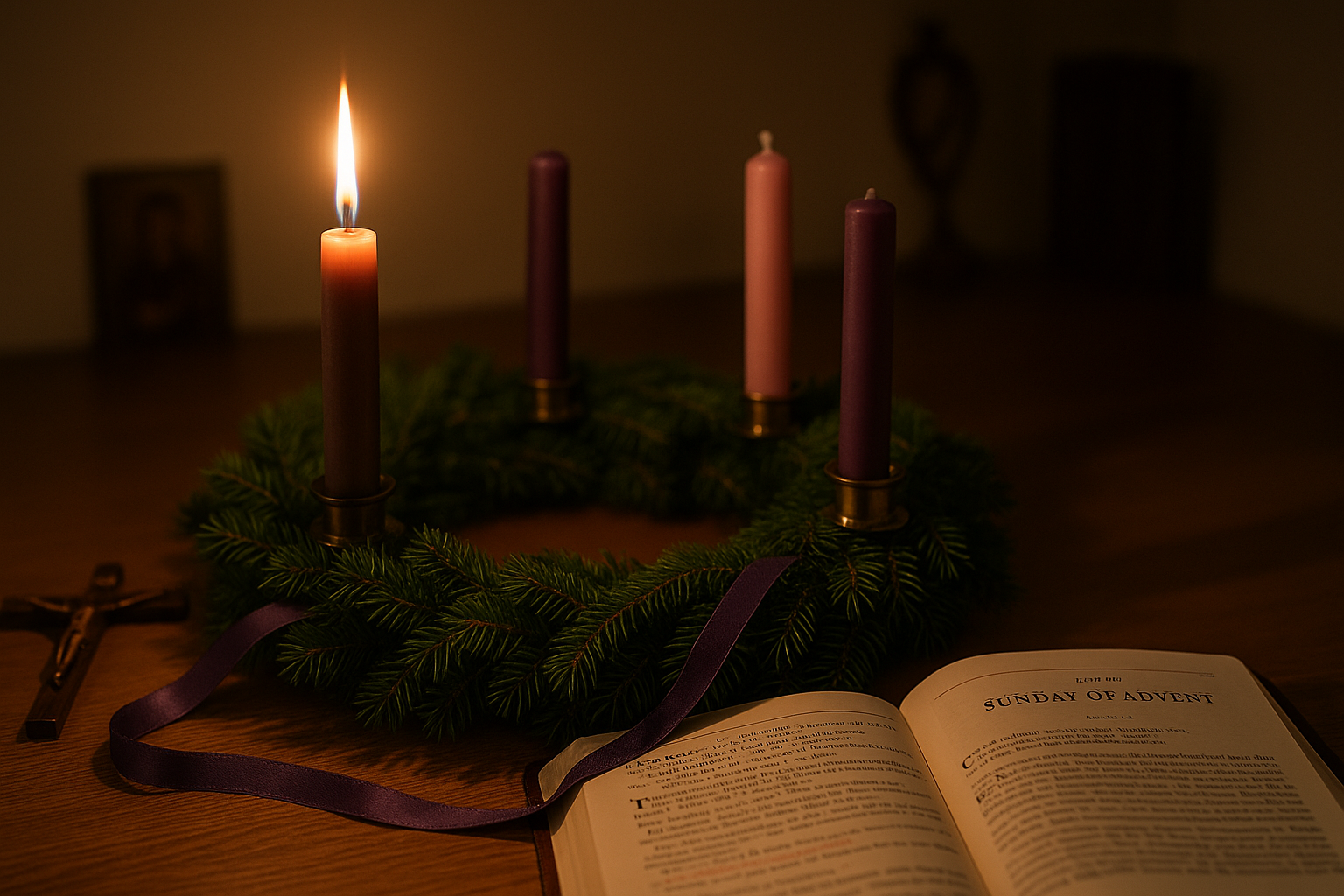
The liturgical discipline of the season deepens this spirituality. The violet vestments speak of penitence and preparation; the Gloria is omitted; the organ falls silent except to sustain chant, refusing all ornamentation; the altar is stripped of flowers. Advent is a season of restraint because the grace it offers is subtle, interior, and contemplative. Its joy is not diminished—only purified of excess.
Under the pre-1955 rubrics, this sobriety reaches its fullest expression in the Advent Ember Days and other ancient observances that mark the season.⁶ The Ember Days—Wednesday, Friday, and Saturday of the third week—root Advent in the rhythm of fasting, prayer, and the sanctification of the seasons. They represent Rome’s oldest liturgical strata, perhaps predating even Christianisation, and transformed by the Church into instruments of sanctification and anticipation. Their retention in the pre-1955 arrangement gives Advent a texture that is both biblical and deeply Roman.
The theology of Advent is fundamentally the theology of desire. The Church longs for Christ because she recognises the inadequacy of this fallen world. The First Sunday of Advent confronts the faithful with the fact that the world is not enough—that human schemes, political deliverers, and philosophical systems cannot redeem mankind. Only the God who once came in humility and who will come again in glory can do so. Advent trains the soul to desire rightly, to hunger for justice, holiness, and truth.
This desire is not passive. The exhortation to vigilance that pervades Advent is not the quietism of resignation but the readiness of love. To “watch” in the Gospel sense means to live with one’s eyes open to grace, awake to one’s duties, and attentive to the movements of the Holy Ghost. Advent is, in this sense, a school of spiritual perception. Its graces sharpen the dullness of the heart.
The First Sunday of Advent therefore functions as the interpretative key to the whole liturgical year. Christmas will make no sense unless we stand first before the Judge; Lent will make no sense unless we begin with the need for redemption; Easter will make no sense unless we long for resurrection; Pentecost will make no sense unless we have waited upon the promise of Christ. Everything begins with Ad te levavi: the soul lifting itself to God, asking not to be confounded.
In the pre-1955 Roman Rite, this beginning is unhurried, unembellished, unmodernised. It allows the ancient texts to speak with their full force. The Church does not rush to the manger; she prepares. She watches. She purifies her heart. She remembers the long vigil of Israel and anticipates the final vigil of the Church.
At the threshold of the liturgical year, the faithful stand as sentinels in the night, waiting for the dawn, lifting their souls to the Lord who comes. Advent begins in darkness, but not despair; it begins with judgment, but not fear. It begins with longing—and that longing, purified by the discipline of the Roman Rite, becomes the doorway through which grace enters anew into the world.
Thus the First Sunday of Advent is not merely the start of a season. It is the annual rebirth of Christian hope.
- The Introit Ad te levavi animam meam is appointed for this Sunday in the earliest Roman sacramentaries; see the public-domain Catholic Encyclopedia (1913), s.v. “Advent.”
- The collect Excita, Domine, potentiam tuam is found in the Gelasian Sacramentary; see H. A. Wilson (ed.), The Gelasian Sacramentary (Oxford, 1894).
- Romans 13:11–14 is attested as the Epistle for this Sunday in the Missale Romanum (1570), public domain.
- The eschatological Gospel from Luke 21 appears in the earliest Roman lectionaries and is preserved in the Tridentine Missal without alteration.
- Advent austerities (violet vestments, omission of the Gloria, organ restraint) are noted in the rubrics of the pre-1955 Missale Romanum and in Adrian Fortescue’s The Mass: A Study of the Roman Liturgy (1912), public domain.
- The Advent Ember Days are well attested in antiquity; see the Catholic Encyclopedia (1913), s.v. “Ember Days.”
related articles


Latest articles
- Today’s Mass: October 25 SOVEREIGNTY OF OUR LORD JESUS CHRIST, SUPREME KINGThe Feast of the Sovereignty of Our Lord Jesus Christ celebrates Christ’s dual kingship by birth and conquest. Established by Pius XI, it aims to deepen faith and counter anti-clericalism. The liturgical observance underscores His authority as King, advocating for societal recognition of His reign to bring peace and harmony.
- TRADITION BEHIND THE FENCEThe Vatican’s prohibition of the traditional Ad Petri Sedem pilgrimage to St Peter’s Basilica has sparked controversy, especially among traditional Catholics. While some cite scheduling conflicts, the broader issue lies in the restrictive policies of Traditionis custodes, which may confine traditional liturgical practices to specific enclaves, risking the transmission and recognition of Catholic Tradition within the wider Church.
- Today’s Mass: October 24 St Raphael the ArchangelThe Feast of Saint Raphael the Archangel highlights his healing powers as depicted in the Book of Tobit, where he aids Tobit and his son, Tobiah. Venerated as a protector of travellers and the blind, Raphael is celebrated for his miraculous interventions. His legacy includes support for nurses, matchmakers, and Catholic studies.
- 25.10.26 Nuntiatoria CXXIX: CHRISTUS REXThe text discusses the relationship between Christ’s kingship and authority within the Church amidst contemporary challenges. It contrasts ecclesiastical power with genuine faith, emphasising that authority must protect divine truth rather than alter it. The witness of imprisoned priests illustrates the enduring significance of fidelity to Christ over institutional conformity.
- THE DOMESTIC CHURCH: 25 October – 2 November 2026 A Home with Room for Heaven: Preparing for All Saints and All SoulsThe content outlines a week’s plan for traditional Catholic families to prepare for the feasts of All Saints and All Souls. Emphasising daily prayers, remembrance of the deceased, and engagement with children’s activities, it aims to integrate Catholic customs into family life, enriching spiritual practices and fostering a shared faith experience.



Leave a Reply