
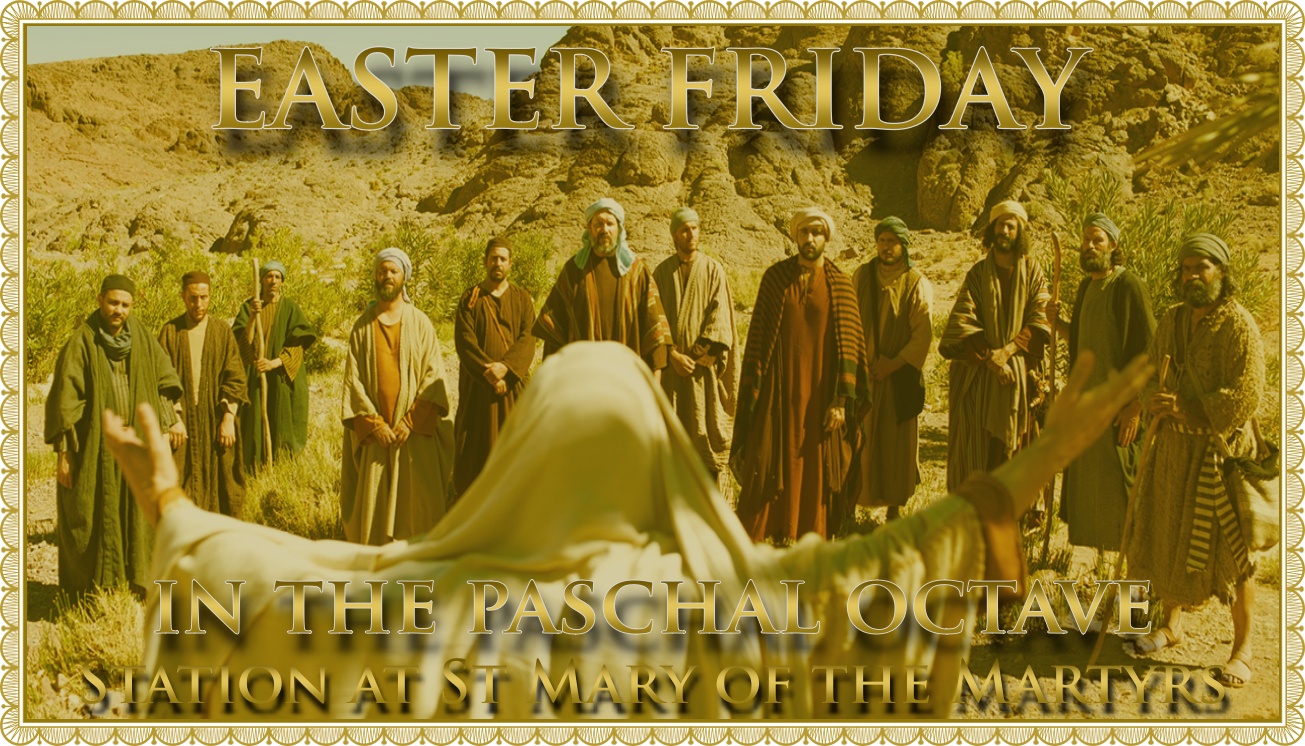
Easter Friday in the Tridentine Rite: The Eucharistic Presence of the Risen Lord
Easter Friday, continuing within the indivisible glory of the Paschal Octave, brings the Church’s contemplation of the Resurrection to a point of profound Eucharistic clarity. The mystery has been proclaimed, recognised, interiorised, and sent forth; now it is abided in. The risen Christ is not only encountered, not only understood, not only proclaimed—He remains. The Resurrection is not a passing manifestation, but a perpetual presence. It does not depart; it dwells.
The Church, still immersed in the one great Day of Easter, refuses all diminution of joy. The Gloria continues to resound, the Sequence is still sung, and the Alleluia—so long silenced—returns with inexhaustible insistence.¹ This repetition is not liturgical redundancy; it is theological necessity. For the Resurrection is not exhausted by comprehension. It must be inhabited. It must become the atmosphere of the Christian soul.
The station for this day is at the Pantheon—Santa Maria ad Martyres—where the ancient temple of all the gods has been consecrated to the true God and to the memory of His martyrs. This transformation is itself a proclamation of the Resurrection’s power: what was once given to idols is now claimed for Christ; what was profane is made holy; what was many is gathered into One. The Resurrection does not merely restore—it transfigures. It takes what is fallen and reorders it to God. In this place, the Church declares that the victory of Christ extends not only to souls, but to the very structures of the world.
The Introit proclaims: *Eduxit eos Dominus in spe, alleluia: et inimicos eorum operuit mare, alleluia, alleluia.*² “The Lord hath brought them out in hope… and the sea hath overwhelmed their enemies.” The imagery is unmistakable: the Exodus fulfilled in Christ. As Israel passed through the waters and saw their enemies destroyed, so the Christian, passing through Baptism, is delivered from sin and death. The Resurrection is the definitive Exodus—the passage from death to life, from bondage to freedom, from fear to hope.
Thomas Aquinas teaches that Baptism derives its power precisely from the Passion and Resurrection of Christ, applying to the soul the fruits of His victory.³ Thus the Red Sea is no longer merely historical; it is sacramental. The waters of Baptism are both tomb and womb—death to sin, birth to grace.
The Collect gathers the faithful into this Paschal confidence, asking that those who have celebrated the solemnities may persevere in the grace they have received. The Church, in her wisdom, does not separate joy from vigilance. The Resurrection is the beginning of a new life—but that life must be sustained. As the Council of Trent teaches, the justified must remain in grace and grow therein through cooperation with God.⁴
The Epistle (Acts 5:34–42) presents a striking moment in the early Church: the Apostles, having been beaten and commanded not to preach, depart rejoicing that they were found worthy to suffer for the Name of Jesus. Here the Resurrection reveals its deepest paradox. It does not remove suffering—it transforms it. What was once feared is now embraced; what was once endured is now rejoiced in.
John Chrysostom marvels at this transformation:
“They rejoiced, not merely because they suffered, but because they suffered for Christ… for this is the greatest honour.”⁵
The Resurrection has so altered the horizon of the soul that suffering itself becomes participation in Christ. Death no longer terrifies; it is already conquered. The Apostles do not merely preach the Resurrection—they embody it.
The Gospel (John 21:1–14) brings us to the Sea of Tiberias. The disciples, returned to their nets, labour through the night and catch nothing. At dawn, Christ stands upon the shore—yet they do not recognise Him. Once again, presence precedes recognition. The risen Lord is there—but unseen.
He speaks: “Mittite in dexteram navigii rete, et invenietis.” Cast the net on the right side. They obey—and the net is filled beyond measure. Then the beloved disciple recognises: “Dominus est.” It is the Lord.
Here the Resurrection is revealed in its ecclesial dimension. The fruitfulness of the Church does not arise from human effort alone, but from obedience to the word of Christ. Apart from Him, the labour is empty; with Him, it is abundant. The miraculous catch becomes a sign of the apostolic mission—the gathering of souls into the net of the Church.
And then comes the culmination: “Venite, prandete.” Come, and dine.
Christ has prepared the meal. Bread and fish are laid out. The disciples are invited—not to observe, but to partake. The scene is unmistakably Eucharistic. The risen Lord feeds His own. The same Christ who broke bread at Emmaus now provides nourishment by the sea. The Resurrection culminates not merely in vision, but in communion.
Augustine of Hippo sees here the sacramental reality prefigured:
“This meal of the Lord… signifies the unity of the faithful, who are fed by Christ.”⁶
The Church is gathered, nourished, sustained—not by memory, but by presence. The meal is not incidental; it is essential. The risen Christ remains with His Church by giving Himself.
The Secret and Postcommunion prayers return this mystery to its sacramental centre, beseeching that those who have received the sacred mysteries may be strengthened in faith and charity. For the Eucharist is not only the presence of Christ—it is the means by which the Resurrection abides within the soul. As Thomas Aquinas teaches, this sacrament is the perfection of the spiritual life, uniting the faithful to Christ and sustaining them in grace.⁷
The Council of Trent declares with solemn authority that in the Eucharist Christ is present “vere, realiter et substantialiter,”⁸ and that this sacrament is the source of spiritual nourishment and growth. The Resurrection, therefore, is not confined to the past—it is prolonged, extended, made present in every Mass.
Dom Prosper Guéranger observes that the Octave unfolds the Resurrection as a lived reality, progressively revealing its implications for the Church.⁹ Easter Friday, in particular, emphasises the abiding presence of Christ—His continued action, His ongoing nourishment, His sustaining grace.
And so the pattern reaches its fullness.
Christ is present—before He is recognised.
Christ is obeyed—and then known.
Christ is known—and then received.
Christ is received—and then abided in.
This is the life of the Resurrection within the Church.
For the risen Lord does not depart.
He remains.
He feeds.
He sustains.
Surrexit Dominus vere.
And He abides—with us, unto the end.
¹ Dom Prosper Guéranger, The Liturgical Year: Paschal Time, trans. Laurence Shepherd (Fitzwilliam, NH: Loreto Publications, 2000), pp. 121–122.
² Missale Romanum, editio typica 1920, Feria VI infra Octavam Paschae, Introit (Eduxit eos Dominus in spe).
³ Thomas Aquinas, Summa Theologiae, III, q.66, a.6.
⁴ Council of Trent, Session VI (1547), Decretum de Iustificatione, ch. 10 (DH 1535).
⁵ John Chrysostom, Homiliae in Acta Apostolorum, Homily 14 (PG 60:116).
⁶ Augustine of Hippo, Tractatus in Ioannem, 123, 2 (PL 35:1970).
⁷ Thomas Aquinas, Summa Theologiae, III, q.79, a.1.
⁸ Council of Trent, Session XIII (1551), Decree on the Eucharist (DH 1636).
⁹ Guéranger, The Liturgical Year, pp. 122–124.
related articles


Latest articles
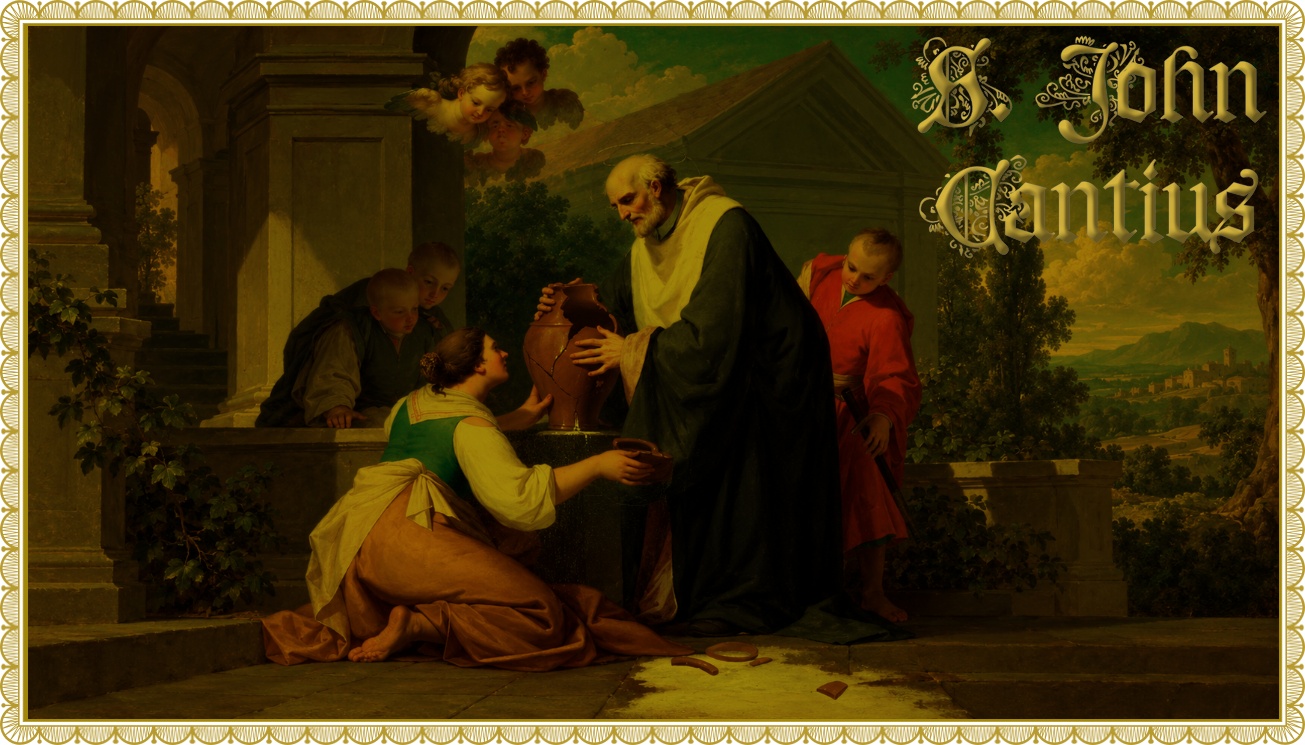
- Today’s homily: St John CantiusThe account of St John of Kenty illustrates true charity, as he prioritised the needs of a poor man over his own comfort, exemplifying how knowledge of faith must translate into actions. His life was marked by humility, generosity, and a dedication to both charitable works and doctrinal integrity, urging a holistic expression of faith.
- Today’s Mass: October 22 St John CantiusSt John of Kenty, originally a humble country lad, succeeded as a theology professor in Kraków but faced opposition that led to his role as a parish priest. Known for his kindness, he lived simply, aiding the poor. After winning his parishioners’ hearts, he returned to teaching, living a life of humility and faith.
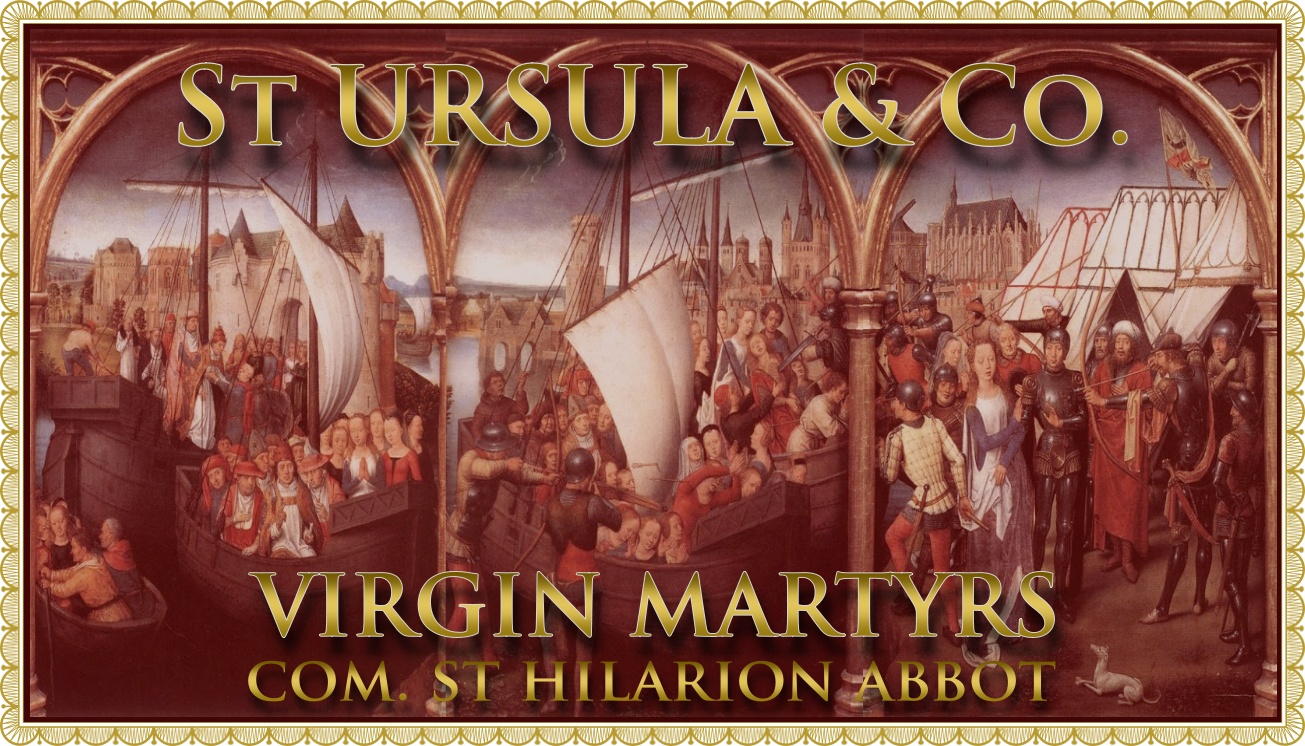
- Today’s Mass: October 21 St Ursula, Virgin Martyr & CompanionsSt Ursula and Companions, Virgins and Martyrs; Commemoration of St Hilarion, Confessor. Though legends concerning Ursula and eleven thousand virgins are historically uncertain, early Christian martyrs were venerated at Cologne. St Hilarion, Palestinian hermit and disciple of St Anthony, embraced severe penance and solitude, dying in 371 aged eighty.
- FR RIPPERGER’S YEAR OF SILENCE: Obedience is not an explanationFr Chad Ripperger has accepted a year-long withdrawal from public speaking as requested by Archbishop Golka of Denver, aimed at focusing on his priestly community. This decision, following the removal of another exorcist, raises concerns about the Church’s balance between discretion and public witness regarding exorcism and supernatural matters.
- Today’s Mass: October 20 Octave Day of St Edward, King & ConfessorEdward the Confessor, England’s last Saxon king, ruled from 1042 until his death in 1066. Born in 1003, he fled to Normandy during Danish rule and returned to take the throne. His reign is debated, seen as both weak and a time of peace. Edward’s legacy includes the establishment of Westminster Abbey, where he is buried.



Leave a Reply