
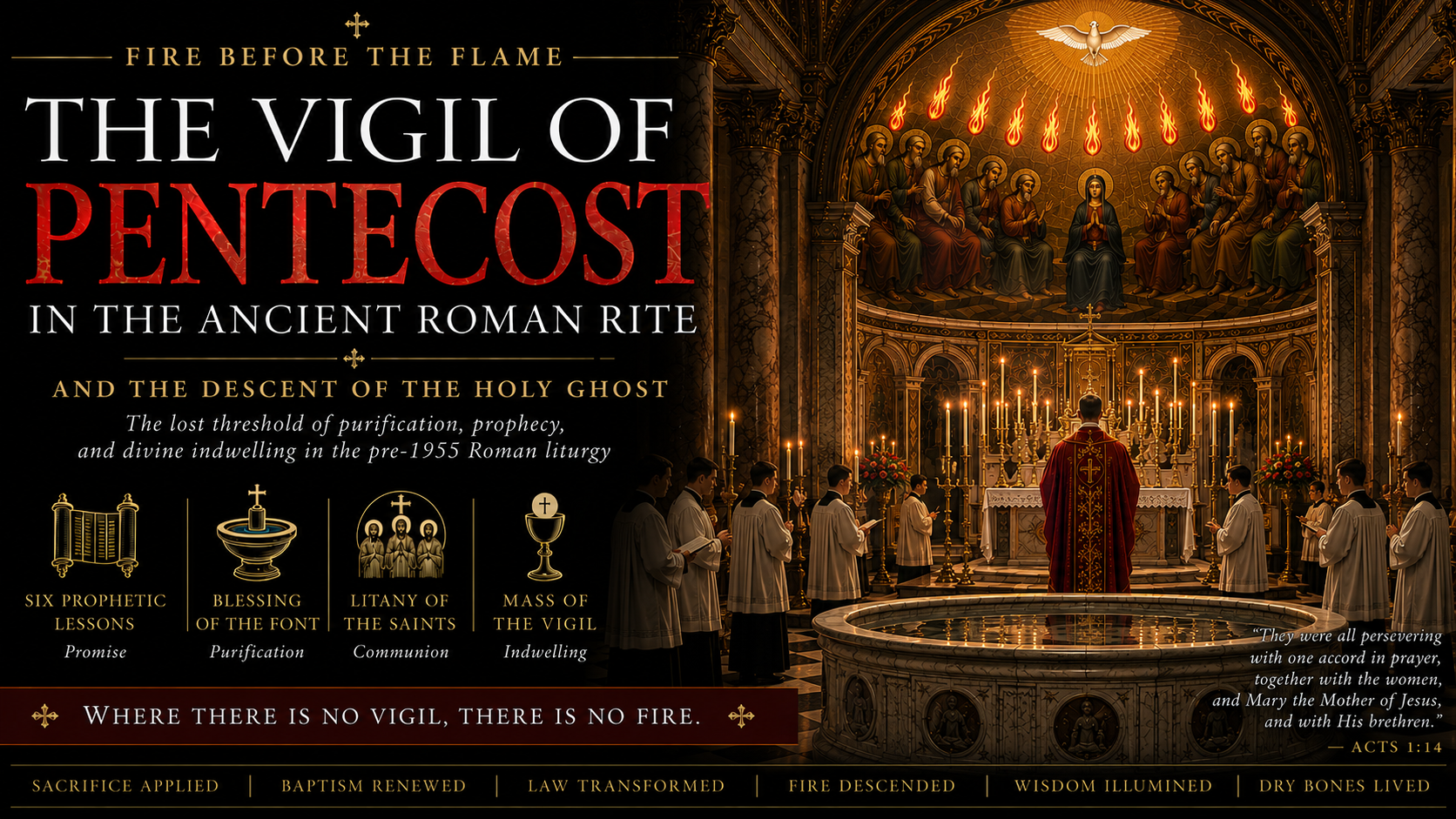
Fire Before the Flame: The Vigil of Pentecost in the Ancient Roman Rite and the Descent of the Holy Ghost
The lost threshold of purification, prophecy, and divine indwelling in the pre-1955 Roman liturgy

The Roman Rite, in its ancient and organic integrity, does not permit the soul to rush into the mysteries of God. It forms by delay, deepens by silence, and prepares by vigil. Before divine fire, there is waiting; before illumination, purification; before mission, recollection. Thus the Church, wise in her pedagogy, placed vigils before her greatest solemnities—not as decorative preliminaries, but as theological necessities. Among these, the Vigil of Pentecost once stood as one of the most profound: a liturgical Cenacle in which the Church, gathered in silence with the Apostles and the Blessed Virgin, awaited once more the descent of the Holy Ghost.¹
This instinct belongs not merely to liturgical tradition, but to the very structure of divine revelation. God prepares before He gives, empties before He fills, wounds before He heals. The rhythm of salvation history is marked by delay and fulfilment: Abraham waits for the promise; Israel wanders before the Land; the prophets cry out before the Word is made flesh; the Virgin conceives in hiddenness; the Apostles tarry in Jerusalem. Pentecost is not interruption but consummation—the moment in which divine preparation yields to divine indwelling.
In the pre-1955 Missale Romanum, this vigil was not a reduced anticipation but a full and solemn rite, consciously mirroring the structure of the Easter Vigil. Six prophetic lessons were proclaimed—Genesis 22, Exodus 14, Deuteronomy 31, Isaiah 4, Baruch 3, and Ezekiel 37—each followed by its collect and tract; then the solemn blessing of the baptismal font; the Litany of the Saints; and the Mass of the vigil.² The station at the Lateran Basilica situated the entire action within the heart of the Church’s visible unity.³ Yet crucially, the Paschal candle was absent. The Resurrection was already accomplished. The Church now stood not before the tomb, but in the Upper Room—between promise and fulfilment.
More precisely still, the ceremonial action of the vigil must be seen as it was enacted. The ministers, vested in penitential simplicity, approach the readings not as proclamation of triumph but as preparation for descent. The faithful listen seated or kneeling, as each prophecy unfolds not merely as narrative but as divine pedagogy. The collects are prayed in a subdued tone; the tracts prolong the meditation. There is no sudden burst of festivity. The liturgy breathes restraint. It stretches the soul.
The liturgy itself articulates this theology. The collect prays: *“Deus, qui hodierna die corda fidelium Sancti Spiritus illustratione docuisti: da nobis in eodem Spiritu recta sapere, et de eius semper consolatione gaudere.”*⁴ The Spirit is invoked not as sensation, but as illumination; not as excitement, but as rectitude; not as novelty, but as abiding consolation in truth. The Roman Rite refuses to reduce Pentecost to experience. It insists upon transformation.
Pentecost is not an isolated feast. It is the consummation of the Paschal mystery. What Christ accomplished in His Passion, manifested in His Resurrection, and enthroned in His Ascension is communicated through the Holy Ghost. As Leo the Great proclaims, “the exaltation of Christ is our elevation,”⁵ yet this elevation is effected interiorly through the Spirit. “What was visible in our Redeemer has passed into the sacraments,”⁶ and through those sacraments—above all Baptism and Confirmation—the Spirit renders divine life present within the soul. Pentecost is therefore not merely commemorative; it is ontological.
Indeed, the Fathers insist upon this interior transformation with striking force. Augustine of Hippo, preaching on Pentecost, declares: “That which the law commanded, grace now accomplishes; for the Spirit is given that what was written on stone may be written in the heart.”⁷ And again, in his exposition of Pentecost: “At Babel tongues were divided; at Pentecost tongues were united—division came from pride, unity from charity.”⁸ Pentecost is therefore not spectacle, but restoration: the healing of division, the reconstitution of unity through divine love.
The vigil expresses this sacramentally. It is, in truth, a second baptismal vigil. From the earliest centuries, Pentecost was a privileged time for the conferral of Baptism, especially in the Roman Church as witnessed in the ancient sacramentaries.⁹ The blessing of the font, placed at the centre of the rite, invokes the Spirit who “moved over the waters” in the beginning,¹⁰ linking creation, redemption, and sanctification in a single divine act. Man is not merely instructed; he is re-created.
The six prophecies unfold this mystery with theological precision and cumulative force.
The sacrifice of Isaac (Genesis 22) establishes the principle: Pentecost flows from sacrifice. Abraham ascending with the beloved son prefigures the Father offering Christ. Augustine of Hippo writes: “The Holy Spirit is the communion of the Father and the Son, their consubstantial love.”¹¹ The Spirit is given because love has been consummated in sacrifice. Pentecost is not sentiment. It is sacrifice applied.
The crossing of the Red Sea (Exodus 14) reveals Baptism. “All were baptized unto Moses in the cloud and in the sea.”¹² John Chrysostom declares: “The sea was a type of the font, and the cloud a type of the Spirit; the one delivered from death, the other led to truth.”¹³ The Spirit both liberates and guides; He both illumines and governs.
The giving of the Law (Deuteronomy 31) prepares its transformation. Sinai commands; Pentecost empowers. “I will write My law in their hearts.”¹⁴ Thomas Aquinas teaches that the New Law is “principally the grace of the Holy Ghost.”¹⁵ Here scholastic precision must be pressed further: the Holy Ghost is the Donum increatum, the uncreated Gift, given to the soul in sanctifying grace.¹⁶ God is present in all things by essence, presence, and power; yet in the just He dwells in a new mode—by grace, as in a temple.¹⁷ This indwelling is appropriated to the Spirit, who proceeds as Love and Gift. Pentecost is therefore not divine proximity, but divine inhabitation.
Isaiah (Isaiah 4) strips away illusion: the Spirit is fire. “By the spirit of burning.” He purifies before He consoles. John of the Cross writes with unflinching clarity: “The soul is purged and transformed in this divine fire until it appears to be fire itself.”¹⁸ Pentecost is not comfort. It is transformation.
Baruch (Baruch 3) reveals illumination. Divine wisdom descends. Bonaventure teaches that in this illumination “the soul passes from knowledge to taste, from understanding to savour.”¹⁹ The Spirit gives a knowledge that is not external but interior, not speculative but participatory.
Ezekiel (Ezekiel 37) reveals resurrection. Dry bones live. Gregory the Great teaches that the Spirit forms the soul through His sevenfold gifts, perfecting it for divine life,²⁰ and Leo XIII affirms: “The Holy Ghost is the principle of all vital and salutary action in each part of the Body of Christ.”²¹ Where He breathes, there is life.
After the prophecies, the rite becomes immediate and sacramental. The Church rises and processes to the font. The chant deepens. The prayers are sung over the waters with solemn insistence. The Litany of the Saints is intoned, invoking the whole communion of the Church—militant, suffering, triumphant. The faithful kneel. Heaven is summoned. The Church waits.
This waiting is not emptiness. It is tension. It is readiness. It is the silence of the Cenacle—the interior stillness in which divine fire descends.
Then the Mass begins.
The Epistle asks: “Have you received the Holy Ghost?”²² The question pierces every age. One may be baptised and yet untransformed, confirmed and yet inert. Confirmation itself is Pentecost sacramentally extended—the strengthening of the soul for witness, the sealing of grace for mission.²³
The Gospel answers: “I will not leave you orphans.”²⁴ Cyril of Alexandria teaches: “By the Spirit we are united to Christ and made partakers of the divine nature; for He dwells in us as in His own temple.”²⁵ Pentecost is not imitation. It is participation.
Here the mystical dimension must be pressed to its full conclusion. The soul becomes a Cenacle. Not metaphorically, but truly. The Blessed Virgin Mary, present at Pentecost, is the archetype of perfect receptivity. She is rightly called Spouse of the Holy Ghost, for in her there is no resistance, no impurity, no division. Ambrose of Milan writes: “Where the Spirit is, there is unity; where there is unity, there is purity; and where there is purity, there God dwells.”²⁶
Thus the entire spiritual life may be read as the unfolding of Pentecost within the soul: purification from sin, illumination by grace, union with God. The vigil prepares this; Pentecost begins it; sanctity consummates it.
Historically, the reduction of this vigil in 1955 represents not merely a liturgical simplification, but a theological contraction. The ancient witness of the Gelasian and Gregorian sacramentaries, with their baptismal emphasis and prophetic structure, gave way to a more abbreviated form.²⁷ The pedagogy of waiting was diminished; the architecture of preparation weakened. The Church, in practice, ceased to linger in the Cenacle.
And this loss is not merely ritual. It is spiritual.
For the modern age seeks fire without sacrifice, illumination without purification, mission without contemplation. It desires Pentecost without vigil.
Yet the liturgy teaches otherwise.
The Apostles did not produce the Spirit.
They waited.
They did not organise renewal.
They prayed.
They did not ignite the fire.
They received it.
The Vigil of Pentecost therefore stands as both memory and summons. It calls the Church back to the Cenacle—to silence, to purity, to sacramental life, to expectant waiting.
For the law of Pentecost is the law of the spiritual life:
Where there is no vigil, there is no fire.
- Josef A. Jungmann, The Mass of the Roman Rite, vol. 2 (Westminster, MD: Christian Classics, 1986), 395–401.
- Missale Romanum (Rome: Typis Polyglottis Vaticanis, 1952), Sabbato in Vigilia Pentecostes.
- Pius Parsch, The Church’s Year of Grace, vol. 3 (Collegeville, MN: Liturgical Press, 1964), 150–52.
- Missale Romanum (1952), Collect for Pentecost.
- Leo the Great, Sermon 73, NPNF.
- Ibid.
- Augustine of Hippo, Sermon 272.
- Augustine of Hippo, Sermon 271.
- Louis Bouyer, Liturgical Piety (1955), 158–60.
- Gen. 1:2.
- Augustine of Hippo, De Trinitate, XV.17.
- 1 Cor. 10:2.
- John Chrysostom, Homilies on Exodus.
- Jer. 31:33.
- Thomas Aquinas, Summa Theologiae, I–II, q. 106.
- St Thomas Aquinas, Summa Theologiae, I, q. 38.
- Ibid., I, q. 43.
- John of the Cross, Living Flame of Love.
- Bonaventure, Itinerarium Mentis in Deum.
- Gregory the Great, Homiliae in Evangelia.
- Leo XIII, Divinum Illud Munus.
- Acts 19:2.
- Catechism of the Council of Trent, Confirmation.
- John 14:18.
- Cyril of Alexandria, Commentary on John.
- Ambrose of Milan, De Spiritu Sancto.
- Fortescue, O’Connell, Reid, Ceremonies of the Roman Rite, 299–300.
related articles


Latest articles
- STABAT MATER DOLOROSA: The Seven Sorrows of the Blessed Virgin MaryThe traditional feast of the Seven Sorrows on 15 September contemplates Mary’s spiritual martyrdom from Simeon’s prophecy to the Burial of Christ. Distinct in origin from the Passion Friday feast of the Compassion, the September observance came especially through the Servite tradition and was extended to the Latin Church by Pius VII before being raised in rank and fixed to 15 September under St Pius X. Its Mass, Stabant juxta Crucem, presents Mary’s sorrow not as sentimental grief but as perfect faith, charity and conformity to Divine Providence, wholly dependent upon and ordered to the unique redemptive Sacrifice of Christ.
- THE FLAG THEY NEVER EXPLAINEDThe transgender pride flag has become ordinary institutional iconography, but the civic account of its origins is highly abbreviated. Its creator, Monica Helms, is male and began living as a woman in 1997. Helms’s autobiography describes sexual excitement associated with presenting himself as female, closely corresponding to what sexologist Ray Blanchard termed autogynephilia, alongside stolen women’s underwear, adult-video work, sex clubs and sexually themed fiction. The flag’s blue and pink also have separate documented uses as sex-coded colours within paedophile symbolism and child-sex markets, although there is no evidence of any connection with Helms’s design. More significant is the flag’s institutional history. It became embedded throughout public life during the same period in which gender-identity assumptions entered law, medicine, schools and safeguarding practice. The Supreme Court, revised RSHE guidance, KCSIE 2026 and the WellBN investigation now reveal a substantial correction towards biological reality, parental involvement, evidence and professional curiosity.
- NSPCC: THE SAFEGUARD THEY REMOVEDThe NSPCC has removed from its new schools guidance the previous recommendation that, where possible, children changing clothes should be supervised by adults of the same sex. Yet in the same month NSPCC Sport retained precisely that principle, while the 2026 statutory safeguarding framework strengthened sex-based protections for school changing rooms. The issue is not suspicion of teachers but why an elementary safeguard protecting children’s privacy, dignity and staff themselves has quietly disappeared.
- PEACE WITHOUT THE KING, UNITY WITHOUT THE CHURCHThe CCEE–CEC meeting in Germany marks the active reception of the revised Charta Oecumenica, whose programme reaches from common prayer and evangelisation to movement towards Eucharistic fellowship. Read beside Pius XI’s Quas Primas and Mortalium Animos, and against the clarifications of Unitatis Redintegratio, Dominus Iesus, Ecclesia de Eucharistia and Apostolicae Curae, the issue is not whether Catholics may cooperate with other Christians. It is whether an ecumenical culture of convergence is beginning to obscure the Social Kingship of Christ, the Catholic missionary claim and the already-existing visible unity of His Church.
- DEFEATED — BUT NOT SETTLEDThe Commons has voted against assisted suicide in England and Wales, with scrutiny revealing concerns over vulnerability, prognoses, and palliative care. Shifted positions among some MPs and the absence of others led to the defeat. The debate underlines the challenges of translating public support into effective legislation amid complex ethical considerations.



Leave a Reply