
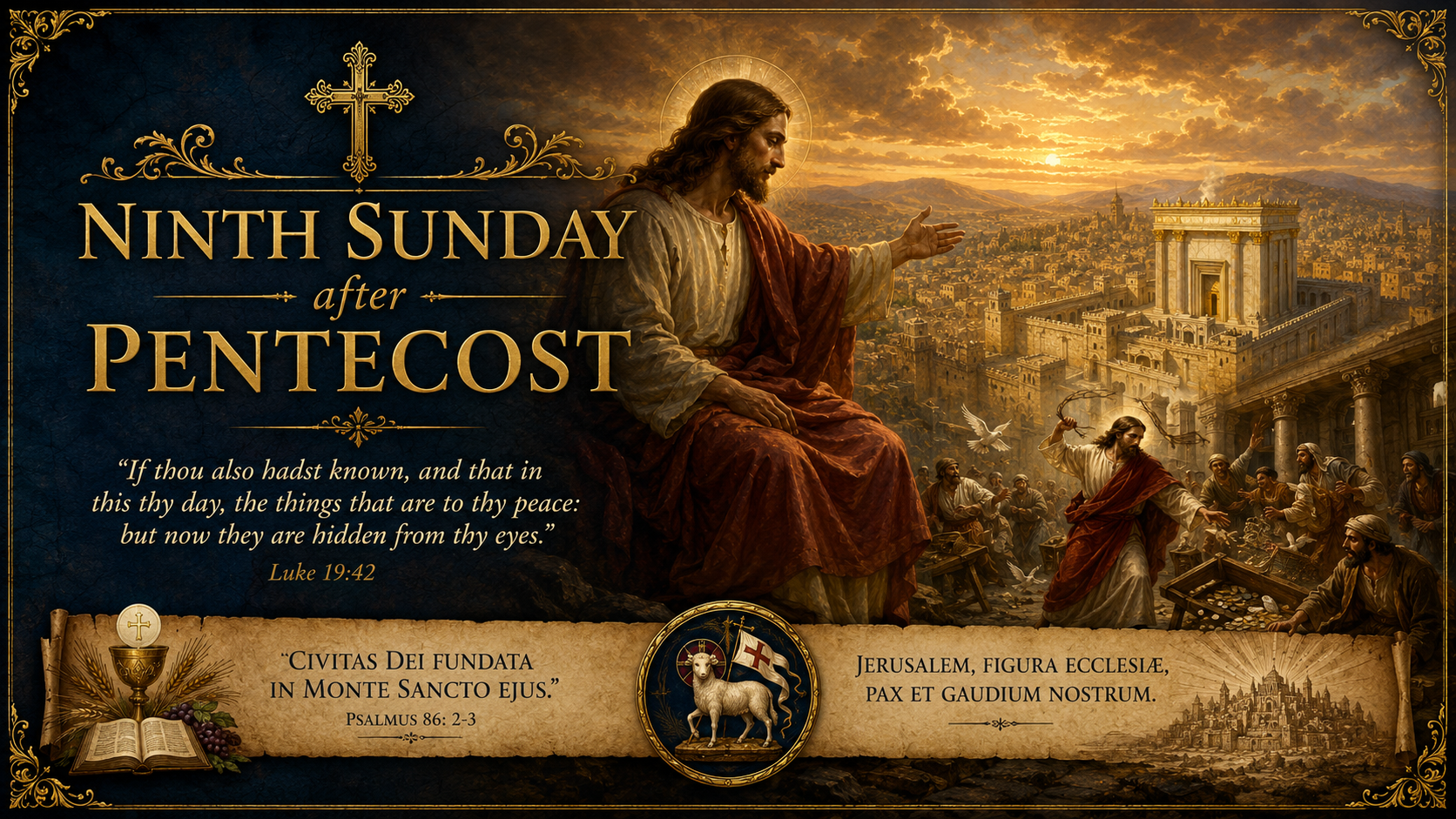
Christ Weeps over the Holy City: The Ninth Sunday after Pentecost
In the Mass of the Ninth Sunday after Pentecost, the Roman Church sets before her children the privileges and ruin of Israel, the tears of Christ over Jerusalem, the cleansing of the Temple and the promise of Eucharistic union. Patristic, scholastic, exegetical, mystical and liturgical tradition reads these texts as a warning against presumption, but also as a revelation of the divine mercy which visits, warns and purifies before judgement falls.

From the western slope of the Mount of Olives, Jerusalem presents itself almost at once. The road descends towards the Kidron Valley and rises again towards the Temple Mount. In the spring sunlight of the first century, the Temple complex, enlarged and adorned under Herod, would have dominated the view. Pilgrims approaching for the Pasch might reasonably have felt wonder, national pride and religious consolation. Our Lord saw the same city and wept.
St Luke records no general expression of sadness. Christ’s lament is precise. Jerusalem has failed to recognise what belongs to its peace. The city’s enemies will surround it, press it on every side, cast it and its children to the ground, and leave not a stone upon a stone, “because thou hast not known the time of thy visitation”. He then enters the Temple and casts out those who are buying and selling, declaring: “My house is the house of prayer. But you have made it a den of thieves.”
The Roman Church appoints this passage for the Ninth Sunday after Pentecost and joins it to St Paul’s warning to the Corinthians concerning the Israelites who perished in the wilderness. Both readings address a people already privileged by God. Israel had passed through the sea, eaten spiritual food and drunk from the spiritual rock; Jerusalem possessed the Temple, the Scriptures, the sacrifices and the promises. Neither sacramental signs nor ecclesial privileges protected those who received grace but resisted its purpose.
The Mass is therefore concerned with the fearful possibility of grace received without corresponding fidelity. Its argument is not that divine gifts are unreal, nor that membership of God’s people is inconsequential. The warning has force precisely because those gifts are real. God visits, teaches, feeds and sanctifies; man remains capable of refusing Him.
The Sunday of the lamentation over Jerusalem
Dom Prosper Guéranger notes that the lamentation over Jerusalem gave this Sunday its distinctive character in the Western liturgical tradition. He relates its observance to the Church’s remembrance of the approaching fulfilment of Christ’s prophecy against the city. The Gospel commonly falls during the summer months, near the period in which Jewish mourning commemorated the destruction of the Temple. Guéranger sees the Christian liturgy looking beyond the political catastrophe to Jerusalem’s refusal of the Messias and to the consequences of rejecting a divine visitation.¹
The historical destruction was neither imaginary nor merely symbolic. In AD 70, after a prolonged siege, the forces of Titus captured Jerusalem and destroyed the Second Temple. Yet the liturgy is not conducting a lesson in Roman military history. It presents the event in the light given by Christ before it occurred. Jerusalem’s overthrow is a judgement because the city did not recognise “the time of its visitation”.
That phrase governs the Sunday. A divine visitation is an approach of God in which grace demands recognition and response. It may come through prophecy, preaching, sacrament, correction, suffering or an interior movement of conscience. The visitation is merciful because God approaches before punishment; it is judicial because the response discloses the disposition of the heart.
The Church herself lives beneath such visitations. She is indefectible because Christ is faithful to His promises, but particular churches, institutions, communities and persons may decline or perish through infidelity. History supplies ample evidence. The disappearance of once-flourishing Christian peoples does not prove a failure in Christ’s promise to His Church. It proves that inherited privilege cannot excuse the refusal of present grace.
The collect of the Mass directs the faithful away from self-chosen remedies:
Let the ears of Thy mercy, O Lord, be open to the prayers of Thy suppliants: and that Thou mayest grant to Thy petitioners the things they desire, make them ask those things which are pleasing to Thee.
This is already a purification of Jerusalem within the soul. Fallen man does not merely lack the things he desires; his desires themselves require correction. He may ask for health without sanctification, peace without justice, success without obedience, deliverance from consequences without deliverance from sin. The Church does not ask God simply to endorse the petitions which arise spontaneously from disordered affections. She asks Him to teach His people what they ought to desire.
St Thomas Aquinas explains that prayer is rightly ordered when it seeks those things which may be referred to beatitude and to the glory of God. Temporal goods may properly be requested, but only in so far as they assist salvation or at least do not obstruct it. The collect therefore belongs exactly with the Gospel. Jerusalem desired peace, but would not accept the order established by the Prince of Peace. It desired preservation while resisting the visitation through which alone preservation could have been found.
“These things were done in a figure of us”
The Epistle is taken from the tenth chapter of the First Epistle to the Corinthians. St Paul has already reminded his readers that the Israelites were “all under the cloud”, that all passed through the sea, and that all ate and drank of the spiritual food and drink which prefigured the Christian sacraments. Nevertheless, “with most of them God was not well pleased: for they were overthrown in the desert”.
The lesson appointed by the Missal begins with the Apostle’s conclusion: “These things were done in a figure of us, that we should not covet evil things as they also coveted.”
The Greek word rendered as “figure” is typos. The events of Israel’s exodus were genuine historical events, but divine Providence gave them a further representative meaning. The passing through the sea prefigured baptism; the manna and water from the rock prefigured supernatural nourishment; Israel’s pilgrimage anticipated the Church’s journey through this life. The punishments also possess a typical significance. A people sacramentally delivered may still return in heart to Egypt.
St John Chrysostom insists that St Paul is correcting sacramental presumption among the Corinthians. Baptism and Eucharistic participation do not make grave sin harmless. The Apostle mentions Israel’s privileges because the Corinthians themselves possessed greater mysteries and were in danger of assuming that sacramental incorporation rendered vigilance unnecessary. Chrysostom does not diminish the sacraments. He rebukes those who would receive them while living in a manner contrary to their grace.²
Cornelius à Lapide develops the same point. The Israelites had received what may be called sacraments in figure, yet many fell through lust, idolatry, fornication, tempting God and murmuring. The Christian, who has received not shadows but the sacraments instituted by Christ, has less excuse for negligence. Greater gifts impose greater responsibility.³
The Epistle specifies several forms of infidelity. Israel desired evil things; some became idolaters; others committed fornication; some tempted Christ; others murmured. These are not randomly selected sins. Together they display the progressive disorder of a people no longer content to be governed by God. Covetous desire turns the heart towards a false good. Idolatry gives that false good the place belonging to God. Impurity subjects reason to appetite. Tempting God demands that Providence justify itself before the creature. Murmuring turns dissatisfaction into a habitual judgement against divine government.
St Paul’s warning reaches its most memorable expression: “Wherefore he that thinketh himself to stand, let him take heed lest he fall.”
The Apostle does not say that the man who stands must deny the grace by which he stands. Nor does he recommend anxious uncertainty concerning God’s power. The danger lies in thinking oneself secure through one’s own condition, status or past fidelity. Spiritual presumption mistakes a present gift for an indefectible personal possession.
St Thomas distinguishes hope from presumption with characteristic precision. Hope relies upon divine assistance while striving towards the difficult good of eternal beatitude. Presumption expects that good in a disordered manner: either because a man imagines he can attain it by his own powers, or because he expects divine forgiveness and glory without repentance and merit. Hope honours God’s mercy; presumption abuses it.⁴
This distinction is indispensable. A Catholic may speak confidently of God’s mercy while quietly assuming that no serious change in his own life will be required. He may imagine that orthodoxy, sacramental access, ecclesiastical office, religious profession or attachment to tradition makes apostasy of conduct impossible. St Paul addresses precisely such confidence. “He that thinketh himself to stand” is endangered not by the weakness of grace but by an inaccurate estimate of himself.
The Epistle nevertheless ends with consolation: “God is faithful, who will not suffer you to be tempted above that which you are able: but will make also with temptation issue, that you may be able to bear it.”
The emphasis remains upon God’s fidelity. The Christian cannot claim that temptation compelled his sin. Divine Providence limits temptation and supplies sufficient grace. Yet the “issue” or means of escape must be accepted. Grace does not render the will passive. Prayer must be made, occasions avoided, counsel followed, confession sought, and the first movements of temptation resisted before consent hardens into habit.
The city which possessed everything but recognised nothing
The Gospel begins: “And when He drew near, seeing the city, He wept over it.”
The Fathers regarded the tears of Christ with particular reverence. The eternal Word does not assume a theatrical humanity. He possesses a true human intellect, will and affections. His sorrow is neither involuntary emotional disorder nor ignorance of the divine plan. It is the ordered grief of perfect charity in the presence of the ruin freely chosen by those whom He came to save.
St Cyril of Alexandria interprets the tears as evidence of the tenderness of Christ towards Jerusalem. He knew the punishment that would follow the city’s unbelief, and He mourned those who would endure it. The divine sentence does not proceed from cruelty. The Judge grieves over the sinner whose obstinacy has made judgement inevitable.⁵
The Venerable Bede sees in Christ’s weeping both the historical ruin of Jerusalem and a perpetual warning to the soul. The Lord weeps when a person, after receiving knowledge of the truth, turns from the path of salvation and becomes unable or unwilling to recognise the peace once offered. The tears reveal that the loss is not trivial. God has created and redeemed the soul for union with Himself.
Origen moves readily from the city to the interior life. Jerusalem signifies the soul which has possessed peace but is now threatened by hostile powers. When vigilance fails and grace is resisted, the enemies form a circle around it. The virtues which once constituted its order are torn down, and the thoughts born within it are brought into captivity. St Thomas preserves this interpretation in the Catena Aurea.⁶
Cornelius à Lapide gathers several reasons assigned by Catholic tradition for the tears of Christ. He wept over the blindness and ingratitude of Jerusalem; over the temporal ruin about to befall it; over the eternal loss of those who would die impenitent; and over the failure, through their own resistance, of the graces offered to them.⁷
None of these meanings contradicts the others. The historical, moral and mystical senses arise from the same reality. Jerusalem is a city; it is also the chosen city. Its stones, worship and institutions embody a divine vocation. The city’s destruction therefore becomes an image of what sin does wherever a creature consecrated to God refuses the end of its consecration.
Our Lord’s words are tender but not vague:
If thou also hadst known, and that in this thy day, the things that are to thy peace: but now they are hidden from thy eyes.
“This thy day” signifies an opportunity actually given. Jerusalem’s tragedy is not that God withheld knowledge which the city could never possess. The day had come. The Messias had preached in its streets, taught in its Temple, confirmed His mission by miracles and entered amid public acclamation. The city failed to know because it did not will to receive the form in which peace was offered.
St Augustine defines peace as the tranquillity of order. Peace cannot therefore be separated from truth, justice and right subordination. The peace of the soul consists in the ordering of its faculties under God; civic peace requires a just ordering of persons and goods; the peace of the heavenly city is perfect concord in the enjoyment of God.⁸
Jerusalem desired a peace largely conceived in temporal and national terms. Many expected liberation from Roman rule. Christ offered something more fundamental: reconciliation with God, deliverance from sin, and a kingdom entered by repentance and faith. Because the city refused the order of divine peace, its pursuit of political security contributed to the violence which destroyed it.
The same temptation recurs in religious life. Men wish Christianity to stabilise society, console the bereaved, legitimise institutions, support culture and reassure the conscience. These are not all illegitimate effects. They become corrupt when severed from the conversion, doctrine, worship and moral order which Christ establishes. A nation cannot retain Christian peace while repudiating Christ’s kingship; a parish cannot possess spiritual vitality while treating the altar as a cultural ornament; a soul cannot enjoy peace while reserving a portion of itself against God.
“Now they are hidden from thy eyes”
Christ’s lament changes from the condition Jerusalem has refused to the blindness that follows refusal: “but now they are hidden from thy eyes.”
This should not be understood as though God arbitrarily punished one moment of hesitation by making all repentance impossible. Scripture describes a gradual judicial blindness. Light repeatedly refused ceases to be welcomed as light. The intellect is not normally deprived of every capacity to know; rather, the will’s attachment to a contrary good distorts judgement. A man learns not to see what would require him to change.
St Thomas teaches that sin can produce ignorance indirectly by disordering the passions and inclining the will against the judgement of reason. Repeated acts form habits, and habits make corresponding choices easier. Vice acquires a kind of connaturality. The sinner may continue to possess abstract knowledge of the moral law while judging his own case through the fog created by attachment.⁹
St John Chrysostom often observes that one sin prepares for another because the sinner must defend his first surrender. Shame may lead to concealment, concealment to falsehood, falsehood to resentment against correction, and resentment to hostility towards the truth itself. What began as an act becomes a position; the position demands an argument; the argument may eventually be treated as a principle.
The mystical authors analyse the same process within the life of prayer. St John of the Cross warns that a deliberate attachment, though apparently small, can impede the soul’s progress when it is knowingly retained against God’s will. The problem is not the material size of the object but the divided will. A thin cord can restrain a bird as effectively as a thick one while it remains unbroken.¹⁰
St Teresa of Avila describes the interior castle as a dwelling of many rooms, with God at its centre. Souls may remain at the outer edge, distracted by creatures and scarcely aware of the splendour for which they were made. Progress requires self-knowledge, prayer and the determination to surrender what obstructs union. The image is illuminating beside the Gospel. Jerusalem possesses the Temple at its centre, yet does not recognise the Lord who enters it.
St Francis de Sales treats the inspirations of grace with greater gentleness of expression but equal seriousness. God attracts without violating liberty. Inspirations invite, awaken and assist; consent remains necessary. A soul should respond promptly and peacefully, because delay often permits contrary affections to recover their influence.¹¹
The “time of visitation” may therefore be missed without any dramatic apostasy. A man postpones confession. He dismisses a correction because of the person who gave it. He recognises a duty but awaits more convenient circumstances. He knows that a friendship, habit or ambition is spiritually destructive but promises himself a later renunciation. Each delay appears temporary. Together they educate the will in refusal.
St Alphonsus Liguori’s preaching on this Sunday is characteristically severe concerning the death of the sinner. His purpose is not to restrict divine mercy but to expose the folly of presuming upon a future conversion. The sinner controls neither the hour of death nor the dispositions with which repeated sin may leave him. To postpone repentance is to assume mastery over time, grace and one’s own future will.¹²
Catholic theology does not teach that every neglected inspiration is the final grace offered to a soul. It does teach that no man possesses a promise of tomorrow. The grace given now is to be used now. Jerusalem’s punishment followed many warnings, yet the long patience of God did not make refusal safe.
The prophecy and the stones of Jerusalem
Our Lord foretells the military form of the city’s destruction:
For the days shall come upon thee: and thy enemies shall cast a trench about thee, and compass thee round, and straiten thee on every side, and beat thee flat to the ground, and thy children who are in thee: and they shall not leave in thee a stone upon a stone.
The prophecy concerns the siege under Titus, but its theological force comes from the causal clause which follows: “because thou hast not known the time of thy visitation”.
Catholic exegesis has never required every material detail of prophetic language to be treated as an exhaustive archaeological description. The Temple was destroyed, the city devastated and its social and religious order overthrown. The warning retains its full force even though stones from ancient structures remained in or beneath the later city. Christ is describing ruin, not issuing a modern surveyor’s report.
The prophecy also recalls earlier biblical judgements upon the Temple. Jeremiah had stood at the gate of the first Temple and warned the people not to trust in the repeated cry, “The temple of the Lord”, while practising injustice and idolatry. The sanctuary would not protect those who used sacred privilege to shelter unrepented sin. God directed them to consider what had happened at Silo. The Temple was a sign of the covenant, not a magical guarantee against its violation.
Ezechiel’s vision is still more terrible. The glory of the Lord departs by stages from the polluted sanctuary and the doomed city. The judgement is preceded by a revelation of the abominations committed in the place consecrated to divine worship. The stones remain for a time after the glory has begun to withdraw.
Malachias, by contrast, foretells the Lord suddenly coming to His Temple. His coming is compared to a refining fire. He purifies the sons of Levi so that sacrifice may again be offered in justice. The Gospel of this Sunday brings these prophetic lines together. The Lord comes to the Temple, but His visitation is simultaneously merciful and purgative. He does not merely admire the building. He claims authority over its purpose.
The destruction of Jerusalem must not be employed as a crude argument against the Jewish people as such. St Paul, in the same Epistle to the Romans in which he grieves over Israel’s unbelief, forbids Gentile Christians to boast against the branches. The root bears them; they do not bear the root. The judgement upon Jerusalem is a warning to the Church, not permission for racial contempt.
Guéranger applies the lesson directly to Christian nations. Jerusalem was punished after refusing Christ; societies evangelised by the Church can likewise lose the blessings associated with Christian civilisation when they repudiate the Faith which formed them. The parallel must be handled carefully. No modern political calamity can be identified confidently as a particular divine punishment without revelation. Yet the general principle remains: a culture cannot systematically reject the natural and divine law without suffering consequences in its institutions, families and common life.
Christ enters the Temple
The Gospel does not end with the lament from the Mount of Olives. Christ enters the Temple and begins to cast out those who buy and sell.
The transition matters. He weeps over the city, then acts against its profanation. Compassion does not leave disorder undisturbed. The tears of Christ are not sentimental acquiescence. Neither is His severity an eruption of uncontrolled anger.
St Thomas teaches that anger may be virtuous when governed by reason and directed against injustice. Christ’s action in the Temple manifests zeal ordered perfectly by charity. He does not act from wounded vanity, private resentment or loss of self-command. He defends the honour of His Father and the sacred purpose of the Temple.¹³
St Augustine remarks elsewhere that the meekness of Christ does not exclude forceful correction. Meekness regulates anger; it does not abolish moral judgement. The Christ who says, “Learn of Me, because I am meek, and humble of heart”, is the same Christ who makes a scourge, overturns tables and denounces hypocrisy.
The Gospel text as appointed by St Luke is concise. The other Evangelists supply further details: the sellers of animals, the money-changers, the doves and the traffic carried through the sacred precincts. Such commerce had an intelligible connection with sacrifice. Pilgrims needed suitable offerings and approved currency. The abuse lay not in the bare existence of exchange but in its invasion and corruption of sacred space, accompanied by avarice and exploitation.
Our Lord combines two prophetic texts: “My house shall be called the house of prayer”, from Isaias, and “you have made it a den of thieves”, from Jeremias. The first identifies the divine intention; the second exposes the human perversion.
A den of thieves is not principally the place where robbery occurs. It is the refuge to which robbers retire. The accusation is therefore sharper than a complaint about noisy commerce. Men have turned religion into shelter from the judgement of God. Sacred observance is being used to provide security without conversion.
The same misuse is possible wherever external Catholicity becomes an alibi for interior disorder. A man may know the rubrics, defend sound doctrine, practise devotions and speak correctly about ecclesiastical crises while remaining unjust to his family, dishonest in business, enslaved to impurity or consumed by hatred. None of those external goods is false. Their use as camouflage is false.
The Lord does not abolish the Temple because it has been profaned. He cleanses it because it belongs to His Father. Catholic reform is therefore neither indifference to abuse nor contempt for the sacred institution in which abuse occurs. Christ’s zeal preserves the divine purpose against those who have obscured it.
This distinction is pertinent whenever scandals arise within the Church. One error defends every existing arrangement in the name of authority. Another turns corruption into an argument against authority, priesthood, sacrament or visible ecclesial order. The Gospel permits neither response. The Temple is holy in its institution and vulnerable in its human administration. Its corruption demands purification, not desacralisation.
The Temple as Christ, Church and soul
Catholic exegesis recognises several related referents in the scriptural image of the Temple.
First, the Temple points to Christ Himself. “Destroy this temple,” He says in St John’s Gospel, “and in three days I will raise it up.” The Evangelist explains that He spoke of the temple of His Body. The material sanctuary finds its fulfilment in the Incarnate Word, in whom God dwells among men not by symbol only but substantially.
Christ is also the true Priest and Victim. The sacrifices of the old Temple prefigure His one oblation upon Calvary. When Jerusalem and its sanctuary are destroyed, sacrifice does not disappear from the world. The perfect Sacrifice has already been offered, and its sacramental representation continues in the Mass.
Secondly, the Temple signifies the Church, the Mystical Body of Christ. St Paul calls Christians the temple of God because the Spirit dwells in them. St Augustine explains that the old Temple was an earthly type of the new people consecrated to God.¹⁴ The Church is not merely an association gathered around shared religious interests. She is a living temple built of stones united to Christ.
Thirdly, each baptised soul is a temple of the Holy Ghost. Sanctifying grace establishes a real participation in the divine life. Mortal sin does not destroy baptismal character, but it expels charity and deprives the soul of that supernatural life by which God dwells within it as in a friend.
The Venerable Bede and other Fathers therefore apply the cleansing of the Temple to the purification of the Christian heart. Christ finds within it buyers and sellers whenever religion is practised for temporal reward. One man serves God for reputation, another for emotional comfort, another because ecclesiastical association supplies influence or identity. The act may remain externally religious while the interior exchange is mercenary.
St Bernard of Clairvaux frequently distinguishes the servile, mercenary and filial movements of the will. The servant acts chiefly from fear of punishment; the hireling seeks his own reward; the son loves the father for the father’s sake. Fear and desire for reward may begin the soul’s return to God, but charity perfects it. The temple is cleansed when God ceases to be treated merely as the means to something else.¹⁵
The mystical life is not a separate enterprise reserved for unusual souls. It is the full development of baptismal grace under the gifts of the Holy Ghost. Garrigou-Lagrange insists upon the unity of the spiritual life: the purgative, illuminative and unitive ways are not three unrelated spiritualities but stages in the maturation of charity. Purification is therefore not an optional severity imposed upon a few. Every soul destined for the vision of God must be freed from all disorder, whether in this life or in purgatory.¹⁶
The cleansing of the Temple displays this purgative action under the figure of divine zeal. Christ overturns what cannot remain. The soul often asks for union with God while resisting the very purification such union entails. It welcomes Christ as consoler but is surprised when He appears as Lord of the house.
Dom Columba Marmion returns constantly to the Christian’s incorporation into Christ. Holiness consists not in constructing a private ideal of perfection but in allowing the life of Christ to be formed in the soul. The Father recognises in the Christian the features of His Son. Anything incompatible with Christ’s dispositions must therefore be surrendered.¹⁷
The question posed by the Gospel is not whether Christ may enter the Temple. It is what He will find when He does.
“My house is the house of prayer”
The Temple’s positive definition is given before its abuse is condemned: “My house is the house of prayer.”
Prayer is not one activity among several equally constitutive uses of sacred space. It expresses the Temple’s purpose: the creature turns towards God in adoration, thanksgiving, expiation and petition. Sacrifice itself is prayer enacted through an offering.
The liturgy of this Sunday embodies all four ends. The Introit invokes God as helper and protector. The collect petitions for rightly ordered desires. The Secret asks that the sacred mysteries may purify and defend. The Canon offers the spotless Victim. Holy Communion unites the faithful to the sacrifice received.
The Church’s buildings exist for the worship of God. They may contain art, music, instruction and communal gathering, but these are ordered towards sacred worship. When a church is treated primarily as a concert venue, political platform, exhibition hall or instrument of institutional messaging, the inversion resembles the disorder condemned in the Gospel. The question is not whether every non-liturgical use is intrinsically forbidden, but whether the house of God remains visibly and practically ordered to prayer.
A similar judgement applies to the liturgy itself. Worship ceases to disclose its true end when it becomes a vehicle for the self-display of ministers, the celebration of the congregation, political instruction or communal experimentation. The sacred rites are not raw material entrusted to each generation for ideological revision. They are received forms by which the Church offers Christ’s worship to the Father.
The Tridentine Rite communicates this ordering with particular clarity. Priest and people face liturgical east; the ancient language is not the ordinary possession of any faction or nationality; silence protects the Canon from theatrical presentation; gesture, chant and hierarchy direct attention beyond the assembly. None of these features produces holiness mechanically. All of them resist the temptation to make the worshipping community its own object.
The Gospel should also prevent traditional Catholics from adopting a merely aesthetic defence of the old rite. The Temple was magnificent. Its beauty did not save those who refused Christ. Attachment to a venerable liturgy is justified because it safeguards and expresses Catholic worship, doctrine and spiritual formation. It becomes spiritually barren when separated from repentance, humility and charity.
A man may love the Roman Mass because it is ancient, dignified and culturally rich while resisting the sacrifice it demands of him. The rite leads to Calvary. Its silence is not an escape from moral conversion; its beauty reveals the order which grace must establish within the soul.
The justices of the Lord and the sweetness of law
The Offertory is taken from Psalm XVIII:
The justices of the Lord are right, rejoicing hearts, and His judgements sweeter than honey and the honeycomb: for Thy servant keepeth them.
This chant answers Jerusalem’s error. The city failed to recognise the things belonging to peace because it would not receive the judgement of God as sweet. Divine law appeared burdensome beside its preferred expectations.
The Psalm does not oppose judgement and joy. God’s ordinances rejoice the heart because they restore the creature to truth. Fallen man experiences commandment as restraint because his appetites pull in contrary directions. Grace does not abolish law; it heals the will so that the good may be loved.
St Thomas teaches that the New Law is principally the grace of the Holy Ghost given through Christ, but it also includes the written and moral precepts which dispose and direct the faithful. Grace makes obedience filial. The Christian is not saved by external observance apart from charity, but neither is charity an inward sentiment liberated from commandments.¹⁸
The Offertory is sung as bread and wine are prepared for sacrifice. The servant who keeps God’s judgements offers more than material gifts. He offers his own will in union with Christ. The sweetness of law is understood most deeply at the altar, where obedience reaches its perfect expression: “Not My will, but Thine be done.”
The Secret asks:
Grant us, we beseech Thee, O Lord, worthily to frequent these mysteries: for as often as the commemoration of this Victim is celebrated, the work of our redemption is carried on.
The Latin phrase, opus nostrae redemptionis exercetur, has great theological density. The Mass does not repeat Calvary or add another sacrifice to it. The one redemptive Sacrifice is sacramentally represented and its fruits applied. The Church’s answer to the ruined Temple is not the abolition of sacrifice but its fulfilment in Christ.
The Eucharistic answer to the ruined city
The Communion antiphon is taken from the sixth chapter of St John:
He that eateth My Flesh and drinketh My Blood, abideth in Me, and I in him, saith the Lord.
The Mass has moved from a city which failed to recognise Christ’s visitation to the most intimate visitation possible before the beatific vision. Christ enters not only the Temple precinct but the communicant. He gives not a sign detached from Himself but His Body, Blood, Soul and Divinity.
The word “abideth” answers the instability of Jerusalem. Its fortifications will fall, its stones be cast down and its children scattered. The soul which remains in Christ possesses a life not dependent upon the permanence of earthly institutions.
Yet the Epistle prevents a facile interpretation. Israel ate spiritual food and still perished through infidelity. The Eucharist is objectively the Body and Blood of Christ; its fruitfulness in the recipient depends upon the absence of a contrary obstacle. Sacrilegious Communion does not unite a man fruitfully to Christ. St Paul warns elsewhere that one who eats and drinks unworthily eats and drinks judgement to himself.
The Church therefore places sacramental union at the culmination of a Mass concerned throughout with conversion. The Eucharist is not a reward for moral perfection, but neither is it a substitute for repentance. It nourishes supernatural life where that life exists; through desire and preparation it draws the faithful towards deeper conformity to Christ.
Marmion speaks of Holy Communion as one of the principal means by which the life of Christ grows within the soul. The communicant receives the Son in whom the Father is well pleased. The proper fruit is not passing emotion but transformation: Christ’s obedience, charity, purity and worship increasingly become the rule of the recipient’s life.¹⁹
The Postcommunion asks that the reception of the heavenly Sacrament may renew both mind and body. The grace of the altar is ordered towards the whole person. Catholic sanctification does not despise the body; it subjects it to the order of charity and prepares it for resurrection.
Jerusalem, the Church and the danger of presumption
The most obvious contemporary application of this Mass concerns the Church herself, but it requires careful distinctions.
The Catholic Church cannot defect from the Faith or cease to be the Church founded by Christ. Her indefectibility rests upon His promise and assistance, not upon the personal holiness or prudence of every officeholder. Yet indefectibility does not mean that every ecclesiastical decision is wise, every pastoral programme fruitful, every institution permanent or every baptised Catholic faithful.
Jerusalem possessed promises, priesthood, sacrifice and Scripture. Its leaders could invoke genuine authority. The judgement pronounced by Christ did not imply that the old covenant had always been false. It revealed that divinely established forms can be administered by men who have ceased to recognise the purpose for which they were given.
The Church must therefore resist two contrary errors. Papal or institutional maximalism treats the human exercise of ecclesiastical authority as though divine assistance guaranteed prudence, clarity and success in every measure. Sectarian reaction treats scandal or error among churchmen as proof that the visible Church and her authority may be discarded. Catholic theology permits neither conclusion.
The tears and zeal of Christ offer the sounder pattern. He does not deny that Jerusalem is the Holy City or that the Temple is His Father’s house. He judges the city precisely according to its vocation. He cleanses the sanctuary rather than treating its profanation as proof that sacred order is unreal.
A faithful Catholic may therefore lament corruption without rejoicing in ecclesiastical ruin. He may resist abuses without despising authority. He may distinguish the indefectibility of the Church from the failure of particular men and policies. He should be especially wary when ecclesiastical prestige, administrative success or outward unity is invoked to prevent examination of whether Christ’s doctrine and worship remain the governing norm.
The tragedy of Jerusalem was intensified by religious confidence. Its inhabitants did not suppose themselves abandoned by God. Many believed their possession of the Temple made catastrophe impossible. Jeremiah had confronted the same illusion centuries earlier.
The modern Church is not exempt from analogous presumption. Empty seminaries, abandoned churches, collapsing sacramental practice, doctrinal confusion and the loss of Catholic moral life cannot indefinitely be explained as unfortunate statistics while programmes demonstrably associated with decline are defended as irreversible movements of the Spirit. Historical causation is complex, and not every local failure has one explanation. Yet a refusal to judge pastoral policies by their conformity to tradition and their actual fruits is not faith. It is institutional self-protection.
Nor may traditional Catholics treat the failures of others as proof of their own security. St Paul’s words apply with particular force to those convinced that they stand. The possession of right doctrine is a grace; it does not make pride, bitterness, impurity or schismatic temper harmless. Jerusalem’s fall should produce fear and compunction before it produces commentary.
The visitation of the individual soul
The liturgy finally presses beyond ecclesiastical analysis. Christ looks upon each soul.
The city has walls, gates, towers, streets and a sanctuary. So does the interior life. Doctrine guards the intellect; discipline protects the senses; prayer orders the day; conscience watches the gates; grace dwells at the centre. Sin seldom destroys the whole city at once. A gate is neglected. An enemy is tolerated because he appears useful. Commerce expands into the sanctuary. Prayer remains, but it must now compete with what the soul refuses to expel.
The progression described by the Mass is recognisable. The Epistle warns against desire before it speaks of idolatry and collapse. The Gospel shows blindness before siege and destruction. Grave spiritual ruin ordinarily has a history.
A person who abandons the Faith may have begun years earlier by ceasing to pray. One enslaved by impurity may first have accepted smaller compromises in imagination and entertainment. Resentment hardens because injuries are rehearsed rather than surrendered. Pride becomes doctrinal in order to avoid appearing merely personal. The soul constructs reasons for retaining what grace has repeatedly identified.
Christ’s visitation may take the form of unease in prayer, the counsel of a confessor, a providential humiliation, a passage of Scripture, illness, bereavement or the example of another’s conversion. Not every emotion or coincidence is a divine message, and private discernment requires prudence. Yet there are moments when a duty becomes morally clear. To postpone it is to risk making the next response more difficult.
The mystical authors do not recommend feverish introspection. Self-examination is ordered towards God, not towards endless occupation with oneself. St Teresa combines determination with confidence; St Francis de Sales counsels peaceful fidelity rather than agitation; St John of the Cross directs the soul beyond sensible consolations towards naked adherence to God.
The cleansing required may be ordinary: a sincere confession, restitution, the ending of an occasion of sin, reconciliation with an enemy, a fixed rule of prayer, greater custody of the eyes, restraint in speech, or the surrender of a private judgement to legitimate authority. Mystical theology begins in the commandments.
The Lord who weeps over the city is not seeking an opportunity to destroy it. He reveals the approaching danger because He wills its salvation. The severity of the warning measures the seriousness of His love.
The tears which precede judgement
The Ninth Sunday after Pentecost does not end in the smoke of Jerusalem. It ends with Christ abiding in the soul through Holy Communion.
The order is essential. The Church does not preach judgement as an isolated terror. She shows the privileges of Israel, the warning of the Apostle, the tears of Christ, the cleansing of the Temple, the sweetness of divine law, the Sacrifice of redemption and the promise of Eucharistic indwelling. Judgement appears within the economy of mercy.
Christ weeps before the city falls. He enters the Temple before its destruction. He teaches daily within it while His enemies seek to destroy Him. Every action reveals patience, but none suggests that time is unlimited.
The Christian response is neither despair nor presumption. Despair treats sin as stronger than mercy. Presumption treats mercy as indifferent to sin. Hope acknowledges both the gravity of the danger and the fidelity of God.
Jerusalem’s fate is not placed before the Church so that Christians may congratulate themselves upon having replaced a condemned people. The Epistle expressly says: “These things were done in a figure of us.” Israel’s history has become Christian admonition. Those who have received the greater fulfilment must not repeat the infidelity of the figure.
The Gospel asks each hearer whether Christ’s presence is recognised while He comes in peace. He comes in the doctrine of His Church, in the absolution of the confessional, in the demands of vocation, in the rebuke of conscience and above all in the Holy Sacrifice. He finds a temple consecrated by baptism, but not necessarily ordered in all things to prayer.
There are tables which only He can overturn, although the soul must consent to their removal. There are attachments which have acquired the appearance of permanent fixtures. There are grievances traded so frequently that the traffic seems part of the building. There are prayers which quietly ask God to preserve precisely what He has come to purify.
The collect supplies the necessary beginning: that God should teach His people to ask for what pleases Him. The Offertory adds delight in His judgements. The Communion gives the final end: abiding in Christ.
Jerusalem failed to recognise the day which belonged to its peace. The Church repeats the Gospel because the present day remains a visitation. Christ still approaches the city. He still weeps over what sin will destroy. He still enters the Temple as its Lord.
The sound of His weeping should not be mistaken for weakness. It is mercy speaking before judgement, and love refusing to call ruin peace.
- Dom Prosper Guéranger, The Liturgical Year: Time after Pentecost, “Ninth Sunday after Pentecost”. Guéranger identifies the lamentation over Jerusalem as the characteristic subject of the Sunday in the Western Church and relates it to the fulfilment of Christ’s prophecy.
- St John Chrysostom, Homilies on the First Epistle to the Corinthians, on 1 Corinthians 10:1–13; see also the collected traditional commentaries listed for the Epistle of this Sunday.
- Cornelius à Lapide, Commentaria in Scripturam Sacram, commentary on 1 Corinthians 10:6–13 and Luke 19:41–48.
- St Thomas Aquinas, Summa Theologiae, II–II, questions 17–22, especially the distinction between hope and presumption.
- St Cyril of Alexandria, commentary on St Luke, fragments preserved in the patristic catena on Luke 19:41–44.
- St Thomas Aquinas, Catena Aurea in Lucam, on Luke 19:41–48, especially the interpretations attributed to Origen, Bede, Gregory and Theophylact.
- Cornelius à Lapide, commentary on Luke 19:41–44, gathering patristic explanations of the tears of Christ over Jerusalem.
- St Augustine, De Civitate Dei, XIX, especially the definition of peace as tranquillitas ordinis; see also his application of Christ’s tears over Jerusalem to Christian imitation.
- St Thomas Aquinas, Summa Theologiae, I–II, on habits, passion, ignorance and the effects of repeated sin upon moral judgement.
- St John of the Cross, The Ascent of Mount Carmel, Book I, on voluntary attachment as an impediment to union with God.
- St Francis de Sales, Treatise on the Love of God, Books II and VIII, on divine inspirations, consent and conformity to the will of God.
- St Alphonsus Maria de Liguori, Sermons for All the Sundays in the Year, Sermon XXXVIII, “Ninth Sunday after Pentecost: On the Death of the Sinner”.
- St Thomas Aquinas, Summa Theologiae, II–II, q. 158, on anger governed by reason and directed by justice.
- St Augustine, De Doctrina Christiana, Book III, on the old Temple as the earthly type of the people consecrated as God’s new temple.
- St Bernard of Clairvaux, On Loving God, on servile, mercenary and filial love.
- Réginald Garrigou-Lagrange OP, The Three Ages of the Interior Life, on the unity of the purgative, illuminative and unitive ways and the universal call to the perfection of charity.
- Blessed Columba Marmion, Christ, the Life of the Soul, on sanctifying grace, divine adoption and conformity to Christ.
- St Thomas Aquinas, Summa Theologiae, I–II, q. 106, on the New Law as principally the grace of the Holy Ghost and secondarily its written precepts.
- Blessed Columba Marmion, Christ in His Mysteries and Christ, the Life of the Soul, on the Eucharistic formation of Christ’s life in the Christian.
- Missale Romanum, Propers of the Ninth Sunday after Pentecost: Introit, Collect, Epistle, Gradual, Gospel, Offertory, Secret, Communion and Postcommunion.
- Ildefonso Schuster, The Sacramentary: Historical and Liturgical Notes on the Roman Missal, on the ancient Roman temporal cycle and the Masses after Pentecost.
- Pius Parsch, The Church’s Year of Grace, on the post-Pentecostal formation of the baptised through the Sunday Masses of the Roman Rite.
related articles


Latest articles
- Today’s Mass: October 26 St Evaristus of RomeSt. Evaristus was the son of a Greek Jew, originally from Bethlehem, and was the sixth Pope of the Catholic Church.
- Today’s homily: Christ the KingThe homily reflects on Christ’s kingship as seen in the Gospel narrative. It contrasts earthly authority with divine truth, emphasising that true allegiance to God requires genuine obedience and transformation. Believers are called to examine their personal commitments and respond to Christ’s demands in everyday life, ultimately recognising their identity as bearers of God’s image.
- Sermon for Christ the KingToday marks the celebration of Christ the King and the Twenty Second Sunday after Pentecost, a feast asserting Christ’s sovereignty against totalitarianism. St. Paul emphasised Christ’s supremacy over power and principalities, challenging early Gnostic beliefs. The early Church’s victory over evil is affirmed in Christ’s resurrection, offering hope and unity amidst contemporary struggles.
- Today’s Mass: October 25 SOVEREIGNTY OF OUR LORD JESUS CHRIST, SUPREME KINGThe Feast of the Sovereignty of Our Lord Jesus Christ celebrates Christ’s dual kingship by birth and conquest. Established by Pius XI, it aims to deepen faith and counter anti-clericalism. The liturgical observance underscores His authority as King, advocating for societal recognition of His reign to bring peace and harmony.
- TRADITION BEHIND THE FENCEThe Vatican’s prohibition of the traditional Ad Petri Sedem pilgrimage to St Peter’s Basilica has sparked controversy, especially among traditional Catholics. While some cite scheduling conflicts, the broader issue lies in the restrictive policies of Traditionis custodes, which may confine traditional liturgical practices to specific enclaves, risking the transmission and recognition of Catholic Tradition within the wider Church.




Leave a Reply