

A Home with Room for Heaven: Preparing for All Saints and All Souls
The coming week takes traditional Catholic families from the Kingship of Christ to the glory of All Saints and the solemn remembrance of the Holy Souls. With a simple daily plan, practical preparations, children’s activities, traditional customs and prayers for use at home, the inaugural edition of The Domestic Church offers a guide to living the Church’s liturgical calendar together.
A Catholic home should have its own liturgical rhythm. The Church’s feasts should influence not only what happens at the altar but what happens around the family table, in children’s activities, in household prayers and in relationships with neighbours. The purpose of The Domestic Church, Nuntiatoria’s new weekly series, is to help traditional Catholics recover these customs and make the Faith a natural, recognisable part of everyday life.
This is not about creating elaborate celebrations or adding unnecessary burdens to already busy households. It is about recovering the habits through which Catholic doctrine becomes lived experience. A child who helps prepare a list of departed relatives for Mass, dresses as a favourite saint, learns to pray for the Holy Souls or shares traditional cakes with neighbours is discovering that the Church’s calendar belongs to the whole family.
The coming week provides a beautiful beginning. Sunday 25 October is the traditional Feast of Christ the King; Sunday 1 November is All Saints; and Monday 2 November is the Commemoration of All the Faithful Departed. These feasts belong together. Christ is the King whom the family serves; the saints are those who already rejoice in His heavenly Kingdom; and the Holy Souls are those for whom the Church on earth continues to intercede. The Church Militant, Triumphant and Suffering are not three unrelated communities but members of Christ’s one Mystical Body.¹
The message of these days is therefore both profoundly theological and wonderfully practical. Families should be preparing names for remembrance at Mass, arranging Requiem intentions, teaching their children about the saints, reviving familiar Catholic customs and preparing to pray for the departed throughout November. Above all, they should remember that the family is itself a school of holiness, where children learn not only what Catholics believe but how Catholics live.
YOUR FAMILY’S PLAN FOR THE WEEK
One principal activity each day, with something children can help to do.
| Day | Family action | Children’s activity |
|---|---|---|
| Sun 25 Oct Christ the King | Attend Mass, renew dedication to Christ and prepare the prayer corner. | Arrange a crucifix, saints’ pictures and flowers. |
| Mon 26 Oct | Write the family’s list of departed relatives and friends. | Make a remembrance card and ask about family ancestors. |
| Tue 27 Oct | Submit Chantry names and request or sponsor a Requiem Mass. | Help prepare names and a Mass offering. |
| Wed 28 Oct Ss Simon & Jude | Choose saints for the coming feast and learn their stories. | Make costumes, saint cards or a picture display. |
| Thu 29 Oct | Invite relatives, friends or neighbours to an All Saints celebration. | Prepare invitations, games and decorations. |
| Fri 30 Oct | Offer Friday abstinence and prayers for the dead; arrange a cemetery visit. | Prepare flowers and learn the Eternal Rest. |
| Sat 31 Oct All Hallows’ Eve | Bake soul cakes, prepare Sunday’s celebration and pray together. | Help bake, finish costumes and prepare treats for neighbours. |
| Sun 1 Nov All Saints | Attend Mass and celebrate the saints with a family feast. | Dress as saints, tell their stories and enjoy the games. |
| Mon 2 Nov All Souls | Attend a Requiem Mass if possible, visit a cemetery and pray for the departed. | Place flowers, read memorial inscriptions and pray. |
The three priorities: Submit the names of the departed, arrange prayer or Mass intentions, and observe All Saints and All Souls. Everything else can be adapted to the time, resources and circumstances of the household.
First, Keep the Daily Catholic Rule of Prayer
Before considering special activities, it is important to remember that the domestic Church is built upon ordinary, consistent prayer. The preparations for All Saints and All Souls should enrich the family’s existing devotional life, not replace it.
Every traditional Catholic household should cultivate the habit of morning and night prayers, the daily Rosary, and the Angelus. These are the spiritual foundations upon which the week’s other activities should rest. The Rosary is especially important. Families should endeavour to pray at least five decades together every day, meditating upon the traditional Joyful, Sorrowful and Glorious Mysteries. Those living alone should maintain the same devotion privately. Parents should teach their children how to pray the Rosary rather than leaving its recitation exclusively to adults.
The Angelus traditionally sanctifies the morning, midday and evening, commonly at six o’clock, noon and six o’clock. Its repeated remembrance of the Incarnation reminds the household that the Word made Flesh is the centre of Christian existence. Morning prayers should include thanksgiving and the offering of the day’s work to God; night prayers should include an examination of conscience, contrition and commendation to divine protection. Prayers to the Guardian Angels are especially suitable for children but no less appropriate for adults.
Grace before and after meals should also be habitual. Even the simplest family meal offers an opportunity to acknowledge God’s providence and teach children that daily necessities are gifts rather than entitlements. A household in which prayer punctuates the ordinary hours will more readily understand the extraordinary solemnities of the Church’s year.
The prayer texts provided later in this article are suitable for recitation by the whole family or by individuals living alone. They may also be printed and kept beside the family crucifix.
Sunday 25 October: Christ the King in the Home
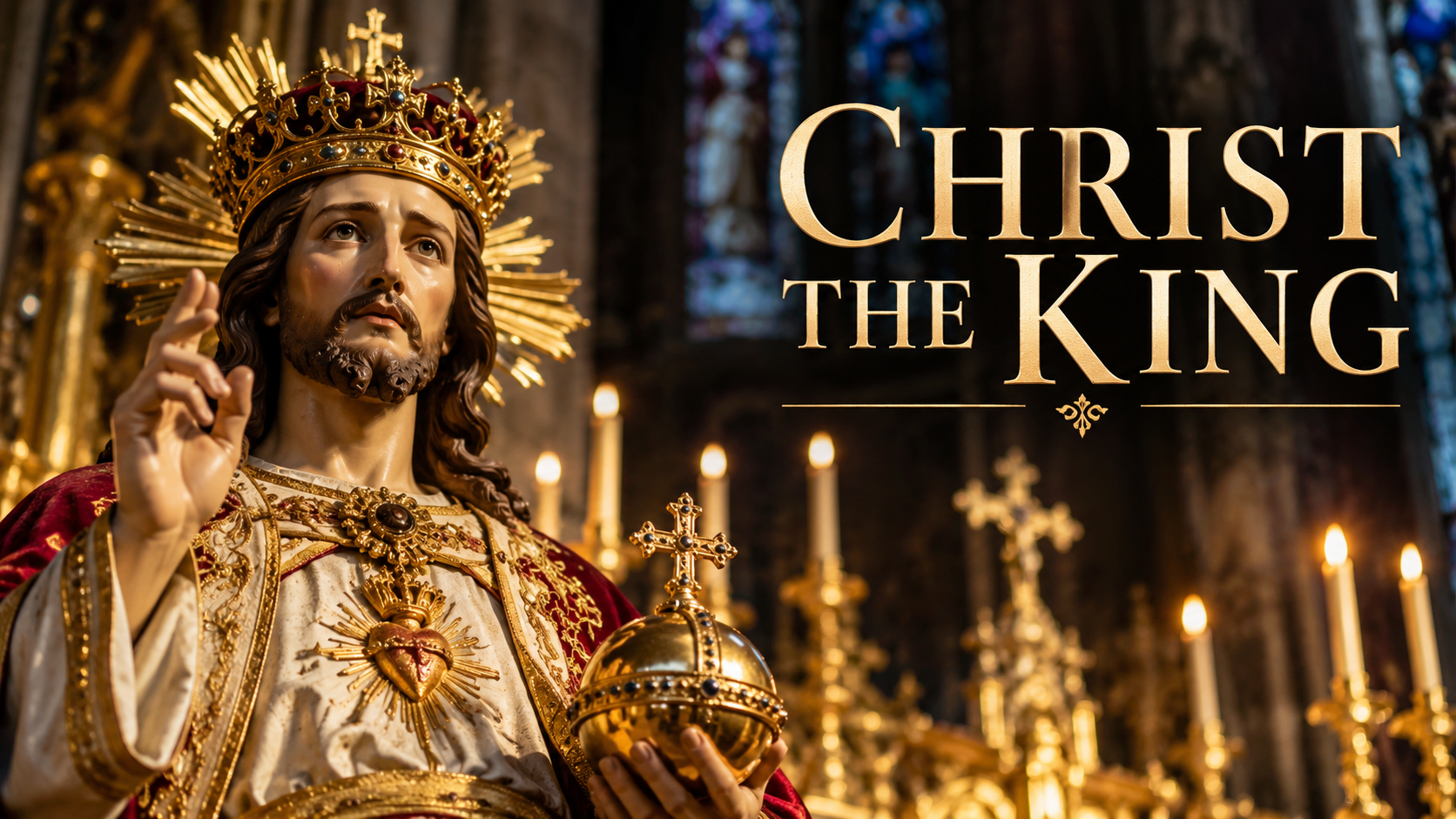
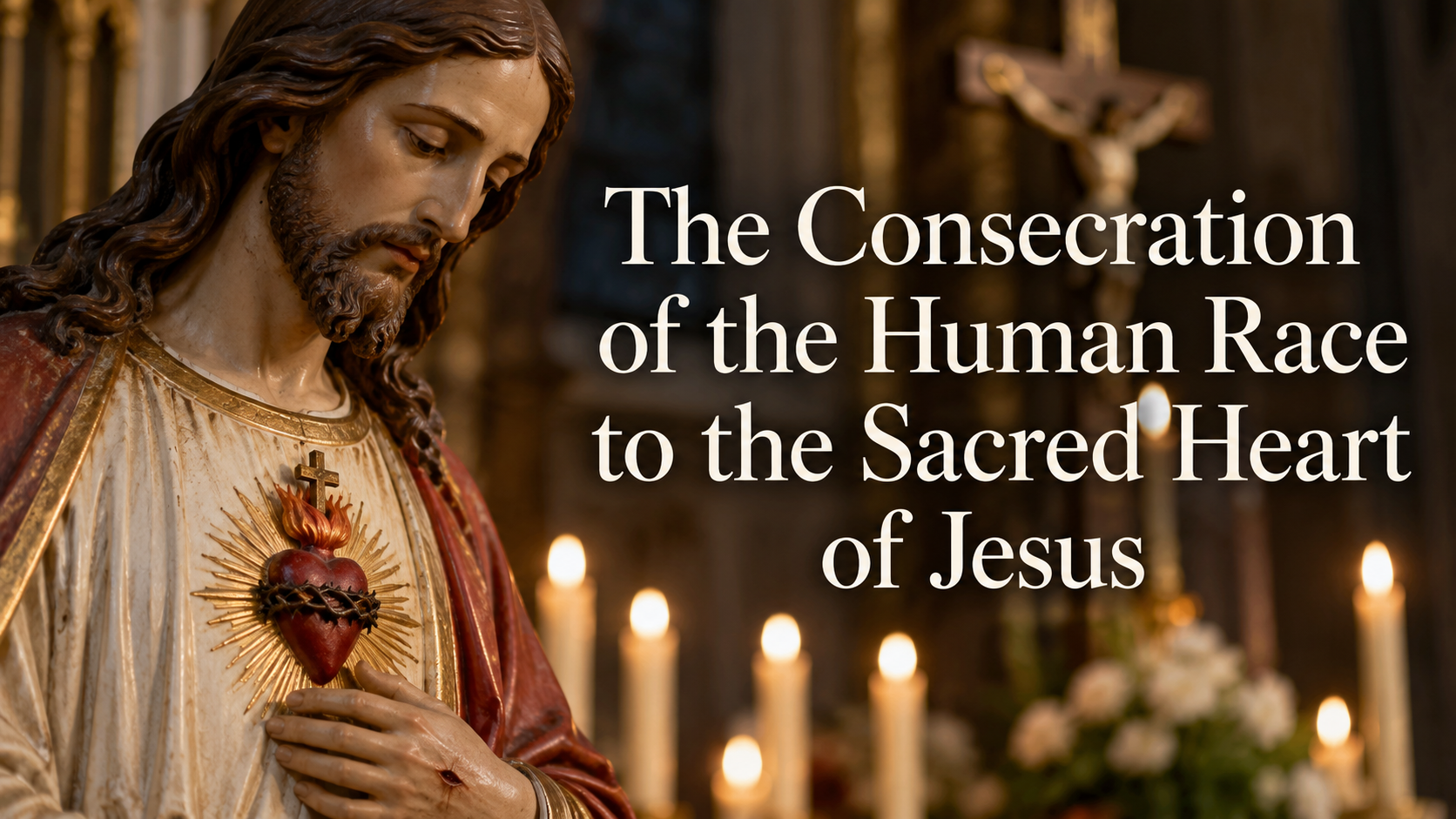
The week begins with Christ the King, whose feast Pope Pius XI deliberately placed on the last Sunday of October, immediately before All Saints. In Quas Primas, he insisted that Christ’s sovereignty must be acknowledged not only by individuals but by families and societies. The Church’s annual consecration of mankind to the Sacred Heart, which he associated with the feast, likewise expresses a kingship that is more than ceremonial.²
After Mass, gather before the family crucifix or an image of the Sacred Heart. Renew any existing family consecration, or recite the short prayer to Christ the King provided below. Where possible, give the home a visible place of prayer, with a crucifix, an image of Our Lady, pictures of patron saints and a small book containing the names of departed relatives. This need not be elaborate. A clean shelf or table, flowers and a candle used safely during prayer are entirely sufficient.
Explain to the children that Jesus is not a king confined to church buildings or religious pictures. He is King of the household, its decisions, its conduct and its relationships. His reign is honoured when family members practise charity, obedience, truthfulness, forgiveness and fidelity to their religious duties. The family Rosary, attendance at Sunday Mass and proper observance of the Lord’s Day are ordinary expressions of that allegiance.
Monday and Tuesday: The Most Important Preparations
The first practical priority is remembering the dead by name. On Monday, gather the names of deceased relatives, friends and benefactors. Consult memorial cards, photographs, family Bibles and older members of the family. Encourage grandparents to tell children about ancestors whom they never knew. The stories need not be sentimental or idealised; the departed were real human beings who struggled, worked, loved and sometimes failed, as everyone does.
Make a Family Book of the Departed, recording names, dates of death and, where known, places of burial. Leave room to add further names over the years. Children might decorate the cover with a cross, the words Requiescant in pace, or an image of Our Lady of Sorrows. This book can remain near the family crucifix throughout November and be brought out each year for All Souls.
On Tuesday, contact the priest, chapel or oratory to submit these names for the November lists or Chantry Book. Do not assume that including a name in a general remembrance list automatically arranges a separate Mass intention. Ask specifically whether a Requiem Mass can be offered for an individual, for several relatives together, or for the Holy Souls generally.
Families should consider sponsoring a Requiem Mass, arranging an annual Mass on the anniversary of a loved one’s death, or offering a Mass intention for those who have nobody to pray for them. The customary offering assists the priest and his ministry; it is not a purchase of the Sacrifice, and those unable to make an offering should never feel excluded from the Church’s prayers.
The Old Roman Apostolate’s Guild of Holy Souls was established to facilitate such remembrance, including the maintenance of Chantry Books recording the departed by the month of their death, regular Requiems and assistance towards traditional Catholic burial. Families attached to Old Roman missions and oratories should enquire about the provisions available locally and consider supporting this charitable work.³
Scripture itself teaches the importance of these suffrages. In 2 Machabees 12:46, prayer for the dead is commended as a holy and wholesome action, offered that the departed may be loosed from sins.⁴ The family’s remembrance book should therefore be understood not simply as an archive of affection but as a record of souls entrusted to its prayers.
Wednesday 28 October: Learning to Love the Saints
The Feast of Saints Simon and Jude provides a natural opportunity for children to choose the saints they wish to celebrate on All Saints’ Day. Each child might learn three things about a chosen saint: where and when the saint lived, what virtue distinguished that life, and what the child can do to imitate it.
Parents might help children prepare simple costumes using materials already in the home. A brown habit suggests St Francis, roses may represent St Thérèse, a key recalls St Peter, a lily St Joseph, and a crown one of the holy kings or queens. These costumes need not be expensive or elaborate. Indeed, making them together is part of the activity.
A particularly enjoyable game is Guess the Saint. Place a picture or symbol of a saint on each child’s back, allowing the child to ask questions until the saint is identified. Alternatively, hide saint cards around the house and organise a treasure hunt in which every discovery prompts a short account of that saint’s life. Older children can prepare a short presentation about a favourite saint, while younger ones can colour pictures or make bookmarks bearing a saint’s name.
The object is not merely amusement. Children should come to recognise sanctity as admirable and attainable through grace. The saints were people of flesh and blood, many with families, responsibilities, fears and hardships much like our own.
Thursday 29 October: Prepare an All Saints Celebration
All Saints should be a feast of genuine happiness. Thursday is a good day to invite relatives, another Catholic family or some neighbours to join the household for Sunday lunch, tea or a modest afternoon gathering.
The children can prepare invitations and decorations, while adults plan a festive meal. White and gold decorations, flowers, saints’ pictures and a special cake can all suggest the joy of heaven. Guests might be invited to come dressed as a saint or bring a picture of one whose life they particularly admire.
This is also an opportunity for Christian witness. Non-Catholic neighbours and children’s friends need not be excluded. They can be welcomed generously and introduced naturally to the meaning of the feast. In this way the household becomes an expression of the Church’s missionary life without making hospitality conditional upon religious participation.
Friday 30 October: Offer Something for the Holy Souls
Friday’s traditional abstinence can be offered for the Holy Souls, together with the small inconveniences, duties and sacrifices of ordinary life. Parents can explain to children that prayer and penance are acts of charity which may be offered for the departed.
Pray the De profundis, Psalm 129 in the Douay-Rheims and Vulgate numbering, or offer a decade of the Rosary specifically for the dead. The family might also perform a work of charity in memory of someone who has died, such as helping an elderly neighbour, visiting someone lonely, or making a donation to those in need.
Arrange Monday’s cemetery visit in advance. Obtain flowers, check the location of family graves and determine whether assistance is needed for elderly relatives. Where family burial places are too distant, visit a local cemetery and pray for all those buried there, especially the forgotten.
Saturday 31 October: All Hallows’ Eve
The Vigil of All Saints, or All Hallows’ Eve, was traditionally a day of preparation and penance before the joy of the following feast. Families may recover that character through prayer and voluntary acts of penance, while preparing food, decorations and activities for Sunday.
One attractive custom is the baking of soul cakes, small spiced cakes associated with the old English practice of souling, in which food, almsgiving and remembrance of the dead were connected. English Heritage has documented the custom and published a traditional-style recipe.⁵
A Simple Family Soul-Cake Recipe
Makes approximately 15 small cakes
Ingredients: 200g plain flour, 90g butter, 75g caster sugar, 60g currants, one egg, one teaspoon mixed spice and a little milk if required.
Method: Heat the oven to 180°C (160°C fan). Rub the butter into the flour and mixed spice, stir in the sugar and currants, then add the beaten egg. Add a little milk if needed to form a soft dough. Roll out to roughly half a centimetre thick, cut into rounds and mark each lightly with a cross. Place on a lined baking tray and bake for approximately 12–18 minutes, until lightly golden. Allow to cool before serving.
Children can help make and decorate the cakes, while parents explain the custom. Some might be packaged for elderly relatives or neighbours, with a small card explaining their association with prayers for the faithful departed. There is no suggestion that the cakes purchase prayers or spiritual benefits; their significance lies in the combination of hospitality, charity and remembrance.
Where neighbourhood children call for Halloween treats, Catholic families can greet them kindly without participating in occult-themed activities. A cheerful welcome, ordinary sweets and perhaps an appropriate All Saints card offer a positive Christian witness. All Hallows’ Eve need not be approached as a contest with one’s neighbours; it is an opportunity to recover the Christian meaning of the season.
Conclude Saturday with the family Rosary and prayers to the saints, preparing spiritually for the following day’s solemnity.
Sunday 1 November: Celebrate All Saints with Joy
After attending Mass, gather the family for a festive meal or an afternoon celebration. Let the children wear their saints’ costumes, tell the stories they have learned, play the prepared games and share the decorations and food.
Invite everyone, adults included, to name a saint whose virtue they wish to imitate. A parent might choose St Monica as a model of persevering prayer, St Joseph for fidelity to household duties, St Francis de Sales for gentleness, or St Thomas More for courage and integrity.
The Litany of the Saints, or the shorter invocations provided below, makes a fitting family devotion. Explain that Catholics adore God alone and venerate the saints as His glorified servants, whose intercession is sought because all are united in Christ.
All Saints honours not merely those formally canonised but the countless souls already enjoying the Beatific Vision. The feast should therefore encourage hope, humility and a determination to pursue holiness. Children should learn that sainthood is not a remote possibility reserved for extraordinary religious personalities but the destiny to which every Christian is called.
Monday 2 November: All Souls, a Day of Charity
All Souls is more solemn than All Saints, but it is not without hope. The faithful departed undergoing purification are destined for heaven; their purification concerns souls who have died in God’s grace and friendship. The Church calls upon the living to assist them by prayer, penance, indulgences and especially the Holy Sacrifice of the Mass.
Attend a Requiem Mass wherever possible. Parents can explain the black vestments, the prayers for mercy, and the Church’s reverence for death and burial. The traditional Requiem refuses to trivialise death, yet places Christian hope firmly in the redeeming Sacrifice of Christ.
Visit the cemetery as planned. Lay flowers, pray the Eternal Rest and, if time allows, the De profundis. Encourage children to read the inscriptions and consider the lives represented there. Remind them that prayer for the dead is not a mere exercise in recollection but a genuine spiritual work of mercy.
Remember the November indulgences. The Church’s published provisions grant a plenary indulgence applicable to the Holy Souls for a devout visit to a cemetery with prayer for the departed on any of the days from 1 to 8 November, provided the usual conditions are fulfilled. A distinct provision concerns visiting a church or oratory on All Souls’ Day and reciting an Our Father and the Creed. The normal conditions for a plenary indulgence include sacramental confession, Holy Communion, prayer for the intentions of the Sovereign Pontiff, freedom from all attachment to sin, and the state of grace.⁶
These indulgences should be properly understood and deliberately sought, rather than treated as automatic benefits obtained merely by visiting a grave.
PRAYERS FOR THE DOMESTIC CHURCH
The following prayers may be recited together or privately. Parents may lead them, allowing children to learn the responses gradually. A person praying alone simply recites both the versicles and responses.
Morning Offering
To be said upon rising, before the day’s ordinary duties.
O my God, I adore Thee and thank Thee for having preserved me through the night. I offer Thee all my prayers, works, joys and sufferings of this day, in union with the Sacred Heart of Jesus and the Holy Sacrifice of the Mass. Grant that all I think, say and do may be pleasing to Thee. Preserve me from sin, guide me in my duties, bless my family and those entrusted to my care, and bring us all at last to everlasting life. Through Christ our Lord. Amen.
The Angelus
Traditionally recited in the morning, at noon and in the evening, commonly at 6 a.m., 12 noon and 6 p.m. After each of the first three responses, recite one Hail Mary.
V. The Angel of the Lord declared unto Mary.
R. And she conceived of the Holy Ghost.
Hail Mary.
V. Behold the handmaid of the Lord.
R. Be it done unto me according to thy word.
Hail Mary.
V. And the Word was made Flesh.
R. And dwelt among us.
Hail Mary.
V. Pray for us, O holy Mother of God.
R. That we may be made worthy of the promises of Christ.
Let us pray.
Pour forth, we beseech Thee, O Lord, Thy grace into our hearts; that we, to whom the Incarnation of Christ Thy Son was made known by the message of an angel, may by His Passion and Cross be brought to the glory of His Resurrection. Through the same Christ our Lord. Amen.
The Hail Mary
Hail Mary, full of grace, the Lord is with thee. Blessed art thou amongst women, and blessed is the fruit of thy womb, Jesus.
Holy Mary, Mother of God, pray for us sinners, now and at the hour of our death. Amen.
Prayer to the Guardian Angel
Especially suitable upon rising and before retiring to bed. Every member of the family should know this prayer.
Angel of God, my guardian dear, to whom God’s love commits me here, ever this day be at my side, to light and guard, to rule and guide. Amen.
At night, substitute “ever this night”.
Prayer to Christ the King
Particularly appropriate for Sunday 25 October and for the renewal of a household’s dedication to Our Lord.
O Christ Jesus, our sovereign King and most loving Redeemer, reign over this home and over all who dwell within it. May Thy holy law govern our conduct, Thy charity direct our hearts, and Thy Sacred Heart be the refuge of our family. Preserve us in the true Faith, defend us against temptation, strengthen us in our duties, and unite us in obedience to Thy divine will. Grant that, having served Thee faithfully upon earth, we may rejoice together in Thy heavenly Kingdom. Who livest and reignest world without end. Amen.
Short Family Litany of the Saints
Especially suitable during preparations for All Saints and at the conclusion of the family Rosary on 1 November. Other patron saints may be added.
V. Holy Mary, Mother of God.
R. Pray for us.
V. St Joseph, spouse of the Blessed Virgin.
R. Pray for us.
V. St Michael the Archangel.
R. Pray for us.
V. St Peter and St Paul.
R. Pray for us.
V. St Simon and St Jude.
R. Pray for us.
V. All ye holy Apostles and Evangelists.
R. Pray for us.
V. All ye holy Martyrs.
R. Pray for us.
V. All ye holy Confessors.
R. Pray for us.
V. All ye holy Virgins and Widows.
R. Pray for us.
V. All ye Saints of God.
R. Make intercession for us.
O Almighty God, Who dost glorify Thy saints and call Thy children to the happiness of heaven, grant us the grace to imitate their virtues and persevere in Thy service, until we too may share in their everlasting joy. Through Christ our Lord. Amen.
The Eternal Rest — Requiem Aeternam
To be prayed daily during November, at family prayers, at gravesides, and whenever the departed are remembered.
V. Requiem aeternam dona eis, Domine.
R. Et lux perpetua luceat eis.
V. Requiescant in pace.
R. Amen.
In English:
V. Eternal rest grant unto them, O Lord.
R. And let perpetual light shine upon them.
V. May they rest in peace.
R. Amen.
The De Profundis — Psalm 129
*Particularly appropriate for All Souls’ Day, the month of November, and anniversaries of death. The text below follows the Douay-Rheims Bible.*⁷
Out of the depths I have cried to thee, O Lord:
Lord, hear my voice. Let thy ears be attentive to the voice of my supplication.
If thou, O Lord, wilt mark iniquities: Lord, who shall stand it.
For with thee there is merciful forgiveness: and by reason of thy law, I have waited for thee, O Lord. My soul hath relied on his word:
My soul hath hoped in the Lord.
From the morning watch even until night, let Israel hope in the Lord.
Because with the Lord there is mercy: and with him plentiful redemption.
And he shall redeem Israel from all his iniquities.
Conclude with the Eternal Rest.
Prayer for the Holy Souls
For recitation after the Rosary, at a cemetery, or during November evening prayers.
O most merciful Jesus, through the merits of Thy Passion and Death, have pity upon the faithful departed, especially those of our families, our friends and benefactors, and those who have no one to pray for them. Grant them the remission of their remaining temporal punishment, refreshment, light and peace. May the merits of Thy Precious Blood and the intercession of the Blessed Virgin Mary obtain for them a speedy entrance into Thy heavenly Kingdom. Amen.
Eternal rest grant unto them, O Lord, and let perpetual light shine upon them. May they rest in peace. Amen.
Night Prayers and Examination of Conscience
Before retiring, gather before the family crucifix or pray privately. Thank God for His blessings, recall the day’s sins and failings, make an act of contrition and commend the household to His protection.
O my God, I thank Thee for all the blessings Thou hast bestowed upon me this day. Forgive my sins, my omissions and my failures in charity. Grant me the grace of true repentance and amendment of life. Watch over this home during the coming night, protect those whom I love, comfort the sick and sorrowful, and grant peaceful rest to all who trust in Thee. Through Christ our Lord. Amen.
Act of Contrition
O my God, I am heartily sorry for having offended Thee, and I detest all my sins because of Thy just punishments, but most of all because they offend Thee, my God, Who art all good and deserving of all my love. I firmly resolve, with the help of Thy grace, to sin no more and to avoid the near occasions of sin. Amen.
Conclude with the Guardian Angel prayer and, during November, the Eternal Rest.
A Custom to Continue Throughout November
When All Souls’ Day has passed, leave the Family Book of the Departed beside the crucifix and add the Eternal Rest to evening prayers every day of November. On anniversaries of death, arrange a Mass where possible and remember the departed member of the family particularly. Parents should encourage children to pray not only for relatives they knew but for those who died before they were born, for departed priests and religious, and for forgotten souls who have nobody to intercede for them.
These devotions should also be maintained by Catholics living alone. A solitary Catholic home is no less a place of Christian prayer. The Angelus, the daily Rosary, morning and night prayers, and remembrance of the departed belong as naturally to a single person’s household as to a large family.
The Church’s traditional observances remind us that the bonds of Christian charity extend beyond death. As the Old Roman pastoral epistle Vocatio aeterna emphasised in its reflection upon All Saints and All Souls, the communion of saints unites the faithful in their common supernatural destiny and in their duty of prayer for one another.⁸ These truths are not abstractions to be considered occasionally; they should give form to the ordinary habits of a Catholic home.
A Home with Room for Heaven
Not every family will be able to organise a party, prepare costumes, bake soul cakes or visit distant graves. Some households are elderly, bereaved, financially constrained or occupied by demanding responsibilities. The domestic Church is not measured by the quantity of its activities but by the fidelity and charity with which its members seek to honour God.
The daily Rosary, the Angelus, morning and night prayers, regular reception of the sacraments, the observance of Sundays and feast days, and the remembrance of the departed provide a foundation upon which countless other customs may grow. The feasts of the Church need not compete with domestic life. They should give it meaning, beauty and purpose.
A child who has helped submit names for a Requiem Mass, celebrated the saints, shared a soul cake with a neighbour and prayed at a grandparent’s grave has learned something of heaven, purgatory, Christian charity and the resurrection of the dead. These lessons are not easily forgotten because they have been experienced as part of the family’s life.
The greatest inheritance parents can give their children is not merely a collection of religious memories but a living Faith and the habits through which that Faith endures. The traditional Catholic home should be a place where Christ is honoured as King, Our Lady is loved as Mother, the saints are known as friends, the Holy Souls are remembered with charity, and prayer is as familiar as the daily meals.
This week, begin with what is possible. Submit the names. Arrange the Mass. Pray the Rosary. Celebrate the saints. Remember the dead. Keep the customs alive.
For the domestic Church is not simply the place where Catholics happen to live. It is where future saints are formed, where the departed are remembered in charity, and where the eternal Kingdom of Christ first becomes familiar to those who hope one day to enter it.
- Archbishop Jerome Lloyd OSJV, Vocatio aeterna: A Pastoral Epistle for All Saints and All Souls 2024, 31 October 2024.
- Pope Pius XI, Quas Primas, 11 December 1925, §§28–29; Nuntiatoria XXIX: Christus Rex, 25 October 2024.
- Old Roman Apostolate, Guild of Holy Souls, 21 November 2022.
- Douay-Rheims Bible, 2 Machabees 12:38–46; Code of Canon Law, Canons 945–958, concerning Mass offerings and intentions.
- English Heritage, What Are Soul Cakes and What’s Their Link with Halloween?.
- Order of Malta, Grand Priory of England, November Indulgences for the Dead, 1 November 2019; Apostolic Penitentiary, The Gift of the Indulgence, 29 January 2000.
- Douay-Rheims Bible, Psalm 129: De profundis.
- Archbishop Jerome Lloyd OSJV, Vocatio aeterna: A Pastoral Epistle for All Saints and All Souls 2024, 31 October 2024.



Leave a Reply