
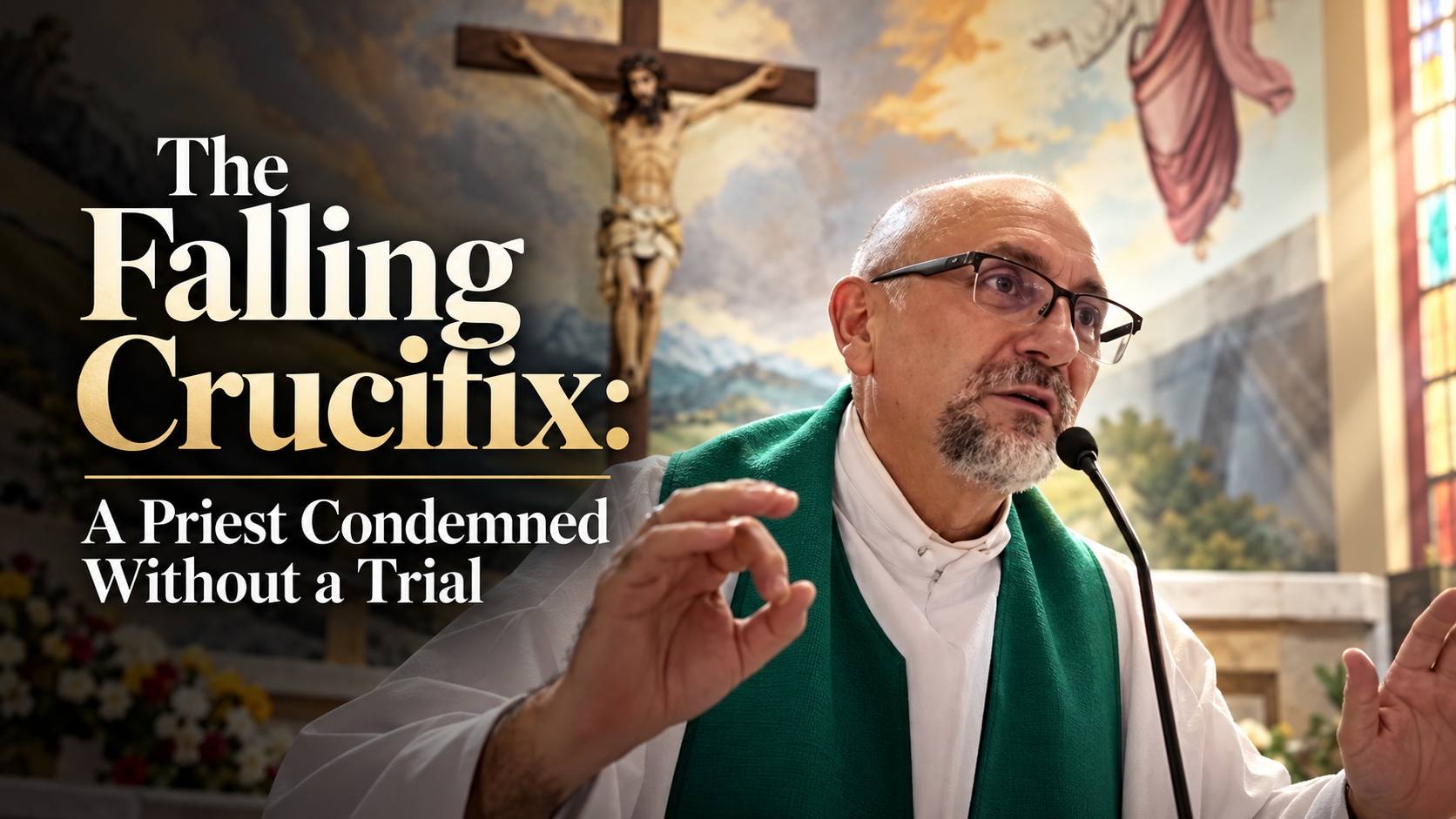
Minutes before a falling crucifix killed him during Mass in Ecuador, a Redemptorist priest warned his congregation that everyone must one day die and that God must come before money. Within days, allegations of a stolen fortune had transformed his death into a supposed act of divine retribution. The contrast exposes a disturbing confusion of justice, providence and the Christian obligation to pray for the dead.
A priest told his congregation that they would all one day die, that money must never come before God, and that the time spent upon earthly distractions could never replace the time owed to their Creator. Minutes later, a heavy wooden crucifix fell from the sanctuary wall and killed him. Within three days, strangers who had never met him were declaring that Almighty God had executed him for stealing money. The priest had preached about the certainty of death and the proper ordering of Christian life. His accusers preferred to interpret his death as proof of crimes for which they had produced no evidence.
On Saturday 17 October 2026, Father Patricio Alfredo Sánchez Molinari, a 52-year-old Redemptorist priest, was celebrating an evening Mass at the Church of Our Lady of Perpetual Help in Guayaquil, Ecuador. During the liturgy, a substantial wooden crucifix became detached from the sanctuary wall and struck him, causing fatal injuries. The celebration was being livestreamed, and the recording subsequently circulated around the world. Parishioners rushed to his assistance, but the priest could not be saved. The Archdiocese of Guayaquil confirmed his death, while his religious congregation mourned a missionary who had completed twenty-one years of priestly service only two days earlier.¹
The most extraordinary aspect of the tragedy is what Father Sánchez had been preaching shortly beforehand. Reflecting upon Our Lord’s command to render to Caesar what belongs to Caesar and to God what belongs to God, he warned his congregation that the demands of work, money and ordinary domestic occupations could easily displace the claims of their Creator. He observed that people readily devoted hours to their telephones, entertainment and other distractions while neglecting prayer. God, he insisted, must come first, before money and before work. Then came the words which would acquire such terrible poignancy: “One day, all of us here will also die.” He reminded his listeners that the time given to God, to their families and to those whom they loved was the time best spent.²
These were not the fevered predictions of a man anticipating some extraordinary intervention. They were the familiar exhortations of a priest reminding his people of the Four Last Things and their obligations in the present life. According to the contemporary account published by El Universo, he concluded by asking God’s blessing upon the congregation and its activities during the coming week. The Creed followed, and the accident occurred during the subsequent prayers of the faithful. His meditation upon death was therefore not literally his final utterance, but it was among the last substantial teachings he delivered. The distinction matters because the truth of what he said requires no embellishment. A priest had reminded his congregation that death comes to everyone. Before the Mass was finished, it had come to him.
That ought to have been sufficient to provoke sober reflection. Instead, by 20 October, the International Business Times was reporting accusations circulating online that Father Sánchez had misappropriated approximately two million dollars in donations. The allegations included claims that he lived in a mansion, drove luxury vehicles and maintained an extravagant lifestyle inconsistent with his religious profession. Another story asserted that a wooden cross had previously developed cracks while he held it during Mass, supposedly constituting a warning of divine punishment. Neither the financial accusations nor the alleged earlier incident had been independently verified. Nevertheless, the supposed scandal was already being offered as the explanation for his death.³
Before considering that interpretation, the accusations themselves deserve examination. Two million dollars is a substantial sum to have disappeared from church donations. Who contributed it? Over what period was it collected? Who discovered the supposed shortfall? Which accounts were examined, and where is the evidence connecting any missing money to Father Sánchez personally? The allegations concerning his supposed wealth invite equally straightforward questions. Where was the mansion? What vehicles did he allegedly own? Were they registered in his name, owned by his congregation or merely available for his use? These are not obscure theological difficulties. They are elementary questions of evidence which any competent investigation would have to answer.
Some ordinary details of the priest’s circumstances are readily discoverable. The Archdiocese of Guayaquil’s official clergy directory identifies Father Sánchez as parish priest of Our Lady of Perpetual Help, whose address is José Mascote 2648, between Maldonado and Calicuchima. The directory supplies a parish telephone number and email address. It does not establish whether he personally lived at that address, in an adjoining Redemptorist residence or elsewhere. Nor would residence at the parish automatically establish that he possessed no other property. Nevertheless, there is an obvious distinction between an identifiable parish appointment, supported by public ecclesiastical records, and an allegation concerning a mansion for which no identifiable property or ownership documentation has been produced in the reporting examined.⁴
Father Sánchez was also a professed member of the Congregation of the Most Holy Redeemer, founded by St Alphonsus Maria de Liguori. His congregation records that he made his religious profession on 15 August 2000 and was ordained on 15 October 2005. His missionary work took him to Loja, Durán, Vinces, Manta and Guayaquil. Fellow religious and parishioners remembered him as a simple and approachable priest who promoted Eucharistic adoration and showed particular concern for the sick and the communities entrusted to his care. Such testimony is not an audit of his finances, but it is attributable evidence concerning his life and character, rather than an anonymous allegation circulated after his death.⁵
The distinction between personal ownership and the legitimate use of congregational property is particularly important here. Redemptorists profess religious poverty, but religious poverty does not require a priest to refuse transport, accommodation or the material resources necessary for his ministry. Religious congregations may own substantial property and vehicles for legitimate apostolic purposes. If Father Sánchez had personally accumulated a fortune through the misappropriation of donations, that would constitute a grave betrayal of his vocation and the faithful. His religious profession would make the offence more serious, not less. Yet the very seriousness of the accusation demands evidence. The Church’s reputation is not protected by concealing financial wrongdoing, but neither is it protected by permitting unsupported accusations to destroy the reputation of a priest who can no longer defend himself.
The available reporting establishes neither the alleged theft nor the ownership of the supposed mansion and luxury cars. That does not establish that the allegations are false. It establishes that they remain unproved. There is an enormous difference between refusing to investigate a credible complaint and refusing to condemn a man without evidence. Those who consider themselves defenders of ecclesiastical integrity should understand the distinction. A genuine financial scandal requires investigation, identified transactions, responsible testimony and properly established facts. It is not proved by the sudden and spectacular death of the person accused.
Here the matter becomes more serious still, because even proof of financial wrongdoing would not establish that Father Sánchez’s death constituted a particular act of divine punishment. Catholic doctrine affirms that God governs all things through His providence and that He may chastise sinners through temporal misfortunes. Sacred Scripture contains unmistakable examples of such judgements. But to acknowledge that God can punish does not establish that human spectators can identify the precise purpose of every extraordinary calamity. Providence is not a code which the living may decipher by arranging accusations around the circumstances of another man’s death.
Our Lord addressed precisely this presumption in the thirteenth chapter of St Luke. Eighteen people had been killed when the tower of Siloam collapsed upon them. Were they greater sinners than the other inhabitants of Jerusalem? Christ answered: “No, I say to you: but unless you shall do penance, you shall all likewise perish” (Luke 13:5, Douay-Rheims). He did not deny divine judgement, nor declare that the victims had been entirely without sin. He rejected the assumption that their unusual death established exceptional personal wickedness. The catastrophe was to become an occasion for repentance among those who survived, not an invitation to pronounce upon the hidden guilt of those who had perished.⁶
The parallel with Guayaquil is almost painfully exact. In Jerusalem, a structure collapsed and killed eighteen people. In Ecuador, a crucifix collapsed and killed a priest. In both circumstances, the temptation is to interpret an extraordinary death as evidence of an extraordinary offence. Christ directs attention away from the supposed wickedness of the victims and towards the spiritual condition of the spectators. The question is not what secret sin may have brought the structure down upon another man. It is whether those who remain alive are prepared to meet their own judgement.
The fifth chapter of the Acts of the Apostles records the deaths of Ananias and Sapphira after their deception concerning money offered to the apostolic community. That episode is sometimes invoked to demonstrate that God may punish financial dishonesty through sudden death. Certainly He may. But there is an essential difference between a judgement disclosed through inspired Scripture and one inferred by spectators from an accident accompanied by unverified accusations. The former possesses divine authority. The latter possesses none. To confuse the two is to mistake human conjecture for revelation.
The Book of Job supplies an equally necessary warning. Job’s companions were convinced that his terrible sufferings must correspond to some hidden personal wickedness. Their reasoning appeared religious, even morally rigorous, but it was founded upon a false assumption concerning the operation of divine justice. God Himself rebuked them. Similarly, when the disciples asked whether a man’s blindness from birth resulted from his own sin or that of his parents, Christ refused the explanation they proposed. These passages do not abolish the relationship between sin and suffering. They forbid the presumptuous claim that particular suffering provides a reliable measure of particular guilt.⁷
Nor should a contrary error be introduced in the attempt to correct the first. Death is indeed a consequence of original sin. St Paul teaches that through one man sin entered the world, and through sin, death. The Church does not regard mortality as something entirely unrelated to the Fall. Yet Christ has transformed death through His redemptive sacrifice and Resurrection. The fact that death entered the world through sin does not mean that every individual’s death is a personal punishment for some identifiable offence. Still less does it mean that the unusual manner of a man’s death discloses the condition of his soul. Catholic doctrine requires these distinctions precisely because it takes sin, providence and judgement seriously.
The moral injury inflicted by the accusations is not confined to their theological interpretation. Catholic moral theology has always condemned rash judgement, detraction and calumny. To accept another man’s guilt without sufficient evidence is an offence against justice; to spread damaging allegations irresponsibly may aggravate that injustice, depending upon what is known, said and intended. The fact that accusations circulate widely does not confer credibility upon them. Neither does the death of their subject remove the obligation to distinguish suspicion from proof. On the contrary, the dead are peculiarly defenceless. They cannot answer their accusers, produce documents or challenge the assertions by which their reputation is being destroyed.
There is something particularly offensive about the use of a crucifix to justify such presumption. The Cross is not merely an instrument associated with death. It is the sign of redemption, the instrument upon which the innocent Christ offered Himself for the sins of mankind. Divine justice and mercy meet upon Calvary. To interpret a falling representation of the Crucified as proof that Christ Himself has executed a supposedly corrupt priest is therefore a claim of considerable theological gravity. The symbolism may be dramatic, but dramatic circumstances do not constitute revelation. If anything, the Cross should recall the duty to pray for sinners rather than encourage satisfaction at the apparent destruction of one.
The ordinary physical circumstances of the tragedy must also be examined. The Archdiocese of Guayaquil announced that it was awaiting a technical report concerning the collapse. According to Primicias, the archdiocese maintained that parish buildings received maintenance with the assistance of technical personnel, although the precise cause of this accident had not been established in the reporting examined. A substantial wooden structure suspended above an occupied sanctuary requires secure installation and appropriate inspection. If defective fixings, deterioration or inadequate maintenance contributed to the death, those failures must be identified and addressed. Nothing in Catholic belief concerning divine providence excuses negligence or removes the obligation to protect those attending divine worship.⁸
The temptation to interpret the incident as supernatural punishment risks distracting attention from both legitimate enquiries. The structural failure requires a technical explanation; any credible financial allegation requires documentary investigation. Neither question is answered by declaring that God has already delivered His verdict. Indeed, the accusation and the accident have been made to reinforce one another in a circular argument: the falling crucifix supposedly proves the priest’s guilt, while his alleged guilt supposedly explains the falling crucifix. This is not an investigation. It is the construction of a narrative whose dramatic conclusion has been determined before its premises have been established.
There is also a danger of sentimentalising Father Sánchez’s death in the opposite direction. To die while celebrating Mass does not constitute canonisation, any more than to die beneath a falling crucifix constitutes condemnation. Every priest remains a sinner in need of grace, and the Church’s traditional prayers for the departed recognise the solemn reality of the particular judgement. The Holy Sacrifice is offered for the repose of souls precisely because the living do not presume to know their eternal condition. Prayer for Father Sánchez is neither an endorsement of every aspect of his ministry nor a denial that genuine wrongdoing, if discovered, should be acknowledged. It is the proper Christian response to the death of a man whose soul has passed into the judgement and mercy of God.
But the most searching indictment of the public reaction remains the priest’s own final exhortation. He had reminded his congregation that God must come before money. He had warned them that earthly distractions consume time which ought to be devoted to prayer and charity. He had spoken of death as an approaching certainty which no one could indefinitely postpone. Those words were neither novel nor sensational. They expressed the ordinary duties of the Christian life. Their terrible poignancy arose because the preacher himself died before the celebration was completed.
The reaction of those who subsequently presented his death as divine vengeance illustrates precisely the danger against which he had been preaching. A priest spoke of the proper use of time, and the response was a prolonged fascination with his supposed possessions. He spoke of giving God His due, and commentators assumed the right to announce God’s secret judgement. He reminded his congregation of death, and the attention of strangers turned towards allegations about the dead rather than repentance among the living. The irony would be remarkable even if the accusations were eventually proved. In their present unsubstantiated condition, it is more disturbing still.
Father Sánchez’s death leaves questions which deserve answers. The technical cause of the falling crucifix must be established. Any credible allegations concerning his handling of donations should be examined according to the evidence. His reputation deserves the justice owed to every person, neither shielded from legitimate scrutiny by his priestly office nor surrendered to rumour because he can no longer defend himself. But the question of why God permitted this particular death, at this particular moment, beneath this particular image of the Crucified, cannot be settled by journalists, investigators or spectators. The Church teaches the reality of divine providence without pretending that its hidden purposes are available for public inspection.
One final distinction is indispensable. Father Sánchez warned his congregation that everyone would one day die. That warning has already been vindicated by the ordinary certainty of human mortality, not by any demonstrated supernatural intervention. His death makes the exhortation unforgettable, but it does not alter its meaning. The purpose of preaching about the Last Things is not to furnish material for condemning others. It is to prepare each soul for its own encounter with God.
When the tower of Siloam fell, Our Lord did not invite the survivors to speculate upon the offences of those crushed beneath its stones. He told them to repent. In Guayaquil, a priest delivered essentially the same warning shortly before a crucifix fell upon him. Those who have since made themselves judges of his soul would do well to consider which part of that warning was addressed to them.
The crucifix fell upon one priest. The summons to repentance is addressed to everyone still alive to pass judgement upon him.
- Associated Press, Catholic Priest Killed by Falling Cross During Livestreamed Mass in Ecuador, October 2026.
- El Universo, Un día, todos los que estamos aquí vamos a morir: la reflexión del padre Patricio Sánchez antes de morir tras accidente en iglesia, 18 October 2026.
- Michael Toledo, International Business Times, Ecuador Priest Crushed by Giant Cross During Mass Accused of Stealing $2M From Worshippers, 20 October 2026.
- Archdiocese of Guayaquil, Directorio de Sacerdotes, official clergy and parish directory.
- Congregation of the Most Holy Redeemer, Fr. Patricio Sánchez Molinari, C.Ss.R.: A Life Dedicated to the Redeemer, October 2026.
- The Holy Bible, Douay-Rheims, St Luke 13:1–5.
- The Holy Bible, Douay-Rheims, Acts 5:1–11; Job 42:7–9; St John 9:1–3; Romans 5:12.
- Gonzalo Herrera, Primicias, Arquidiócesis de Guayaquil espera informe técnico sobre la cruz que causó la muerte del sacerdote Patricio Sánchez, 19 October 2026.



Leave a Reply