
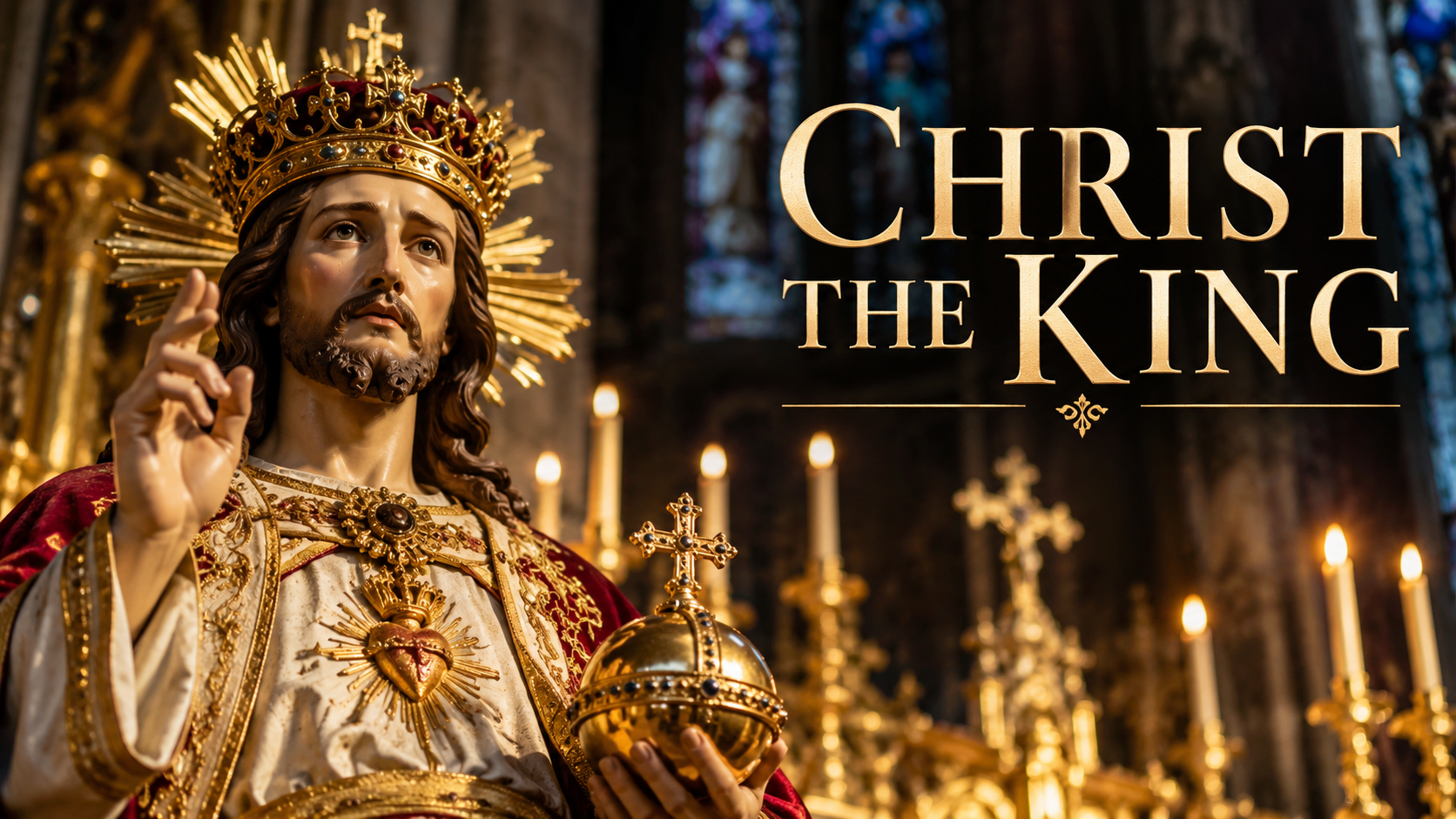
The Mass of Christ the King in the Traditional Roman Rite — Divine Majesty, Redemptive Sacrifice and the Kingdom of Grace
The Mass of Our Lord Jesus Christ the King presents one of the most complete expressions of Catholic teaching concerning the Person, authority and redemptive mission of Jesus Christ. From the heavenly acclamation of the Lamb who was slain to the final petition that the faithful may reign with Him eternally, its sacred texts reveal the inseparable relationship between divine sovereignty, the sacrifice of Calvary and the sanctification of mankind. The King whom the Church adores is the eternal Word made flesh, whose dominion embraces all creation, whose Precious Blood has purchased man’s redemption, and whose Kingdom is truth and life, holiness and grace, justice, love and peace.
The Feast of Our Lord Jesus Christ the King, celebrated on the last Sunday of October in the traditional Roman calendar, is a Double of the First Class, with white vestments, the Gloria, Credo and a proper Preface. The Mass, Dignus est Agnus, is distinguished by the remarkable coherence of its scriptural passages and liturgical prayers. Its texts do not merely praise the majesty of Christ under different titles, but disclose the theological foundation of His sovereignty, the means by which He accomplishes redemption, the character of His Kingdom and the eternal destiny of those who belong to Him.¹
Three aspects of Christ’s office emerge throughout the celebration. As Prophet, He reveals divine truth and summons mankind to hear His voice; as Priest, He reconciles sinners to the Father through the offering of Himself; and as King, He governs all creation and directs the redeemed towards their supernatural end. These offices are distinct in their proper significance but united in the one Person of the Incarnate Word. His kingship cannot be separated from His priesthood, because the redemption of mankind is accomplished through sacrifice; nor from His prophetic office, because His dominion requires the submission of the intellect to revealed truth as surely as the obedience of the will to divine law.
The Introit: The Lamb Who Was Slain
The Mass begins with the words of the Apocalypse: Dignus est Agnus, qui occisus est — worthy is the Lamb who was slain. The heavenly acclamation attributes to Him power, divinity, wisdom, strength and honour, concluding with the declaration that glory and dominion belong to Him for ever. The accompanying verse from Psalm 71 asks God to give His judgement to the King and His justice to the King’s Son.
The choice of these passages establishes the character of the feast immediately. The Church introduces the sovereignty of Christ through the worship of the sacrificial Lamb, identifying royal triumph with the victory of redemption. The One whom heaven acclaims is not simply a righteous man rewarded with authority for His fidelity, but the eternal Son of God who assumed human nature and offered Himself for the salvation of the world.
Catholic theology distinguishes the titles by which Christ possesses royal authority. As God, He shares the one divine sovereignty of the Father and the Holy Ghost, possessing dominion over creation by essence and nature. As man, He possesses royal dignity by reason of the hypostatic union, through which His humanity subsists in the divine Person of the Word. He is also King by acquired right, having redeemed mankind through His Passion and purchased sinners with His Precious Blood. These are not three independent sovereignties, but distinct foundations for recognising the universal lordship of the one Christ.²
The distinction safeguards the proper understanding of Calvary. Christ did not acquire divine power by suffering, nor did His Resurrection transform a merely human teacher into a heavenly ruler. The eternal Son already possessed divine majesty before the Incarnation; in His assumed humanity He accomplished the work of redemption, meriting the exaltation and glory proper to His victorious mission. The sacrifice of the Lamb is therefore the supreme manifestation of His saving kingship, not the source of His eternal divinity.
The Introit presents an essential characteristic of Christian worship: the adoration of sovereign majesty inseparable from gratitude for redeeming love. The faithful who hear the heavenly acclamation are reminded that the price of their salvation was not silver or gold, but the Blood of Christ, the spotless Lamb. To acknowledge His kingship is consequently to recognise both His divine authority and the obligations arising from His redemption.
The Collect: The Restoration of All Things
The Collect addresses Almighty and everlasting God, who has willed to restore all things in His beloved Son, the King of the universe: in dilecto Filio tuo, universorum Rege, omnia instaurare voluisti. It then petitions that all the families of nations, divided by the wound of sin — peccati vulnere disgregatae — may be brought beneath His most gracious dominion: ejus suavissimo subdantur imperio.
The prayer begins with the divine purpose rather than the human predicament. God wills the restoration of creation in Christ, and the Church asks that mankind may be brought into conformity with that purpose. The expression omnia instaurare recalls the Apostle’s teaching concerning the recapitulation of all things in Christ (Ephesians 1:10). The Incarnate Word is the principle through whom creation receives its existence and the Redeemer through whom fallen humanity is restored to its supernatural end.
The reference to the wound of sin identifies the fundamental disorder which redemption must overcome. Man’s alienation from God has consequences extending beyond his private conscience, affecting his understanding, moral judgement, relationships and institutions. The restoration sought by the Collect cannot therefore be reduced to an improvement in temporal circumstances. It requires reconciliation with God and the reordering of human life according to the divine law.
The adjective suavissimo deserves particular attention. Christ’s dominion is described as most sweet or gracious, yet the prayer asks for genuine submission to His authority. The sweetness of His rule does not consist in the absence of commandments or the relaxation of moral obligation, but in the goodness of the end towards which His authority directs mankind. Divine law is not an arbitrary restriction imposed upon human flourishing. It expresses the wisdom of the Creator, while supernatural grace enables man to fulfil the obligations of his vocation and attain the beatitude for which he was made.
The Collect thus unites authority and restoration. Christ governs not to diminish His creatures but to bring them into the right order of truth and goodness. Submission to His dominion is the restoration of authentic freedom, because freedom achieves its perfection not in independence from God but in willing adherence to the supreme good.
The Epistle: The Primacy of Christ in Creation and Redemption
The Epistle, Colossians 1:12–20, furnishes the principal scriptural exposition of Christ’s sovereignty. St Paul begins by thanking the Father, who has delivered the faithful from the power of darkness and transferred them into the Kingdom of His beloved Son, in whom they possess redemption through His Blood and the forgiveness of sins.
This opening is particularly significant because it identifies entry into the saving Kingdom with deliverance from sin. Membership in Christ’s Mystical Body is not simply the assumption of a religious identity or assent to a moral philosophy. It is the consequence of supernatural grace, by which the sinner is reconciled to God and brought into a new condition of life.
The Apostle then declares that Christ is the image of the invisible God, the firstborn of every creature, through whom all things were created, visible and invisible, including the angelic thrones, dominations, principalities and powers. The expression primogenitus omnis creaturae signifies His pre-eminence over creation, not that the eternal Word belongs to the order of creatures. St Paul’s immediately following affirmation, that all things were created through Him, excludes such an interpretation. Christ is begotten, not made, consubstantial with the Father, and the divine power by which all things exist belongs equally to the three Persons of the Most Holy Trinity.
The declaration omnia in ipso constant — that all things subsist in Him — carries the doctrine beyond the original act of creation. Every creature remains dependent upon God for its continued existence. Christ’s sovereign authority therefore concerns not merely the religious aspirations of mankind but the very foundation of created reality.
St Paul proceeds to identify Christ as the Head of the Body, the Church, the beginning and firstborn from the dead. The order of his argument is deliberate: the One through whom all things were created is also the One through whom fallen humanity is reconciled. His Resurrection is the victory of the Redeemer and the beginning of that glorified life in which His faithful are called to participate.
The passage culminates in the reconciliation of all things through the Blood of the Cross. This does not signify that every rational creature is necessarily saved, irrespective of faith, repentance or final perseverance. It proclaims the universal sufficiency of Christ’s redemption and His pre-eminence as the principle of reconciliation, whose saving fruits are communicated according to the divine economy of grace.
The ecclesiological consequences are equally important. The Church does not confer headship upon Christ, nor does her authority originate in the collective will of her members. She receives her supernatural life, doctrine, sacramental constitution and mission from Him. The authority entrusted to her ministers is consequently ministerial and subordinate to that of her divine Head. They are charged with guarding and communicating the deposit of faith, not determining anew what Christ ought to have revealed. The Epistle places every office and institution within the Church beneath the primacy of the Redeemer, whose truth she must profess and whose grace she exists to communicate.³
The Gradual and Alleluia: An Everlasting Kingdom
The Gradual draws upon Psalm 71:8, 11: Dominabitur a mari usque ad mare, et a flumine usque ad terminos orbis terrarum — He shall rule from sea to sea, and from the river unto the ends of the earth. It proceeds to declare that all kings shall adore Him and all nations shall serve Him.
The Alleluia takes its proclamation from Daniel 7:14: Potestas ejus, potestas aeterna, quae non auferetur — His power is everlasting and shall not be taken away. The prophet’s vision of the Son of Man receiving dominion and glory from the Ancient of Days is here applied to the Incarnate Word, whose Kingdom is not subject to the uncertainties which accompany earthly government.
The two chants establish the universality and perpetuity of Christ’s reign. His authority extends over all nations and cannot be limited by territorial boundaries, historical circumstances or human consent. Earthly rulers possess a temporary and derivative authority; Christ possesses supreme dominion, which neither begins with their recognition nor ends with their disappearance.
The Gradual is concerned with the extent of His sovereignty, while the Alleluia proclaims its indestructible character. Together they prepare the faithful for the Gospel, where the King whose dominion reaches to the ends of the earth will appear before a Roman governor apparently deprived of every outward sign of power.
The Gospel: Kingship and the Authority of Truth
The Gospel, St John 18:33–37, recounts the interrogation of Our Lord by Pontius Pilate. The setting provides one of the most striking contrasts in Sacred Scripture. Pilate represents the authority of imperial Rome; Christ stands before him as an accused prisoner. The governor possesses the immediate power of judgement, yet the One whom he interrogates is Himself the divine Judge of the living and the dead.
Asked whether He is the King of the Jews, Our Lord replies by distinguishing His Kingdom from the political authority which Pilate understands:
Regnum meum non est de hoc mundo.
“My kingdom is not of this world.”
The final phrase of His explanation is decisive: Nunc autem regnum meum non est hinc — His Kingdom is not from hence. Christ speaks of its origin and character, not of an absence of authority over earthly affairs. His Kingdom does not derive its legitimacy from human institutions, nor is its redemptive mission accomplished by the armed methods through which temporal rulers defend their dominion.
St Augustine, commenting upon this passage, explains that Christ’s Kingdom exists within the world without deriving its origin from the world. Its citizens are gathered from among men and called to a heavenly inheritance. The distinction neither abolishes legitimate temporal authority nor places human conduct beyond the jurisdiction of divine law. It safeguards the supernatural nature of Christ’s saving mission while preserving the universality of His sovereignty.⁴
Pilate’s subsequent question elicits the central revelation of the Gospel:
Ego in hoc natus sum, et ad hoc veni in mundum, ut testimonium perhibeam veritati: omnis qui est ex veritate, audit vocem meam.
“For this was I born, and for this came I into the world; that I should give testimony to the truth. Every one that is of the truth, heareth my voice.”
The royal office of Christ is here joined explicitly to His prophetic mission. He reigns as the eternal Word who reveals the Father and bears witness to divine truth. His authority does not depend upon the persuasive force of an argument considered merely as human reasoning, although divine revelation is never contrary to right reason. It commands the assent of faith because God Himself is its author.
The distinction has immediate consequences for Christian discipleship. To hear the voice of Christ means more than finding consolation in selected passages of the Gospel. It demands the submission of the intellect to revealed truth and the conformity of the will to the divine commandments. No individual, whether layman or cleric, possesses the authority to make his private judgement the ultimate measure of revelation. The duty of conscience is to adhere to truth, not to manufacture it according to personal preference.
Christ’s confrontation with Pilate reveals the limits of earthly jurisdiction without denying its legitimate exercise. Pilate may pronounce sentence according to the authority he possesses, but he cannot determine the truth of Christ’s divine identity by an act of political judgement. The accused King is not dependent upon the governor’s recognition. His kingship rests upon the reality of His Person, and His testimony requires a response which no earthly tribunal can finally evade.
The Offertory and Secret: The Sacrifice of Reconciliation
The Offertory antiphon takes its words from Psalm 2:8: Postula a me, et dabo tibi gentes hereditatem tuam, et possessionem tuam terminos terrae — Ask of Me, and I will give Thee the nations for Thy inheritance and the ends of the earth for Thy possession.
The Father’s promise to the Messianic King accompanies the preparation of the offerings. Its placement directs attention towards the sacrifice through which the inheritance of the redeemed is obtained, for the nations are called into Christ’s saving Kingdom through the grace purchased by His Passion.
The Secret develops this connection with unmistakable clarity: Hostiam tibi, Domine, humanae reconciliationis offerimus. The Church offers the Victim of human reconciliation and petitions that Christ, whom she offers in the present Sacrifice, may grant to all nations the gifts of unity and peace.
The language is sacrificial in the strict Catholic sense. The Mass is not a mere commemoration of the Last Supper, nor a symbolic presentation of the community’s worship. It is the true Sacrifice of the New Law, in which the same Priest and Victim of Calvary is offered sacramentally through the ministry of the ordained priest. Christ’s bloody oblation was accomplished once for all upon the Cross; the Mass makes that one Sacrifice present in an unbloody manner and applies its saving fruits. The Council of Trent expressly maintained the identity of the Victim and principal Offerer while distinguishing the manner of offering.⁵
The Secret’s petition for unity and peace follows naturally from this doctrine. Christ reconciles mankind to the Father through His Blood, and the supernatural unity of His Church proceeds from communion with Him in faith, grace and charity. Peace cannot be understood merely as the accommodation of conflicting interests or the absence of visible disagreement. It is the fruit of restored order, beginning with the reconciliation of man to God.
The Eucharistic Sacrifice consequently occupies the proper centre of the feast. The sovereignty proclaimed in the scriptural readings is now contemplated through the actual sacramental offering of the Redeemer. His authority is not merely described or acclaimed; the Church approaches the Father through the mediation of the eternal Priest, whose perfect obedience has accomplished man’s salvation.
The Preface: Priesthood, Kingship and the Kingdom of Grace
The proper Preface is the theological summit of the Mass. Addressing the eternal Father, it proclaims that He has anointed His only-begotten Son, Our Lord Jesus Christ, as eternal Priest and King of the universe: Sacerdotem aeternum et universorum Regem, oleo exsultationis unxisti.
The anointing recalls the royal language of Psalm 44 and its application to Christ in Hebrews 1:8–9. It signifies His divine appointment and the fullness of grace belonging to His sacred humanity. His priesthood and royal authority are exercised within the one saving mission of the Incarnate Word, who offers Himself as Mediator and governs those whom He redeems.
The Preface proceeds to describe Christ offering Himself upon the altar of the Cross as an immaculate and peace-making Victim: seipsum in ara crucis hostiam immaculatam et pacificam offerens. Through this oblation He accomplishes the mysteries of human redemption and presents to the infinite majesty of the Father an eternal and universal Kingdom.
The language is remarkable for its precision. Christ’s priesthood is identified with the offering of Himself, while His royal work is directed towards the restoration of creation and the glorification of the Father. His office as Priest provides the sacrificial means of reconciliation; His kingship directs the redeemed towards their final end. Neither office can be adequately understood apart from the Incarnation, for the same divine Person acts through His assumed humanity in accomplishing the salvation of mankind.
The Preface culminates in its celebrated description of the Kingdom:
Regnum veritatis et vitae; regnum sanctitatis et gratiae; regnum justitiae, amoris et pacis.
“A kingdom of truth and life; a kingdom of holiness and grace; a kingdom of justice, love and peace.”
These terms constitute a theological description of the supernatural order rather than a catalogue of desirable social conditions. Truth is fundamental because communion with God requires adherence to divine revelation. Life signifies the supernatural participation in God’s own life communicated through sanctifying grace. Holiness is the perfection towards which that grace directs the redeemed soul, while grace itself remains the indispensable principle of man’s elevation above his natural capacities.
Justice, love and peace describe the right ordering of human conduct beneath divine charity. Justice renders to God and neighbour what is due; charity loves God above all things for His own sake and the neighbour for the love of God; peace arises from the tranquillity of an order established in truth and goodness. St Augustine’s definition of peace as the tranquillity of order, developed by St Thomas Aquinas in his treatment of charity, illuminates the relationship between these virtues. Peace is not secured by the abandonment of truth or the suspension of moral judgement, but by the proper ordering of the soul and its affections towards God.⁶
The Preface thus refuses to separate the moral fruits of the Kingdom from their supernatural foundation. Justice cannot be reduced to the administration of competing earthly interests, charity to indiscriminate benevolence, or peace to the mere avoidance of conflict. Their fullest Christian meaning derives from the supreme good towards which man is directed: eternal communion with God.
The description culminates in the presentation of the Kingdom to the Father. St Paul’s teaching that Christ shall deliver the Kingdom to God the Father, that God may be all in all (1 Corinthians 15:24–28), concerns the final consummation of His mediatorial reign, not the termination of His everlasting kingship. The Son remains eternally divine, and His glorified humanity possesses an imperishable royal dignity. What reaches fulfilment is the work of redemption, when the elect shall enjoy the perfect possession of God.
The Communion: The Peace Bestowed by the King
The Communion antiphon returns to the Psalms: Sedebit Dominus Rex in aeternum: Dominus benedicet populo suo in pace — the Lord shall reign as King for ever; the Lord shall bless His people with peace (Psalm 28:10–11).
Its place within the liturgy is especially appropriate. Having contemplated the majesty of Christ and assisted at the Holy Sacrifice, the faithful are invited to receive the King Himself beneath the sacramental species. Holy Communion contains the true Body, Blood, Soul and Divinity of Our Lord Jesus Christ, substantially present by the conversion of bread and wine into His Body and Blood.
The sovereign who demands obedience also communicates the grace necessary for faithful service. The Eucharist nourishes supernatural life, increases charity and strengthens the properly disposed soul against temptation. Christ’s reign in the Christian is therefore more profound than the external observance of commandments, although such observance remains indispensable. Through grace, the redeemed person is progressively conformed to the Redeemer, whose divine life is communicated sacramentally.
The peace promised by the antiphon is not immunity from suffering. The martyrs possessed that peace amid persecution, and the saints frequently enjoyed it while enduring severe trials. Its foundation is reconciliation with God and the right ordering of the soul through charity. The faithful who receive Holy Communion worthily are strengthened in that supernatural union which earthly circumstances cannot of themselves destroy.
This union nevertheless requires proper disposition. Sacramental communion is not an unconditional declaration that the communicant already enjoys the friendship of God. The person conscious of mortal sin must first seek reconciliation through sacramental confession. The King’s presence in the Blessed Sacrament demands reverence, faith and a conscience prepared to receive Him. The grace communicated through Holy Communion perfects the Christian life; it does not render repentance or obedience unnecessary.
The Postcommunion: Beneath the Standard of Christ
The concluding prayer gives the feast its final personal application:
Immortalitatis alimoniam consecuti, quaesumus, Domine: ut, qui sub Christi Regis vexillis militare gloriamur, cum ipso, in caelesti sede, jugiter regnare possimus.
Having received the nourishment of immortality, the Church petitions that those who glory in serving beneath the standards of Christ the King may reign with Him eternally in His heavenly dwelling.
The military imagery is deliberate. The Christian’s incorporation into Christ through baptism and his nourishment by the Eucharist do not exempt him from spiritual combat. He belongs to the Church Militant and must contend against sin, temptation and the disordered inclinations of fallen nature. The service expressed by militare entails perseverance in faith, the practice of virtue, fidelity to divine law and the willingness to suffer rather than betray the truth.
There is nothing merely figurative about the obligations of this allegiance. The Christian who professes Christ as King must permit His authority to govern the whole of life. The intellect must submit to revelation, the conscience must be formed according to divine law, and conduct must be conformed to the moral demands of the Gospel. The standard of Christ cannot be carried with honour while His commandments are knowingly disregarded.
Yet the Postcommunion does not end with the hardships of service. Its final petition is cum ipso … jugiter regnare possimus — that the faithful may reign with Him for ever. The reward of perseverance is not an independent sovereignty, but participation in the glory of Christ. The blessed reign with Him because they share, by grace, in the eternal life which belongs to God by nature.
The progression from spiritual combat to heavenly blessedness is the proper conclusion of the entire Mass. The Eucharist sustains the faithful during their earthly pilgrimage, but its final purpose lies beyond the present world. The sacramental presence of Christ prepares the soul for the unveiled possession of Him in the Beatific Vision, when faith gives way to sight and the blessed enjoy that communion which constitutes their everlasting happiness.
The Crown, the Cross and the Altar
The Mass of Christ the King reveals a sovereignty which cannot be understood apart from the whole mystery of the Incarnation and Redemption. The Introit identifies the heavenly King with the Lamb who was slain; the Collect petitions for the restoration of mankind beneath His gracious dominion; the Epistle establishes His primacy over creation and His headship of the Church; and the Gospel discloses the divine truth upon which His authority rests. The Offertory, Secret and Preface then bring these doctrines to their sacrificial centre, while the Communion and Postcommunion direct the faithful towards the supernatural life which Christ communicates and the eternal glory which He promises.
The decisive theological principle is the unity of Christ’s Person and mission. His sovereignty is not an attribute added to His priesthood or an honour bestowed upon Him after His Passion. He is the eternal Son, whose assumed humanity possesses a royal dignity proper to the Incarnate Word, and whose redeeming sacrifice establishes His acquired title over those purchased by His Blood. As Prophet He reveals the truth, as Priest He offers Himself for sinners, and as King He governs the redeemed towards the everlasting possession of God.
The liturgical celebration leaves no room for a purely nominal allegiance. Christ does not seek the admiration of spectators who remain sovereign over their own beliefs and conduct. He calls men to repentance, faith, obedience and communion with Himself. His commandments are the expression of divine wisdom, His grace is the principle of supernatural life, and His Sacrifice is the inexhaustible source of the reconciliation by which sinners may approach the Father.
The final words of the Postcommunion therefore provide the appropriate conclusion. The Church asks that those who glory in serving beneath the standard of Christ may reign with Him eternally. Between that present service and future glory lies the Christian life itself: sustained by the Holy Eucharist, governed by divine truth, strengthened through grace and perfected through charity.
The King whom the Church adores upon His throne is the Victim whom she offers upon the altar. His Crown bears witness to His majesty; His Cross reveals the price of redemption; and His Eucharistic presence communicates the life by which His faithful are prepared for heaven. To belong to His Kingdom is to accept His truth, receive His grace and persevere in His service, until the soul passes from the worship of the Lamb beneath sacramental veils to the unveiled contemplation of His glory for ever.
- Missale Romanum, In Festo Domini Nostri Jesu Christi Regis — Complete Mass Propers, including the Collect, Secret, Preface and Postcommunion.
- Pius XI, Quas Primas, §§13–14 — Christ’s Kingship by Nature, Hypostatic Union and Acquired Right; St Thomas Aquinas, Summa Theologiae, III, q. 59.
- Epistle to the Colossians, 1:12–20, Douay-Rheims Bible; St Thomas Aquinas, Summa Theologiae, III, q. 8 — The Grace of Christ as Head of the Church.
- St Augustine, Tractates on the Gospel of John, Tractate 115, on John 18:33–40.
- Council of Trent, Session XXII, Doctrine on the Sacrifice of the Mass, Chapter 2; St Thomas Aquinas, Summa Theologiae, III, q. 83.
- St Augustine, The City of God, Book XIX, Chapter 13; St Thomas Aquinas, Summa Theologiae, II–II, q. 29 — On Peace.
- St Thomas Aquinas, Summa Theologiae, III, q. 79 — The Effects of the Eucharist; I–II, q. 3 — The Nature of Beatitude.


Leave a Reply