
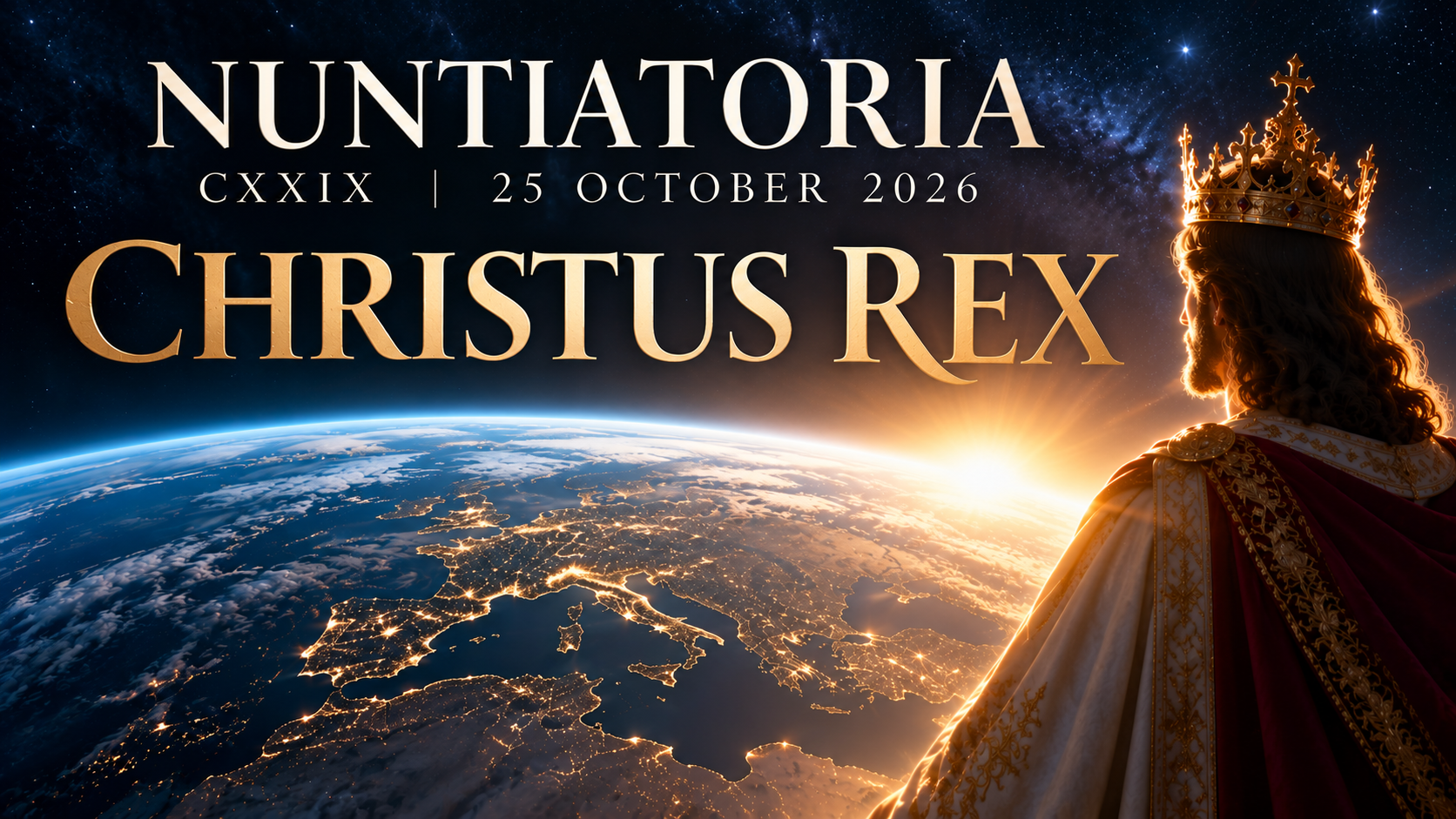
THE KINGSHIP OF CHRIST AND THE CRISIS OF AUTHORITY
The sovereignty of Christ is not a matter for negotiation. As institutions in Church and society increasingly confuse authority with the power to redefine truth, the feast of Christ the King recalls the limits of human government—and the responsibility of every Catholic household to make His reign visible.
There is a striking contradiction at the heart of contemporary ecclesiastical life. The Church proclaims a King whose authority extends over heaven and earth, yet much of her institutional energy appears devoted to discovering how far His teaching, worship and commandments may be accommodated to the expectations of the present age. The language is one of renewal, dialogue and participation. The underlying question is whether those entrusted with governing the Church still recognise that they are custodians of something they have no authority to reinvent.
The feast of Christ the King makes that distinction unavoidable. Pius XI instituted it not as a picturesque celebration of religious monarchy, but as a solemn proclamation that individuals, families, governments and nations are subject to the sovereignty of Jesus Christ.¹ His Kingship is not conferred by popular approval, parliamentary legislation or ecclesiastical consultation. It belongs to Him by nature and by right of redemption. The Church cannot convincingly summon the world to recognise His authority while appearing uncertain whether His revealed truth remains binding upon herself.
The controversies examined throughout this edition disclose the consequences of forgetting that distinction. When ecclesiastical authority accommodates the demands of a Communist state while maintaining a markedly different posture towards traditional Catholics, questions arise about the consistency of its principles. When the meaning of Tradition itself becomes a subject for renewed official investigation, while practices of manifestly recent origin are defended because they have become locally established, the relationship between continuity and change is turned upside down. When doctrinal questions are approached principally through the language of personal experience, the danger is that pastoral understanding becomes indistinguishable from doctrinal concession.
These are not simply disagreements about administration. They concern the nature of the Church and the purpose of her authority. Bishops are successors of the Apostles, not authors of a new revelation. The Pope is the guardian of the deposit of faith, not its proprietor. Authentic development brings greater clarity to what has been received; it cannot transform contradiction into continuity merely by invoking discernment. The question is not whether the Church may respond to changing circumstances. She must. It is whether those circumstances are to be judged by her perennial teaching, or whether that teaching must itself submit to the judgement of the age.
The consequences are equally apparent beyond ecclesiastical affairs. A society which increasingly treats fundamental moral distinctions as negotiable cannot be surprised when its institutions struggle to exercise coherent authority. Governments invoke public order while applying uncertain standards to competing political causes. Educational and professional bodies adopt contested ideological assumptions while presenting them as settled obligations. Institutions charged with safeguarding, fairness and public accountability risk allowing their original purposes to become subordinate to the reputational or political interests of those administering them. The common failing is not always malice or deliberate dishonesty. Often it is the more insidious conviction that institutional consensus can substitute for an objective standard of truth.
The Church ought to provide the corrective to precisely this confusion. Yet she cannot do so by becoming another participant in the competition for ideological approval. Her social teaching is neither a religious endorsement of fashionable political causes nor a defence of established power for its own sake. It proceeds from an understanding of the human person, moral responsibility, justice and the common good rooted in divine and natural law. Her independence depends upon fidelity to principles which neither governments nor popular movements possess the authority to alter.
Perhaps the most searching contrast is supplied by those who remained faithful when almost every outward instrument of religious authority had been taken from them. The witness of priests who celebrated Mass secretly under Communist persecution, including Cardinal Ernest Simoni and Cardinal François-Xavier Nguyễn Văn Thuận, reminds us that the Church’s strength cannot be measured by her diplomatic influence, administrative resources or public standing. Nguyễn Văn Thuận could celebrate the Holy Sacrifice with a few drops of wine while imprisoned because he understood that his priesthood belonged to Christ. The authorities who controlled his movements could obstruct his ministry, but they could neither abolish the Mass nor redefine its meaning.
There is a judgement upon contemporary ecclesiastical priorities in that simple fidelity. Men endured imprisonment rather than abandon what they had received, while Catholics today are too frequently invited to regard their inherited worship and discipline as impediments to renewal. The circumstances are not equivalent, and genuine persecution must never be trivialised by comparison with internal controversy. Nevertheless, the witness of the confessors asks a question which institutional Christianity cannot evade: what is the Church prepared to preserve when preservation becomes inconvenient?
Yet Nuntiatoria cannot content itself with diagnosing the failures of ecclesiastical and civil authorities. The sovereignty of Christ imposes obligations much closer to home. It is comparatively easy to lament decisions made in Rome, the failures of political leaders or the erosion of Christian culture. It is considerably more demanding to establish the reign of Christ within one’s own household, to order daily life around prayer, to instruct children in the faith, and to practise the charity, discipline and perseverance which Christian life requires.
It is for this reason that Nuntiatoria introduces The Domestic Church, a new weekly series offering practical guidance for living the traditional Catholic faith at home. Following the Church’s Sundays, feasts and seasons, it will provide prayers, customs, devotions and family activities through which the liturgical year may shape domestic life. The inaugural article, A Home with Room for Heaven: Preparing for All Saints and All Souls, encourages the submission of names for remembrance at Mass, the arranging of Mass intentions for the departed, the celebration of the saints with children, and renewed devotion to the Holy Souls. It recalls the daily Rosary, the Angelus, morning and evening prayers, and the invocation of the Guardian Angels—not as pious accessories, but as the ordinary substance of a Catholic home.
This new initiative is deliberately more than a devotional supplement. It provides a practical answer to the central problem explored throughout the edition. If the Church is suffering from a failure to transmit what she has received, the recovery of that transmission must begin in the places where faith first becomes familiar. A child who learns to kneel before a crucifix, to pray for a deceased grandparent, to honour a patron saint and to recognise the seasons of the Church encounters a reality infinitely greater than religious opinion. Such habits establish a Catholic understanding of time, duty, sacrifice and eternity long before the controversies of ecclesiastical administration become intelligible.
The approach of All Saints and All Souls makes the point especially fitting. Christ’s Kingdom is not confined to the circumstances of the present world. The saints in glory and the faithful departed awaiting their purification remind us that earthly life is a preparation for eternity. The Communion of Saints exposes the poverty of a religion concerned principally with contemporary relevance. The Church exists to bring souls to Heaven. Every institution, ministry, devotion and pastoral initiative must ultimately be judged according to its fidelity to that supernatural purpose.
Christ’s Kingship, then, is not merely a claim to be defended in theological controversy or asserted against secular governments. It is a reality to be acknowledged in worship, in moral judgement, in the exercise of authority and in the ordinary conduct of Christian life. His crown belongs neither to the state nor to the ecclesiastical administrator. His truth is not theirs to negotiate, and His inheritance is not theirs to surrender.
The imprisoned priest offering Mass in secret and the Catholic family gathered before its household crucifix bear witness, in very different circumstances, to the same sovereign Lord. Neither possesses the power to direct the affairs of the universal Church. Both possess the freedom—and the obligation—to remain faithful.
The renewal of Christendom will not begin by inventing a new Christianity more acceptable to the world. It will begin wherever Catholics recover the courage to live according to the Christianity they have already received.
Christus vincit. Christus regnat. Christus imperat.
- Pius XI, Quas Primas, 11 December 1925.
- Nuntiatoria CXXVIII, Non Potest Veritas Subdi Potestati, 18 October 2026.
- Nuntiatoria CXXVII, State, et Tenete Traditiones, 11 October 2026.
- Nuntiatoria CXXIX, published edition and articles, 25 October 2026.
IN THIS EDITION
- THE DOMESTIC CHURCH: 25 October – 2 November 2026 A Home with Room for Heaven: Preparing for All Saints and All Souls
 The content outlines a week’s plan for traditional Catholic families to prepare for the feasts of All Saints and All Souls. Emphasising daily prayers, remembrance of the deceased, and engagement with children’s activities, it aims to integrate Catholic customs into family life, enriching spiritual practices and fostering a shared faith experience.
- THE IMAGE CAESAR CANNOT CLAIM: The Twenty-Second Sunday after Pentecost
 In response to the Pharisees’ attempt to trap Jesus with a question about tribute to Caesar, He highlights the greater obligation to God. Christ distinguishes between worldly duties and divine authority, asserting that while earthly obligations exist, the ultimate purpose of life is to serve God. The human soul, made in God’s image, must render love, worship, and obedience to the Creator.
- CHRIST MUST REIGN AT HOME
 The restoration of Catholic civilisation begins at home, prioritising prayer, virtue, charity, and adherence to the Church’s calendar. This transformative process shapes daily life, cultivating an environment that fosters faith and Christian values necessary for future generations. Without revitalised domestic life, Catholic institutions cannot sustain a Christian society effectively.
- THE CONSECRATION OF THE HUMAN RACE TO THE SACRED HEART OF JESUS
 On 25 October, traditional Catholics will renew the Consecration of the Human Race to the Sacred Heart of Jesus, affirming Christ’s sovereignty over humanity. This act, historically significant, highlights the relationship between divine authority and human responsibility, countering contemporary misunderstandings of faith and moral truth, which increasingly fade from Catholic consciousness.
- Christ the King: The Sovereignty of the Crucified Redeemer
 The Mass of Christ the King articulates core Catholic beliefs about Jesus’ divine authority, redemptive sacrifice, and the essence of His Kingdom. It emphasises Christ as Prophet, Priest, and King, whose sovereignty is inseparable from His mission of reconciliation, calling the faithful to acknowledge His authority and embrace moral duties rooted in divine truth.
- VIRILITER AGITE: THE COURAGE THE MODERN CHURCH HAS FORGOTTEN
 The Church faces a challenge in balancing the courage to adapt with the need to uphold established doctrine. While contemporary dialogue and synodality are encouraged, loyalty to the apostolic faith and traditional worship remains crucial. True fortitude involves steadfastness in faith, confronting modern pressures while ensuring the integrity of Catholic teachings.
- Pius XII, Capital Punishment and the Gospel of Consequences
 Pius XII’s views on capital punishment explore the relationship between criminal responsibility and state authority, asserting that severe crimes can forfeit an individual’s right to life. This raises important theological questions amid recent changes in the Catechism. Ultimately, the Church’s mission should focus on spiritual salvation beyond temporal welfare, prioritising God’s higher good.
- FRANCE’S RIOTS and the Collapse of Moral Responsibility
 France faces a crisis of civilisational identity, with recent disturbances highlighting a detachment from its Christian moral inheritance. The unrest reflects deeper societal issues, including radical ideologies and inadequate integration, resulting in a fragmentation of authority and common purpose. Restoring order requires a renewed commitment to moral and spiritual foundations.
- THE POPE IS NO LONGER POPE — SAYS WHO?
 The content explores the authority of individuals within the Catholic Church to declare the Apostolic See vacant due to alleged papal heresy, analysing pre-Vatican II canonists’ views. It distinguishes between recognising theological possibilities and possessing jurisdiction, emphasising that resistance to error does not equate to authority over the Pope.
- LEO XIV AND THE LIMITS OF CONSCIENCE: The Unfinished Business of Amoris Laetitia
 Pope Leo XIV has emphasised that conscience must align with divine law as interpreted by the Church’s Magisterium. His reaffirmation comes in light of ongoing debates surrounding Amoris laetitia and seeks to clarify the Church’s teachings on marriage and pastoral practice, urging adherence to objective moral standards amid evolving interpretations.
- LEO XIV ASKS WHAT COUNTS AS TRADITION. ROME ANSWERED IN 1989.
 Pope Leo XIV’s new International Theological Commission aims to examine Sacred Tradition, despite the Vatican’s previous conclusions on doctrinal continuity and development established in 1988-1989. These foundational criteria, articulated under Cardinal Ratzinger, remain essential today. Rome must clarify any inadequacies in prior findings before commencing another investigation.
- LEUVEN: TRADITION IS THE MEASURE, NOT THE ACCUSED
 An international conference at KU Leuven critically examines the extensive reconstruction of the ancient Roman Mass, questioning its reconciliation with the Church’s obligation to preserve Tradition. It highlights the need for the postconciliar reform to justify its changes against this liturgical inheritance, underscoring that Tradition should be upheld as the essential standard.
- IN THE FOOTSEPS OF BUDDHA: Milan’s World Youth Day Course Leaves Christ Out of the Syllabus
 The Archdiocese of Milan is offering five lectures on Buddhism in preparation for World Youth Day 2027, raising concerns about the omission of Christian teachings. While understanding other religions is valuable, the initiative suggests a shift away from emphasising Catholic doctrine, risking a blurring of essential differences between Buddhism and Christianity.
- FR RIPPERGER: THE DECREES, THE DEMONS AND THE CORRUPTION ROME CANNOT DENY
 Fr Chad Ripperger’s recent withdrawal from public speaking raises questions about the possible influence of his teachings on marriage and the family’s role in the decision, as well as the voluntary nature of his arrangement. This controversy highlights ongoing concerns about ecclesiastical corruption and the need for transparency in the exercise of episcopal authority within the Church.
- COLCHESTER PUTS HELL ON NOTICE
 The conflict between Colchester City Council and Bread of Life Community Church highlights concerns over the policing of Christian preaching, specifically regarding the boundary between public nuisance and religious expression. The case raises critical questions about freedom of speech, the legitimacy of complaints based on religious content, and the extent of governmental authority in regulating religious messaging.
- THE FALLING CRUCIFIX: A Priest Condemned Without a Trial
 Minutes before a falling crucifix killed him during Mass in Ecuador, Father Patricio Sánchez warned his congregation that God must come before money and that everyone must prepare for death.
- ROME, THE SOCIETY AND THE LIMITS OF OBEDIENCE: Peace Cannot Be Bought at the Price of Truth
 Fr Thomas Crean OP proposes a theological basis for reconciliation between the Holy See and the Society of St Pius X (SSPX). He challenges the requirement for unconditional acceptance of Vatican II and modern liturgical reforms, advocating for a balance between papal authority and the preservation of Catholic Tradition. Reconciliation hinges on mutual fidelity to both aspects.
- VENITE AD ME: Leo XIV, Cardinal Fernández and the Tradition Rome Has Failed to Transmit
 The Vatican has initiated a theological investigation into Sacred Tradition amid concerns over the declining transmission of Catholic faith globally. The ongoing reforms since Vatican II are scrutinised for their impact on faith retention. The challenge lies in understanding ecclesiastical responsibility while distinguishing authentic Tradition from contemporary cultural adaptations.
- CHRISTIAN BRITAIN WITHOUT CHRISTIANITY: Faith, Fear and the Politics of National Identity
 A recent Theos study indicates growing attachment to Christian identity in Britain, despite declining belief and practice. The research critiques ethnic nationalism and secular attitudes towards public faith, emphasising the need for a distinction between cultural Christianity and genuine belief. It calls for recognising Christ’s authority over national identity.
- EUROPE WITHOUT CHRIST: The Failure of the Multicultural Settlement
 Europe’s cohesion crisis stems from a shift in societal understanding, driven by multiculturalism and identity politics that favour separate cultural identities over shared obligations. These tensions are exacerbated by the influence of political Islam. Catholic teaching emphasises the need for social coherence grounded in a common moral and religious inheritance, stressing the Church’s role in affirming Christ’s sovereignty in public life.
- THE OCTOBER 17 MOVEMENT: MILAN’S LOOTING AND THE INVENTION OF ‘PROLETARIAN EXPROPRIATION’
 The October 17 Movement emerged from the riots in Milan, aiming to challenge Giorgia Meloni’s Government through a rhetoric of proletarian expropriation. Investigations into social-media-driven protests highlight issues of political responsibility. In contrast, a Catholic bishop suggests that redistributing stolen goods fails the essential moral obligation of restitution.
- CARDINAL KOOVAKAD’S ASSISI ERROR: AN EVENT IS NOT DOCTRINE
 Cardinal Koovakad argues that the 1986 Assisi gathering is now part of the Church’s ordinary Magisterium and uses Pentecost to justify its interreligious symbols, labelling traditionalist critics as schismatic. However, events do not equate to doctrine, and the Pentecost model emphasises a singular Faith rather than diverse religious practices.
- « C’EST PAS LA CAUSE ! » THE FRENCH BISHOPS AND THE CAUSE OF CHRIST
 A woman in Paris confronts looters, voicing concern for the betrayal of their cause. This incident parallels the French bishops’ response to recent riots, questioning whether their condemnation of violence adequately reflects the Church’s mission. Pope Leo XIV previously urged bishops to proclaim Christ as central to healing France’s social divisions.
- WHY THE DEVIL HATES BELLS SO MUCH
 The Catholic Church historically blessed its church bells, invoking divine protection while smaller altar bells called worshippers to the Eucharist. This practice highlights the theological significance of sacred sound in worship. However, recent liturgical reforms have diminished their meaning, reflecting a deeper decline in Catholic belief and communal religious identity.
- THE HOLY GHOST DOES NOT CONTRADICT HIMSELF
 Sister Mary Barron’s recent comments on women’s potential priestly ordination, supported by Pope Leo XIV’s synodal programme, challenge established Catholic doctrine. This raises concerns about the authority of Revelation. The risk lies in subjective experiences being treated as a basis for doctrinal change, undermining the Church’s mission to uphold definitive teachings.
- THE NEW CLERICALISM HAS NO NEED OF CLERICS
 Timothy Kirchoff’s proposal for a Church free from clericalism through lay involvement is critiqued for failing to distinguish between authority and administrative power. The argument suggests that clericalism can persist in a bureaucracy, highlighting that mere redistribution of roles may not eliminate the abuse of ecclesiastical authority while underscoring the significance of bishops’ sacred governance.
- THE GOSPEL IS NOT A CONSULTATION EXERCISE
 The Vatican’s recent gathering on Amoris Laetitia highlighted the rising prominence of lived experience in Catholic theology, paralleling social activism’s focus on personal testimony. While some experts advocated for compassion through understanding, key doctrinal controversies persisted. Bishop Erik Varden and Archbishop Jerome Lloyd emphasized fidelity to truth and sacramental reverence, advocating for a balance between compassion and adherence to divine Revelation.
- THE CHURCH OF ENGLAND IS RUNNING OUT OF CHURCH
 Gill and Craven’s report reveals that the Church of England’s administrative growth has occurred alongside a significant decline in clergy and congregations, mirroring challenges faced by the Catholic Church in England and Wales. Both institutions must assess whether their administrative frameworks effectively promote Christianity or merely manage its decline.
- CARDINAL RYŚ AND THE LITURGICAL REFORM THAT MUST NEVER BE JUDGED
 Cardinal Grzegorz Ryś asserts that after sixty years, the liturgical reforms of Vatican II remain unachieved, prompting reflection on whether ongoing implementation is necessary or if the reform itself warrants critical examination. The Council’s teachings indicate that tangible participation does not guarantee deeper spiritual engagement, challenging the assumptions behind contemporary liturgical practices.
- DEVON’S DISCIPLINARY DOUBLE STANDARD: The Councillor Who Questioned Safeguarding
 The controversy at Exeter Library involved sexually explicit displays near children’s activities, leading to criticism from a councillor and a subsequent investigation by Devon County Council, which found no safeguarding breach. However, arrangements were altered for future events. This incident highlights the conflict between safeguarding children’s welfare and institutional reputation.
- THE ST GALLEN MAFIA’S LONG SHADOW: WHEN DISOBEDIENCE BECOMES TRADITION
 Bishop Beat Grögli of St Gallen defends the long-standing practice of lay homilies, challenging the Church’s prohibition while invoking pastoral tradition. His controversial stance reflects a continuity with reformist ideas promoted by the historical St Gallen Group, raising questions about ecclesiastical authority and the relationship between tradition and contemporary practice.
- BISHOP RIFAN AND THE CAMPOS EXCEPTION: Rome Can Protect Tradition. Why Does It Restrict It Elsewhere?
 Bishop Fernando Rifan advocates for the reconciliation of Campos with Rome, cautioning against habitual canonical irregularity. His case highlights a discrepancy in Rome’s treatment of the traditional Roman liturgy, which is secure in Campos but subject to constraints elsewhere. This raises questions about the Church’s commitment to preserving its liturgical heritage.
- UK Catholic Schools, Abortion and the Bishops’ Duty to Answer
 John Smeaton has raised concerns regarding the teachings on abortion and contraception in Catholic schools, questioning the Catholic Education Service’s adherence to Church doctrine. He highlights the need for clarity and accountability in education. Parents should not bear the responsibility of ensuring doctrinal fidelity, which should instead be guaranteed by bishops and educational authorities.



Leave a Reply