
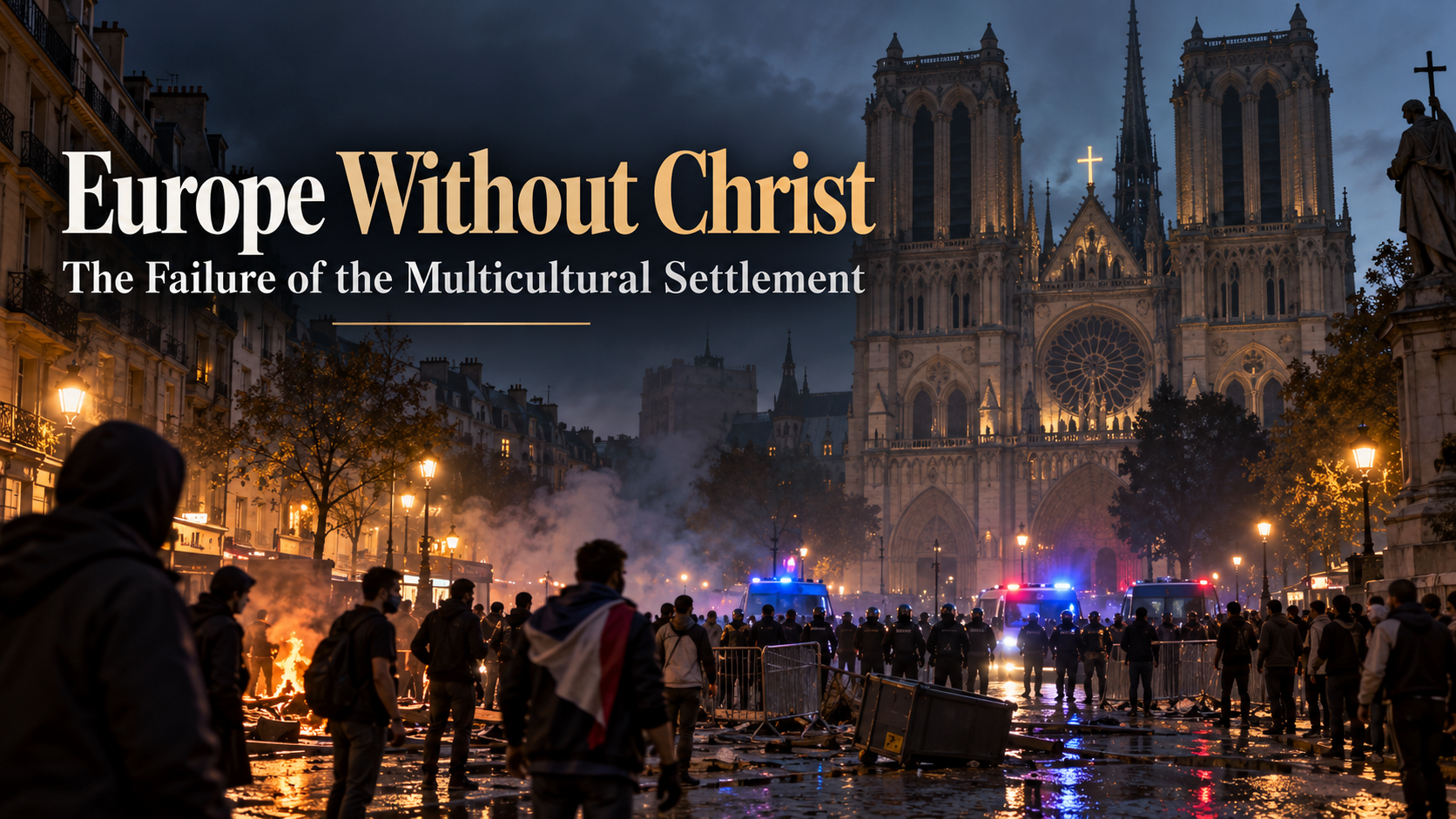
Religious indifferentism, political Islam, identity politics and the abandonment of the Social Kingship of Christ
Europe’s crisis of cohesion is not simply the consequence of mass immigration, economic stagnation or failures of government. It is the consequence also of a profound transformation in the understanding of society itself. Multiculturalism has encouraged the preservation of separate cultural identities without consistently requiring integration into a common national inheritance. Identity politics and certain diversity, equity and inclusion policies have reinforced the tendency to organise public life around competing groups rather than shared obligations. The growth of Islam and the political ambitions of Islamist movements have exposed the limitations of this settlement. Yet traditional Catholics must confront a still more fundamental question: how far has the Church’s own accommodation of secularism, religious indifferentism and post-conciliar Modernism weakened her ability to preserve, influence and renew European civilisation? The traditional Magisterium supplies an answer considerably more substantial than the prevailing language of tolerance and inclusion. It begins with the objective truth of the Catholic Faith, the duties of political society towards God and the sovereignty of Jesus Christ over nations as well as individuals.
The disturbances which have shaken France during October 2026 have reopened questions which European governments have struggled to answer for decades. The protests originated in grievances over education, deteriorating school buildings, staff shortages and public provision. They subsequently developed into wider demonstrations involving trade unions, political organisations and citizens concerned about living costs. Much of the participation has been peaceful, while arson, looting, attacks upon public buildings and serious confrontations with police have created a separate crisis of public order. Reporting on 22 October also recorded a peaceful Paris demonstration following a court’s decision to overturn a police prohibition.¹ It would therefore be unsound to attribute the disturbances as a whole to immigration, Islam or a single ideological movement. Their wider importance lies elsewhere: they reveal a society in which legitimate grievances, weakened institutional confidence and radical political mobilisation can rapidly converge, while raising the more enduring question of what constitutes the common allegiance of a nation.
That question cannot be answered simply through citizenship documents, economic participation or compliance with civil regulations. Nations are historical communities, formed through institutions, language, law, religion, memory and reciprocal obligation. Their continuity depends upon successive generations recognising an inheritance which they have received and for which they bear responsibility. A person may be economically productive while possessing little attachment to the society in which he lives. Another may have been born elsewhere and yet acquire a profound loyalty to his adopted country. Integration is therefore neither an automatic consequence of residence nor a matter reducible to ancestry. It requires the formation of shared loyalties through institutions which possess sufficient confidence in their own inheritance to transmit it.
The difficulty with the contemporary multicultural settlement is that it has too frequently encouraged the preservation of separate identities without providing an equally compelling account of the common identity into which newcomers should integrate. A multi-ethnic nation need not be a multicultural society in this ideological sense. People of different ancestries may recognise the same laws, national history, institutions and public obligations. Catholic civilisation itself was never confined to one ethnicity. The Church’s universality transcends national descent, and Christian Europe contained distinct peoples with different languages, political institutions and customary traditions. What gave that civilisation a recognisable unity was not racial uniformity but a common religious and moral inheritance, however imperfectly realised in particular societies.
Nuntiatoria has repeatedly distinguished these two conceptions of social life. Its earlier commentary on civic unity and integration examined the difference between receiving new citizens into an identifiable historical community and establishing an administrative framework within which permanently differentiated groups coexist. Its examinations of institutional accommodation, cousin marriage, educational ideology and political sectarianism have returned to the same underlying problem. Respect for persons does not require moral neutrality towards every practice, and the maintenance of cultural difference is not itself evidence of successful integration. The essential test is whether common institutions, mutual obligations and national allegiance are strengthened or weakened.
There is substantial official evidence that the institutional problem has been recognised for years. Dame Louise Casey’s 2016 review investigated integration and opportunity in some of Britain’s most isolated communities. The Government’s 2018 Integrated Communities Strategy Green Paper acknowledged that residential separation could restrict opportunities for social contact, reinforce school segregation and reduce incentives to learn English. It also recognised the particular disadvantages experienced by some women whose opportunities were constrained by cultural expectations.² These findings did not establish that every culturally distinct neighbourhood had failed to integrate. Indeed, residential concentration may arise for understandable economic and familial reasons. They did establish that coexistence within one political territory is insufficient when the conditions for participation in a common civic life are absent.
The continuity of these concerns is striking. The Government’s 2026 cohesion strategy, Protecting What Matters, again identifies the importance of a shared language, common civic expectations and the integration of newcomers into the communities where they settle. It proposes clearer integration expectations and acknowledges the need to confront extremism and communal division.³ After decades of multicultural policy, the State finds itself obliged to affirm that national cohesion requires something more than the formal recognition of different identities. This is not evidence that every element of multicultural policy has been unsuccessful. It is evidence that integration remains sufficiently problematic to demand a renewed public strategy, and that governments themselves recognise the inadequacy of assuming that it will occur spontaneously.
The cultural dimension matters because the principal differences between populations are not always matters of food, clothing or language. They may involve marriage, kinship, family authority, religious observance, the status of women, freedom of conscience and the relationship between religious and civil law. These differences cannot be assumed of every individual from a particular ancestry or religion. They are nevertheless proper subjects of examination wherever institutions and practices have identifiable consequences for the wider society. Cultural relativism becomes an obstacle to integration when it discourages the distinction between customs which may rightly be accommodated and those which conflict with justice, personal freedom or the common civil order.
Earlier Nuntiatoria commentary on cousin marriage illustrated this problem through a particular institution. The relationship between marriage patterns, extended kinship and broader social organisation has been explored in historical and anthropological scholarship, while the Born in Bradford research documented increased risks of congenital anomalies associated with consanguineous parentage.¹⁵ The significance of the medical evidence is not that a population should be judged collectively by the customs of some of its members. It is that medical practice must remain governed by truth and the welfare of patients, even where findings have cultural implications. Equally, the historical significance of kinship structures lies in their influence upon the relationships through which obligations and loyalties are formed. Integration policy which ignores such relationships may underestimate how strongly inherited communal patterns can persist after migration.
The rise of diversity, equity and inclusion policies has further complicated the distinction between equal justice and the institutional recognition of group identity. There is nothing contrary to Catholic moral teaching in protecting individuals against unjust discrimination or removing genuine obstacles to opportunity. But some interpretations of DEI go further, treating demographic categories, collective historical disadvantage and differences in group outcomes as the primary framework for judging institutions. Under such arrangements, the individual can become principally a representative of an identity, while professional judgement and common standards are interpreted through competing claims of privilege and disadvantage.
The distinction between lawful equality duties and broader ideological programmes is significant. Government guidance on the Public Sector Equality Duty confirms that public authorities must consider disadvantage and the fostering of good relations, but it expressly states that positive-action programmes are not compulsory.⁴ Institutional leaders therefore cannot simply assume that every measure introduced in the name of equity is legally required, still less that its effectiveness is established by its stated intentions. Policies ought to be judged by their actual effects upon fairness, opportunity, professional integrity and relations between citizens.
The stronger Catholic objection concerns the anthropology underlying identity politics. The person is not morally defined by ancestry, collective guilt or membership of a demographic constituency. Human dignity arises from creation in the image of God, while justice requires rendering to each his due. Historical injustices may properly require particular remedies, but neither moral innocence nor moral culpability can be conferred indiscriminately through group membership. A society organised around permanent categories of oppression and grievance risks replacing common obligation with reciprocal accusation. Where public institutions make the preservation of difference a principal objective, they may aggravate the very fragmentation which integration is supposed to overcome.
These risks become particularly serious when the historic culture of the receiving nation is treated differently from the identities of newcomers. Minority communities may be encouraged to preserve their languages, religious observances and ancestral narratives, while attachment to Britain’s or France’s Christian inheritance is increasingly characterised as exclusionary or historically compromised. European history undoubtedly contains injustices which must be taught accurately. But it also contains the development of universities, hospitals, charitable institutions, legal traditions, art, philosophy and moral thought profoundly influenced by Christianity. A civilisation cannot be understood solely through its failures, nor can its inheritance be transmitted where successive generations are encouraged to regard it primarily as something requiring repudiation.
Identity politics has also acquired an unmistakable electoral dimension. The British general election of 2024 demonstrated that religious and communal loyalties can become important organising factors within constituency politics. Dr Parveen Akhtar’s analysis recorded that in twenty-one constituencies where Muslims comprised more than 30 per cent of the population, Labour’s average vote share declined from 65 per cent in 2019 to 36 per cent in 2024. Five formerly Labour constituencies were won by independent candidates campaigning prominently on Gaza, although the Islington North result and its particular political circumstances should not be conflated with Muslim communal mobilisation.⁵ The significance of the wider pattern is not that Muslims voted unlawfully or that support for Gaza was confined to Muslims. It is that religiously associated political concerns demonstrated the capacity to reorganise established electoral allegiances.
It is necessary to distinguish religiously informed political judgement from sectarian politics. Catholics have never been obliged to exclude moral theology from their consideration of public affairs. On the contrary, political conduct remains subject to moral law. The difficulty arises when candidates and representatives increasingly understand their obligations in relation to particular communal constituencies rather than the entire political community. Where overseas conflicts become determining features of domestic religious allegiance, political relationships may be organised around causes whose origins and objectives extend beyond the nation itself. Those relationships are not necessarily illegitimate, but they require a coherent understanding of citizenship if the common good is not to be subordinated to competing sectional demands.
The political influence of Islam must be considered in this setting. Islam is not simply a private spirituality, and its historical traditions include teachings concerning public law, marriage, inheritance, communal obligation and political authority. Muslims differ considerably in their interpretations of these traditions, and many accept European constitutional institutions without seeking to establish Islamic government. Islamism, however, is a distinct political phenomenon in which particular interpretations of Islam are advanced as principles for the ordering of public authority and social life. Its organisations and methods vary, and political Islam must not be equated indiscriminately with violent terrorism. Nevertheless, its institutional ambitions are a legitimate subject of investigation.
France’s Interior Ministry published a government-commissioned report in May 2025 examining networks associated with the Muslim Brotherhood and political Islam. The existence of the inquiry demonstrates that such movements are treated as matters of public concern within the French State itself.⁶ The report’s particular findings must be assessed according to their evidence, and they do not justify attributing Islamist objectives to Muslims as a whole. But it would be equally mistaken to suppose that political Islam exists only as a collection of extremist opinions disconnected from institutional strategy. The relationship between religious organisations, education, political participation and communal authority is precisely what such investigations seek to understand.
The challenge becomes particularly apparent where religious expectations are advanced as grounds for limiting the lawful conduct of those outside the community. Questions concerning apostasy, conversion, blasphemy, religious criticism and the treatment of dissenters reveal the potential conflict between particular religious doctrines and the liberties recognised within European civil society. A person may peacefully profess a religion which others believe false. That differs from attempting to compel others to observe its prohibitions. The distinction is essential to maintaining civil peace and protecting individuals against coercion, including those who wish to abandon or criticise the religion in which they were raised.
Britain’s experience of group-based child sexual exploitation provides a different but important example of institutional responsibility in a culturally divided society. Baroness Casey’s 2025 national audit found that national ethnicity data were inadequate for establishing a reliable overall profile of perpetrators, with ethnicity unrecorded for approximately two-thirds in the relevant dataset. Yet better-quality local data demonstrated significant over-representation of suspects of Asian ethnicity in certain group-based investigations. Greater Manchester Police data recorded 52 and 54 per cent of suspects as Asian in two relevant sets of investigations, compared with an Asian share of 20.9 per cent in the local population. Casey also found that the examination of ethnicity had too often been avoided or handled inadequately.⁷ These figures cannot responsibly be generalised to all sexual offending or all Muslim or Asian communities. Their significance is that public authorities were obliged to investigate relevant patterns while ensuring that children received protection irrespective of the identity of offenders. The common law cannot become subordinate to fears about the political consequences of following evidence.
Such cases support a definite criticism of institutional practice, although they do not establish that multiculturalism alone caused the failures. Administrative negligence, inadequate safeguarding, failures of professional accountability and institutional defensiveness all contributed. The more precise argument is that an institutional culture reluctant to examine particular demographic or cultural factors can obstruct the discharge of common duties. Where authorities treat community cohesion principally as the avoidance of uncomfortable facts, the appearance of harmony may be purchased at the expense of justice. No Catholic conception of the common good can accept that exchange.
The demographic context is equally important. The 2021 census recorded 3.9 million Muslims in England and Wales, representing 6.5 per cent of the population, compared with 4.9 per cent in 2011. Over the same period, the proportion identifying as Christian fell from 59.3 to 46.2 per cent, while those identifying with no religion rose from 25.2 to 37.2 per cent.⁸ The most substantial development was therefore not simply the increase in Muslim identification but the wider retreat of Christianity as a declared religious affiliation. These figures do not establish changes in belief or religious practice with the precision that more detailed surveys might provide. They nevertheless reveal a profound alteration in the religious composition of a society whose history and institutions were extensively shaped by Christianity.
For traditional Catholics, this is where the political discussion becomes inseparable from theology. Europe’s difficulty is not merely that Islam possesses a stronger understanding of public religious identity than the secular institutions which seek to accommodate it. The more fundamental problem is that European governments increasingly understand political society as religiously autonomous, while much of the Catholic establishment has retreated from the traditional doctrine that nations possess duties towards God. The growth of religious pluralism has therefore coincided with a diminished willingness to defend the public claims of the religion which historically contributed most substantially to Europe’s moral and institutional formation.
The pre-conciliar Magisterium cannot be incorporated into an account of this problem by treating modern liberal religious freedom as an uncontested Catholic norm. Gregory XVI’s Mirari Vos rejected religious indifferentism and the associated conception of unrestricted liberty of conscience. Pius IX’s Quanta Cura condemned propositions concerning liberty of conscience and worship which detached civil society from its obligations towards the true religion. The accompanying Syllabus of Errors rejected indifferentist propositions and the claim that Catholicism should no longer enjoy public recognition appropriate to its truth.⁹ These condemnations must be read within their historical controversies and precise formulations, rather than abstracted into an indiscriminate theory of coercion. But their doctrinal premise is unmistakable: religious truth is objective, error is not morally equivalent to truth, and political society is not exempt from duties towards God.
Leo XIII subsequently developed the argument in Immortale Dei and Libertas Praestantissimum. In the former, he taught that civil society, no less than the individual, owes worship and obedience to God. In the latter, he rejected unrestricted freedom of worship understood as a natural moral entitlement to profess any religion or none without reference to truth. His distinction between liberty properly ordered towards the good and liberty interpreted as unrestricted licence lies at the centre of traditional Catholic political doctrine.¹⁰ The Pope also recognised that certain liberties may be tolerated for just cause. This distinction between tolerating error and affirming a moral right to error is not an incidental qualification; it is what prevents the traditional doctrine from being reduced either to secular religious indifferentism or to an indiscriminate demand for religious coercion.
The teaching is exacting. There is no natural moral right to reject God or to treat religious error as equivalent to divine revelation. Equally, it does not follow that every error may prudently or justly be suppressed by civil force. Faith itself cannot be generated by compulsion, and political authority remains subject to justice and the common good in determining what may legitimately be restrained. The traditional distinction is therefore between the moral standing of a religious claim and the prudential question of its civil toleration. Neither can be substituted for the other without confusion.
The theological controversy surrounding the Second Vatican Council’s Dignitatis Humanae must be confronted at precisely this point. The declaration expressly states that it leaves untouched the traditional doctrine concerning the duties of individuals and societies towards the true religion and the one Church of Christ. It then defines religious freedom in terms of civil immunity from coercion, including public religious exercise, within due limits.¹¹ The distinction advanced in defence of continuity is that a moral right to religious error differs from the civil immunity of persons who remain obliged in conscience to seek religious truth. The traditionalist difficulty is whether the latter formulation, particularly when extended to public religious propagation, adequately preserves the earlier teaching concerning the obligations of Catholic political society.
The controversy cannot be settled merely by noting that the texts address different concepts. Their objects differ, but the disputed question is whether those differences fully reconcile their practical and doctrinal implications. Nor does the controversy justify asserting that every form of toleration recognised by Dignitatis Humanae was previously condemned. The Church’s earlier doctrine already recognised prudential toleration, while rejecting the liberal philosophical principle of religious indifferentism. An adequate theological treatment must therefore identify exactly what civil immunity means, the grounds upon which it is claimed, the duties which remain upon political society and whether any proposition in the conciliar declaration requires qualification in the light of the prior Magisterium. The question deserves more than an appeal to historical development which assumes what remains to be demonstrated.
For traditional Catholics, the practical consequences of the post-conciliar period are as important as the textual dispute. Whatever the arguments advanced concerning continuity, public Catholic life in much of Europe has increasingly accommodated the secular understanding of religious pluralism. The duty of rulers towards the true religion, the rights of the Church and the public authority of Christ have receded from ordinary ecclesiastical discussion. Interreligious engagement has become a prominent institutional activity, while the necessity of conversion and the exclusive claims of Catholic revelation have often received less explicit public emphasis. These tendencies are not universal, and their extent varies substantially across ecclesiastical institutions. Nevertheless, they indicate a shift of emphasis which requires serious examination, particularly where dialogue appears to become a substitute for evangelisation.
The danger was identified in a more fundamental form by St Pius X in Pascendi Dominici Gregis. His condemnation of Modernism concerned the subordination of revelation and dogma to religious consciousness, historical change and the supposed necessity of doctrinal evolution.¹² This cannot responsibly be applied as a blanket description of every later theological development. But the underlying error remains relevant whenever Catholic truth is treated as something whose authoritative meaning must be reconstructed according to prevailing cultural expectations. The Church cannot offer an effective alternative to secular relativism if she has first accepted the proposition that her received doctrine must remain permanently negotiable.
Contemporary debates about synodality, inclusion, representation and lived experience reveal why the distinction matters. These terms may describe legitimate pastoral concerns, but they cannot become independent sources of doctrinal authority. The Catholic Church is not constituted by competing demographic groups whose claims determine sacramental or moral teaching through consultation. The subjective experience of a vocation does not establish the possibility of an ordination which the Church teaches herself unable to confer. Nor can a prohibited liturgical practice acquire theological legitimacy simply because it has persisted for decades. Nuntiatoria’s recent examinations of women delivering homilies at Mass in St Gallen and the renewed controversy surrounding women’s ordination have drawn attention to the consequences of allowing institutional custom or personal experience to displace received doctrine.
Such developments matter for European civilisation because the Church’s historic public influence rested upon her claim to teach truths which did not depend upon the consent of governments or prevailing opinion. If Catholic institutions increasingly employ the same categories of identity, representation and moral autonomy which shape secular politics, their ability to challenge those categories is diminished. The problem is not merely that the Church becomes less visible. She becomes less distinctive. Her social teaching may then be presented as a set of humanitarian priorities rather than as part of a comprehensive doctrine concerning God, man, nature, grace, justice and the supernatural end of political society.
The post-conciliar transformation of worship and devotional life belongs within this examination, although its relationship with secularisation must be argued carefully. Catholic observance declined amid extensive social change, including altered family structures, changing sexual morality, urban mobility, economic transformation and the weakening of institutional religion across different Christian traditions. Those developments prevent any responsible claim that liturgical reform alone caused the retreat of Catholicism. Yet the loss of inherited ritual, catechetical continuity and devotional culture may reasonably be examined as contributing to the weakening of Catholic identity. It cannot simply be assumed that changes to worship have no consequences for the transmission of belief.
The traditional Roman liturgy historically stood within a comprehensive Catholic way of life. The liturgical calendar ordered the year; fasts and feasts entered domestic life; processions, confraternities, schools, charitable foundations and parish associations gave public expression to a shared supernatural allegiance. The traditional Mass conveyed the primacy of divine worship through its orientation, language, ceremonial and sacrificial theology. These were not merely aesthetic characteristics of an earlier culture. They formed part of the means through which successive generations learned what Catholicism was and what obligations it imposed. The weakening of those practices therefore involved more than changing the form of a Sunday service. It contributed to the transformation of the social environment in which Catholic belief was sustained.
The Church’s diminished cultural influence should not, however, be attributed to theological controversies alone. The decline of European Catholic authority began long before the Council and differed considerably between countries. Secularisation in France was shaped by revolutionary and republican conflicts; British religious change followed different political and denominational histories; and the relationship between Church and State varied across Catholic Europe itself. These distinctions prevent the construction of a simplistic account in which one ecclesiastical event caused the subsequent transformation of Western society. The stronger argument is that the post-conciliar accommodation of secular assumptions occurred within an already advancing secularisation and, in particular respects, weakened the confidence with which Catholic institutions opposed it.
That distinction does not diminish ecclesiastical responsibility. The Church cannot be held accountable for every decision made by secular governments, but she must answer for the fidelity and clarity of her own teaching, worship and mission. Where Catholic schools have neglected doctrinal formation, where pastors have ceased to explain the duties of political society towards God, where religious indifferentism has obscured the necessity of conversion, and where ecclesiastical institutions have borrowed the moral vocabulary of secular ideology without sufficient theological discrimination, the resulting loss of distinctive witness cannot be attributed exclusively to external hostility. These are matters requiring reform within Catholic life itself.
The positive alternative was articulated with particular force by Pius XI in Quas Primas, promulgated on 11 December 1925. The Pope did not institute the feast of Christ the King merely to encourage a private devotion. He taught that the exclusion of Christ and His law from public affairs weakened the foundations of political authority, family life and social concord. More importantly, he affirmed that the sovereignty of Christ extends to individuals, families and nations. The feast was appointed, in the original Roman calendar, for the last Sunday of October, so that the faithful would annually renew their understanding of His royal authority over the whole social order.¹³
The doctrine is neither an endorsement of one political party nor a requirement that every historical feature of Catholic monarchy be restored. Leo XIII recognised that different legitimate forms of government might exist. What cannot be surrendered is the principle that public authority is subject to God, that the natural and divine law bind political society, and that the Church possesses rights derived from her divine Founder rather than privileges granted at the discretion of the State. Christ’s kingship is not conferred by majority opinion. Nor does the decline of Catholic numerical influence extinguish the truth of His sovereignty.
This is why the crisis of multicultural Europe ultimately reaches beyond immigration and identity. The secular State proposes to administer competing religious and cultural communities without itself acknowledging the authority of revealed religion. Identity politics organises society around group interests which lack a sufficiently compelling transcendent principle of unity. Political Islam offers particular religious and political objectives which cannot be dismissed as private preference. Meanwhile, Catholic institutions may find themselves seeking equal accommodation within the very secular settlement whose premises earlier popes condemned. The result is not simply cultural competition, but uncertainty concerning the foundations upon which common life ought to rest.
Traditional Catholic social teaching provides a different account of political obligation. In Rerum Novarum, Leo XIII defended the natural rights of the family and the moral responsibilities associated with property, work and social life. In Quadragesimo Anno, Pius XI articulated subsidiarity, recognising that families and intermediate associations possess proper responsibilities which higher authorities should assist rather than absorb.¹⁴ These principles resist both excessive State administration and the reduction of society to competing identities. A political community is not simply an agreement between autonomous individuals or a negotiation among permanently separate groups. It is an order of relationships and duties directed towards the common good.
The nation occupies a legitimate place within this understanding. Patriotism need not rest upon racial descent or hostility towards foreigners. It expresses gratitude towards a particular historical community and the responsibility to preserve its genuine goods. Catholic universalism does not abolish national cultures; it subjects them to moral truth while recognising their rightful particularity. A person of African, Asian or Middle Eastern ancestry who embraces the Catholic Faith is no less a member of the Church than one whose forebears lived for centuries in Christian Europe. Likewise, a migrant may acquire genuine national allegiance without abandoning every lawful custom inherited from his family. What integration requires is participation in common obligations and institutions rather than permanent separation under the protection of an ideological claim to diversity.
The same understanding establishes limits to political authority. Governments possess real duties concerning the regulation of immigration, the protection of children, the administration of justice, education and the maintenance of public order. But no government can manufacture the substance of a civilisation simply through policy statements. Families, churches, schools, neighbourhoods, professions and voluntary associations remain indispensable means of moral and civic formation. A State which weakens those institutions while enlarging administrative programmes for cohesion cannot assume that institutional trust will thereby be restored.
The public restoration of Catholic witness must therefore begin with institutions and responsibilities which Catholics themselves can recover. Traditional worship is essential, but the faithful cannot regard the preservation of liturgical forms as the completion of their apostolate. A parish or oratory which maintains the ancient Roman rite while neglecting catechesis, the formation of families, charitable responsibility and public moral instruction has preserved something indispensable without fulfilling everything that preservation demands. The liturgy forms Catholics for the worship of God and the Christian life; it is not an end in the sense of being detached from the Church’s wider mission to sanctify souls and bring all things under the sovereignty of Christ.
Catholic education must once again transmit the Faith as objective revelation rather than as one religious outlook among others. Children require knowledge of Scripture, doctrine, Church history, the moral law and the intellectual foundations of Christian civilisation. They must understand why the Church teaches what she teaches and how that teaching differs from the prevailing assumptions of secular society. The classical virtues, the obligations of justice, the rights of the family and the duties of citizenship must be taught as elements of an intelligible moral order, not merely as matters of personal preference. In a society where historical memory is increasingly fragmented, Catholic education must also recover confidence in the study and transmission of its own inheritance.
The responsibility of Catholic parents is equally immediate. The family remains the primary natural society in which children acquire an understanding of authority, obligation, sacrifice and love. The weakening of marriage, the difficulty of establishing stable households and the displacement of parental responsibility by institutions possessing competing ideological commitments all affect the conditions under which Catholic life can be transmitted. Public Catholic advocacy should therefore address housing, employment, educational independence, parental rights and the economic circumstances which make family formation increasingly difficult. The natural family is not simply one constituency among many. Its rights and duties belong to the foundations of social life.
Clergy have a corresponding responsibility to teach the public consequences of Catholic doctrine without subordinating the pulpit to party politics. The Social Kingship of Christ, the natural law, the nature of religious liberty, the moral obligations of government and the duties of Catholics towards the nation are legitimate subjects of pastoral instruction. They cannot remain permanently absent from preaching while the faithful are expected to exercise sound judgement in public affairs. The spiritual character of the Church’s mission does not render her social doctrine irrelevant. It establishes the theological foundation upon which that doctrine rests.
The laity must exercise their own responsibilities within civic institutions, education, law, the professions, charitable organisations and legitimate political life. Catholic participation should not be reduced to seeking occasional exemptions from secular requirements or defending a narrow collection of denominational interests. It should offer a positive account of justice and the common good. This includes defending the rights of parents, scrutinising ideological programmes within education, insisting upon impartial safeguarding and professional standards, opposing unlawful coercion, and contributing to the formation of institutions capable of sustaining common civic allegiance. Where policies justified by inclusion or cultural accommodation produce identifiable injustice, Catholics should be capable of explaining the difficulty through evidence and objective moral principles.
The Church’s missionary responsibility must remain central. The presence of substantial non-Christian populations in Europe cannot be approached merely as a demographic concern or a challenge to national culture. It presents persons to whom the Gospel must be preached. The Catholic response to Islam cannot be exhausted by criticism of Islamism or the defence of Europe’s historical Christian identity. It must include the confident proclamation of the divinity of Christ, the truth of the Trinity, the necessity of redemption and the Church’s divine mission. Religious disagreement need not involve personal hostility. Indeed, charity requires that Catholics neither conceal what they believe to be saving truth nor mistreat those who do not yet accept it.
The distinction between public Catholic witness and political coercion remains essential. Conversion belongs to the order of faith and grace, not to the manufacture of religious conformity by civil authority. The traditional doctrine concerning the duties of political society towards God does not absolve Catholics from acting prudently within the circumstances of contemporary religiously diverse nations. Existing laws, the rights of persons, the maintenance of civil peace and the foreseeable consequences of political action all require consideration. Prudential toleration is not the surrender of religious truth. Nor does fidelity to that truth justify injustice towards those who reject it.
For the Old Roman apostolate, this responsibility is particularly significant. The preservation of the traditional Roman Mass, the perennial Magisterium and the inherited discipline of the Church is not the creation of a separate religious identity to be maintained for its own sake. It is a service to Catholic continuity and the spiritual needs of the faithful. The value of that service must become evident in doctrinal clarity, sacramental life, serious formation, charity, evangelisation and an informed Catholic presence within the public affairs of the communities served. Catholics who preserve the tradition of the Church ought also to be capable of explaining its relevance to the social and political questions which confront their neighbours.
Europe’s difficulties demand effective government, sound public institutions and serious reform of the conditions under which integration takes place. Housing shortages, unequal educational opportunities, inadequate language acquisition, economic insecurity and institutional failures are not imaginary problems which can be dismissed through theological argument. Nor does the pre-conciliar Magisterium supply a single administrative solution to every contemporary controversy. Political prudence remains necessary. But these considerations do not exhaust the problem, because an integrated society requires more than the efficient administration of material interests. It requires a conception of human life sufficiently substantial to command loyalty, sustain sacrifice and bind successive generations in common obligation.
The failure of multiculturalism is most clearly demonstrated where the permanent preservation of separate identities has been pursued without adequate means of cultivating a shared national allegiance. Its ideological weakness is the presumption that cultural difference can become the principal object of public recognition while the receiving civilisation remains uncertain about its own legitimacy. The influence of political Islam and increasingly visible religious communal politics has exposed the fragility of that assumption. Yet it would be intellectually unsound to attribute every failure of integration, every disturbance or every instance of radicalisation to multicultural ideology alone. The evidence establishes distinct institutional failures and identifiable political movements; the broader argument concerns the ways in which they may reinforce one another within a society whose common inheritance has weakened.
That weakening also imposes obligations of examination upon the Church. The theological controversies of the post-conciliar period, the retreat of Catholic religious practice and the increasing accommodation of secular political assumptions must be considered according to their actual content and consequences. The Church’s diminished public influence is not adequately explained by any single council, liturgical reform or intellectual movement. Nevertheless, Catholics cannot evade the question of whether ecclesiastical institutions have too often adopted the assumptions of secular society instead of proclaiming the truths by which that society ought to be judged.
The Catholic answer is not to construct a political programme out of nostalgia for a vanished Europe. It is to recover an objective understanding of the person, society, authority and the common good, founded upon natural and divine law. It requires the restoration of doctrinal fidelity, traditional worship, Catholic education, evangelisation and the public exercise of Christian responsibility. These things do not guarantee immediate political success. Their importance does not depend upon such success. They belong to the duties of Catholics regardless of whether the surrounding society acknowledges them.
The centenary of Quas Primas, which fell on 11 December 2025, and the approaching celebration of Christ the King according to the traditional calendar provide a particularly fitting occasion for this recovery. Pius XI did not institute the feast to preserve an historical memory of Christian political institutions. He intended to reaffirm a permanent truth which the modern State had increasingly sought to exclude from public affairs: that the sovereignty of Christ embraces nations and rulers as well as individuals, and that the authority of the Church is derived from her divine Founder rather than the permission of civil government. The original appointment of the feast on the last Sunday of October placed that public profession of Christ’s kingship before the faithful annually and deliberately.
The crisis of European civilisation is therefore inseparable from the question of what Europe recognises as authoritative. Multicultural administration cannot manufacture the unity which a common moral inheritance has ceased to provide. Identity politics cannot replace justice with permanent group competition. Political Islam cannot be understood adequately within a philosophy which treats religion as merely private. And Catholicism cannot influence European society effectively while its own institutions hesitate to proclaim the objective truth and public authority of the Faith.
Europe cannot be restored merely by asking newcomers to respect a civilisation whose own institutions have ceased to transmit its defining inheritance. Still less can that inheritance be renewed by Catholics who accept religious indifferentism as the permanent basis of public life. The political task is to recover the conditions of common citizenship and legitimate national continuity. The Catholic task is deeper: to restore the public witness of the Church, the transmission of her doctrine and the recognition that nations, no less than individuals, remain subject to the sovereignty of Jesus Christ.
The restoration of Christian civilisation begins not with the pursuit of cultural dominance for its own sake, but with the fidelity of Catholics to the Faith entrusted to them. From that fidelity must follow the recovery of schools, families, parishes, charitable works, intellectual life and public institutions capable of expressing Catholic principles in action. It is not enough to lament the retreat of Christianity or the advance of competing ideologies. The Church must again be recognisable as the teacher of revealed truth, the guardian of the moral law and the apostolic society commissioned to make disciples of all nations.
The choice confronting traditional Catholics is therefore not between religious withdrawal and political agitation. It is between accepting the indefinite privatisation of the Faith and fulfilling the public responsibilities inseparable from its profession.
Oportet illum regnare. He must reign.
- Reuters, French Students Keep Up Protest Pressure With Some Demonstrations Hit by Violence, 8 October 2026; Associated Press, Thousands Gather in Paris After a Court Lifts a Protest Ban Despite Fears of New Violence, 22 October 2026.
- Dame Louise Casey, The Casey Review: A Review into Opportunity and Integration, December 2016; HM Government, Integrated Communities Strategy Green Paper, March 2018.
- HM Government, Protecting What Matters: Towards a More Confident, Cohesive, and Resilient United Kingdom, updated 28 April 2026.
- Cabinet Office, Public Sector Equality Duty: Guidance for Public Authorities, December 2023.
- Parveen Akhtar, Changing Pattern amongst Muslim Voters: The Labour Party, Gaza and Voter Volatility, UK Election Analysis 2024.
- French Ministry of the Interior, Frères musulmans et islamisme politique en France, 21 May 2025.
- Baroness Louise Casey, National Audit on Group-based Child Sexual Exploitation and Abuse, Home Office, June 2025, particularly Chapters 4–6.
- Office for National Statistics, Religion, England and Wales: Census 2021, 29 November 2022.
- Pope Gregory XVI, Mirari Vos, 15 August 1832; Pope Pius IX, Quanta Cura, 8 December 1864; Syllabus of Errors, propositions 15–18 and 77–80.
- Pope Leo XIII, Immortale Dei, 1 November 1885, especially paragraphs 6 and 35; Libertas Praestantissimum, 20 June 1888, especially paragraphs 19–21 and 42–43.
- Second Vatican Council, Dignitatis Humanae, 7 December 1965, paragraphs 1–3.
- Pope St Pius X, Pascendi Dominici Gregis, 8 September 1907, especially paragraphs 21 and 26.
- Pope Pius XI, Quas Primas, 11 December 1925, especially paragraphs 17–25 and 28–29.
- Pope Leo XIII, Rerum Novarum, 15 May 1891; Pope Pius XI, Quadragesimo Anno, 15 May 1931, especially paragraphs 79–80.
- Eamonn Sheridan et al., Risk Factors for Congenital Anomaly in a Multiethnic Birth Cohort: An Analysis of the Born in Bradford Study, The Lancet, vol. 382, no. 9901, 19 October 2013, pp. 1350–1359, DOI: 10.1016/S0140-6736(13)61132-0.





Leave a Reply