
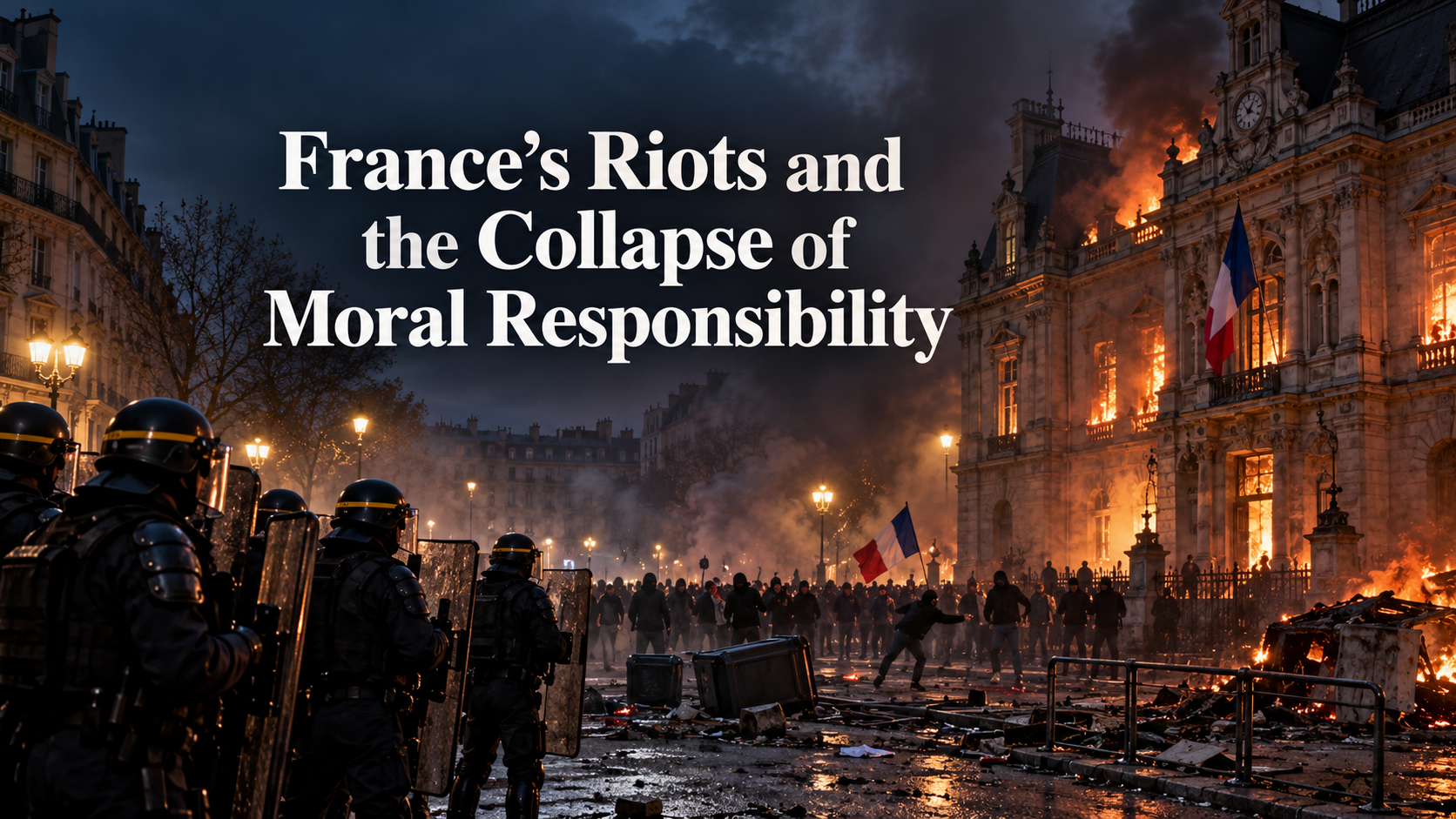
France’s burning streets have exposed a crisis deeper than failures of policing or public provision. A civilisation increasingly uncertain of its Christian inheritance now struggles to sustain moral responsibility, social cohesion and legitimate authority, while organised ideological movements, including political Islam, retain the conviction and institutional purpose which much of Europe has abandoned. The question is no longer simply how France restores order, but what moral and spiritual order it intends to restore.
France’s burning streets have exposed the contradictions of a civilisation which increasingly enjoys the inheritance of Christianity while repudiating the principles that helped create it. The destruction of Limoges Town Hall on 17 October 2026, the looting of businesses, attacks upon public institutions and violence against police officers were not simply evidence of inadequate security or political frustration. They revealed the consequences of a deeper disorder in which grievance is increasingly detached from personal responsibility, established authority struggles to command allegiance and the common good competes with the demands of ideological movements. The material destruction was immediate and spectacular; the erosion of the moral and spiritual convictions upon which ordered society depends has been proceeding for generations.¹
The immediate causes of the disturbances were neither uniform nor exclusively ideological. Legitimate protests concerning education, living standards and public services were accompanied by revolutionary agitation, ultra-left activism and opportunistic criminality. French authorities identified radical-left groups among those responsible for the violence. Yet the deeper question extends beyond the identification of individual perpetrators. The Anglican commentator Mike Starkey recognised in the disturbances the consequences of a revolutionary and postmodern culture increasingly suspicious of objective truth and inherited authority. Ayaan Hirsi Ali, interviewed by Steven Edginton on 20 October, identified another dimension: the failure of European governments to defend the social contract, the inadequate integration of newcomers and the continuing ambitions of organised political Islam. Taken together, these observations raise a question which neither increased public expenditure nor more effective policing can answer: what unifying moral inheritance does contemporary France still possess the confidence to transmit?²
The relevance of Islamism cannot be dismissed simply because the October disturbances have not been shown to constitute a Muslim Brotherhood operation. The distinction between the immediate organisation of particular riots and the longer-term influence of religious-political movements is necessary, but it does not render the latter irrelevant. France’s own Ministry of the Interior recognised the seriousness of the issue in May 2025, publishing its investigation into the Muslim Brotherhood and political Islam. Researchers including Florence Bergeaud-Blackler and Bernard Rougier have examined the methods through which Islamist networks seek influence in education, religious associations, community institutions and political life, including attempts to shape the conduct and loyalties of Muslim communities themselves. Their findings raise substantive questions about ideological organisation, religious authority and the obligations of citizenship. These matters deserve examination according to the evidence, not silence imposed by the fear that criticism of political Islam must necessarily constitute hostility towards Muslims.³
The deeper indictment, however, concerns Europe itself. Secularism has progressively weakened Christianity’s authority in public life; multiculturalism has too often substituted the management of differences for the transmission of a common inheritance; identity politics has encouraged competing grievances where shared obligations ought to unite; and educational institutions have increasingly struggled to explain the relationship between liberty, truth and virtue. Meanwhile, movements possessing comprehensive religious or political convictions continue to form adherents and cultivate institutional influence. Most troubling of all, the Catholic Church, whose faith helped form Europe’s civilisation, has too often appeared more concerned to accommodate prevailing secular assumptions than to confront them with the claims of Christian truth. The result is not merely political uncertainty or cultural fragmentation, but a crisis of civilisational purpose. Europe increasingly struggles to explain what it believes, what it expects of those who join it and what it considers worthy of defending. The answer cannot lie simply in recovering the mechanisms of public order, but in restoring the moral and religious foundations without which that order cannot endure.
Indeed, the French state had recognised the challenge of organised political Islam well before the present disturbances. In May 2025, the Ministry of the Interior published Frères musulmans et islamisme politique en France, following an investigation commissioned in April 2024. The inquiry examined Islamist separatism, institutional influence, religious associations, educational activity and the possibility of developing political authority through local networks. Its concern extended beyond overt revolutionary violence to influence exercised through ordinary institutions and social structures. The report’s conclusions have been disputed, including by specialists who question the present organisational strength of the Brotherhood. Nevertheless, the investigation demonstrates that the phenomenon has become a recognised subject of French public policy, not merely a preoccupation of political commentators.⁴
One of the most significant researchers in this field is Florence Bergeaud-Blackler, the CNRS anthropologist whose work examines what she terms frérisme, the political and social strategy associated with Brotherhood networks. Responding to the French government’s investigation in May 2025, she described its publication as « une prise de conscience » — an awakening of awareness. In her research, the central danger is not limited to isolated extremists or occasional acts of violence. It concerns the formation of an organised religious-political counter-society capable of establishing influence within institutions while retaining objectives fundamentally different from those of the surrounding society.⁵
The significance of her work became particularly apparent in reporting by Le Point concerning an internal training manual associated with networks historically linked to the Muslim Brotherhood. Bergeaud-Blackler and Bernard Rougier examined the importance of such material for understanding methods of ideological formation and institutional influence. The publication’s investigation provides a concrete basis for scrutiny, although the complete original document has not been independently examined for this editorial. Its reported contents should therefore be treated as evidence presented through the newspaper’s investigation rather than as an independently authenticated primary source.⁶
Such evidence deserves serious consideration because ideological influence does not necessarily begin with political office or public confrontation. It may develop through the patient formation of individuals, the establishment of associations, the provision of educational and charitable activities, and the cultivation of relationships with public authorities. None of these activities is inherently illegitimate. Catholic institutions themselves have historically undertaken religious formation, education and charitable work. The decisive questions concern the doctrine being transmitted, the political objectives being pursued, the transparency of organisational relationships and the methods by which influence is obtained.
Bernard Rougier, the French political scientist whose research examines Islamist networks and their influence upon local communities, introduces another important dimension. In an interview published by Le Point on 23 May 2025, he declared: « Le musulman non islamiste est la cible réelle des Frères musulmans » — the non-Islamist Muslim is the Muslim Brotherhood’s real target. His argument challenges the assumption that Islamist political organisation should be understood principally as a confrontation between Muslim and non-Muslim populations. It may also involve competition for authority within Muslim communities themselves.⁷
That distinction is essential. Muslims who reject Islamist political objectives may experience pressure from movements seeking to define authentic religious belonging in increasingly political terms. The preservation of individual conscience, the protection of lawful civic participation and resistance to coercive communal control are therefore relevant to Muslim citizens no less than to their non-Muslim neighbours. A movement seeking to monopolise religious representation or exert political pressure through communal institutions requires scrutiny because of its conduct and objectives, not because its members belong to a particular ethnic population.
The possibility of such institutional influence becomes more consequential when a receiving society has ceased to articulate clearly the obligations attached to membership. Contemporary multiculturalism has frequently promised social harmony through the recognition of difference without adequately explaining the nature of the common good. Integration cannot consist merely in the geographical coexistence of communities whose political, moral and cultural commitments remain permanently separate. A nation possesses an inherited public life, established institutions, obligations of citizenship and standards of conduct which make cooperation possible.
Here the effects of secularism and identity politics converge. A society which repeatedly teaches that its own historical inheritance consists chiefly of oppression, exclusion and injustice may struggle to communicate why newcomers should share that inheritance. Historical wrongs require honest acknowledgement, but they do not erase the positive achievements of a civilisation or the obligations necessary for its continuation. When national identity becomes primarily an object of embarrassment, common citizenship risks being reduced to administrative status rather than participation in a recognisable moral and cultural order.
The same difficulty arises where diversity, equity and inclusion policies cultivate permanent categories of collective grievance rather than a shared understanding of justice. Equality before the law and fair treatment of individuals remain genuine goods. Yet a political culture organised primarily around competing identities may weaken the loyalties which permit different communities to recognise common obligations. A civilisation cannot be held together indefinitely by procedures for adjudicating competing resentments. It requires a substantive account of the good which its members are expected to pursue together.
Hirsi Ali’s personal reflections on integration deserve attention in this context. Recalling her arrival in the Netherlands in 1992, she describes her astonishment at the relative absence of public violence and the security she experienced in ordinary social life. Having grown up in societies marked by political instability and coercion, she recognised that European peace depended upon habits and institutions which could not simply be taken for granted. Her contention is that newcomers require an understanding of the moral expectations which sustain their receiving society: obedience to legitimate law, respect for others, participation in civic life and the rejection of violence as a means of settling ordinary disputes.³
This is not an argument that people from particular backgrounds are incapable of integration. It is an argument that integration requires formation. Nor should a government imagine that merely admitting people into its territory will automatically confer upon them the habits necessary for peaceful social life. Language, education, employment, civic instruction, safeguarding and genuine engagement with the surrounding society all matter. So too does the responsibility to identify organisations which actively discourage such engagement or promote political objectives incompatible with lawful public order.
The consequences of inadequate integration are often concentrated in neighbourhoods already experiencing serious pressures upon housing, schools, healthcare and employment. Hirsi Ali argues that poorer communities bear a disproportionate share of the resulting difficulties while wealthier citizens remain comparatively insulated. These concerns require examination through evidence rather than presumption. Yet the moral point remains: public policy must consider not only those seeking admission or assistance, but also the existing communities expected to accommodate the practical consequences of governmental decisions.
The disorder of October 2026 has also revealed the economic fragility of the French state. Writing for Chatham House on 22 October, Grégoire Roos observed that France’s public debt was approaching 119 per cent of GDP, while the destruction associated with the disturbances was projected to exceed €1.2 billion. The latter figure was an estimate, not a final audited total. The burden of restoring businesses and infrastructure nevertheless threatens to fall upon taxpayers, insurers and shopkeepers already struggling with economic uncertainty. Those who destroy public assets in the name of improved public services thereby impose additional costs upon the society whose resources they claim are inadequate.⁸
Roos also drew attention to the extraordinary contrast between the peaceful reception of Pope Leo XIV in France and the violence which erupted only weeks later. In his analysis, the two events suggest a society searching for direction amid political fragmentation and uncertainty about the future. The observation is important because it moves beyond the immediate management of disturbances. A government may disperse rioters and repair buildings while remaining unable to restore the confidence upon which stable political life depends.
That difficulty has a specifically moral character. The state cannot manufacture a common purpose merely through public expenditure. Nor can economic prosperity substitute indefinitely for an account of what human beings owe one another. A society may possess extensive infrastructure, sophisticated technology and considerable material wealth while lacking the virtues necessary to preserve them.
The French Catholic response to the disturbances provides a valuable corrective to explanations confined to economics or partisan politics. Cardinal Jean-Marc Aveline, Archbishop of Marseille, issued a statement on 18 October identifying the destruction inflicted upon his city. He reported that shops had been looted, churches forcibly entered, the city hall invaded and damaged, a police station ransacked and members of the security forces attacked. He described the violence as « violences inacceptables » and appealed to citizens not to be drawn further into its destructive cycle.⁹
The reported intrusion into churches deserves particular attention. These were not merely commercial premises or instruments of public administration. They were places dedicated to divine worship. The diocesan statement did not establish the religious affiliation or motives of those responsible, and the exact circumstances of the intrusions remain important. Nevertheless, an attack upon a church concerns more than the replacement of damaged property. It violates a place which Catholics hold sacred and which possesses a distinctive significance within the religious and historical life of the community.
Such incidents acquire additional meaning in a country whose public identity remains profoundly marked by Catholicism, notwithstanding generations of secularisation. France’s churches, cathedrals, monasteries and pilgrimage sites are not simply historical ornaments. They bear witness to a civilisation whose understanding of the human person, justice, education and public duty was formed over centuries through Catholic belief. Their protection cannot be reduced to the preservation of tourist attractions or architectural monuments.
Archbishop Olivier de Germay of Lyon likewise condemned the violence in his city. He acknowledged that the disorder reflected a society experiencing profound distress, but rejected violence as a solution. His wider analysis challenged a social order driven by consumption, hedonism and individualism, arguing that material abundance cannot satisfy the deepest human search for meaning. Such reflections identify an inadequacy at the heart of the prevailing secular conception of progress: greater comfort does not necessarily produce greater virtue.¹⁰
Archbishop Vincent Jordy of Tours, speaking to Vatican News, identified the weakening of society’s shared commitments. He described a widespread anxiety concerning the future and the fragmentation of public life into competing interests. His concern was that the French increasingly struggle to recognise the common good as something exceeding the immediate demands of their own groups or circumstances. He also acknowledged that some participants were exploiting legitimate protests to pursue separate objectives.¹¹
This distinction between legitimate grievance and illegitimate exploitation is crucial. Social injustice may be real. Political authorities may have failed in their duties. Young people may experience understandable anxiety about education, employment and the future. None of these realities makes an act of violence morally good. The individual who destroys another’s livelihood remains responsible for his decision. The existence of social causes does not abolish moral agency.
The same point emerges with particular force in the observations of Abbé Vincent de Mello, published by France Catholique on 20 October. Asked what the disturbances revealed, he described the consequences of inadequate education and moral formation. His provocative declaration, « Ces violences signent l’acte de décès de Jean-Jacques Rousseau ! », connected the riots with an understanding of human nature which places insufficient emphasis upon discipline, authority and the deliberate cultivation of virtue.¹²
De Mello also identified a loss of rootedness among young people who no longer understand their obligations towards their country and its history. His concern extended to the cultivation of victimhood as an organising explanation of personal circumstances. Where an individual is taught to regard himself primarily as the victim of institutions or inherited injustices, his own moral obligations may increasingly appear conditional upon the satisfaction of his grievances.
The priest’s most important observation, however, concerns the responsibility of adults. Children cannot be expected to acquire mature judgment without formation. Parents, teachers, clergy and communities must communicate standards of conduct and provide examples of self-discipline. A society which abandons these duties cannot reasonably expect its youngest members to develop the virtues which it has neglected to teach.
De Mello places particular emphasis upon the patronage, the Catholic tradition of organised educational, recreational and spiritual activities for young people. This is a significant practical proposal because it addresses the formation of the person outside the classroom as well as within it. The solution is not simply additional instruction or more elaborate educational administration. It is the recovery of institutions through which young people encounter responsible adults, learn cooperation and discover obligations extending beyond themselves.
St Thomas Aquinas understood virtue as a stable disposition directing human faculties towards the good. Prudence, justice, fortitude and temperance do not emerge automatically from economic security or technological progress. They require formation, repeated practice and the recognition of standards which the individual does not invent. A young person who has never learned self-command will not necessarily acquire it because a government provides improved facilities or greater material opportunities.
The philosophical problem is therefore inseparable from the educational one. France’s revolutionary inheritance gave political prominence to liberty, equality and fraternity, but those ideals cannot define themselves. Liberty for what purpose? Equality according to what understanding of justice? Fraternity founded upon what recognition of human nature? Detached from the natural law and an objective moral order, the language of rights can be invoked to contradict the very duties which make rights meaningful.
Modern intellectual movements have further complicated this inheritance by encouraging suspicion towards claims of objective truth and established authority. Such suspicion may expose genuine abuses, but when elevated into a comprehensive philosophy it risks making every moral judgment appear merely an instrument of power. If truth is reduced to social construction, the condemnation of wrongdoing becomes difficult to distinguish from the imposition of one group’s preferences upon another.
The resulting moral incoherence is visible wherever individuals demand justice while denying their obligations towards those who disagree with them. Property may be destroyed in the name of social improvement; intimidation may be exercised in the name of liberation; political dissent may become an excuse for cruelty. The vocabulary of morality survives while its objective foundations are increasingly disputed.
The Church’s traditional understanding of liberty provides an altogether different foundation. Leo XIII, particularly in Immortale Dei and Libertas Praestantissimum, taught that genuine human freedom is perfected through conformity to reason and the moral law. Freedom does not consist in the unrestricted exercise of individual will. Its proper purpose is the pursuit of the good. A man governed by anger, greed or appetite is not made more free by the absence of restraint. He is increasingly subject to passions which he has failed to master.¹³
Catholic political teaching likewise understands legitimate authority as a moral office directed towards the common good. St Thomas Aquinas defines law as an ordinance of reason promulgated by one entrusted with the care of the community. Such authority is not justified merely by the possession of coercive power. It must serve justice, protect the innocent and recognise obligations derived from the natural law.
This has consequences both for governments and for those who oppose them. The state may not neglect its responsibility to maintain public order. Equally, citizens cannot claim that legitimate grievances grant unlimited permission to employ violence. The proper exercise of authority and the proper exercise of freedom are both subject to the same objective moral order.
The historical experience of France supplies a warning. The Revolution’s proclamation of emancipation was accompanied by the persecution of clergy, suppression of religious communities and attempts to reconstruct public life without reference to the Church’s authority. The revolutionary state claimed powers over religious and social institutions which earlier Catholic political thought would have regarded as incompatible with the proper limits of temporal government.
The contemporary secular settlement has inherited aspects of this rupture. Religion may be tolerated as an expression of personal conviction while its claims concerning public truth are treated with suspicion. Yet the continuing vitality of organised political religions demonstrates that secularisation does not necessarily eliminate religion from public affairs. It may instead weaken one religious inheritance while leaving the political order uncertain how to respond to others.
This is why the challenge of Islamism cannot be understood solely through the assumptions of secular liberalism. Traditional Catholic doctrine does not teach that religious truth and error possess identical claims upon the conscience or that political society is ultimately indifferent to divine revelation. The Church’s historical teaching concerning the Social Kingship of Christ recognises obligations extending beyond private devotion into the moral life of societies.
Such teaching also requires careful distinctions. The Church’s obligation to proclaim the truth does not abolish the dignity of those outside her communion. Criticism of Islamic doctrines or Islamist political programmes must concern what they actually teach and seek to accomplish. It cannot justify the indiscriminate condemnation of persons on account of ancestry or religious identification. The point is not to make theological disagreement disappear, but to ensure that it is conducted according to truth and justice.
For Catholics, the present crisis therefore raises a question considerably more serious than whether secular governments can successfully control particular political movements. It asks why historically Christian societies have so extensively neglected the formation and transmission of their own religious inheritance.
Hirsi Ali’s criticism of Western complacency is especially pertinent here. She observes that ideological movements possessing a coherent understanding of religious and political purpose may continue to establish institutions, form adherents and seek influence while historically Christian communities retreat from sustained public engagement. The comparison concerns organisation and conviction, not a suggestion that Catholics should imitate coercive or deceptive political methods.
The practical question is whether the Church still believes that she possesses a truth which must be communicated to society, or whether her activities have increasingly been reduced to accompanying the social changes determined by others.
The French Bishops’ Conference issued a letter to young Catholics on 22 October, following the violence. Drawing upon Pope Leo XIV’s recent address to young people in France, the bishops urged them to resist pride, greed and violence while seeking justice, faith, charity and peace. The letter reminded its readers that Christian commitment requires action rather than resignation and encouraged young Catholics to discern how they might serve their communities.¹⁴
That intervention contains an important principle. Catholic youth cannot be formed merely through the rejection of violence. They must be given something worthy of their positive commitment: the pursuit of holiness, the service of their neighbours, the defence of justice and the active transmission of the Faith. A Church which merely warns young people against social disorder without offering them a demanding and coherent Christian vocation risks leaving them susceptible to more assertive ideological movements.
Yet the responsibility extends far beyond the young. Catholic clergy, parents, educators, religious communities and lay associations must recover a sense of deliberate missionary purpose.
The Catholic Duty: From Lamentation to Restoration
The Church was not established merely to preserve the memory of Christian civilisation or to offer pious reflections upon its disappearance. She was established to proclaim the Gospel, sanctify souls and bring the nations to the knowledge of Jesus Christ. The restoration of Christian society cannot therefore be delegated to politicians, public authorities or secular institutions, however necessary their proper functions remain. It must begin with Catholics recognising that the Faith makes claims upon the whole of human life, including education, family relations, economic conduct, civic responsibility and the exercise of public authority.
The first responsibility belongs to the clergy. Priests must recover confidence in preaching the whole Catholic Faith: the reality of sin, the necessity of repentance, the obligations of the natural law, the virtues necessary for social life, the duties of parents and the ultimate accountability of human beings before God. The pulpit cannot become merely another platform for repeating the language of secular humanitarianism. Christian charity is indispensable, but it cannot be separated from the truth about man’s nature, moral responsibility and supernatural destiny.
A priest who speaks readily about solidarity but seldom about judgment, grace, sacramental discipline or the Kingship of Christ leaves his people inadequately formed to confront the prevailing moral confusion. Nor is this simply a question of adopting a more combative rhetorical style. It requires serious doctrinal instruction, sound moral theology, reverent worship and the consistent example of priestly life.
The second responsibility belongs to Catholic families. Christian civilisation was not principally established through government decrees. It grew through households in which children learned to pray, obey legitimate authority, distinguish good from evil and understand their responsibilities towards others. Parents must recover their role as the first educators of their children rather than surrendering moral formation entirely to schools, entertainment, digital culture or the ideological assumptions of contemporary society.
Family prayer, the Rosary, the observance of Sunday, instruction in the Catechism, the practice of charity and the cultivation of personal discipline are not nostalgic survivals of an earlier age. They are the ordinary foundations of Christian social life. The child who learns obedience, self-restraint and charity within the family acquires dispositions essential to the responsibilities of adulthood and citizenship.
Catholic education must recover the same purpose. The formation of young people cannot be measured exclusively through academic attainment, employment prospects or technical competence. It must communicate the nature of truth, the requirements of justice, the meaning of virtue and the responsibilities accompanying freedom. Catholic schools should transmit the intellectual, philosophical and spiritual inheritance of the Church without embarrassment, including the historical contribution of Catholicism to European civilisation.
The observations of Abbé de Mello offer a practical model. Catholic patronages, youth associations, sporting organisations, drama groups, educational societies and other institutions can provide opportunities for young people to encounter responsible adults, develop their abilities and learn cooperation within a Christian moral environment. Such initiatives will not solve every social problem, but they can contribute to the restoration of the institutions through which character is formed.
Catholic laypeople likewise possess obligations extending beyond attendance at Mass. They should participate intelligently and courageously in the affairs of their communities, serving where appropriate on school governing bodies, local councils, charitable organisations, professional associations and civic institutions. Catholic social teaching should inform their consideration of education, public order, immigration, safeguarding, religious freedom, social cohesion and the common good.
Such engagement must remain recognisably Catholic. It cannot consist merely in adopting the slogans of competing political factions or treating the Church’s moral teaching as subordinate to partisan loyalty. The Catholic understanding of justice is broader than any contemporary political programme, and the obligations of charity cannot be suspended according to political preference.
The evangelisation of Europe must also recover urgency. Hirsi Ali’s question about the absence of effective Christian missionary activity deserves a direct answer. If other religious movements are energetically establishing institutions, transmitting doctrine and seeking adherents, Catholics cannot respond merely by complaining about the loss of Christianity’s historic cultural position. They must preach, teach, catechise, baptise, invite and establish communities capable of sustaining an authentically Christian life.
This includes the evangelisation of those who have abandoned Christianity, those who have never encountered it and those belonging to other religions, including Islam. The Church’s missionary obligation cannot be set aside because religious disagreement is culturally uncomfortable. The proclamation of Christ must be charitable, truthful and free from coercion, but it must also be unmistakable in its purpose: the conversion of souls and their reconciliation with God through Jesus Christ.
Particular attention should be directed towards communities experiencing poverty, fragmentation and cultural separation. Catholics must not retreat into comfortable religious enclaves while lamenting the condition of neighbourhoods beyond them. Parishes, missions, oratories and charitable associations should become recognisable centres of spiritual and practical assistance, offering hospitality, catechesis, support for families, education and opportunities for genuine encounter.
The point is not simply to reproduce secular welfare provision under Catholic sponsorship. Material assistance is an authentic work of charity, but the Church’s distinctive responsibility extends to the spiritual good of those she serves. Her charitable activity should be inseparable from the witness of Christian belief, even while respecting the conscience and dignity of every recipient.
Catholic organisations must consequently examine the purposes for which they exist. Schools, charities and associations should remain faithful to their professed doctrines, transparent about their activities and capable of distinguishing cooperation for the common good from partnerships which compromise essential principles. A Church uncertain of its own mission cannot reasonably expect to exercise a coherent influence upon wider society.
The traditional liturgical and devotional life of the Church is indispensable to this work. The Holy Sacrifice of the Mass, frequent Confession, Eucharistic adoration, the Rosary, fasting and the observance of the Christian year form dispositions which no political movement can manufacture. The liturgy teaches the primacy of God; sacramental discipline teaches the seriousness of sin and grace; prayer cultivates humility; penance strengthens self-mastery; and genuine charity teaches responsibility for one’s neighbour.
These are not distractions from the social crisis. They address its deepest spiritual causes. A civilisation cannot be restored merely through external organisation if the persons inhabiting it remain governed by pride, resentment and appetite.
The centenary context of Pope Pius XI’s Quas Primas, which instituted the Feast of Christ the King in 1925, makes its teaching particularly pertinent. Written amid the political and spiritual upheavals of twentieth-century Europe, the encyclical insisted that peace could not be securely established while individuals and states rejected the sovereignty of Christ. The Kingship of Christ is not simply an interior devotion. It expresses the truth that human societies, no less than individuals, remain subject to the moral authority of God.¹⁵
That doctrine supplies a more substantial foundation for Catholic public action than either secular nationalism or the accommodation of competing ideological interests. The Church does not exist to sanctify every inherited political arrangement, nor to replace the legitimate responsibilities of civil government. She exists to proclaim the truth by which individuals and societies must ultimately be judged.
The practical programme is therefore clear. Catholic homes must recover the Faith as the organising principle of family life. Priests must restore doctrinal seriousness to preaching and catechesis. Catholic schools and youth organisations must cultivate virtue and moral responsibility. Laypeople must participate courageously in civic affairs. Missions, parishes and religious associations must renew their commitment to evangelisation. Catholic charitable works must demonstrate the union of spiritual purpose and practical service. And all such activity must be sustained by prayer, sacramental life and fidelity to the Church’s traditional teaching.
None of these responsibilities requires Catholics to await a sympathetic government, an ideal cultural climate or the restoration of perfect ecclesiastical conditions. Every Catholic possesses duties proportionate to his state of life, abilities and opportunities. A parent forming children in the Faith, a priest preaching unpopular truths, a teacher communicating Catholic doctrine, a layperson defending justice in public office and a volunteer assisting the poor each contributes to the recovery of that moral order whose absence has become so painfully apparent.
Nor should Christian engagement be confused with an obligation to minimise genuine ideological conflicts. Political Islam, revolutionary extremism, secularism and religious indifferentism raise substantive questions about the principles upon which society is organised. Catholics are entitled, and sometimes obliged, to examine those principles critically. Such examination must proceed through evidence, sound reasoning and fidelity to the truth, rather than collective suspicion or indiscriminate hostility.
France’s present predicament therefore reveals several converging crises. There is the immediate failure of public protection, the deterioration of confidence in political authority, the attraction of revolutionary violence, the fragmentation of national identity and the difficulty of sustaining integration in a society uncertain of its own inheritance. There is also the documented challenge of organised political Islam, whose methods and objectives deserve sustained scrutiny. Beneath these questions lies a more fundamental difficulty: the weakening of the conviction that liberty is ordered towards truth and that human societies remain accountable to a moral law they do not create.
No government can resolve such problems solely through additional police powers, although protecting citizens and punishing wrongdoing remain essential duties of legitimate authority. Neither can increased public expenditure, however necessary in particular circumstances, restore the moral foundations of a society which no longer knows what it intends to transmit to the next generation.
Europe will not recover its Christian inheritance through nostalgia, resentment or political rhetoric alone. It requires Catholics who believe the Faith, practise it faithfully, teach it without apology and make its principles visible within the societies in which they live. The choice is not between withdrawal from public life and surrender to its prevailing assumptions. It is to engage society as Catholics, possessing both the charity to serve their neighbours and the courage to proclaim what they believe to be true.
France’s damaged buildings may be repaired, its broken windows replaced and its streets cleared. The recovery of a civilisation’s moral and spiritual inheritance is an altogether greater undertaking. It demands not merely the restoration of order but the recovery of the truth for which order exists.
The restoration of Christian civilisation will not begin when secular governments rediscover Christianity’s usefulness, but when Catholics themselves recover the courage to live, defend and proclaim its truth.
1. Arthur Carpentier, Police Overwhelmed by October 17 Protest Turnout, with Several Groups Getting ‘Close to the Elysée’, Le Monde, 18 October 2026; EWTN News, French Bishops Appeal for Calm as Riots and Looting Sweep France, October 2026.
2. Mike Starkey, The French Being French? What Is Behind the Recent Riots?, Psephizo, 19 October 2026; Ayaan Hirsi Ali, The Truth About France’s Muslim Riots, interview with Steven Edginton, October 2026.
3. Ayaan Hirsi Ali, The Truth About France’s Muslim Riots, interview with Steven Edginton, October 2026; Ministère de l’Intérieur, Frères musulmans et islamisme politique en France, 21 May 2025.
4. Ministère de l’Intérieur, Publication du rapport « Frères musulmans et islamisme politique en France », 21 May 2025.
5. Le Parisien, Rapport sur les Frères musulmans : « C’est une prise de conscience », estime Florence Bergeaud-Blackler, 20 May 2025.
6. Erwan Seznec, « Plus personne ne pourra nier le double discours des Frères musulmans », Le Point, 21 May 2025.
7. Erwan Seznec, Bernard Rougier : « Le musulman non islamiste est la cible réelle des Frères musulmans », Le Point, 23 May 2025.
8. Grégoire Roos, France’s Riots and Mounting Debt Reveal a Country in Disarray Ahead of Pivotal Presidential Election, Chatham House, 22 October 2026.
9. Cardinal Jean-Marc Aveline, Ne nous laissons pas emporter par l’engrenage de cette violence, Archdiocese of Marseille, 18 October 2026.
10. EWTN News, French Bishops Appeal for Calm as Riots and Looting Sweep France, October 2026.
11. Vatican News, Church in France Seeks to Help Restore a Sense of Meaning, 20 October 2026.
12. Fabrice Madouas, « Éducation : l’acte le plus politique » — Entretien avec l’abbé Vincent de Mello, France Catholique, 20 October 2026.
13. Leo XIII, Immortale Dei, 1 November 1885; Libertas Praestantissimum, 20 June 1888; St Thomas Aquinas, Summa Theologiae, I–II, qq. 90–97.
14. Conférence des évêques de France, « Notre seule arme est celle de l’amour qui se donne » : Lettre aux jeunes catholiques de France, 22 October 2026.
15. Pius XI, Quas Primas, 11 December 1925; Leo XIII, Sapientiae Christianae, 10 January 1890.



Leave a Reply