
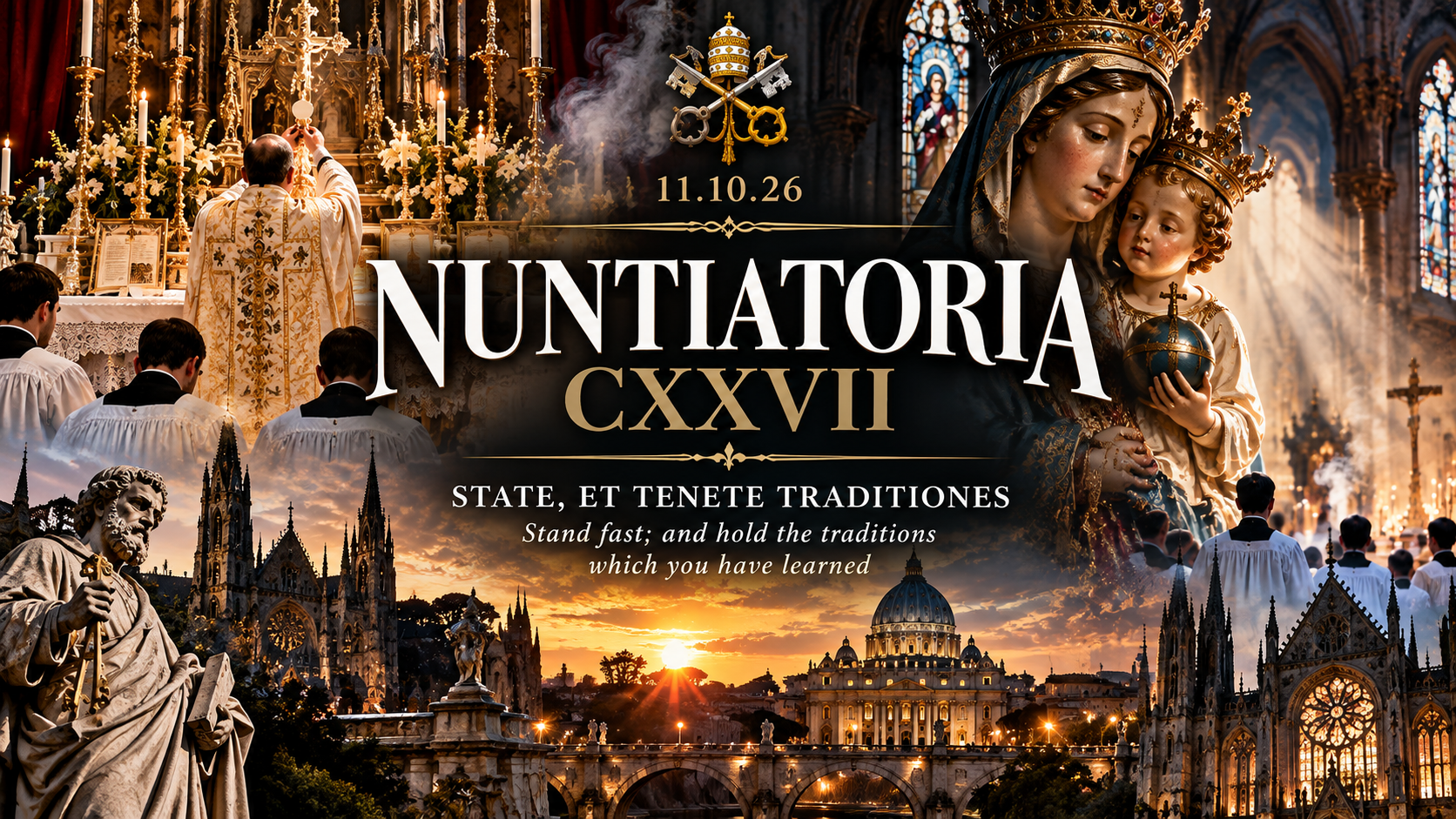
EDITORIAL “Stand fast; and hold the traditions which you have learned.”
This edition repeatedly encounters the same question in very different places: what happens when something received — biological reality, revealed doctrine, ecclesiastical law, the Roman liturgy, the supernatural order itself — becomes material for reconstruction? From school toilets and pregnancy law to women’s ordination, Marian theology, papal legitimacy, liturgical reform, Glasgow’s collapse and the recovery of Tradition among the young, the issue is not whether the Church or society may ever develop. It is whether development remains accountable to the reality from which it began. St Paul gives the necessary principle: “Stand fast; and hold the traditions which you have learned.” The Christian does not preserve everything merely because it is old. He holds fast because some things have been received, and fidelity begins by recognising that they are not ours to reinvent.
“Therefore, brethren, stand fast; and hold the traditions which you have learned, whether by word, or by our epistle.”¹ St Paul’s injunction is easily caricatured as the motto of people afraid of change. It is almost the opposite. One can only hold a tradition after receiving it, understanding what it is and knowing why it matters. The Apostle does not command attachment to habit for habit’s sake. He speaks of something learned, handed down and therefore binding upon those who have received it.
That distinction runs through this edition of Nuntiatoria. Some things are conventions and may be altered. Some are disciplines which legitimate authority may prudently reform. Some are theological opinions which may develop or even be corrected. Others arise from nature, Revelation or the constitution Christ gave His Church. Wisdom begins by knowing which is which.
The liturgy of this Sunday places that question before us at its highest level. The Feast of the Divine Maternity does not honour an agreeable piece of Marian terminology. Theotokos safeguards the identity of Jesus Christ. Mary is Mother of God because the Person whom she conceived and bore according to His human nature is the eternal Son of God. The title does not make Mary divine; it prevents Christ from being divided. Ephesus defended a truth about the Son by defending the proper title of His Mother.²
That is already a lesson in the limits of linguistic reconstruction. Nestorius could offer reasons for preferring another expression. The Church eventually judged that the proposed alternative failed adequately to protect what had been received concerning Christ. Words mattered because reality mattered.
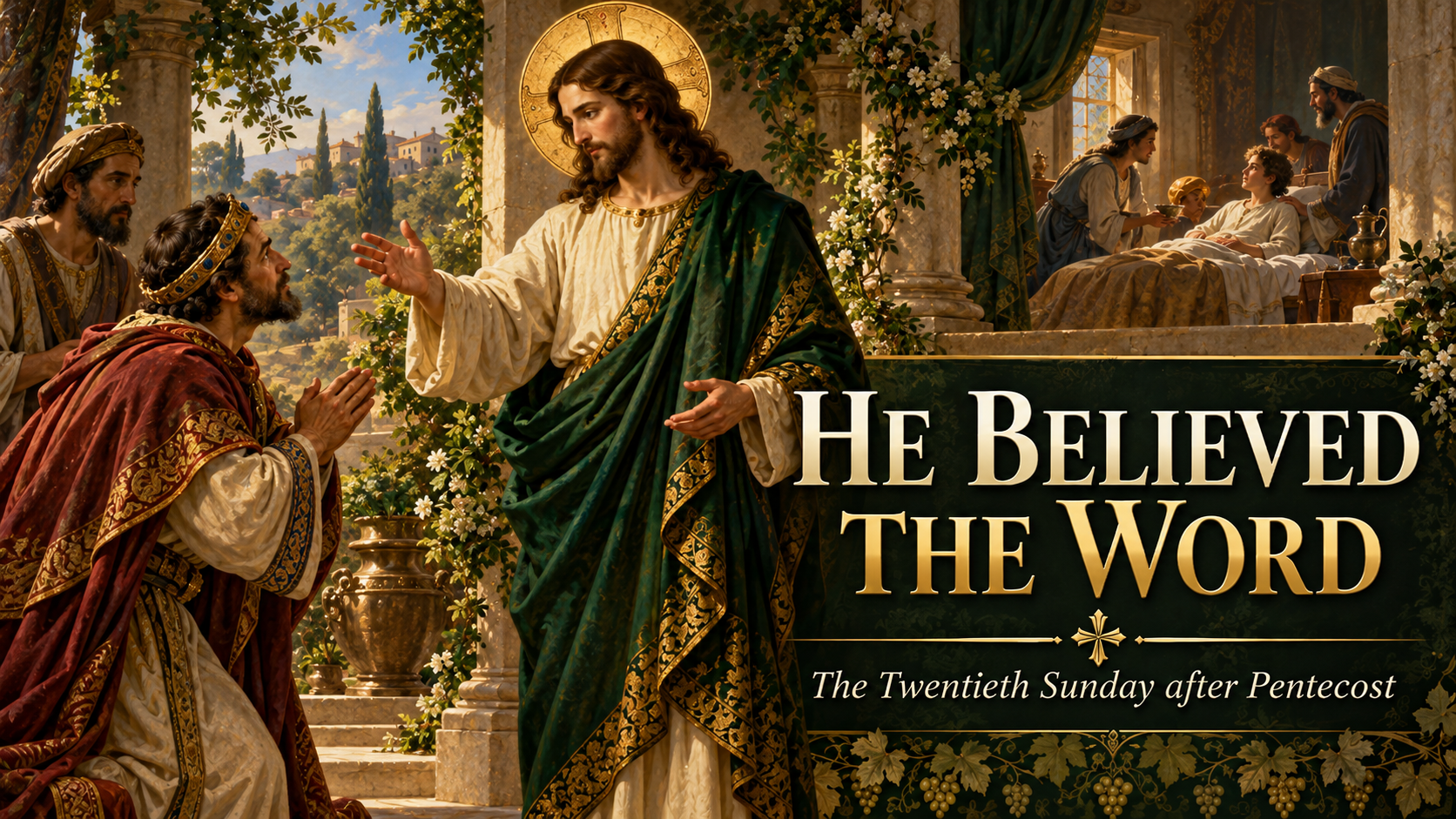
The occurring Twentieth Sunday after Pentecost supplies the corresponding lesson in faith. The ruler asks Christ to come physically to his dying son. Christ gives him instead a word: “Go thy way; thy son liveth.” The man must act before he sees. He believes Christ’s word and begins the journey home; only afterwards does visible confirmation arrive.³ Christian faith is not the manufacture of reality by conviction. It is precisely the reverse: the submission of conviction and conduct to a reality guaranteed by the truthfulness of God.
Those two liturgical themes — reality received and the word trusted — provide an illuminating way to read almost everything else gathered here.
Consider first the apparently mundane question of school toilets. Karon Monaghan KC’s Opinion has forced educational authorities to confront the difference between a cubicle and a room.⁴ The distinction sounds almost comically elementary until one remembers what depends upon it. Regulations providing separate facilities for boys and girls permit an exception where a toilet is contained within a room capable of being secured by one pupil. A lockable cubicle opening into a common mixed-sex washing and circulation area is not transformed into a self-contained room simply because policy language wishes it to be one.
The larger issue is the habit of believing that language alters the thing described. A mixed-sex facility becomes “gender-neutral”; diminished privacy becomes “safeguarding”; the removal of sex separation becomes “inclusion”. Yet boys and girls remain embodied persons. Menstruation remains a female bodily reality. Privacy does not cease to matter because architects have provided taller partitions.
The Australian controversy over “potential pregnancy” exposes the same difficulty in almost laboratory conditions. Pregnancy discrimination law exists for an intelligible reason: female persons can become pregnant and have historically suffered disadvantage because employers anticipate or respond to that possibility. Yet once the legal category “woman” is detached from biological sex while sex-specific protections remain elsewhere in the statute, the law begins struggling to explain how a person incapable of pregnancy can enter a category whose rationale depends upon the possibility of becoming pregnant.⁵
The point is not ridicule. Nor is it that people suffering gender distress should lack legal protection against cruelty or arbitrary treatment. The problem is categorical coherence. Law can create rights and prohibitions. It cannot confer reproductive capacities by definition. When legal vocabulary ceases to correspond sufficiently to material reality, contradictions migrate from one part of the statute book to another.
Something surprisingly similar can happen within ecclesiastical discourse. Pope Leo XIV’s appointment of Sister Mary Teresa Barron to senior missionary responsibilities is not objectionable because she is a woman. The difficulty concerns her recent public treatment of women’s priestly ordination as something apparently still available for discernment.⁶ The Church certainly may listen to women who believe themselves called to priesthood. She cannot therefore conclude that the sacramental possibility itself remains undecided. Ordinatio Sacerdotalis taught that the Church has no authority whatsoever to confer priestly ordination upon women and that this judgement is definitively to be held.
A subjective sense of vocation does not create sacramental capacity any more than changing a statutory definition creates biological capacity. Discernment tests an interior conviction against what has been received. It does not require Revelation and the sacramental constitution of the Church to become provisional whenever somebody sincerely experiences them differently.
Yet the Marian controversy examined elsewhere in this edition demonstrates why the word “settled” must itself be used carefully. The Dicastery for the Doctrine of the Faith has judged the title Co-Redemptrix “always inappropriate”. Cardinals Raymond Burke and Gerhard Müller have now publicly argued otherwise, while affirming without ambiguity that Christ alone is Redeemer in the primary and proper sense. Müller goes further, maintaining that the reality expressed by the title is “objectively contained in revelation”.⁷
Here the disagreement is real, but it is not equivalent to reopening the priestly ordination of women. No dogma defines that Catholics must call Mary Co-Redemptrix, nor has the title been definitively condemned as doctrinally false. The present Roman judgement is authoritative but non-definitive. It can therefore be received respectfully while its theological arguments remain capable of examination.
That distinction is indispensable. Catholic fidelity is not produced by treating every ecclesiastical statement as though it enjoyed identical authority. Neither is fidelity served by treating every inconvenient Roman intervention as disposable opinion. The Church has dogmas, definitive doctrines, authoritative non-definitive teachings, disciplines, prudential judgements and theological arguments. Confusion follows whenever these categories are flattened into either “Rome has spoken, discussion is impossible” or “nothing short of an ex cathedra definition obliges anyone to take notice”.
Our consideration of papal legitimacy makes the same point from another direction. Universal peaceful acceptance is a powerful traditional theological argument protecting the Church from endless private re-litigation of the identity of the Roman Pontiff. The visible Church cannot be expected to live indefinitely under the possibility that an amateur conclave investigator may tomorrow discover that the man universally received as Pope was never Pope at all. Yet universal acceptance must not be converted into a theory that conclave law has no real juridical content or that an election becomes valid simply because subsequent events make it convenient that it should be so.⁸
Peter is not created by opinion polling. Neither is Peter above the juridical order governing the election by which his identity becomes known. Law is real; so is ecclesial reception. Catholic theology is strongest when it refuses the artificial choice between the two.
The same refusal of false alternatives governs this edition’s treatment of the liturgical crisis. The Reform Before the Reform examines the years between Sacrosanctum Concilium and the promulgation of the new Missal, when priests and congregations were progressively taught a different relationship with inherited worship.⁹ The significance of 1965 and 1967 lies not merely in a list of altered rubrics. What changed was an instinct.
Gestures which generations of priests had been trained to perform became repetitions to be eliminated. Silence became something requiring pastoral justification. The joined canonical fingers disappeared. Signs of the Cross were drastically reduced. The Canon could be spoken aloud. Vernacularisation accelerated. Celebration facing the people spread even though Vatican II had not required it. The clergy were being taught, before the new Missal arrived, that received liturgical forms existed under a presumption of revisability.
Authority to regulate worship is not in dispute. The more difficult question is whether the manner of reform corresponded to the Council’s own principle that innovations should be introduced only where the genuine and certain good of the Church required them and that new forms should grow organically from those already existing.
That history makes Archbishop Michael McGovern’s sympathetic reflections upon young Catholics discovering the traditional Mass particularly interesting. He recognises that many are searching for roots, stability, sacredness and an inheritance larger than themselves. He compares their experience to descendants rediscovering an ancestral language.¹⁰ It is a perceptive analogy, but one whose implications reach further than the Archbishop appears willing to follow.
If young Catholics are rediscovering something their parents were not given, the pastoral question cannot merely be how to educate them into appreciating why it disappeared. Bishops must also be willing to ask whether the young have discovered something which should not have been taken from ordinary Catholic life in the first place.
The astonishing feature of the contemporary traditional revival is that so little of it can be attributed to nostalgia. A twenty-year-old Catholic in 2026 has no personal memory of parish life in 1955. He does not remember the high altar being removed because he was born after even the children of those who removed it had reached middle age. When such a Catholic learns Latin, discovers Gregorian chant, encounters the ancient Offertory, kneels at the altar rail and begins studying the traditional cycle of feasts and fasts, he is not returning to childhood. He is encountering an inheritance withheld from his childhood.
That does not make every judgement made by a traditional Catholic correct. This edition deliberately refuses such romanticism. Bishop Robert Mutsaerts’ advice that Catholics should seek spiritually sound pastoral provision applies just as readily to dysfunctional traditional chapels as to dysfunctional Novus Ordo parishes.¹¹ The ancient liturgy does not make an overbearing priest charitable, an imprudent superior wise or a factional congregation holy.
For the same reason, criticism of the reformed liturgy does not itself establish the stronger claim that every Catholic who attends it commits sin. One may judge the reform historically discontinuous, ritually impoverished and pastorally damaging without pretending that all the distinctions between validity, liceity, prudence, spiritual danger and personal culpability have therefore disappeared. That is particularly important when considering the pastoral arguments sometimes advanced by the Society of Saint Pius X.
Tradition must not reproduce the maximalism it criticises in others. A Catholic who objects when papal authority is treated as though it could turn every prudential choice into irreformable truth should be equally reluctant to grant any traditionalist organisation the practical authority to turn its disputed theological conclusions into universal moral legislation.
This is also why the ancillary character of the Old Roman Apostolate matters. Its purpose is not to persuade Catholics that they require another ecclesial identity. Catholics approaching its priests for the traditional Mass, sacramental assistance, catechesis or spiritual direction remain Catholics. Old Romans provide ministry within the irregular circumstances of the present crisis; they do not claim that every recipient of that ministry must become an Old Roman. The distinction protects the purpose of the apostolate from becoming another exercise in institutional self-perpetuation.
Glasgow shows what happens when institutional preservation becomes the dominant vocabulary of ecclesiastical crisis. Twenty-four churches face closure. The number of parishes may be halved. Weekly Mass attendance has collapsed, the diocesan clergy have fallen dramatically, and among Glasgow’s diocesan priests there is reportedly only one under the age of forty-five. Archbishop William Nolan has himself identified the essential issue: “This is not a problem of numbers. It’s a problem of faith.”¹²
That admission should change the entire discussion. If the problem is principally faith, restructuring can only manage its consequences. It cannot cure its cause.
Buildings may sometimes have to close. Parishes may require amalgamation. Priests cannot be multiplied by administrative decree. But a Church which has spent decades responding to shrinking congregations by managing the shrinkage must eventually ask why its people ceased transmitting Catholicism to their children, why vocations disappeared, why sacramental practice declined and why so much catechesis failed to produce adults capable of articulating even elementary Catholic doctrine.
The striking contrast with younger traditional communities does not prove that every difficulty would disappear if every parish adopted the old Missal tomorrow. It does prove that bishops confronting demographic collapse should be intensely interested wherever Catholic worship is attracting young adults, producing large families, encouraging frequent confession and generating priestly vocations. To observe such fruit and respond principally by explaining why its liturgical environment ought eventually to disappear would be an extraordinary failure of pastoral curiosity.
Yet even here Nuntiatoria must practise the discrimination it demands from others. “Tradition” cannot become a label attached indiscriminately to everything pre-modern, mysterious or hostile to contemporary liberalism. That is the importance of the controversy surrounding Dr Peter Kwasniewski, Sebastian Morello and the attempted rehabilitation of the language of “magic” and Hermeticism.¹³
Catholicism is supernatural. It believes in angels, miracles, sacramentals, grace, mystical contemplation and the objective efficacy of sacraments. Modern materialism does indeed impoverish reality by treating creation as though nothing exists beyond what can be weighed, quantified and manipulated. But the alternative to disenchantment is Catholic faith, not esotericism.
Not everything opposed to the Enlightenment belongs to Tradition. Paganism is older than Christianity. Divination is ancient. Hermeticism possesses antiquity. None becomes Catholic by sharing Christianity’s rejection of materialism. The Church already possesses a precise vocabulary for grace, sacrament, nature, miracle, providence, angelic action and mystical union. When “magic” must repeatedly be qualified until it means something quite different from what the word ordinarily and historically suggests, it is reasonable to ask what theological work the term is performing which Catholic language could not perform more safely.
This is not peripheral to the theme of the edition. Tradition is not the preservation of whatever modernity dislikes. It is the faithful transmission of what has been received.
St Denis and his companions, whose feast opened today’s publications, provide the sterner form of that lesson. The Gospel from St Luke warns the disciples against fearing those who can kill the body while forgetting the judgement of God. The martyrs did not preserve Christianity by making it intellectually fashionable in pagan Paris. They confessed what they had received because it was true, and accepted the consequences.¹⁴
That witness prevents “holding fast” from degenerating into cultural conservatism. Catholics are not commanded merely to preserve old buildings, old vestments, old social arrangements or old vocabulary. They are commanded to keep the Faith. Everything else must finally be judged by its relationship to that purpose.
The Ordo for the coming week makes the same point quietly through the Church’s calendar. The Divine Maternity, St Wilfrid, St Edward the Confessor, St Callistus, St Teresa of Jesus, St Hedwig, St Margaret Mary and St Luke are not exhibits in an ecclesiastical museum. Their feasts make different ages, nations and vocations contemporaneous at the altar. England remembers Wilfrid’s Roman fidelity; Spain honours Our Lady of the Pillar; the Philippines recalls La Naval and the Marian inheritance of Zamboanga; regional traditions in France, Germany, the Low Countries and Central Europe remain visible within the wider Roman order.¹⁵ Universality does not require historical amnesia. Catholic unity has always been capable of containing legitimate local memory precisely because both are ordered to the same Faith.
Perhaps that is the distinction our age finds hardest to understand. Tradition is neither immobility nor permanent reconstruction. A living thing develops according to what it is. An oak grows because it remains an oak. Doctrine deepens because the same Revelation is understood more explicitly. Liturgy develops because inherited worship accumulates expressions of faith and devotion. Law adapts because justice must be applied to changing circumstances. None of these processes requires the original reality to become negotiable.
The Church may develop her explanation of the divine maternity; she may not discover that Christ is two persons. Theology may debate the usefulness of Co-Redemptrix; it may not invent a second Redeemer. Canon law may regulate papal elections; it may not create a papacy independent of Christ. Liturgical authority may reform discipline; it cannot make yesterday’s sacred inheritance contemptible merely because tomorrow’s committee prefers another arrangement. Civil law may protect every person from injustice; it cannot make male bodies potentially pregnant. Pastoral sensitivity may accompany a person through confusion; it cannot demand that truth become confused in sympathy.
And traditional Catholics themselves are subject to exactly the same rule. They may resist destructive innovation; they may not turn resistance into a substitute magisterium. They may recover what modern ecclesiastical culture neglected; they may not baptise everything modernity rejected. They may defend the old Mass; they may not suppose its celebration dispenses them from charity, humility or obedience to truth.
The ruler in Sunday’s Gospel finally shows what holding fast looks like when stripped of every cultural association. Christ speaks. The man believes. Then he walks.
He does not yet see his son restored. He possesses no confirming message from home. He cannot explain how Christ will accomplish at a distance what he had assumed required physical presence. He has only the word of One whom he has learned to trust.
Our Lady stands before the Church in an even more perfect obedience. Fiat mihi secundum verbum tuum. Her faith does not manufacture the Incarnation. It receives the word through which God accomplishes it.
That is the opposite of the modern desire to construct reality through assertion. Christian faith begins in receptivity. God speaks before man answers. Creation exists before ideology names it. Revelation is given before theology explains it. Christ institutes before the Church administers. The Apostles hand on before succeeding generations receive.
There is freedom within that inheritance because Catholic Tradition is immensely richer than ideological uniformity. There is legitimate development, theological argument, canonical prudence and pastoral adaptation. But there are also boundaries, because a religion in which everything may perpetually be reopened eventually possesses nothing definite enough to hand on.
The injunction of St Paul is therefore neither fearful nor nostalgic. It is missionary. One cannot transmit what one has first dissolved.
State, et tenete traditiones, quas didicistis.
Stand fast, then. Hold the traditions which you have learned. Receive accurately. Distinguish carefully. Reform prudently. Correct where necessary. Develop what can genuinely develop. But when something has been given by God, established in nature, defined by the Faith, or faithfully handed down through the life of the Church, do not imagine that progress consists in forgetting what it is.
Only a Church which knows what she has received can know what she is commanded to hand on.
¹ Douay-Rheims Bible, 2 Thessalonians 2, v. 15: “Therefore, brethren, stand fast; and hold the traditions which you have learned, whether by word, or by our epistle.”
² Nuntiatoria, THE MOTHER OF GOD: THE DOCTRINE THAT SAFEGUARDS THE INCARNATION, 9 October 2026.
³ Nuntiatoria, HE BELIEVED THE WORD: FAITH, OBEDIENCE AND THE POWER OF CHRIST: The Twentieth Sunday after Pentecost, 9 October 2026.
⁴ Nuntiatoria, A CUBICLE IS NOT A ROOM, 9 October 2026.
⁵ Nuntiatoria, WHEN POTENTIAL PREGNANCY NO LONGER REQUIRES THE POSSIBILITY OF PREGNANCY, 9 October 2026.
⁶ Nuntiatoria, WHEN SETTLED DOCTRINE BECOMES AN OPEN QUESTION, 9 October 2026.
⁷ Nuntiatoria, CO-REDEMPTRIX: WHEN “ALWAYS INAPPROPRIATE” MEETS “OBJECTIVELY CONTAINED IN REVELATION”, 9 October 2026.
⁸ Nuntiatoria, PETER, LAW AND UNIVERSAL ACCEPTANCE, 9 October 2026.
⁹ Nuntiatoria, THE REFORM BEFORE THE REFORM, 9 October 2026.
¹⁰ Nuntiatoria, THEY ARE LOOKING FOR ROOTS — WHY ARE WE STILL TRYING TO EDUCATE THEM OUT OF THEM?, 9 October 2026.
¹¹ Nuntiatoria, WHEN A PARISH HARMS THE FAITH: BISHOP MUTSAERTS, THE LATIN MASS AND THE SSPX, 9 October 2026.
¹² Nuntiatoria, GLASGOW: YOU CANNOT RESTRUCTURE A CHURCH BACK TO LIFE, 9 October 2026.
¹³ Nuntiatoria, DR PETER KWASNIEWSKI AND THE OCCULT, 9 October 2026.
¹⁴ Nuntiatoria, Today’s homily: St Dennis, Bishop with Rusticus & Eleutherius, Martyrs, 9 October 2026.
¹⁵ Nuntiatoria, ORDO w/c 11.10.26, 9 October 2026.
IN THIS EDITION
- 11.10.26 Nuntiatoria CXXVII: STATE, ET TENETE TRADITIONES
 This edition explores the tension between preserving traditions and responding to contemporary challenges within the Church. It emphasises the need for accountability in developments related to doctrine, liturgy, and law, while asserting that fidelity to received teachings is crucial. The necessity of discerning between genuine tradition and change is highlighted.
 - ORDO w/c 11.10.26
 The week of 11–18 October begins with the feast of the Divine Maternity of Mary, involving reflections on the Incarnation, faith, and Christian authority. Significant saints, including St Luke and St Edward, are commemorated. Local traditions across various countries highlight Spain, the Philippines, England, and France, enriching the universal calendar.
 - HE BELIEVED THE WORD: FAITH, OBEDIENCE AND THE POWER OF CHRIST: The Twentieth Sunday after Pentecost
 The Twentieth Sunday after Pentecost highlights a father’s journey from desperation to faith as he seeks healing for his dying son. Christ’s command to believe without needing visible signs teaches about divine authority and the necessity of supernatural faith. This message emphasises the importance of understanding God’s promises and remaining faithful amidst uncertainty.
 - THE MOTHER OF GOD: THE DOCTRINE THAT SAFEGUARDS THE INCARNATION
 The Feast of the Divine Maternity of the Blessed Virgin Mary, celebrated on 11 October, acknowledges Mary’s essential role as Theotokos, or Mother of God. This doctrine, affirmed at the Council of Ephesus in AD 431, highlights the unity of Christ’s divine and human natures, emphasising Mary’s significance within the Catholic understanding of the Incarnation and Redemption.
 - THEY ARE LOOKING FOR ROOTS — WHY ARE WE STILL TRYING TO EDUCATE THEM OUT OF THEM?
 Archbishop Michael McGovern acknowledges a rising interest among young Catholics in the traditional Roman Mass, driven by a search for truth and continuity. While recognising their appeal, he avoids fully embracing their concerns about post-conciliar reforms, suggesting a reluctance to question the changes that have occurred. This highlights a disconnection within the Church regarding its liturgical heritage.
 - CO-REDEMPTRIX: WHEN “ALWAYS INAPPROPRIATE” MEETS “OBJECTIVELY CONTAINED IN REVELATION”
 Cardinals Burke and Müller have reopened a question Rome appeared to have settled — and the former Prefect of the CDF has directly answered the arguments used to discourage one of Catholicism’s most contested Marian titles
 - PETER, LAW AND UNIVERSAL ACCEPTANCE
 Universal peaceful acceptance is a powerful traditional argument for the legitimacy of a Roman Pontiff. But it must not be turned into papal positivism. Catholic theology can affirm the certitude supplied by the Church’s reception of a pope while still recognising that papal elections are juridical acts governed by law.
 - THE REFORM BEFORE THE REFORMThe decisive liturgical revolution did not begin abruptly in 1969. Between Sacrosanctum Concilium and the new Missal, clergy and faithful were progressively retrained into a different ars celebrandi. The transitional reforms matter because they reveal how a new liturgical mind was formed before the new rite arrived.
- DR PETER KWASNIEWSKI AND THE OCCULT
 The controversy around Sebastian Morello’s Mysticism, Magic, and Monasteries raises a question larger than one provocative book. When defenders of Catholic Tradition rehabilitate the vocabulary of magic and Hermeticism, the burden is on them to show why language the Church has treated with grave caution should now be spiritually useful.
 - WHEN SETTLED DOCTRINE BECOMES AN OPEN QUESTION
 Pope Leo XIV’s promotion of Sister Mary Teresa Barron places a prominent Synod participant who publicly spoke of women sensing a call to priesthood or diaconate in a major missionary post. The issue is not her sex, but what such appointments communicate about questions the Magisterium says are settled.
 - WHEN POTENTIAL PREGNANCY NO LONGER REQUIRES THE POSSIBILITY OF PREGNANCY
 Australia’s Sex Discrimination Commissioner has exposed a contradiction created when gender identity is made legally operative across protections whose very rationale depends upon biological sex. The problem is not pregnancy law itself, but a legal architecture increasingly required to speak as though material realities were interchangeable.
 - WHEN A PARISH HARMS THE FAITH: BISHOP MUTSAERTS, THE LATIN MASS AND THE SSPX
 Bishop Mutsaerts urges Catholics to leave spiritually harmful parishes. The same principle applies to traditional chapels, but does that make Novus Ordo attendance sinful? An examination of the SSPX position and the Old Roman Apostolate’s ancillary mission.
 - A CUBICLE IS NOT A ROOM
 Karon Monaghan KC’s new Opinion argues that some mixed-sex and open-plan school toilets may conflict with existing law, raising serious questions about girls’ privacy, safeguarding, religious liberty and Catholic education.



Leave a Reply