
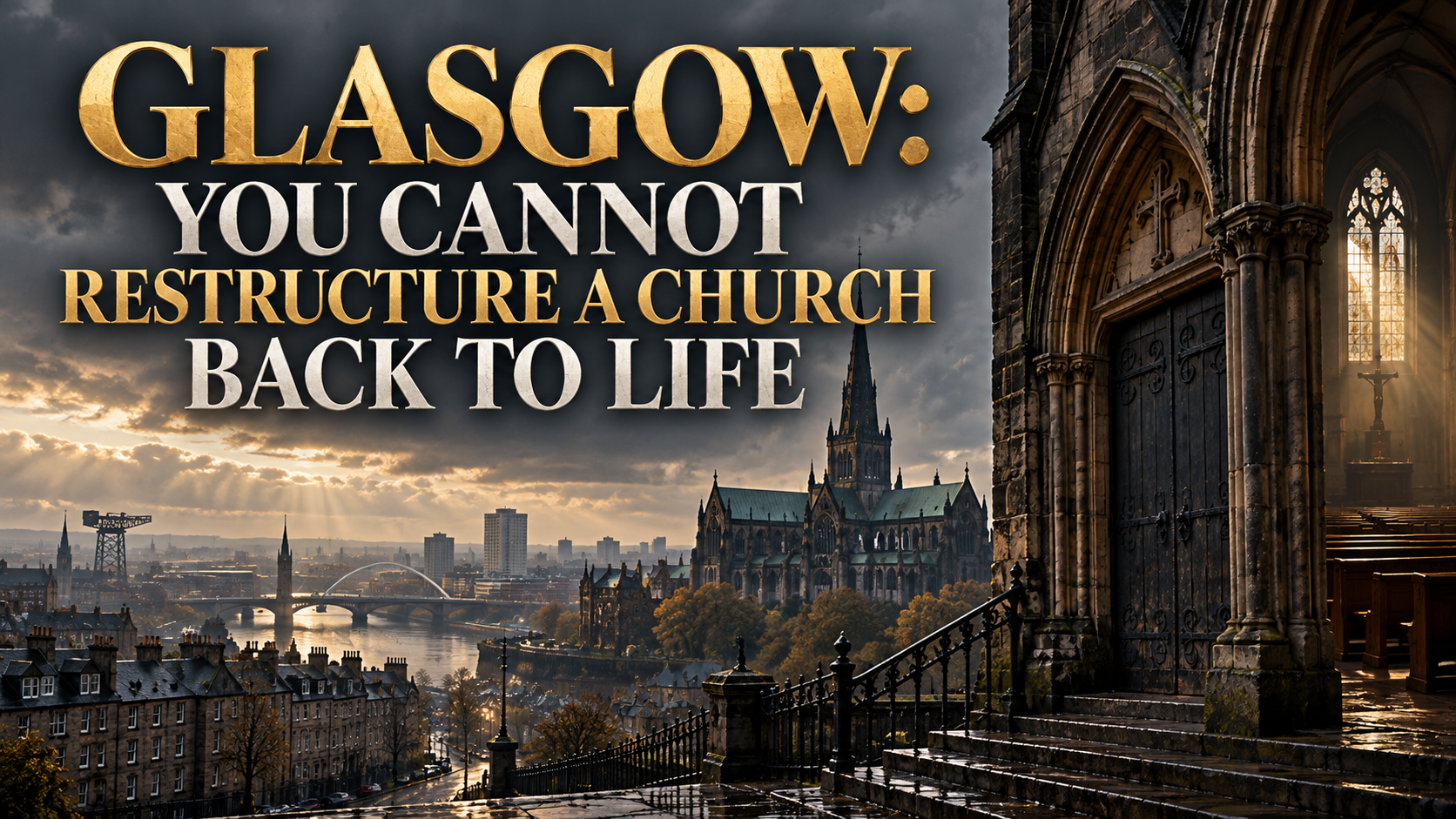
Archbishop William Nolan has acknowledged that Glasgow’s predicament is fundamentally a crisis of faith. The Archdiocese now proposes to close twenty-four churches and reduce its parishes by half, measures which may relieve immediate administrative pressures but offer no assurance of spiritual recovery. The collapse in priestly vocations, the disappearance of practising Catholics and the weakening of Catholic family life demand an examination of the pastoral assumptions which have prevailed for decades. The Church cannot continue indefinitely to adjust its structures to declining belief without asking whether its own approach to transmitting the Faith has contributed to that decline.
There are moments when a single statistic reveals more about the condition of the Church than any number of pastoral documents, consultations or episcopal statements. Glasgow has reached such a moment. Archbishop William Nolan has announced proposals to close twenty-four Catholic churches and reduce the number of parishes by approximately half, to around forty, over the next five to ten years. The number of active priests has fallen by a third during his less than five years in office, most of those remaining are over sixty, and weekly Mass attendance has reportedly fallen below 23,000. Yet the most disturbing figure is this: among Glasgow’s diocesan priests, only one is under the age of forty-five. The proposals have received approval in principle and will now proceed to local consultation. Individual closures have not yet been definitively decided, but the emergency which has prompted them is undeniable.¹
An archdiocesan assessment reported in September suggested that, if current trends continue, Glasgow could have as few as eight of its own priests remaining in active parish ministry twenty years from now. Approximately three-quarters of the diocesan clergy are already over sixty. Five seminarians were expected to be studying in Rome during 2026, but priestly formation can take eight or nine years, while retirement and ill health continue to diminish the available clergy. Religious congregations presently serve fourteen parishes, and priests from overseas provide assistance without which, as Archbishop Nolan himself acknowledges, the situation would already be considerably worse. Their generosity deserves recognition. Nevertheless, an archdiocese which increasingly depends upon clergy formed elsewhere must ask why its own Catholic population is producing so few men willing to become priests.²
The historical figures demonstrate how long this decline has been developing. Statistics derived from successive editions of the Annuario Pontificio record 338 diocesan priests in Glasgow in 1970, falling to 243 in 1990, 205 in 2000 and 111 by 2023. These figures count diocesan priests generally, rather than those available for active parish ministry, but they establish a reduction of approximately two-thirds over little more than half a century. During the same period, the recorded Catholic population declined from approximately 323,000 to 223,000. Glasgow’s nominal Catholic population has diminished substantially, while the number of its diocesan priests has fallen much more sharply. The statistics do not explain every cause of the decline, but they leave no doubt about its duration or scale.³
This is Glasgow, a city whose Catholic history was forged through the sacrifices of generations who frequently possessed very little except their Faith. Irish immigrants and their descendants, alongside other Catholic communities, built churches, established schools, supported priests and religious congregations, and created an extensive network of charitable and social institutions. Their churches were often constructed in working-class districts by people for whom the expense represented a considerable personal sacrifice. Yet those communities understood the importance of having the Holy Sacrifice of the Mass celebrated among them. Their religion was woven into family life through baptism, confession, Sunday worship, marriage, devotional societies and prayers for the dead. The parish church stood at the centre of a community because the Faith stood at the centre of its understanding of life.
Their descendants are now being told that many of those churches can no longer be maintained. Some buildings may indeed have become too expensive to repair or too sparsely attended to justify their continued use. A bishop cannot require ageing priests to maintain indefinitely a network of parishes designed for a substantially larger Catholic population. Archbishop Nolan has inherited difficult circumstances, and proposals for extensive reorganisation were already being considered under Archbishop Philip Tartaglia more than a decade ago. It would be unjust to attribute the present emergency to the decisions of one man. It would be equally mistaken, however, to treat decades of ecclesiastical decline as an unfortunate development for which nobody exercising ecclesiastical authority bears any responsibility.
In September, Archbishop Nolan made an observation which ought to govern the whole discussion. Addressing the shortage of priestly vocations, he declared: “This is not a problem of numbers. It’s a problem of faith.” He then asked how a parish could regard itself as spiritually vibrant while producing no vocations to the priesthood.² It was a remarkably candid acknowledgement. The Archbishop recognises that the shortage of priests is symptomatic of something deeper than demographic change or the difficulties of maintaining buildings. The Catholic community is struggling to reproduce its own religious life. That diagnosis demands a response directed towards the restoration of belief and practice, accompanied by an honest examination of the means through which the Church has attempted to transmit them.
For sixty years, the hierarchy has presided over profound changes in Catholic worship, catechesis, pastoral discipline and the public presentation of the Church’s mission. Throughout much of that period it has also witnessed declining Mass attendance, diminished sacramental practice, fewer religious vocations and an increasingly uncertain Catholic identity among younger generations. The coincidence of these developments does not establish that every postconciliar reform caused the decline. Britain underwent immense social changes during the same decades. Secularisation, altered family structures, geographical mobility, changing educational assumptions and the disappearance of close-knit neighbourhood communities all contributed to the weakening of religious observance. Protestant denominations have suffered comparable losses. Yet those external pressures cannot settle the question of whether the Church’s own response was effective. They make the question more urgent.
The essential distinction concerns what bishops could reasonably have controlled. They could not prevent the secularisation of British society, nor compel Catholic parents to practise their religion. They did, however, possess responsibility for the integrity of Catholic teaching, the formation of clergy, the supervision of religious education, the preservation of liturgical discipline and the spiritual direction of their dioceses. Successive episcopal appointments, educational policies, seminary programmes and pastoral priorities were decisions made within the Church. Their consequences deserve examination. It is possible to recognise the formidable external pressures upon Catholic life while also asking whether ecclesiastical leadership responded with sufficient doctrinal confidence, pastoral courage and fidelity to the Church’s inheritance.
The decline of catechesis provides an obvious subject for investigation. Catholic doctrine may remain perfectly intact in official documents while becoming increasingly unfamiliar to those who attend Catholic schools or participate in parish life. Generations of children have received religious instruction, yet many emerge with only a rudimentary understanding of the sacraments, the nature of the Mass, the necessity of grace, the reality of mortal sin or the Church’s teaching concerning salvation. This is not an accusation against every Catholic teacher or school; many have worked conscientiously under difficult circumstances. But the persistence of widespread religious ignorance demands scrutiny of what has been taught, how clearly it has been taught and whether the formation received by children has been reinforced by their families and parishes.
Similar questions arise concerning worship. The traditional Roman liturgy was shaped by centuries of organic development, during which the Church’s doctrines were expressed through gesture, ceremonial, sacred language, silence and sacrificial symbolism. Its orientation towards God, the priest’s distinctive liturgical role and the reverence surrounding the consecration communicated truths which ordinary Catholics absorbed through repeated participation. The postconciliar liturgical transformation altered that experience profoundly. The widespread adoption of celebration facing the people, vernacular worship, revised ceremonial and new forms of congregational participation was accompanied by a different manner of presenting the liturgy to the faithful. Whatever claims are advanced on behalf of those changes, their pastoral consequences should be open to examination. Where the sacrificial nature of the Mass has become less evident in popular understanding, it is reasonable to ask whether the prevailing manner of celebration and instruction has helped or hindered its transmission.
The question extends beyond liturgical preference. The priesthood itself becomes harder to understand when its supernatural purpose is obscured beneath the increasingly extensive administrative responsibilities of contemporary parish ministry. Young men are unlikely to devote their lives to the priesthood merely because an institution requires more personnel to coordinate activities, attend meetings and maintain buildings. A vocation arises from a different understanding: that Christ calls certain men to offer the Holy Sacrifice, absolve sinners, administer the sacraments, preach revealed truth and guide souls towards eternal life. Pope John Paul II, in Pastores Dabo Vobis, reaffirmed the priest’s unique relationship to Christ as Head and Shepherd of the Church, insisting that priests are ministers of the Eucharistic sacrifice and that their role cannot be replaced by lay ministry. The document also identified the Eucharist as the centre and root of priestly life.⁴ An archdiocese seeking vocations must cultivate this conviction long before a young man considers entering a seminary.
The Church’s traditional inheritance therefore has an importance which reaches considerably beyond the attachment of particular congregations to an older form of worship. The Roman liturgy, classical catechesis, disciplined devotional life, regular confession, Eucharistic adoration, the Divine Office and the unmistakably sacred character of priestly ministry helped form generations for whom Catholicism was a demanding and coherent way of life. These practices were not the exclusive possession of exceptionally devout individuals. They belonged to the ordinary religious culture of the Church. Their recovery would provide a substantial foundation for renewed Catholic formation, particularly where contemporary approaches have failed to establish an enduring understanding of the Faith.
Nor is the continuing vitality of traditional priestly formation merely a matter of recollecting a more favourable past. The Priestly Fraternity of Saint Peter, dedicated to the traditional Roman liturgy, reported in November 2025 that it had 387 priests, thirty deacons and 162 non-deacon seminarians, including postulants. Its members had an average age of thirty-nine, and during the preceding twelve years it had ordained an average of fourteen priests annually. The Fraternity is an international society drawing candidates from numerous countries, so its figures cannot be directly compared with those of one geographically defined archdiocese. Nevertheless, its capacity to attract candidates committed to a demanding traditional priestly life is significant. It demonstrates that liturgical Tradition, doctrinal clarity and an explicitly sacerdotal identity remain capable of inspiring young men in a profoundly secular age.⁵
Those figures do not establish that every traditional community flourishes or that liturgy alone explains the difference in vocational recruitment. They do challenge the assumption that traditional Catholic formation belongs to a disappearing religious culture with little relevance to the future. Bishops confronting a serious vocations shortage should examine communities which are successfully attracting candidates, sustaining regular sacramental practice and encouraging Catholic family life. A genuine commitment to renewal requires the willingness to learn from what is spiritually fruitful, even where the evidence challenges familiar pastoral preferences.
Glasgow itself continues to provide for the Traditional Latin Mass. At present it is celebrated with the permission of the Holy See and Archbishop Nolan at St Vincent de Paul, Thornliebank, under Father Gerard Byrne, the Archbishop’s delegated chaplain. The history of that provision is instructive. Following Traditionis Custodes, the Archbishop announced that the Mass according to the 1962 Missal would cease at Immaculate Heart of Mary, Balornock, from May 2023 and transfer to St Brigid’s, Toryglen, following permission from Rome. In September 2025 the authorised celebration moved to Thornliebank, where a sung Mass is now offered on Sundays at noon.⁶
The new restructuring proposals envisage merging St Vincent’s parish with Holy Name, Mansewood, and eventually reducing the two to a single church building within five to ten years. Neither church has been definitively designated for closure, and no announcement has been made concerning the removal of the traditional congregation. Nevertheless, its future at Thornliebank plainly merits consideration during consultation.⁷ An archdiocese which has already relocated its traditional liturgical provision should take particular care to protect the stability of that community. The wider contribution of traditional worship and formation to Catholic renewal deserves serious attention. Glasgow cannot afford to overlook any authentic source of spiritual vitality when its own figures reveal such a precarious future.
Archbishop Nolan has, to his credit, recognised the need for evangelisation. In November 2023, the Archdiocese established a £1 million Evangelisation Fund, financed largely through the sale of the former Archbishop’s residence. The scheme was intended to support new missionary initiatives through start-up grants, rather than maintain existing commitments. Applicants were required to demonstrate financial viability, and successful projects were expected to report upon their progress after six months. Programmes such as Salt, Leaven and Light have also encouraged lay Catholics to participate more actively in spreading the Gospel. These initiatives deserve assessment on their merits, and their existence should be acknowledged when considering the Archbishop’s response to declining religious practice.⁸
The concern is that Glasgow has yet to demonstrate renewal on a scale proportionate to its crisis. The Evangelisation Fund’s own reporting requirements provide an obvious starting point for a more comprehensive assessment. How many lapsed Catholics have returned to regular Mass attendance? How many adults have been received into the Church? Have confession, baptisms and Catholic marriages increased in the communities where evangelisation projects have operated? What evidence exists of young people continuing to practise their Faith after leaving school? Have any initiatives contributed to renewed interest in the priesthood or religious life? Such questions are necessary if the Archdiocese is to distinguish effective missionary work from well-intentioned activity whose results remain uncertain.
It would be equally valuable to establish the condition of Catholic religious education. Glasgow possesses an extensive Catholic educational inheritance, supported by schools whose purpose includes the religious formation of successive generations. The presence of Catholic schools does not guarantee Catholic practice, and responsibility cannot be transferred entirely from parents to teachers. Nevertheless, when the number of practising Catholics and priestly vocations diminishes so markedly, the effectiveness of religious formation deserves rigorous attention. There must be a recognisable connection between the Faith taught in school, the worship offered in church and the life expected of a Catholic family. Where that connection has weakened, it needs to be restored deliberately.
These are matters upon which episcopal accountability should be exercised. The hierarchy cannot be judged simply by the number of consultations conducted, initiatives launched or pastoral plans published. Bishops are successors of the Apostles, entrusted with teaching, sanctifying and governing the faithful. Their office exists for the salvation of souls. They are therefore entitled to expect cooperation in the difficult decisions which their responsibilities require, while the faithful are entitled to ask whether the spiritual priorities and policies of their dioceses are producing the results for which they were intended. If catechetical programmes fail to communicate doctrine adequately, they should be improved. If priestly formation lacks sufficient supernatural conviction, its assumptions should be reconsidered. Where fruitful traditional practices have been neglected or restricted, their restoration deserves proper consideration.
The proposed closures raise an additional question concerning the Church’s own law. Under canon 515 §2 of the 1983 Code of Canon Law, the diocesan bishop possesses authority to erect, suppress or alter parishes after consulting the presbyteral council. The permanent closure of a church building involves a separate canonical decision, governed particularly by canon 1222. The Congregation for the Clergy’s 2020 Instruction, The Pastoral Conversion of the Parish Community in the Service of the Evangelising Mission of the Church, is unusually explicit about the distinction. Paragraphs 46–51 require individual, reasoned decrees for parish suppression and reject a single general administrative measure as sufficient to suppress numerous parishes. The Instruction further explains that a general shortage of clergy or diocesan financial difficulties do not, by themselves, justify certain forms of parish suppression or ordinarily warrant reducing churches to secular use. Even where a parish is lawfully suppressed, its church should ordinarily remain available for worship unless grave reasons require otherwise.⁹
These provisions have immediate relevance to Glasgow. Merging parishes administratively does not establish that their church buildings must disappear. Each proposed suppression and closure requires proper consideration of its particular circumstances, including the needs of the faithful and the possibility of continued sacred use. The present proposals remain preliminary, and nothing yet establishes that eventual decisions will be canonically defective. Nevertheless, consultation must address the requirements of ecclesiastical law rather than simply secure local acceptance of a predetermined reduction in buildings. The same 2020 Instruction warns against allowing parish reform to become excessively bureaucratic and concerned with institutional self-preservation. That warning deserves particular attention when administrative restructuring threatens to dominate the discussion of an acknowledged spiritual crisis.⁹
There is also a moral obligation towards the generations who built and maintained these churches. Their attachment to sacred buildings should not be dismissed as nostalgia or resistance to necessary change. A consecrated church has a significance beyond its usefulness as a meeting place, and its continued availability for divine worship can itself assist evangelisation. The preservation of every existing building may be impossible, but where a church can reasonably remain in sacred use, that possibility deserves serious consideration. The faithful should receive clear reasons for decisions affecting their parishes and an account of how their sacramental needs will continue to be met.
Archbishop Nolan has appealed to the image of pruning the vine, urging Catholics to remember the past with affection while accepting the changes required for future growth. His analogy recalls Our Lord’s teaching in the fifteenth chapter of St John’s Gospel. Christ describes Himself as the true vine, His Father as the husbandman, and His disciples as branches which bear fruit only through their continuing union with Him. “Without me you can do nothing.”¹⁰ Pruning may serve the life of a healthy vine, but cutting away branches does not create the life upon which their fruitfulness depends. The Church draws her supernatural vitality from Christ through the Faith, the sacraments, prayer, repentance and obedience to His commandments. Those are the realities which must govern any authentic programme of renewal.
Glasgow’s needs are therefore clear. Catholic teaching must recover its full doctrinal substance, especially in schools and sacramental preparation. Families should be encouraged and equipped to practise their religion at home, with regular prayer, Sunday Mass, confession and a serious understanding of the obligations of Catholic life. Priests need opportunities to devote themselves to preaching, spiritual direction and the sacraments without being overwhelmed by administration. Traditional liturgy and spirituality should be recognised as valuable resources for renewal, while priestly and religious vocations become an ordinary concern of every parish. Effective evangelisation deserves continued support, accompanied by evidence of its contribution to conversion and enduring religious practice.
The faithful themselves have responsibilities which cannot be transferred to bishops or priests. Catholic parents who neglect the religious education of their children, parishioners who treat Sunday worship as optional, and those who expect the Church to remain permanently available while contributing little to its spiritual or material life cannot reasonably place every difficulty at the door of the hierarchy. The restoration of Catholic life requires sacrifice and fidelity throughout the Church. Nevertheless, episcopal leadership establishes the direction in which that sacrifice is encouraged, the doctrine through which it is informed, and the liturgical and pastoral conditions in which it bears fruit. That responsibility deserves particular scrutiny when generations of Catholics have been lost to regular practice.
The most uncomfortable aspect of Glasgow’s predicament is that it has been anticipated for so long. The decline of the diocesan priesthood from 338 priests in 1970 to 111 in 2023 unfolded across several generations of episcopal leadership. The shortage of vocations did not emerge without warning, and the weakening of sacramental practice has been evident for decades. The Church has repeatedly reorganised its pastoral provision, promoted new initiatives and sought ways to accommodate a changing society. Some of that work has undoubtedly been necessary and beneficial. But the overall figures remain profoundly discouraging. The adequacy of the underlying pastoral approach must now be subjected to serious examination, including those aspects which have become so familiar that their assumptions are seldom questioned.
What is at stake reaches far beyond the preservation of individual churches. Glasgow’s ecclesiastical structures were created to serve a Catholic community capable of sustaining them through faith, vocations and family life. Their present contraction reflects the weakening of that community. The churches which may now close were once evidence of extraordinary religious conviction. They were built because ordinary Catholics believed that divine worship mattered, that the priesthood was indispensable, and that the Faith entrusted to them must be transmitted to their children. Their buildings have survived longer than the convictions which brought them into existence among much of the population they were intended to serve.
Archbishop Nolan deserves the prayers and cooperation of the faithful as he confronts the difficulties entrusted to his care. He also deserves credit for identifying the crisis as fundamentally one of faith. But that diagnosis carries consequences. It requires a willingness to examine the pastoral and liturgical assumptions which have accompanied decades of decline, to assess existing programmes by their spiritual fruit, and to recover the Catholic inheritance which once enabled Glasgow’s faithful to establish and sustain such a remarkable ecclesiastical life.
The danger is that Glasgow will emerge from the present reorganisation with fewer churches, fewer priests and fewer practising Catholics, while the methods of transmitting the Faith remain substantially unchanged. Its finances may become more manageable, and its remaining clergy less burdened by the demands of an overstretched parish system. Those would be useful achievements. They would offer little security for the following generation unless accompanied by a demonstrable recovery of Catholic belief, sacramental practice, family life and vocations.
The Archdiocese has spent decades adjusting to decline. The task now is to confront the causes of that decline, including those which lie within the Church’s own pastoral decisions. Glasgow needs a renewal rooted in Catholic doctrine, reverent worship, serious catechesis, the supernatural identity of the priesthood and the recovery of family religion. Such renewal cannot be guaranteed by an administrative programme, but without it even the most carefully devised reorganisation will remain vulnerable to the same forces which made the present closures necessary.
The measure of Glasgow’s renewal will not be how efficiently it closes twenty-four churches, but whether it can recover the Faith, the families and the priestly vocations necessary to prevent the closure of the next twenty-four.
¹ Archdiocese of Glasgow — Archbishop’s Letter on Parish Changes, 7 October 2026; The Times — Roman Catholic Church to Close Half of Glasgow’s Parishes, 8 October 2026.
² The Democrat — Vocations Shortage Will Mean Major Changes Are Needed in Local Catholic Church, 24 September 2026.
³ Catholic-Hierarchy — Archdiocese of Glasgow: Historical Statistics, derived from successive editions of the Annuario Pontificio, 1970–2023.
⁴ Pope John Paul II — Pastores Dabo Vobis, 25 March 1992, especially §§12–18, 23 and 48.
⁵ Priestly Fraternity of Saint Peter — Statistics Update 2025, 1 November 2025.
⁶ Archdiocese of Glasgow — Traditionis Custodes, 2023; Glasgow Latin Mass — Current Arrangements.
⁷ ScottishNews — How Glasgow Archdiocese Parish Changes May Affect the Number of Churches, 7 October 2026.
⁸ Archdiocese of Glasgow — £1m Evangelisation Fund Launched, 8 November 2023; Salt, Leaven and Light — Parish Evangelisation Resources.
⁹ Code of Canon Law, 1983 — Canon 515 §2; Code of Canon Law, 1983 — Canon 1222; Congregation for the Clergy — The Pastoral Conversion of the Parish Community in the Service of the Evangelising Mission of the Church, 29 June 2020, especially §§34–36 and 46–51.
¹⁰ Douay-Rheims Bible — St John 15:1–8.


Leave a Reply