
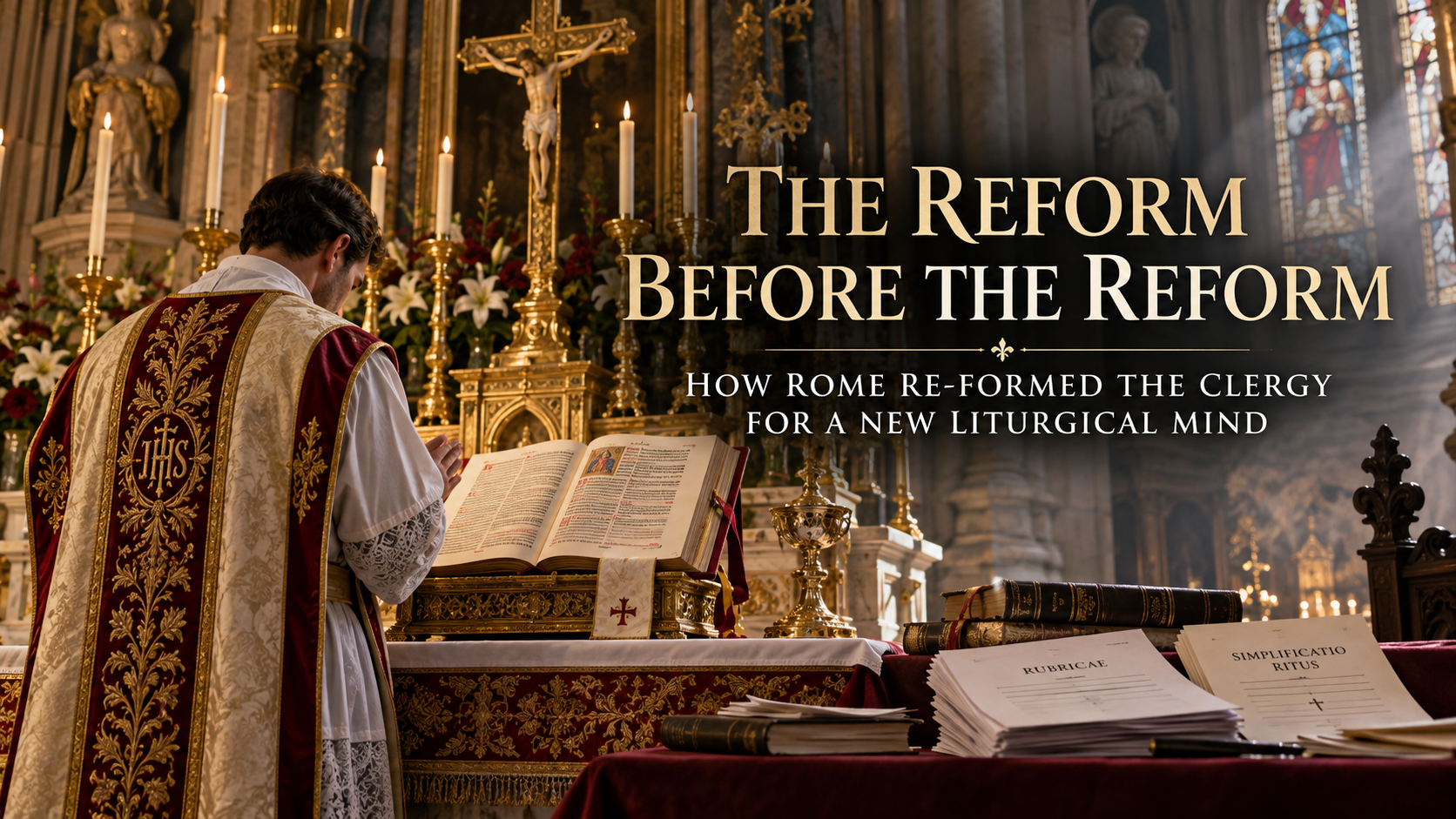
How Rome Re-formed the Clergy for a New Liturgical Mind
The familiar story jumps from the Council to the Novus Ordo as though a single missal suddenly replaced another. The historical reality is more revealing. From 1964 onwards a sequence of authorised changes progressively taught priests to handle the altar, the Canon, sacred gestures, language and ceremonial differently. By 1969 the reform was not merely introducing new texts; it was completing a process of liturgical re-formation already under way.
One of the most important facts in the history of the post-conciliar liturgy is also among the least discussed: the clergy had to be retrained. Priests who had learned to celebrate according to a stable inherited ceremonial were instructed, within a few years, to omit gestures they had previously been taught were obligatory, say aloud texts they had been trained to whisper, face the congregation at moments formerly directed to the altar, use the vernacular where Latin had been normative, and adopt a simplified ritual logic increasingly unlike the one in which they had been formed.
This matters because it places the reform in its proper chronology. Sacrosanctum Concilium, promulgated in December 1963, did not order a new rite of Mass. It called for reform while simultaneously insisting that Latin be preserved in the Latin rites, Gregorian chant retain pride of place, and innovations be introduced only when the good of the Church genuinely and certainly required them, with new forms growing organically from forms already existing.1 Those principles form the benchmark against which the subsequent process must be judged.
The first major implementation instruction, Inter Oecumenici, came in September 1964 and took effect in March 1965.2 The resulting “1965 Mass” is often treated as a simple halfway house. In one sense it was. Much of the traditional Ordo remained recognisable, the Roman Canon remained, and the rite had not yet acquired the architecture of the 1969 Missal. Yet the significance of 1965 lies precisely in this transitional character. Priests and congregations were being habituated to alteration as a normal feature of liturgical life.
Vernacular use expanded. Parts of the rite were recast in congregational terms. The sanctuary’s orientation began to change in many places. The instruction spoke of constructing the main altar so that Mass could be celebrated facing the people; it did not command the destruction of existing high altars, still less establish versus populum as a theological requirement. Yet the practical effect of the reform movement was increasingly to make celebration facing the people appear to be the expected modern norm.
This point deserves emphasis because versus populum is frequently narrated as though Vatican II had required it. It did not. The Council’s Constitution nowhere orders Mass facing the people. Subsequent rubrics continued to contain directions whose natural meaning presupposed that priest and people might be facing the same liturgical direction. The transformation of church interiors therefore cannot be defended simply by invoking the Council.
The second instruction, Tres abhinc annos, issued in May 1967, made the process still clearer. At the Offertory the celebrant was to omit signs of the cross made with the paten and chalice. In the Canon he was to make only one sign of the cross over the offerings at the beginning of the Te igitur, with the other traditional crosses removed. After the Consecration he no longer had to keep thumb and forefinger joined. The maniple ceased to be required. The Canon could be said aloud, and wider vernacular use was authorised.3
Each change can be described as small when isolated. That is precisely why the cumulative effect must be studied. The priest’s body had been trained into a theology. Joining the canonical fingers after touching the Sacred Host expressed not neurotic anxiety but the objective reality of Eucharistic fragments. Repeated signs of the cross over the oblations articulated sacrificial and consecratory reverence. Kisses of the altar, genuflections, bows and precise manual acts formed a ritual grammar in which the celebrant’s body confessed what the text taught.
When such gestures were reduced, the official explanation was usually “simplification”, intelligibility or avoidance of repetition. But simplification is not a neutral criterion. A repeated gesture may be redundant in an instruction manual yet richly cumulative in worship. Organic liturgy is full of repetitions because love, adoration and ritual memory do not operate according to bureaucratic economy. The Rosary repeats. The Kyrie repeats. The Sanctus repeats. Scripture itself repeats the praise of Heaven.
The abolition of the joined thumb and forefinger is particularly revealing. As late as 1962 Roman authorities treated the practice as sufficiently normal to govern even the design of chalices. Five years later the obligation was removed, without any demonstrated Eucharistic necessity requiring the change. This does not mean that a priest who separates his fingers denies the Real Presence. It does mean that an ancient discipline embodying heightened caution towards the Sacred Species was judged dispensable as part of a wider programme of ritual simplification.
The same question applies to the crosses. The issue is not whether every medieval accretion must be frozen for all time. The Roman liturgy did develop. But organic development normally adds, adapts, localises and matures across generations. A commission deciding within a few years that a dense inherited ceremonial contains too many signs is a different kind of process. Antiquity was sometimes invoked to remove later developments, even though those “later” developments might themselves be many centuries old and fully assimilated into the Roman rite.
This is where Pius XII’s warning against archaeological primitivism in Mediator Dei remains relevant. The fact that a practice is older does not automatically make it purer, nor does returning to a conjectured earlier simplicity automatically constitute authentic restoration.4 The Church’s liturgy possesses history. Centuries of received development are not an unfortunate crust hiding an original essence.
By the later 1960s the clergy were therefore being taught a new instinct: inherited ceremonial should justify its continued existence. What had been received as a coherent whole became a collection of elements subject to selection by reforming authority. This psychological change was as important as any individual rubric. A priest formed before the Council had been trained to conform himself to the rite. The emerging reform increasingly trained clergy to understand the rite as a pastoral instrument capable of continual adaptation.
This did not mean that every priest embraced experimentation. Nor did every parish move at the same pace. Many clergy obeyed faithfully and reluctantly. Others welcomed vernacular language and simplification while expecting continuity in essentials. Some improvised far beyond authorised texts. The historical point is that official reform itself created a moving target. What a priest learned in seminary could be altered in 1965, altered again in 1967, and replaced by a new Ordo in 1969.
That instability helps explain why the Novus Ordo was received so differently from the way a new edition of the Roman Missal had previously been received. The faithful had already spent years being told that further change was coming. Altars had been moved, ceremonial simplified, language altered and expectations reset. The new Missal arrived in a population already educated to regard rupture with yesterday’s rubric as obedience to today’s authority.
None of this proves sacramental invalidity. It should not be made to carry an argument it cannot bear. Pope Paul VI possessed authority to regulate the liturgy; the promulgated Missal exists as a Catholic sacramental rite; valid celebrations are true Masses. But those propositions do not answer the historical question of whether the reform was organically continuous with the inherited Roman rite, proportionate to the Council’s actual mandates, or pastorally wise.
Nor does papal promulgation make every historical judgment disappear. Authority can lawfully impose a reform without thereby proving that every component of the reform was demanded by Tradition or by Vatican II. Catholic obedience is not historical amnesia.
The “re-education” of the clergy is therefore central to understanding the reform. Priests were not merely handed a new book in 1969. They had first been taught to think differently about ritual inheritance. Gesture became optional, repetition became duplication, silence became an obstacle to comprehension, inherited orientation became a pastoral problem, and stability itself increasingly appeared as rigidity.
The result was a new ars celebrandi before there was a new Missal. That is why the transitional years deserve more attention than they usually receive. They show the reform in motion, and they permit a question too often evaded by both enthusiasts and polemicists: not simply whether Rome had authority to change the liturgy, but whether the manner and scale of change embodied the Council’s own principle that authentic reform should grow organically from what the Church had already received.
1 Second Vatican Council, Sacrosanctum Concilium, especially §§23, 36 and 116.
2 Sacred Congregation of Rites, Inter Oecumenici, 26 September 1964.
3 Sacred Congregation of Rites, Tres Abhinc Annos, 4 May 1967, especially §§9–13, 25 and 28.
4 Pius XII, Mediator Dei, 20 November 1947, especially §§61–64.
5 Annibale Bugnini, The Reform of the Liturgy 1948–1975, historical account of the Consilium and implementation.

Leave a Reply