

The Feast of the Divine Maternity of the Blessed Virgin Mary — 11 October in the Traditional Roman Rite
The title Theotokos, Mother of God, is among the most consequential affirmations in Catholic theology. Defended by the Fathers at Ephesus in AD 431, it protects the truth that Jesus Christ is one divine Person in two natures, and that the woman who bore Him is therefore truly the Mother of God. The traditional Roman feast of 11 October commemorates this victory of orthodoxy through a remarkable synthesis of Scripture, patristic teaching, scholastic theology and liturgical prayer. Its Mass and Divine Office reveal that the divine maternity is no isolated Marian privilege, but a doctrine inseparable from the Incarnation, the Redemption and the Church’s entire understanding of Jesus Christ.
When the bishops assembled at Ephesus in AD 431 condemned the teaching of Nestorius, the people of the city greeted the decision with extraordinary enthusiasm. The account preserved in the ecclesiastical tradition, and recalled fifteen centuries later by Pope Pius XI, describes the faithful accompanying the Fathers through the streets by torchlight, rejoicing that the Blessed Virgin Mary had been vindicated in her ancient title of Theotokos, Mother of God. Their joy was understandable. They had witnessed the Church defending a truth which touched the very foundations of the Christian faith. The controversy was ostensibly about what Mary should be called, but its real subject was the identity of her Son. Was the child born at Bethlehem personally the eternal Word of God made flesh, or was He a human individual associated with the divine Word in some lesser manner? Upon the answer depended the Church’s understanding of the Incarnation and, consequently, of the Redemption itself.
This is what makes the Feast of the Divine Maternity of the Blessed Virgin Mary so important. Celebrated on 11 October in the traditional Roman calendar, it honours Our Lady’s greatest privilege while recalling the theological controversy in which its proper significance was solemnly defended. Its purpose is not simply to add another title to the praises of Mary. The feast requires the faithful to contemplate what it means that the eternal Son of God, without ceasing to possess the divine nature, assumed a complete human nature from a woman and was genuinely born of her. The Mother of Jesus is the Mother of God because Jesus Christ is God. Everything else follows from that fundamental confession.
Although Pius XI extended the observance to the universal Roman calendar in 1931, the feast itself was considerably older. On 22 January 1751, during the pontificate of Benedict XIV, its celebration was granted to Portugal and associated territories, initially on the first Sunday of May. During the following decades it spread to other dioceses, including those of Venice, Naples and Tuscany, and eventually became associated in many local calendars with the second Sunday of October. By the early twentieth century it was already widely observed, although it did not yet possess a place in the universal calendar. The anniversary of Ephesus provided Pius XI with the occasion to establish that universal observance, assigning it to 11 October and providing the Church with a proper Mass and Divine Office under the rank of Double of the Second Class. The texts were officially promulgated by the Sacred Congregation of Rites in 1932.¹
The Pope explained his purpose in Lux Veritatis, issued on Christmas Day 1931 to commemorate the fifteenth centenary of the Council. The encyclical is worth reading in its entirety, not least because it treats the divine maternity within the wider ecclesiastical and doctrinal context of the fifth century. Pius XI was concerned with three closely related truths: the unity of the Person of Christ, the divine maternity of Mary, and the authority of the Church to preserve the apostolic faith against erroneous interpretations. The first establishes the second, while the controversy surrounding both demonstrates the necessity of the third. The decision to commemorate Ephesus liturgically was therefore more than an expression of Marian devotion. It was an act of doctrinal remembrance, preserving for successive generations the significance of a controversy whose implications had never ceased to matter.²
The difficulty arose when Nestorius, Patriarch of Constantinople, opposed the established use of Theotokos, literally the one who bears or gives birth to God. He preferred Christotokos, Mother of Christ, fearing that the former expression might suggest that the eternal Godhead had acquired its existence from a creature or had become subject to the changes proper to human generation. His concern to preserve divine transcendence was not itself unreasonable. God is eternal, immutable and impassible. The divine nature cannot begin to exist, cannot increase or diminish, and cannot undergo suffering or death. The error lay in attempting to protect these truths through a Christological account which, as St Cyril of Alexandria recognised, inadequately expressed the personal unity of the incarnate Word.
The theological language of the fifth century was still being refined, and historians rightly caution against reducing every feature of the controversy to a simple opposition between good and bad theological terminology. The Alexandrian and Antiochene traditions approached the mystery with different emphases. The former stressed the unity of the incarnate Word; the latter was particularly anxious to safeguard the integrity of His humanity and the distinction between His divine and human properties. Both concerns were legitimate when properly understood. The difficulty arose when the distinction between the two natures appeared to become a division between two personal subjects. Cyril insisted that a union of dignity, indwelling, moral agreement or external association could not adequately express the Incarnation. The eternal Son had not merely entered into a special relationship with a man. He had Himself become man.
The distinction between person and nature is indispensable here. Nature answers the question of what a being is; person identifies who possesses that nature and performs its actions. In Jesus Christ there are two complete and distinct natures, divine and human, but only one Person: the eternal Son of God. He possesses all that belongs to the divine nature, which He shares eternally with the Father and the Holy Ghost. He also possesses everything necessary to complete human nature: a real human body, a rational soul, a human intellect and a human will. His humanity is neither an appearance nor an incomplete instrument of divinity. Yet it does not subsist as a second human person existing alongside the Word. From the first instant of His conception, the humanity derived from Mary belongs personally to the eternal Son.
This is the hypostatic union, the union of the two natures in the one divine Person of Christ. Because the acting subject is one, the experiences of His human life can truly be attributed to the Person who is God, provided the nature according to which they occur is properly understood. The Son of God was born, suffered and died according to His humanity. His divine nature neither underwent birth nor became capable of suffering. Nevertheless, the Person who experienced birth and death was the eternal Word Himself. Theology calls this the communicatio idiomatum, the communication of properties, by which what belongs to either nature may be predicated of the one Person without confusing the natures themselves.
The consequences are profound. When the Church proclaims that God was born at Bethlehem, she does not mean that the divine nature began to exist. When she teaches that God shed His blood upon Calvary, she does not suggest that divinity possesses blood or is subject to death. She confesses that the Person born of Mary and crucified under Pontius Pilate is truly God. The same reasoning establishes the divine maternity. Mary did not generate the Godhead. She conceived and bore, according to His human nature, the Person who is God the Son. Motherhood concerns the person born, not merely the nature according to which birth takes place. Consequently, to deny her the title Mother of God is, unless the expression is being rejected through misunderstanding alone, to endanger the correct profession of Christ’s personal identity.
St Cyril expressed the doctrine in his second letter to Nestorius, which was examined and approved at Ephesus. The Word had not assumed a man already possessing an independent personal existence, nor was He united to human nature merely through honour or association. He united flesh animated by a rational soul to Himself personally and was born according to that flesh. Cyril’s first anathema against Nestorius accordingly joins the two propositions: Emmanuel is truly God, and the Blessed Virgin is therefore Theotokos. The second proposition follows necessarily from the first. Strict historical precision requires acknowledging that Ephesus did not issue a separate, self-contained definition of the title in the form sometimes suggested by popular summaries. Its authoritative reception of Cyril’s Christological teaching, together with its condemnation of Nestorius, nevertheless affirmed the doctrine which the title expresses.³
The role of Pope St Celestine I should not be overlooked. In 430 he had acted against Nestorius and authorised Cyril to demand a retraction. At Ephesus, Cyril presided over the opening proceedings, while the Roman legates subsequently took part in the conciliar judgment. The eventual Formula of Reunion between Cyril and John of Antioch in 433 helped establish a terminology which safeguarded both the unity of Christ’s Person and the distinction of His natures. These developments culminated in the more precise formulation of Chalcedon in 451, which confessed one and the same Christ, acknowledged in two natures without confusion, change, division or separation. Ephesus and Chalcedon must therefore be read together. The former rejected a division of the incarnate Lord; the latter also excluded any confusion or absorption of His humanity into the Godhead. Catholic Christology requires both truths.
The doctrine was not invented in the fifth century. The Fathers who defended it were drawing upon a much older apostolic inheritance. St Ignatius of Antioch, writing early in the second century, speaks of Jesus Christ as our God and refers to His conception by Mary within the divine economy of salvation. St Irenaeus of Lyons subsequently develops the parallel between Mary and Eve, explaining that Mary’s obedience reverses the disobedience through which Eve had cooperated in the Fall. The comparison belongs to his wider theology of recapitulation, according to which Christ, the new Adam, restores fallen humanity through His saving obedience. Mary’s part is genuine but subordinate. She is the obedient Virgin through whom the new Adam enters human history, not another redeemer acting independently of Him.⁴
St Ephrem the Syrian, writing in the fourth century, offers a particularly beautiful witness to the same mystery. His Hymns on the Nativity repeatedly contemplate the paradox of the Creator accepting the limitations of infancy. Mary nourishes the One who sustains all creatures; the child carried in her arms is the Lord upon whom the existence of heaven and earth depends. In one passage Ephrem reflects upon Christ receiving milk from His Mother while remaining the divine giver of the nourishment she herself possesses. The imagery is poetical, but its theology is precise. The infant does not cease to be God when He becomes dependent upon maternal care, nor is His dependence merely an appearance. Both realities are true because the one divine Person exists and acts according to two natures.⁵
St Gregory Nazianzen, in his Letter 101 to Cledonius, likewise insisted upon Mary’s divine maternity before the controversy at Ephesus. He rejected the suggestion that the humanity of Christ constituted a separate personal subject joined to the Word only subsequently. His argument illustrates the breadth of the patristic inheritance upon which Cyril depended. An especially immediate witness was St Proclus of Constantinople, who preached a celebrated homily upon the Holy Virgin in 430, in the presence of Nestorius himself. Proclus proclaimed the genuine union of divinity and humanity in the incarnate Christ and defended the title Theotokos as a safeguard of that union. The same Lord born of Mary would suffer, die and rise again. Bethlehem and Calvary could not be assigned to different personal subjects.⁶
Pope St Leo the Great brought extraordinary clarity to the Western exposition of this doctrine. In his sermons upon the Nativity and in the celebrated Tome addressed to Flavian, he insisted that the two natures retain their proper characteristics within the unity of Christ’s Person. The divine nature remains immutable and impassible; the assumed humanity remains genuinely human. Their union neither destroys the distinction between them nor divides Christ into two persons. St Leo’s teaching is especially valuable because it avoids both dangers which repeatedly threatened the doctrine of the Incarnation: treating Christ’s humanity as insufficiently real, and treating His divinity as something merely associated with a separate human individual. What is at stake in both errors is the identity of the Redeemer.
St John Damascene subsequently provided an exposition of the divine maternity which became influential throughout the scholastic tradition. In his Exposition of the Orthodox Faith, he explains that Mary did not give origin to the eternal Godhead but truly bore the Word incarnate. The body of Christ was not brought from heaven and merely passed through her. He received genuine human nature from her substance, by the operation of the Holy Ghost. The distinction matters because the Redemption required the Son of God to assume the very nature which had fallen. The humanity of Christ must be our humanity, sin alone excepted, if He is truly to restore the human race. Mary’s maternity supplies a decisive witness to that reality.⁷
St Thomas Aquinas takes the argument to its scholastic conclusion in the Summa Theologiae, III, question 35, article 4. He asks whether the Blessed Virgin should be called the Mother of God. His answer depends upon a distinction which remains both simple and essential: birth is attributed to the person, although it takes place according to a nature. A human mother does not generate her child’s rational soul, which is immediately created by God, yet she is the mother of the child as a whole, rather than merely of his body. Similarly, Mary is not the origin of the divinity of Christ, but the Person whom she conceived and bore is divine. Her motherhood terminates in that Person. The title Mater Dei is therefore not an extravagant devotional metaphor. It is the precise theological description of her relationship to her Son.⁸
Aquinas also provides the necessary framework for understanding Mary’s extraordinary dignity. In the First Part of the Summa, he observes that the Blessed Virgin possesses a certain infinite dignity because of the infinite good to whom her maternity relates. The expression must not be misunderstood. Mary does not possess an infinite created nature, nor does her sanctity make her equal to God. Her dignity is infinite in a qualified, relational sense, because the Person to whom her motherhood is directed is the infinite Son of God. No other merely human creature can possess that particular relationship to the Godhead. Here lies the theological foundation for Mary’s pre-eminence among the saints.
The distinction also explains the proper character of Marian veneration. The adoration called latria belongs to God alone. The saints receive the honour of dulia, while the Blessed Virgin, because of her incomparable dignity, receives hyperdulia, a unique and superior veneration which nevertheless remains wholly distinct from divine worship. Aquinas discusses the matter expressly in Summa Theologiae, III, question 25, article 5. The honour given to Mary is not a rival form of worship standing alongside adoration of Christ. It arises from her relationship to Him and is ordered towards His glory. The more accurately the Church understands the divine maternity, the less justification there is either for withholding Mary’s rightful honour or for exaggerating it beyond the boundaries of Catholic doctrine.⁹
The same principle illuminates Mary’s other privileges. The Immaculate Conception concerns the singular grace by which God preserved her from original sin in view of the foreseen merits of her Son. Her perpetual virginity witnesses to the miraculous character of the Incarnation and the complete dedication of her person to the divine purpose. Her Assumption manifests the glorious completion of the life of the woman uniquely associated with the Redeemer. None of these doctrines is simply an interchangeable consequence of the divine maternity, for each has its own theological foundations. Nevertheless, her vocation as Mother of God supplies their common point of reference. Aquinas similarly reasons that grace is bestowed in accordance with a person’s divinely appointed vocation. It was therefore fitting that the woman chosen to bear the incarnate Word should receive an exceptional fullness of sanctifying grace. Her holiness is wholly received from God, and its highest purpose is found in her relationship to Christ.
The scriptural foundations of the feast are correspondingly rich. At the Annunciation, the archangel Gabriel declares that the child conceived by Mary will be called the Son of the Most High and that the Holy Ghost will come upon her. The virginal conception is thus presented as the work of divine omnipotence, not as an ordinary generation followed by some later supernatural association. When Elizabeth greets Mary, she asks how it is that the Mother of her Lord should come to her. Within St Luke’s account, the expression belongs to the revelation of the identity of the promised child. St Matthew applies the prophecy of Isaias concerning Emmanuel to the virginal conception, while St John gives the mystery its most concentrated theological expression: the eternal Word was made flesh. St Paul approaches the same truth from another direction when he declares that God sent His Son, made of a woman, under the Law. The Son who was sent already existed eternally; His birth from Mary marks His entrance into human history according to the nature which He assumed.
There is a further biblical resonance in St Luke’s account of the Visitation. Mary’s journey into the hill country of Juda, Elizabeth’s astonishment at her arrival, and the unborn Baptist’s response to the presence of Christ recall elements associated with the Ark of the Covenant in the Old Testament. The Ark was the privileged sign of God’s presence among His people. Mary bears within herself not merely a symbol of that presence but the incarnate Lord. The parallels are typological rather than a claim that every detail of the earlier narrative was originally intended as a direct historical prediction of the Blessed Virgin. Nevertheless, the comparison helps explain the language employed by the Fathers and the liturgy when they contemplate the woman within whose womb the Word of God dwelt.
The proper Mass of 11 October, Ecce Virgo, begins with the prophecy of Isaias concerning the Virgin who will conceive and bear Emmanuel. Its opening words direct attention immediately towards the identity of the promised Son. The Collect then expresses the mystery with admirable theological precision. God willed that His Word should take flesh in the womb of the Blessed Virgin at the announcement of the angel; the faithful therefore ask that, believing her truly to be Mother of God, they may receive assistance through her intercession. The prayer moves from the Incarnation to the divine maternity and from the divine maternity to Marian intercession. Doctrine establishes the foundation of devotion. The Church seeks Mary’s prayers because she is truly the Mother of the incarnate Lord, and because all the grace which her intercession obtains derives from Him.¹⁰
The Epistle, Ecclesiasticus 24:23–31, employs the language of divine Wisdom. The speaker presents herself as the mother of fair love, holy hope and the knowledge of God, inviting those who seek her to receive the fruits of spiritual life. In its original literary setting, the passage concerns personified Wisdom; it cannot simply be treated as a literal historical statement concerning Mary’s personal existence before her conception. The Church’s liturgical application is typological and accommodative. Mary is the creature most intimately associated with the incarnate Wisdom of God, and the fruits described in the sacred text may therefore be contemplated in relation to her maternal office. This is characteristic of the traditional Roman use of sapiential passages upon Marian feasts. Such applications must be understood within the distinction between the original scriptural sense and the Church’s subsequent theological appropriation.
The Gradual takes up the prophecy of Isaias concerning the shoot arising from the root of Jesse and the flower which springs from it. The ancient Christian interpretation sees in Mary the virginal shoot of David’s line and in Christ the flower brought forth from her. The continuation of the prophecy, announcing that the Spirit of the Lord will rest upon Him, makes clear that the principal subject is the Messiah. The Marian interpretation remains subordinate to that Christological fulfilment. The Alleluia then contemplates the wonder of the One whom the universe cannot contain dwelling within the Virgin’s womb. The language brings together the immensity of the divine nature and the humility of the Incarnation. God is not diminished by assuming finite humanity. The Word remains infinite, omnipresent and eternal even while genuinely possessing the human body conceived within Mary.
The selection of the Gospel is particularly revealing. Instead of the Annunciation or the Visitation, which might have appeared the more obvious choices, the Roman Church reads Luke 2:43–51, the account of the finding of the twelve-year-old Jesus in the Temple. Here Mary’s genuine motherhood and Christ’s eternal divine Sonship are placed beside one another. Mary speaks as a mother who has suffered the anxiety of losing her child, asking why He has caused such distress to herself and St Joseph. Jesus answers by directing their attention towards His heavenly Father. His reply reveals that His relationship with the Father precedes and transcends every earthly relationship. Yet the Evangelist immediately records that He returned with them to Nazareth and was subject to them.
The apparent tension is the very heart of the Gospel. Christ’s obedience within the Holy Family was genuine, because His human nature and human will were genuine. The eternal Son of God, according to His humanity, accepted the ordinary authority exercised by Mary and Joseph. The same divine Person who possesses all authority over creation freely embraced the dependence proper to childhood. His submission did not diminish His divinity; nor did His divinity make His human obedience unreal. The Gospel thus expresses through an historical episode the truth which the Fathers defended through theological argument. The Son of Mary is the Son of the eternal Father, and these are not two sons or two persons, but one Lord Jesus Christ.
St Luke adds that Mary and Joseph did not fully understand His response, and that Mary kept these things in her heart. The statement deserves particular attention. Her singular holiness did not require exhaustive knowledge of every mystery or every future development of her Son’s mission. Faith is not identical with complete comprehension. Mary received the divine revelation with perfect fidelity, even when its implications unfolded beyond what she could immediately grasp. Her conduct at Nazareth, her perseverance during the public ministry and her presence at Calvary belong to this continuous obedience of faith. She did not need to possess the knowledge proper to God in order to be the most faithful of His creatures.
The traditional commentators found in this Gospel a particularly rich field of interpretation. St Thomas Aquinas, in the Catena Aurea, gathers observations from St Ambrose, Origen, St Bede and other Fathers concerning Christ’s words in the Temple. St Ambrose distinguishes His eternal generation from His temporal birth. Origen reflects upon the significance of seeking Christ and finding Him among the teachers of the Law, while Bede attends to the spiritual meaning of the three days of searching. These interpretations preserve the historical reality of the episode while drawing attention to its doctrinal and spiritual significance. Mary’s sorrow anticipates the greater sorrow which will accompany the Passion; the finding of Christ after three days also invites contemplation of His Resurrection. The liturgy therefore places the divine maternity within the entire mystery of salvation, rather than confining it to the events surrounding the Nativity.¹¹
The Divine Office develops that same theological vision. Its Invitatory at Matins is especially instructive. The Church announces that she is celebrating the maternity of the Blessed Virgin and summons the faithful to adore Christ her Son. The object of adoration is unambiguously identified. Mary is honoured; Christ is worshipped. The relationship between devotion to the Mother and adoration of the Son is established before the psalms and lessons have even begun. This is one of the clearest demonstrations that the traditional liturgy possesses its own doctrinal discipline, often expressing in a single antiphon what theological controversy requires many pages to explain.
The proper hymn at Matins begins by contemplating the Redeemer choosing the womb of the Virgin, where He assumed the mortal body in which He would become the Victim of sacrifice. The hymn then recalls His redeeming blood, His suffering and His Cross, before turning towards Mary’s maternal intercession. This movement from conception to sacrifice is deliberate. The Word became flesh in order to redeem fallen humanity through the humanity He had assumed. The body which Christ offered upon Calvary was the body He received from His Mother. The Incarnation was not an event complete in itself and subsequently followed by an unrelated work of salvation. It was ordered from the beginning towards the redemptive sacrifice through which God reconciled mankind to Himself.
The first nocturn draws upon Ecclesiasticus 24, while its responsories repeatedly identify Mary as the Virgin from whom the Sun of Justice arose and through whom the Saviour entered the world. The second nocturn contains lessons from Pope St Leo the Great’s sermons upon the Nativity. St Leo teaches that Mary received the mystery by faith before conceiving the Word in her body, and that the eternal Son assumed humanity without abandoning the glory of the Father. The newness of His birth lies in the virginal conception and the personal union of divinity and humanity; the human nature assumed remains truly consubstantial with our own. The Office consequently presents the doctrine of Ephesus through the teaching of the Pope whose Christology would subsequently exercise such influence at Chalcedon.
The sixth lesson recalls Pius XI’s commemoration of the Council and the restoration of the mosaics in the Basilica of St Mary Major. These had been commissioned under Pope St Sixtus III, whose pontificate immediately followed Ephesus, and formed an enduring Roman witness to the mystery of the Incarnation. Their restoration was undertaken alongside the establishment of the universal feast. The connection between sacred art, doctrine and liturgy was no accident. The Roman Church had confessed the truth of the divine maternity not only in councils and theological treatises, but in the images which adorned her churches and in the worship through which successive generations received the apostolic faith.¹²
The third nocturn turns to a homily of St Bernard of Clairvaux upon the finding in the Temple. Bernard is astonished that Mary can address the Lord of the angels as her Son, and that the Evangelist can describe Him as subject to human parents. His famous question, Quis? Quibus? Deus hominibus?, expresses the mystery with extraordinary force: who obeys, and whom does He obey? God obeys human beings. The saint places before his hearers both the humility of the divine Son and the exceptional dignity of His Mother. Mary possesses genuine maternal authority in the ordinary circumstances of Christ’s assumed human life, although never authority over His eternal divine nature or the Godhead itself.
Bernard refuses, however, to leave the matter as an occasion for admiration alone. The obedience of Christ becomes an accusation against human pride. If the Creator willingly submitted Himself within the household of Nazareth, what excuse remains for the creature who treats obedience as an affront to personal dignity? If the Son of God accepted the ordinary conditions of human life, the Christian cannot legitimately regard humility, service and patient submission to the divine will as occupations beneath him. Bernard’s lesson concludes by directing the faithful towards Mary’s humility. Her virginity and divine maternity are singular privileges; her humility is a virtue which all must strive to imitate. The Church thus converts the contemplation of an extraordinary mystery into a demand upon the conscience.¹³
The antiphons at Lauds continue this treatment of divine greatness and human humility. Mary is blessed because she bore the Creator of all things. One antiphon, Genuisti qui te fecit, says in four words that she gave birth to the One who made her. The apparent paradox is not a contradiction. Mary exists because the eternal Word created her; the same Word, assuming a human nature from her, became truly her Son. The distinction between His eternal divine generation and His temporal human birth makes both propositions possible. He is before her as Creator and after her according to His human birth. The one Person is the subject of both relationships.
The hymn at Lauds, addressed to the Mother of God, recalls the sin of Adam and implores Mary’s protection against the deceit of the devil. Its petitions rest upon the belief that her intercession is powerful precisely because she is the Mother of the Redeemer. At Second Vespers, the antiphon of the Magnificat celebrates the joy which her maternity brought to the world, because from her arose Christ, the Sun of Justice. The whole Office thus moves from the eternal Word to the Incarnation, from the Incarnation to Redemption, and from Redemption to the spiritual benefits sought by the faithful through Mary’s prayers.
The Offertory of the Mass recalls that Mary was found with child of the Holy Ghost. The Communion antiphon blesses the womb which bore the Son of the eternal Father. The Eucharistic conclusion is particularly appropriate. The Person whom Mary conceived and bore is the Person who offered Himself upon Calvary and who gives Himself sacramentally beneath the species of bread and wine. The Incarnation is not repeated in Holy Communion, nor does sacramental reception confer upon the communicant the unique physical relationship which Mary possessed with her Son. Nevertheless, the identity of the divine Person remains unchanged. The one whom she carried within her body is the one whom the faithful receive in the Blessed Sacrament. The lesson is unmistakable: the faith and humility with which Mary welcomed the Word should become the model for every worthy approach to the altar.¹⁴
Traditional liturgical commentators have recognised the centrality of this mystery. The St Andrew’s Daily Missal, associated with Dom Gaspar Lefebvre and the Benedictine liturgical tradition, identifies the divine maternity as Mary’s greatest prerogative and the foundation of her other privileges. Pius Parsch, in The Church’s Year of Grace, gives particular attention to the institution of the feast and Pius XI’s intention to preserve the memory of Ephesus. Both approaches reflect the understanding that the liturgical year is not merely an arrangement of commemorative dates, but the Church’s ordered presentation of the mysteries of Christ for the instruction and sanctification of the faithful. Care is needed when invoking Dom Prosper Guéranger in this connection. His great work The Liturgical Year provides an indispensable account of the theological purpose of Catholic worship, but passages in later editions discussing the universal feast established by Pius XI necessarily belong to subsequent editorial additions, since Guéranger died in 1875.¹⁵
Pius XI also intended the feast to have a direct influence upon Christian family life. In Lux Veritatis, he presented Mary, St Joseph and the Holy Family of Nazareth as models for marriage, parenthood and the religious upbringing of children. The Incarnation took place within the ordinary conditions of human life. The eternal Son accepted conception, birth, infancy, dependence, nourishment, education and work. He did not merely appear among men as an adult possessing the external characteristics of humanity. He entered the human condition through the family, and the years of hidden life at Nazareth belonged to the divine purpose no less truly than the miracles of His public ministry.
There is much in this which deserves renewed attention. Motherhood cannot be reduced to a biological function, nor fatherhood to an arbitrary social designation. Both involve responsibilities which arise from the nature of human generation and the needs of children. The Christian family is not sanctified through the mere existence of affectionate feelings, but through fidelity, sacrifice, discipline, patience and the habitual practice of charity. The Holy Family possessed a unique relationship to the mystery of the Incarnation, but the virtues manifested at Nazareth remain relevant to every household. Mary’s greatness did not exempt her from the ordinary demands of maternal care. St Joseph’s vocation was not biological paternity, but a genuine paternal guardianship undertaken with fidelity and obedience. The divine Son Himself accepted the discipline of family life.
The feast also illuminates Mary’s spiritual motherhood of the redeemed. Catholic tradition has long contemplated Christ’s entrustment of His Mother to St John at Calvary as possessing a significance extending beyond the immediate care of the Apostle. Mary is Mother of Christ the Head and, by grace and divine appointment, exercises a maternal office towards the members of His Mystical Body. This relationship does not place her alongside Christ as an independent source of Redemption. Her cooperation is subordinate to His saving work, and her intercession derives its efficacy entirely from His merits. The doctrine is properly understood only when the unique mediation of Jesus Christ is preserved without qualification. The Virgin is most truly honoured when her maternal office is recognised as an expression of the generosity of her Son.
Pius XI’s ecumenical concern in Lux Veritatis is likewise worth remembering. He appealed particularly to Eastern Christians who continued to venerate the Blessed Virgin as Theotokos, expressing the hope that their common inheritance might assist the restoration of ecclesial unity. Yet his appeal did not propose doctrinal indifference as the foundation of reunion. The Council of Ephesus had demonstrated precisely why doctrinal agreement matters. The Church could not preserve unity by treating the identity of Christ as a negotiable formula. Genuine communion requires a common profession of revealed truth, even while legitimate differences of language, theological emphasis and liturgical tradition are recognised. The history of the fifth century offers an important distinction between the reconciliation of differing orthodox expressions and the acceptance of propositions which alter the substance of the faith.¹⁶
There is a further significance to the date of the feast within the traditional Roman calendar. The reform of the universal calendar following the Second Vatican Council no longer retained 11 October as the separate celebration of the Divine Maternity, while 1 January was assigned the Solemnity of Mary, Mother of God. The doctrine was not abandoned, and its celebration within the octave of Christmas has an evident theological appropriateness. Nevertheless, the older October feast possesses a distinctive historical character. It recalls not simply the fact of Mary’s motherhood, but the defence of that motherhood at Ephesus and the consequences of that defence for the Church’s understanding of Christ. Its proper Office, with lessons from St Leo, St Bernard and the historical account of Pius XI’s commemoration, supplies a concentrated treatment of the doctrine which is not identical with the emphasis of the January observance.
Under the pre-1955 Roman rubrics, the Divine Maternity is celebrated as a Double of the Second Class, with white vestments, the Gloria, the Creed and the Preface of the Blessed Virgin Mary using the proper festal form. In 2026, 11 October falls upon the Twentieth Sunday after Pentecost. Because an ordinary Sunday after Pentecost is a lesser Sunday under the older system, the feast takes precedence and the Sunday is commemorated. At Matins, its Gospel homily supplies the ninth lesson; at Mass, its Gospel is read as the Last Gospel. Under the later 1962 rubrics, the Twentieth Sunday after Pentecost takes precedence, and the feast is commemorated. These distinctions are worth preserving because the changes introduced from 1955 onwards altered not merely the nomenclature of feast days, but their practical relationship to the Sunday cycle.¹⁷
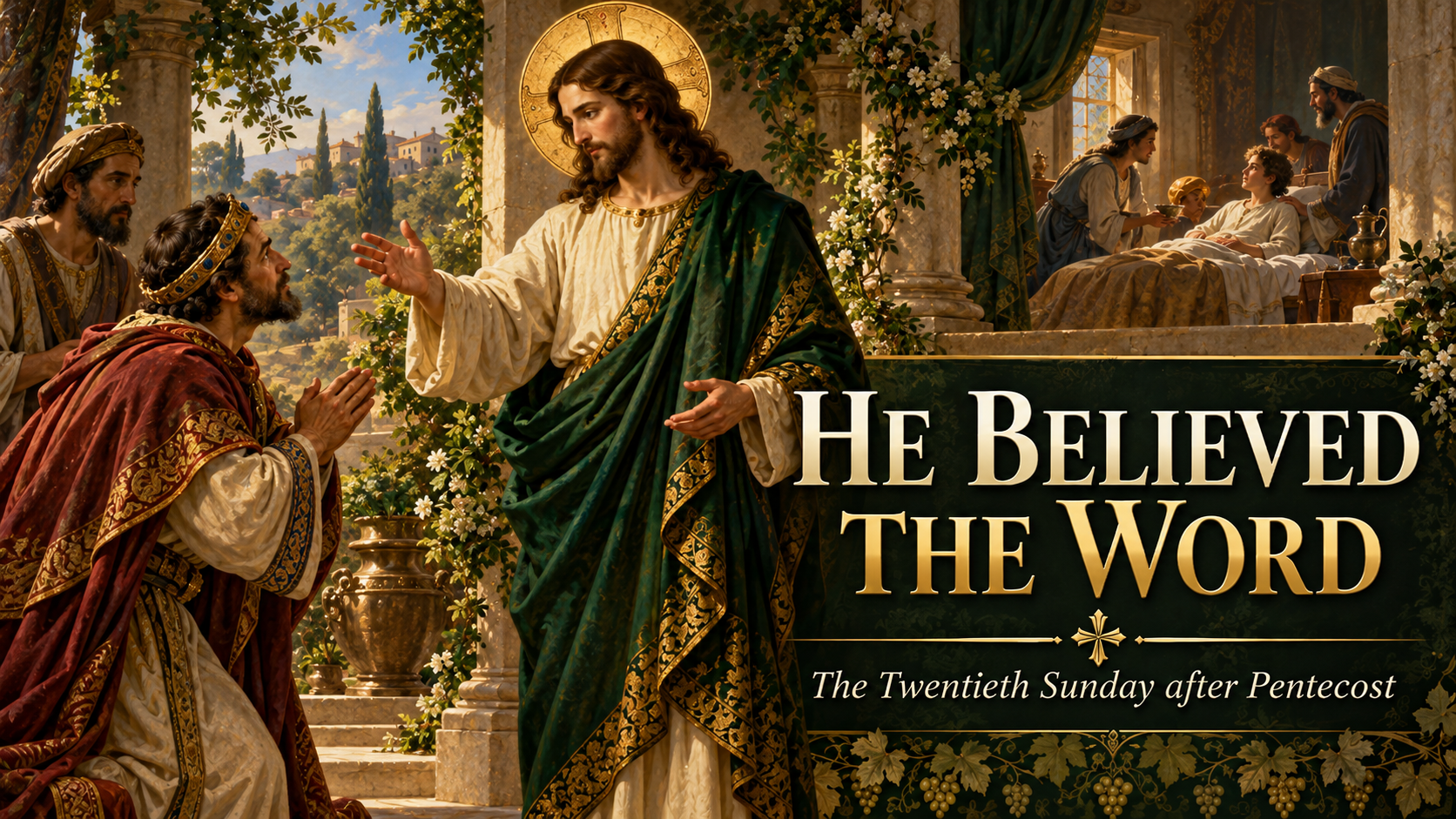
The concurrence in 2026 also presents an interesting spiritual comparison. The Gospel of the Twentieth Sunday recounts the healing of the ruler’s son at Capharnaum, where faith in the word of Christ precedes the visible confirmation of the miracle. The Gospel of the Maternity presents Mary preserving in her heart the mystery of a divine Son whose words she did not yet fully understand. Both episodes concern the obedience of faith before the full manifestation of divine power. The ruler believes the word spoken by the Lord and discovers that his son has been healed. Mary receives and keeps the words of her Son, remaining faithful as the mystery of His vocation unfolds. The divine maternity does not dispense her from faith; it places her within a relationship to God which demands its most complete exercise.
The contemporary importance of the doctrine extends beyond specifically Marian controversy. Modern Christological speculation has sometimes encouraged a separation between the Jesus of history and the divine Son professed by the Church, as though His divinity were principally an interpretation subsequently imposed upon an otherwise merely human religious figure. Other approaches treat the Incarnation as an exceptional manifestation of divine presence without preserving the substantial distinction between the hypostatic union and the indwelling of grace. These questions differ in detail from the controversy of the fifth century, and they should not all be indiscriminately labelled Nestorian. Nevertheless, the doctrine of Ephesus establishes a standard against which their implications must be considered. Is the historical Jesus personally the eternal Word, or is He not? Catholic Christianity cannot treat the answer as secondary.
The same principle governs the Church’s understanding of salvation. Christ saves mankind through the obedience, suffering, death and Resurrection of the one divine Person who assumed our nature. His human obedience is the obedience of the incarnate Son. His sacrifice possesses its saving significance because the one who offers it is truly God and truly man. The ancient Fathers understood that Christ could not redeem what He had not assumed, and that His humanity must be genuinely ours if humanity is to be restored. Mary’s maternity stands at the point where this saving assumption of human nature enters history. She contributes no divinity to the Word, but from her He receives the human nature in which He accomplishes Redemption.
There is consequently a limit to what may be called Christ-centred devotion if it treats the Blessed Virgin as a dispensable element in the mystery. Of course Christ is the source of grace, the sole Redeemer and the supreme object of Christian worship. No creature, including His Mother, can occupy His place. But the Christian confession of the Incarnation includes the historical and theological truth that the Son of God was born of Mary. To honour that maternity is not to divert attention from the Redeemer. It is to acknowledge the concrete manner in which He chose to enter the world. A devotion to Christ which is embarrassed by the title Mother of God has not thereby become more rigorously Christological; it risks neglecting one of the very truths by which orthodox Christology is expressed.
Equally, the divine maternity places necessary boundaries upon Marian devotion itself. Mary is not divine. She is not another incarnation of God, nor is she the origin of the Son’s eternal existence. Her holiness is entirely dependent upon grace, and her maternal intercession remains subordinate to Christ’s unique mediation. The greatness of the Blessed Virgin is neither enlarged by theological exaggeration nor diminished by the preservation of these distinctions. Catholic doctrine accords her the highest dignity that can belong to a mere human creature precisely because it refuses to confuse her with the Creator. The greater the truth of her relationship to Christ is understood, the less need there is for language which obscures it.
The practical application of the feast is therefore more exacting than a general exhortation to admire Mary’s privileges. The fidelity of Our Lady was exercised within the ordinary circumstances of human life as well as in the extraordinary events of the Incarnation. She accepted the divine message without demanding foreknowledge of every consequence. She fulfilled the duties of motherhood in poverty and obscurity. She sought her missing Son with genuine maternal distress, received His words without complete comprehension, and persevered beside His Cross when the promises of the Annunciation appeared to stand in terrible contradiction with what she witnessed. Her greatness was shown in a faith which did not withdraw its consent when obedience became costly.
St Bernard’s teaching is especially important at this point. The humility of Mary and the obedience of Christ at Nazareth leave little room for a religion built upon personal importance, self-assertion or the constant demand that God justify His providence to us. The Christian is not asked to imitate Mary’s divine maternity, which is unique and unrepeatable. He is asked to imitate the faith, humility, recollection and obedience with which she fulfilled her vocation. Such virtues may be practised in a family, a parish, a religious community, a workplace or in the solitude of suffering. Their value does not depend upon public recognition. Much of the life through which the Saviour sanctified human existence was hidden at Nazareth.
The Eucharist brings the entire argument to its proper conclusion. The divine Person born of Mary is the same Lord who becomes present upon the altar through the sacramental action of the priest. The humanity offered in sacrifice is the humanity received from her. The faithful who approach Holy Communion should therefore contemplate not only the greatness of the sacrament, but the dispositions of the woman who first received the incarnate Word. Her faith was without reservation, her humility without pretence, her obedience without calculation. She received what God gave because she believed the Giver. No communicant possesses her unique vocation, but every communicant may learn from the manner in which she fulfilled it.
The Feast of the Divine Maternity ultimately returns the Church to the question which confronted the Fathers at Ephesus. Who is the child born of the Virgin? If He is merely an extraordinary man, the title Mother of God becomes an exaggeration. If He is the eternal Son of God personally united to the human nature which He received from Mary, that title is unavoidable. The whole Catholic understanding of the Incarnation is contained within the distinction. The child of Bethlehem, the obedient Son of Nazareth, the teacher in the Temple, the crucified Victim of Calvary and the risen Lord are one and the same Jesus Christ, true God and true man.
That is why the ancient acclamation retains all its force. The Church does not make Mary great by calling her Mother of God. She acknowledges the greatness which God bestowed upon her when the Word was made flesh. Her maternity belongs to history, but the humanity which the Son received from her remains forever united to His divine Person. He who was carried within her womb now reigns in the glory of heaven, possessing eternally the humanity through which He redeemed the world.
At Ephesus the faithful carried torches because they understood, however simply, that the Church had defended the identity of their Saviour. The traditional Roman liturgy of 11 October preserves the same confession in the language of Scripture, the teaching of the Fathers and the prayers of the Mass. Mary is Mother of God because her Son is God; and her Son became man so that mankind might be redeemed. The two truths cannot be separated.
The final word belongs to the prayer which generations of Catholics have learned almost before they could understand its theological depth, and which the Church places upon the lips of the faithful throughout their lives: Sancta Maria, Mater Dei, ora pro nobis peccatoribus, nunc et in hora mortis nostræ.
¹ Catholic Encyclopedia — Feast of the Maternity of the Blessed Virgin Mary, Frederick G. Holweck, 1911, documenting the original concession of 1751 and the feast’s extension to various dioceses; Acta Apostolicæ Sedis, Vol. XXIV (1932), pp. 151–159 and 169–170, containing the officially promulgated Mass, Office and decree of the Sacred Congregation of Rites.
² Pius XI — Lux Veritatis, 25 December 1931, especially Parts I–III, discussing the Council of Ephesus, the unity of Christ’s Person, the divine maternity and the institution of the universal feast.
³ Council of Ephesus, AD 431 — Conciliar Acts and Letters of St Cyril, particularly Cyril’s second letter to Nestorius and the Twelve Anathemas; The Virgin as Theotokos at Ephesus and Earlier, Richard Price, The Oxford Handbook of Mary, 2019, examining the historical development of the title and its treatment at Ephesus.
⁴ St Ignatius of Antioch — Epistle to the Ephesians, chapters 7 and 18; St Irenaeus of Lyons — Against Heresies, Book III, chapter 22, concerning Mary as the new Eve and her obedient cooperation in the divine plan.
⁵ St Ephrem the Syrian — Hymns on the Nativity, especially Hymn III, concerning the Creator’s genuine dependence upon His Mother according to His assumed humanity.
⁶ St Gregory Nazianzen — Letter 101 to Cledonius, defending the unity of Christ and the divine maternity; St Proclus of Constantinople — Homily on the Holy Virgin Theotokos, The Cambridge Edition of Early Christian Writings, concerning the homily preached in the presence of Nestorius in 430.
⁷ St John Damascene — An Exposition of the Orthodox Faith, Book III, particularly chapter 12, explaining the proper meaning of the title Mother of God and the genuine humanity assumed from Mary.
⁸ St Thomas Aquinas — Summa Theologiae, III, Question 35, article 4, on whether the Blessed Virgin should be called Mother of God; Summa Theologiae, I, Question 25, article 6, reply to objection 4, concerning Mary’s dignity in relation to the infinite good.
⁹ St Thomas Aquinas — Summa Theologiae, III, Question 25, article 5, distinguishing the veneration of the Blessed Virgin from divine worship; Summa Theologiae, III, Question 27, article 5, on the fullness of grace appropriate to her vocation.
¹⁰ Acta Apostolicæ Sedis — Proper Mass of the Divine Maternity, Vol. XXIV (1932), pp. 158–159, containing the Introit Ecce Virgo, Collect, Epistle, Gradual, Alleluia, Gospel and other proper texts.
¹¹ St Thomas Aquinas — Catena Aurea, Commentary upon St Luke 2, collecting the interpretations of St Ambrose, Origen, St Bede and other Fathers concerning the finding in the Temple; Douay-Rheims Bible — St Luke, Chapter 2, verses 41–52.
¹² Acta Apostolicæ Sedis — Proper Divine Office of the Maternity, Vol. XXIV (1932), pp. 151–154, including the Invitatory, hymn and lessons of St Leo the Great; St Leo the Great — Sermons on the Nativity, supplying the wider patristic context.
¹³ Acta Apostolicæ Sedis — Matins, Third Nocturn, Vol. XXIV (1932), pp. 155–156, containing lessons seven to nine from the homily attributed to St Bernard of Clairvaux; Roman Breviary — Matins of the Maternity, providing the liturgical text and translation.
¹⁴ Acta Apostolicæ Sedis — Mass and Office of the Divine Maternity, Vol. XXIV (1932), pp. 156–159, especially the Lauds and Vespers antiphons, Secret, Communion and Postcommunion.
¹⁵ St Andrew’s Daily Missal — Feast of the Divine Maternity, reproduced material from the traditional missal; Pius Parsch — The Church’s Year of Grace, Divine Maternity, commentary on Pius XI’s institution of the feast; Dom Prosper Guéranger — The Liturgical Year, concerning the general theological purpose of the liturgical year.
¹⁶ Pius XI — Lux Veritatis, particularly Part III, on Mary’s dignity, spiritual motherhood, the Holy Family and ecclesial unity.
¹⁷ General Roman Calendar of 1954 — Pre-1955 Ranking and Precedence, documenting the precedence of Doubles of the Second Class over lesser Sundays and the commemorated Sunday’s Last Gospel; The Divine Office — A Study of the Roman Breviary, Edward J. Quigley, explaining the older Office rubrics; Compendium of the Reforms of the Roman Breviary — The Simplified Rubrics of 1955, on the suppression of the ninth lesson of an impeded Sunday; Ordo — Twentieth Sunday after Pentecost, 11 October 2026, confirming the concurrence under the later 1962 calendar.

Leave a Reply