

The Divine Maternity of the Blessed Virgin Mary opens a week in which the Church contemplates the mystery of the Incarnation, the supernatural character of faith, the responsibilities of Christian authority, and the lives of saints whose fidelity took very different forms. The Twentieth Sunday after Pentecost is commemorated and its Mass resumed during the week; the feast of St Luke concludes the period, with the Twenty-first Sunday similarly commemorated. The older national and diocesan propers also bring into view the Marian traditions of Spain and the Philippines, the missionary inheritance of England, and the historic cults of France, Germany, the Low Countries and Central Europe.
The week begins on Sunday, 11 October, with the feast of the Divine Maternity of Our Lady, a Double of the Second Class. The Twentieth Sunday after Pentecost yields to this greater feast but retains its commemoration, its ninth lesson at Matins and its proper Last Gospel. On Monday, the Mass of the impeded Sunday is resumed in the universal Roman calendar, while the older English proper provides for the celebration of St Wilfrid, Bishop and Confessor. The sanctoral cycle then commemorates St Edward the Confessor, St Callistus I, St Teresa of Jesus, St Hedwig and St Margaret Mary Alacoque. On Sunday, 18 October, the universal calendar celebrates St Luke the Evangelist, with commemoration of the Twenty-first Sunday after Pentecost.
The principal entries below follow the Roman calendar and rubrics in use before the reforms of 1955. Local celebrations are recorded separately in the Notae and in the corresponding daily commentaries. Where a historical devotion is established but its precise pre-1955 liturgical rank cannot be authenticated, that distinction is made explicitly rather than assigning an unsupported precedence.
ORDO — 11–18 OCTOBER 2026
| DIES | DOM 11 | FER II 12 | FER III 13 | FER IV 14 | FER V 15 | FER VI 16 | SAB 17 | DOM 18 |
| OFFICIUM | Maternitas B. Mariæ Virginis | Missa Dominicæ XX resumpta | S. Eduardi Regis et Confessoris | S. Callisti I Papæ et Martyris | S. Teresiæ Virginis | S. Hedwigis Viduæ | S. Margaritæ Mariæ Alacoque Virginis | S. Lucæ Evangelistæ |
| CLASSIS | Duplex II cl. | Feria / Simplex | Semiduplex | Duplex | Duplex | Semiduplex | Duplex | Duplex II cl. |
| COLOR | Albus | Viridis | Albus | Rubeus | Albus | Albus | Albus | Rubeus |
| MISSA | Ecce Virgo | Omnia, quæ fecisti nobis | Os justi | Státuit ei | Dilexísti | Cognóvi | Sub umbra | Mihi autem |
| ORATIONES | 2a Dom. XX post Pentecosten | 2a A cunctis; 3a ad libitum | 2a A cunctis; 3a ad libitum | Unica | Unica | 2a A cunctis; 3a ad libitum | Unica | 2a Dom. XXI post Pentecosten; pro Propagatione Fidei ubi præscribitur |
| RUBRICÆ | Gl. Cr. Præf. BMV. IX lectio et Ult. Ev. Dom. | Sine Gl., sine Cr. Præf. communis. Benedicamus Domino. | Gl. Præf. communis. | Gl. Præf. communis. | Gl. Præf. communis. | Gl. Præf. communis. | Gl. Præf. communis. | Gl. Cr. Præf. Apostolorum. IX lectio et Ult. Ev. Dom. |
| NOTÆ LOCALES | Philippines: La Naval de Manila, 2nd Sunday of October; applicable proper to determine precedence. | England: St Wilfrid, Bp.C. Spain: Our Lady of the Pillar. Philippines: Our Lady of the Pillar, Zamboanga. | England: St Edward, higher local rank. France: St Géraud of Aurillac. Central Europe: St Coloman, where proper. | Local propers and commemorations where appointed. | Local propers; no established general national displacement. | Historic Silesia: St Hedwig, patronal significance. German-speaking regions: St Gall, where proper. | Local propers and First Vespers of following feast. | Southwark: Cathedral Dedication, d1, with octave; St Luke transferred to 19 Oct. Other cathedral or patronal feasts according to proper. |
Abbreviations: Gl. — Gloria; Cr. — Credo; Præf. — Preface; Dom. — Sunday; IX lectio — ninth lesson of Matins; Ult. Ev. — Last Gospel; d1/d2 — Double of First/Second Class. The tabulated ranks follow the older Ordo rather than modern memorial classifications.
Sunday, 11 October — The Divine Maternity of the Blessed Virgin Mary
Duplex II classis — White — Missa Ecce Virgo
The feast of the Divine Maternity, Maternitatis Beatæ Mariæ Virginis, takes precedence over the Twentieth Sunday after Pentecost. The Mass is Ecce Virgo, with Gloria, Creed and the Preface of the Blessed Virgin Mary, Et te in Festivitate. The Sunday is commemorated, its Gospel supplies the ninth lesson at Matins, and its Gospel is read as the Last Gospel of Mass. At Vespers the Marian feast retains its precedence, with the Sunday commemorated according to the rubrics.
The doctrine celebrated is foundational to the Catholic confession of Christ. The Council of Ephesus in 431 defended the title Theotokos, Mother of God, against a conception of the Incarnation which threatened to divide Christ into distinct personal subjects. Mary is not the source of the divine nature, nor did the eternal Word begin to exist at Bethlehem. She is truly Mother of God because the Person whom she conceived and bore according to His assumed human nature is God the Son Himself.
The title therefore protects a truth about Our Lord before it expresses a privilege of His Mother. The same Person who is eternally begotten of the Father was born in time of the Virgin Mary. His divinity and humanity are neither confused nor separated; they belong to the one divine Person of the Word. The extraordinary dignity of the Blessed Virgin follows from the identity of her Son.
The Mass draws together the prophecy of Emmanuel and its fulfilment. The Church’s Marian devotion is thus inseparable from the doctrine of the Incarnation. The Blessed Virgin is honoured not as an independent source of salvation, but as the woman chosen to become the Mother of the Redeemer, whose obedience belongs to the history of man’s reconciliation with God.
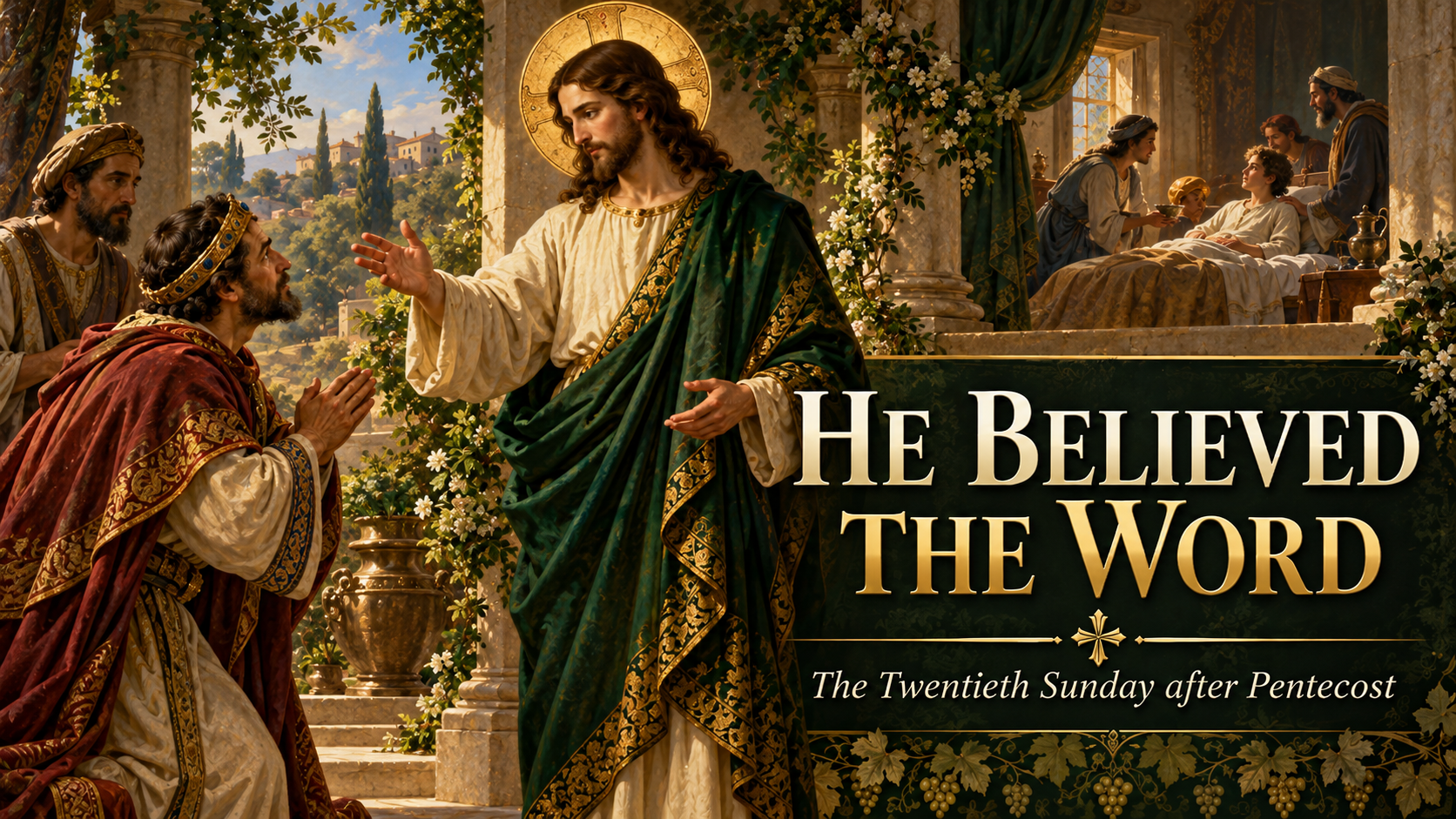
The Gospel of the occurring Twentieth Sunday after Pentecost, John 4:46–53, complements the feast through the theme of faith. The ruler who seeks the healing of his son must learn to trust Christ’s word before seeing its fulfilment. Our Lord commands him to return home, assuring him that his son lives. He departs believing what he has been told, and subsequently discovers that the healing occurred at the very hour when Christ spoke.
The parallel with the Annunciation is instructive. Mary assented to the divine promise before its fulfilment could be perceived by human senses. The ruler likewise acts upon the word of Christ before possessing visible proof. In neither case is faith irrational credulity. It rests upon the authority and truthfulness of God.
The older Roman arrangement preserves the Sunday Gospel within the feast precisely because the temporal cycle continues to instruct the faithful even when its ordinary observance is impeded.
Philippine variation. The second Sunday of October is traditionally associated with Our Lady of La Naval de Manila, commemorating the victories of 1646 attributed to the intercession of the Blessed Virgin. In 2026 this falls on 11 October. The celebration has particular importance in Manila and the Dominican tradition. Its historical observance is firmly established; however, a particular pre-1955 Philippine or Dominican proper is required to determine whether the local feast displaces, is commemorated with, or is celebrated externally alongside the Divine Maternity. The modern designation of La Naval as a diocesan solemnity must not be retroactively applied to the older rubrics.²
Monday, 12 October — Resumption of the Twentieth Sunday after Pentecost
Feria — Green — Missa Omnia, quæ fecisti nobis
In the universal Roman calendar, Monday is devoted to the resumed Mass of the Twentieth Sunday after Pentecost. The vestments are green and the Mass begins Omnia, quæ fecisti nobis. Neither Gloria nor Creed is said; the Common Preface is used, and the conclusion is Benedicamus Domino. The customary collects are A cunctis and a third ad libitum. This is not a second celebration of Sunday, but the permitted recovery of a Mass whose normal place was occupied by a feast of higher precedence.³
The Epistle from Ephesians 5:15–21 exhorts the faithful to walk carefully, redeeming the time because the days are evil. St Paul contrasts the dissipation of worldly living with the fullness of the Holy Ghost. The life of grace must transform conduct, speech, worship and the disposition of the heart. The Christian who professes faith cannot reserve the claims of Christ for occasions of formal worship while allowing entirely different principles to govern his ordinary decisions.
The Gospel recounts the healing of the ruler’s son at Capharnaum. The father approaches Christ in considerable distress, believing that only the Lord’s physical presence can save his dying child. Christ’s reply requires something more. The man must accept His divine authority without demanding that it conform to his own expectations. He believes the word spoken to him, and only afterwards discovers the promised healing.
The distinction between seeking a miracle and believing the word of Christ is essential. Signs may confirm faith, but supernatural faith rests upon the authority of God revealing. The ruler’s example therefore speaks to those who find themselves tempted to make obedience conditional upon immediate evidence of divine intervention.
English variation — St Wilfrid, Bishop and Confessor. In the historical English proper, and specifically the older Southwark calendar, 12 October is the feast of St Wilfrid, a Double, celebrated in white with the Mass Sacerdotes tui. This local observance takes the place of the universal ferial arrangement where the proper is binding. The Southwark reconstruction consequently assigns the resumed Sunday Mass to Friday, 16 October, with St Hedwig commemorated.⁴
St Wilfrid was among the most consequential ecclesiastical figures of seventh-century England. His advocacy of the Roman observance at the Synod of Whitby in 664, his episcopal activity, his appeals to Rome and his missionary work contributed to the development of English ecclesiastical life. His particular importance to Sussex lies in his missionary activity among the South Saxons and his association with the origins of the episcopal see at Selsey.
His career also reminds the Church that Roman unity was not understood merely as administrative convenience. Liturgical and canonical observance expressed a conviction that the churches of England belonged to the wider communion of the Apostolic See. Wilfrid was not without controversy, but the persistence with which he defended his understanding of ecclesiastical order forms part of his historical significance.
Spanish variation — Our Lady of the Pillar. On 12 October Spain celebrates Nuestra Señora del Pilar, Our Lady of the Pillar, associated particularly with Zaragoza. The devotion commemorates the ancient tradition of an apparition of the Blessed Virgin to St James the Apostle during his mission in Spain. The historical tradition must be distinguished from the documentation of its subsequent cult and liturgical privileges, but the importance of the shrine to Spanish Catholic identity is beyond dispute.
The feast acquired significant proper liturgical privileges before the twentieth century. In Aragon, a First-Class celebration with octave was historically authorised; elsewhere the rank and accompanying obligations depended upon the relevant Spanish proper. Thus the feast may affect more than 12 October alone, particularly when considering local commemorations through the succeeding week. The Aragonese octave must not, however, be presumed throughout Spain.⁵
Philippine variation — Our Lady of the Pillar, Zamboanga. The Marian title possesses a longstanding patronal significance at Zamboanga, where Spanish missionary and colonial history contributed to the local cult of Nuestra Señora del Pilar. The local patronal celebration is noted here without assigning an unauthenticated pre-1955 liturgical rank.
Tuesday, 13 October — St Edward the Confessor, King
Semiduplex — White — Missa Os justi
St Edward the Confessor is observed as a Semidouble in the universal calendar, with the Mass Os justi. The Gloria is said and the Common Preface used. The customary additional collects are A cunctis and a third ad libitum. A higher rank belongs to the feast in certain English diocesan propers, notably the older Southwark calendar, which assigns it as a Double of the Second Class.
Edward reigned over England from 1042 until his death in January 1066. His memory became closely associated with piety, justice, generosity towards ecclesiastical institutions and the foundation of Westminster Abbey. Canonised in 1161 by Pope Alexander III, he acquired an enduring place in the religious memory of England.
The designation Confessor expresses the Church’s recognition of sanctity apart from martyrdom. It does not require the historian to suppose that every political decision of Edward’s reign was faultless. The Church honours the Christian virtues attributed to him, particularly those concerned with the just exercise of authority and the subordination of earthly power to divine law.
The Mass Os justi presents the righteous man’s speech and judgement as governed by wisdom. Christian kingship, properly understood, is not the unlimited exercise of personal preference. The ruler is accountable to God for the use of authority entrusted to him. The same principle applies to magistrates, bishops, superiors and parents, whose responsibilities differ but whose authority remains ordered towards justice and the common good.
English variation. St Edward enjoys a higher proper rank in certain historical diocesan calendars. The Southwark reconstruction gives the feast as a Double of the Second Class. The alleged octave attributed generally to the United Kingdom in the corresponding 2025 Nuntiatoria Ordo is not supported by that proper and must not be introduced into subsequent commemorations without specific authorisation.
French variation — St Géraud of Aurillac. In parts of the Auvergne, particularly the territory associated with Aurillac and the Diocese of Saint-Flour, 13 October honours St Géraud, or Gerald of Aurillac. A lay nobleman who died about 909, he was remembered for the exercise of justice, care for the poor and the foundation of the monastic establishment at Aurillac.
St Géraud is a valuable example of lay sanctity. His vocation did not require the abandonment of all temporal responsibility; instead, he sought to fulfil his duties according to Christian principles. The persistence of his cult in the region is established, but his exact pre-1955 proper rank requires consultation of the applicable French diocesan books.⁶
Central European variation — St Coloman, Pilgrim and Martyr. St Coloman, traditionally associated with the beginning of the eleventh century, has an important cult in Austria and the historical lands of the Hungarian Crown. This makes him relevant to the ecclesiastical history of Slovakia, whose dioceses belonged to the Hungarian ecclesiastical structure before modern national boundaries were established.
His veneration may be noted where a historical diocesan proper provides for it. It would nevertheless be inaccurate to describe him as a universally obligatory Slovak feast without evidence from the appropriate diocesan calendar.
Wednesday, 14 October — St Callistus I, Pope and Martyr
Duplex — Red — Missa Statuit ei
The Church commemorates St Callistus I, Pope and Martyr, as a Double. The vestments are red and the Mass is Statuit ei. The Gloria is said, with the Common Preface.
Callistus governed the Roman Church in the early third century, during a period when the discipline of reconciliation and the authority of the Roman bishop were subjects of vigorous controversy. His career is known partly through writings associated with Hippolytus of Rome, whose hostility requires careful historical judgement. Polemical allegations cannot simply be repeated as established facts.
Callistus is associated with the catacomb complex on the Appian Way that bears his name. The cemetery became one of the most important burial places of early Roman Christianity, preserving the memory of martyrs, bishops and ordinary members of the faithful.
The controversies surrounding his pontificate concerned, among other matters, the reconciliation of Christians guilty of grave sin. The larger doctrinal question was whether the Church possessed authority to restore the repentant after serious offences. Catholic discipline has always had to hold together the demands of repentance and the reality of the power to forgive sins entrusted by Christ to His Church.
The example of Callistus therefore invites reflection upon the proper exercise of ecclesiastical government. Authority is not an end in itself. Its purpose is to preserve the Faith, protect the sacraments, maintain discipline and provide for the salvation of souls. Severity without justice may become cruelty; indulgence without repentance may become a denial of moral truth.
Thursday, 15 October — St Teresa of Jesus, Virgin
Duplex — White — Missa Dilexisti
St Teresa of Jesus, or Teresa of Avila, is celebrated as a Double, with white vestments and the Mass Dilexisti. The Gloria is said and the Common Preface used.
Born in Avila in 1515, Teresa entered the Carmelite Order and became the central figure in the reform associated with the Discalced Carmelites. Her principal spiritual writings, particularly the Life, the Way of Perfection and the Interior Castle, belong to the great inheritance of Catholic mystical theology.
Teresa’s reform aimed at the recovery of recollection, poverty, detachment and fidelity to the obligations of religious life. She was concerned not simply with outward regularity but with the cultivation of a profound interior union with God. Yet her teaching avoids the separation of mystical prayer from ordinary Christian duty. Humility, charity, obedience and perseverance remain the indispensable foundations of the spiritual life.
Her account of the interior journey is particularly important because she does not regard unusual experiences as the measure of sanctity. Consolations and extraordinary phenomena may occur, but they cannot replace the exercise of virtue. Prayer is authentic when it leads the soul towards greater conformity with the will of God.
Spain has a particular historical claim upon the saint as one of its greatest religious reformers, but her feast is universal and no separate nationwide displacement of the Roman entry is required. Particular Carmelite houses and religious communities must, however, observe their own approved propers, which may assign a higher rank.
Teresa’s feast also prepares naturally for the following observances. The Christian perfection she pursued through prayer is manifested in different ways in the charitable works of St Hedwig and the reparation taught through the devotion promoted by St Margaret Mary.
Friday, 16 October — St Hedwig, Widow
Semiduplex — White — Missa Cognovi
St Hedwig is celebrated as a Semidouble in the universal Roman calendar. The vestments are white and the Mass is Cognovi. The Gloria is said, with the Common Preface and the usual additional collects, A cunctis and ad libitum.
Hedwig was born into the noble family of Andechs in the late twelfth century and married Henry I, Duke of Silesia. She became noted for her religious devotion, generosity towards the poor and support for monastic foundations. The Cistercian monastery at Trzebnica, established through the patronage of Hedwig and her husband, became closely associated with her life and subsequent cult.
Her circumstances illustrate the possibility of sanctity amid considerable temporal responsibility. Wealth and influence were not, in themselves, incompatible with Christian perfection, but they imposed obligations. Hedwig’s charitable activity was grounded in the conviction that possessions were held in stewardship and that the powerful must answer before God for their treatment of those in need.
Following her husband’s death, she spent much of her remaining life associated with the religious community at Trzebnica. Her increasing austerity continued rather than contradicted the spiritual principles which had governed her married life.
The Mass Cognovi draws upon the praise of the virtuous woman. Its significance is not restricted to widowhood or religious withdrawal. The faithful are presented with an example of practical charity, disciplined stewardship and perseverance in prayer.
Historic Silesian variation. St Hedwig occupies an especially prominent place in the ecclesiastical history of Silesia, a territory whose political boundaries have changed repeatedly. Her cult is therefore relevant to the historical calendars of German-speaking Silesia and to the broader Central European tradition. A higher patronal or diocesan rank may apply where expressly provided by an approved proper; it must not be inferred merely from the saint’s regional popularity.
German-speaking regional variation — St Gall, Abbot. The ancient cult of St Gall belongs especially to the region around Lake Constance and the monastery and town which bear his name. Traditionally remembered as a disciple and companion of St Columbanus, Gall became one of the significant figures of the early missionary and monastic history of the Alemannic lands.
His feast on 16 October is important to the older religious calendars of the region, particularly where local or monastic propers include him. The territory historically associated with his cult does not correspond neatly to a modern national boundary: it extends across areas now belonging to Switzerland, Germany and Austria. He should therefore be described as a regional or local observance rather than a nationwide German feast.
Slovak consideration. The missionary inheritance associated with St Gall and the wider Columbanian tradition also belongs to Central European religious history. However, a distinct obligatory pre-1955 observance in the Slovak dioceses has not been established from the evidence examined. It should not be inserted as a formal Slovak proper merely because the saint appears in a modern regional calendar.
Saturday, 17 October — St Margaret Mary Alacoque, Virgin
Duplex — White — Missa Sub umbra
St Margaret Mary Alacoque is celebrated as a Double, in white, with the Mass Sub umbra. The Gloria is said and the Common Preface used.
Born in Burgundy in 1647, Margaret Mary entered the Visitation monastery at Paray-le-Monial in 1671. Her name is inseparable from the revelations concerning the Sacred Heart of Jesus which she reported during her religious life. She died in 1690 and was canonised by Pope Benedict XV in 1920.
The devotion which developed through her influence has a firm theological foundation in the mystery of the Incarnation. The Sacred Heart is the Heart of the divine Person of Christ, considered in His assumed humanity as the living symbol of His love. Its veneration is therefore directed towards the Incarnate Word, not towards a merely human affection separated from His divinity.
The practices associated with St Margaret Mary, particularly Holy Communion on First Fridays, the Holy Hour and acts of reparation, are properly understood as responses to the love of Christ. They cannot be reduced to sentimental religious exercises or treated as mechanical guarantees independent of repentance and fidelity to the commandments.
The Mass Sub umbra draws upon the imagery of the Song of Songs, which the Church has long interpreted in relation to the love between Christ and the soul. The language of affection is appropriate, but it must remain governed by the supernatural virtue of charity.
There is a particular continuity between the feasts of St Teresa and St Margaret Mary. Both belong to the mystical tradition, yet neither permits religious experience to replace obedience, humility or the pursuit of virtue. Extraordinary graces are ordered towards holiness; they do not constitute an alternative to the ordinary demands of Christian life.
The feast belongs to the universal calendar, and no additional nationwide displacement has been established for the countries under consideration. Particular Visitation communities and religious congregations associated with the Sacred Heart may possess approved propers assigning a different rank or additional liturgical observances.
At Vespers the occurring feast yields to the First Vespers of St Luke the Evangelist, a Double of the Second Class, with the commemoration of St Margaret Mary where prescribed. Where a higher-ranking diocesan dedication feast occurs on the following Sunday, the local proper determines the Office and its commemorations.
Sunday, 18 October — St Luke the Evangelist; Commemoration of the Twenty-first Sunday after Pentecost
Duplex II classis — Red — Missa Mihi autem
The week concludes with the feast of St Luke the Evangelist, a Double of the Second Class. The vestments are red and the Mass is Mihi autem. The Gloria and Creed are said, and the Preface is of the Apostles. The Twenty-first Sunday after Pentecost is commemorated, providing the ninth lesson at Matins and the proper Last Gospel. The commemoration for the Propagation of the Faith is also indicated in the older Ordo where prescribed.¹
St Luke occupies a distinctive place among the Evangelists. Traditionally identified as the author of both the Third Gospel and the Acts of the Apostles, he provides the Church with a continuous narrative extending from the birth of Christ to the missionary expansion of the apostolic Church. His Gospel preserves some of the most familiar and theologically significant passages of the New Testament.
The Annunciation, Visitation, Magnificat, Benedictus, presentation in the Temple and finding of the Child Jesus at Jerusalem all contribute to the Church’s understanding of the Incarnation. The parables of the Good Samaritan and the Prodigal Son, together with the account of the disciples on the road to Emmaus, illustrate the extraordinary richness of his witness to the mercy and saving work of Christ.
The feast is particularly appropriate in a week which began with the Divine Maternity. Much of the biblical foundation for the Church’s meditation upon the Blessed Virgin Mary comes from St Luke. His account of the Annunciation reveals both the divine initiative and Mary’s obedient response, while his presentation of the infancy of Christ preserves the inseparable connection between the historical events of Our Lord’s birth and the fulfilment of divine prophecy.
The Acts of the Apostles continues this account by showing how the mission of Christ is extended through the preaching and sacramental ministry of His Church. The risen Lord has not abandoned His disciples. Through the Holy Ghost, the apostolic ministry continues the work entrusted to it, proclaiming the Gospel to Jews and Gentiles alike.
Luke’s traditional association with St Paul, and the reference to him as the beloved physician in Colossians 4:14, gives his writings a particular place in the Church’s recollection of the first missionary generation. He is not honoured as an independent religious philosopher but as an Evangelist whose testimony serves the revelation of Christ.
The occurring Twenty-first Sunday after Pentecost supplies the parable of the unforgiving servant, Matthew 18:23–35. The first servant is released from an enormous debt, yet refuses to show mercy to another whose debt is insignificant by comparison. The contrast exposes the moral inconsistency of seeking divine forgiveness while withholding forgiveness from others.
The lesson is uncompromising. Mercy received imposes obligations upon the recipient. A Christian cannot invoke the patience of God for himself while claiming an unrestricted right to resentment, vengeance or deliberate hardness of heart towards his neighbour.
The correspondence with St Luke’s Gospel is especially apt. Divine mercy is never represented as indifference towards sin. It is the mercy which calls the sinner to repentance, restores him to communion and requires the amendment of life. To preach forgiveness without conversion is to distort its meaning; to demand conversion while denying the possibility of forgiveness is equally contrary to the Gospel.
The Mass Mihi autem honours the Apostles and Evangelists as the friends of God, whose testimony belongs permanently to the Church’s inheritance. Their authority is derived from Christ and ordered towards the faithful transmission of His revelation. Their example reminds every generation that the Church is called not to invent a new Gospel, but to preserve and proclaim what was entrusted to the Apostles.
In the universal calendar, Second Vespers are of St Luke, with commemoration of the occurring Sunday according to the rubrics. In Southwark usage, the Office follows the Dedication and its proper concurrence.


Leave a Reply