
Editorial
There are moments in the life of a civilisation when its crises can no longer be mistaken for coincidence. They begin to align, to converge, to reveal not merely a sequence of failures but a structure—a pattern of thought, a habit of governance, a disposition of the soul. Such moments demand more than commentary. They demand diagnosis. This edition of Nuntiatoria proceeds from the conviction that we are no longer dealing with isolated controversies, but with the unfolding consequences of a profound and sustained rupture at the heart of Western life.
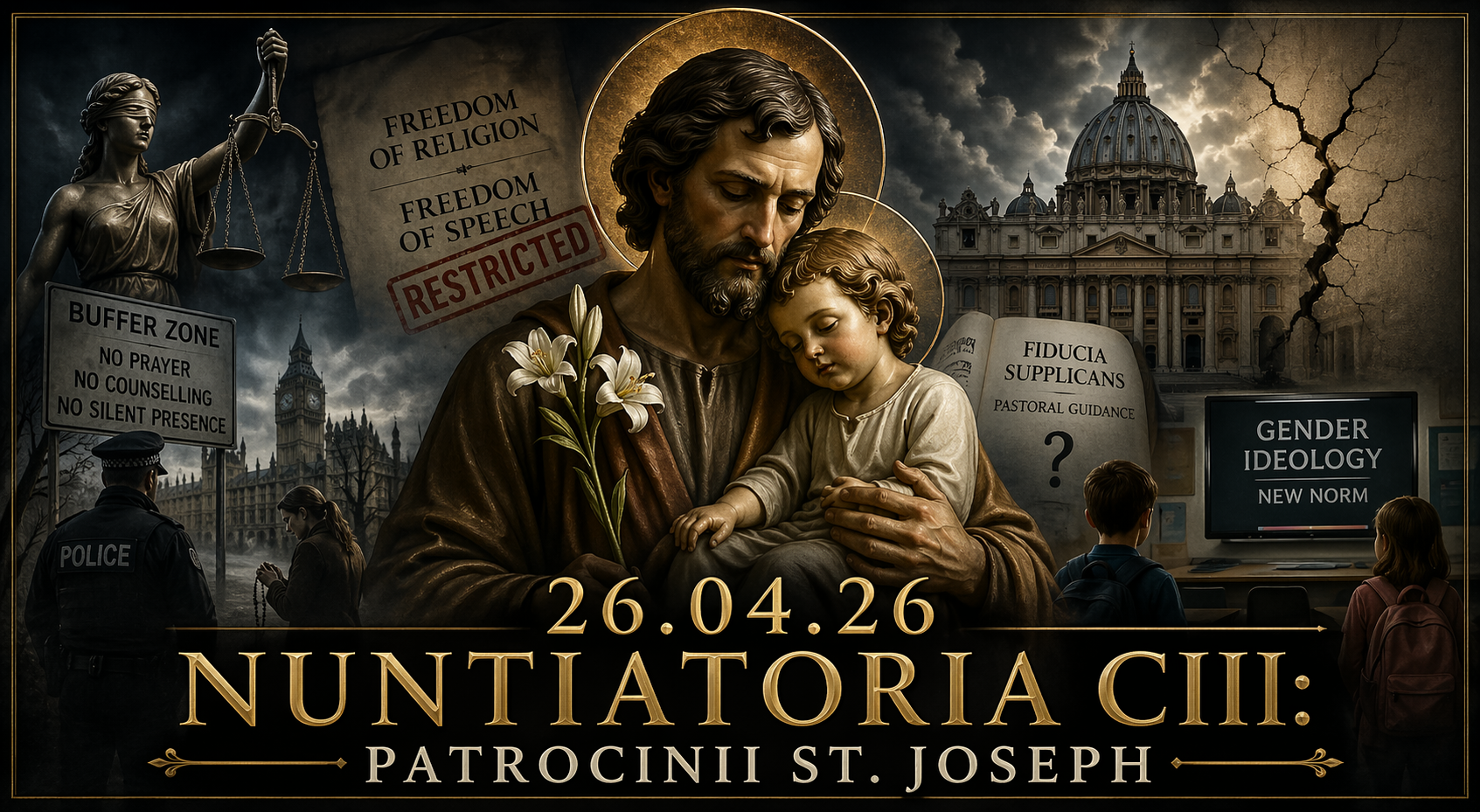
Consider the range of subjects addressed herein: the steady extension of abortion provisions toward birth; the criminalisation of prayer, counsel, and even silent presence within designated “buffer zones”; the ideological formation of children within educational systems increasingly detached from parental authority; the selective enforcement of speech norms; the reconfiguration of pastoral practice within the Church under the language of accompaniment and inclusion. These are not disparate developments. They are expressions of a single underlying shift—the displacement of truth by will, of nature by construction, of moral order by procedural consensus.
At the centre of this shift lies an anthropological error of the most serious kind: the denial that man possesses a knowable nature ordered toward a definable good. Once this premise is abandoned, rights cease to be grounded in reality and become instead instruments of preference, negotiated and enforced through power. Law, in such a context, is no longer an ordinance of reason directed to the common good, as articulated by Thomas Aquinas, but a mechanism for the codification of competing claims. The result is not neutrality, but the quiet absolutisation of whichever vision prevails within the institutions that govern.
This is why the language of rights, so dominant in contemporary discourse, has become increasingly detached from its original moral framework. Rights are asserted without reference to duties; freedoms are expanded without regard to their proper ends; protections are extended in ways that, paradoxically, diminish the very conditions necessary for genuine human flourishing. Nowhere is this more evident than in the legal sphere, where the expansion of regulatory regimes—particularly in matters of speech and conscience—has begun to erode the classical understanding of liberty itself.
The jurisprudence of the late twentieth century, exemplified in cases such as Kokkinakis v Greece, affirmed that the freedom to manifest one’s religion includes the right to persuade, to witness, and to live publicly according to one’s convictions. That principle is now increasingly qualified in practice. The emergence of “buffer zones,” the policing of expression under broad and often ambiguous categories of harm, and the willingness of authorities to intervene pre-emptively in matters of conscience suggest a shift from the protection of freedom to its management. What is presented as the safeguarding of vulnerable individuals risks becoming the restriction of moral agency itself.
Yet it would be insufficient to attribute this development solely to the state. Law reflects culture, and culture, in turn, reflects deeper assumptions about truth, authority, and the nature of the human person. The crisis we observe is therefore as much theological as it is political. For when truth is no longer proclaimed with clarity within the Church, it will not long be defended with conviction within society. The internal ambiguities of the postconciliar period—manifest in shifting pastoral emphases, contested doctrinal interpretations, and the language of adaptation—have contributed, however unintentionally, to a broader cultural uncertainty. When the Church hesitates to speak definitively, the world does not remain silent; it speaks in its place.
This dynamic is particularly evident in contemporary debates surrounding human identity, family life, and the moral formation of the young. The increasing marginalisation of parental authority, the introduction of ideologically driven educational materials without consultation, and the redefinition of fundamental anthropological categories all point toward a reconfiguration of society at its most basic level. The child, who ought to be the primary beneficiary of law and culture, becomes instead the subject of competing visions imposed from above. In such a context, the language of protection obscures a deeper instability: the loss of any shared understanding of what it means to be human.
It is here that the convergence of legal, cultural, and ecclesial crises becomes most apparent. For the same anthropological confusion that permits the redefinition of the family also underlies the expansion of abortion, the restriction of conscience, and the reconfiguration of pastoral practice. Each development reinforces the others. Each contributes to a cumulative effect in which the structures of society are gradually detached from the realities they were once designed to serve.
And yet, it must be said with equal clarity: this is not a counsel of despair. Crisis, rightly understood, is revelatory. It strips away illusion. It exposes contradiction. It compels a return to first principles. The present moment, for all its gravity, is also one of opportunity—an opportunity to recover what has been obscured, to articulate what has been forgotten, and to rebuild on foundations that do not shift with the currents of opinion.
Such renewal, however, cannot be merely institutional. It must be personal. The restoration of a rightly ordered society begins with the restoration of rightly ordered souls. The call, therefore, is not only to analysis, but to conversion: to the reorientation of the intellect toward truth, of the will toward the good, and of the whole person toward God. Without this interior transformation, external reform will prove fragile and incomplete.
If a single principle governs this edition, it is this: that truth is not an imposition upon freedom, but its condition. Where truth is denied, freedom dissolves into power; where truth is affirmed, freedom finds its proper form. The task before us is to bear witness to that truth—clearly, courageously, and without compromise—within every sphere of life.
For a civilisation that forgets what man is cannot remember what it is for.
And a Church that hesitates to teach cannot long sustain a people who must live—and, if necessary, suffer—for the truth she proclaims.

IN THIS EDITION
- The Accusation Is the Sentence: Nadeem Masih and Pakistan’s Blasphemy Machinery
- Synodality or Stage Management? Fr. James Martin, Study Group 9, and the Manufactured Consensus Crisis
- The Synod and the Revolt Against Revelation: Bishop Schneider’s Warning and the Crisis of Catholic Identity
- Judicial Rebuke: High Court Overturns OfS Free Speech Fine — Process Collapses, Not the Question Itself
- Net Zero and the Moral Supply Chain Crisis: Britain’s Green Transition and the Hidden Cost of “Clean” Energy
- Audience Denied, Errors Embraced: Vatican II, the SSPX Crisis, and the Asymmetry of Rome’s Ecumenical Praxis
- Montagna Report: Vatican Preparing Schism Declaration Ahead of SSPX Consecrations — A Crisis of Ecclesial Authority and Legitimacy
- Crewe Raid Exposes a Known Safeguarding Pattern—And a System That Still Acts Too Late
- Abortion Images and Free Speech: R v Skinner Overturns Conviction in Landmark High Court Ruling
- Free Speech on Trial: The Crown’s Failure at Glasgow and the Fragility of Britain’s “Buffer Zone” Regime
- Rome Opens the File on Charlotte — A Test Case for Liturgical Authority
- Cardinal Ernest Simoni and Pope Leo XIV: The Witness of the Martyrs in an Age of Amnesia
- Pope Leo XIV and Sarah Mullally: When the Church Shows What She Does Not Teach
- Immanence and Transcendence: The Relocation of God and the Crisis of the Modern Church
- Catholic Bishops’ Empty Moralizing? Dignity, Order, and the Collapse of Proportion in Contemporary Catholic Discourse
- Independence Without Authority: CofE Safeguarding Reform and the Limits of Ecclesial Self-Regulation
- “Who Is Tearing the Tunic?”: The SSPX Consecrations and the Unravelling of Postconciliar Ecclesiology
- Mary’s Month of May: The Queen Crowned in the Springtime of Grace
- The Patronage of St Joseph: Guardian of the Church in an Age of Crisis
- 26.04.26 Nuntiatoria CIII: Editorial
- ORDO w/c 26.04.26
- Reform or Restoration? Bishop Schneider and the Limits of the “Reform of the Reform”
- Unity Without Truth? Pope Leo XIV, Moral Priority, and the Question of Blessings
- From Principle to Enforcement: The Reconstitution of Academic Freedom in Britain
- Earth Day and the Restoration of the Steward: Creation, Crisis, and the Question of Interpretation
- Speech, the Soul, and the State: The Supreme Court, Therapy, and the Limits of Ideological Law
- From Rupture to Reconstitution: The Priesthood After the Break of Vatican II
- Preaching in the Public Square: Colchester, Clive Johnston, and the Quiet Reconfiguration of Religious Liberty
- The Miracle Reinterpreted: “Sharing,” Multiplication, and the Doctrinal Stakes
- Pastoral Ambiguity and Doctrinal Drift: The German Implementation of Fiducia Supplicans
- The Crime of Meaning: Preaching, Presence, and the New Boundaries of Speech
- The Juridification of Morality: The European Court and the Reordering of Sovereignty in Hungary
- Fayoum and the Fault Line: Persecution by Administration in Modern Egypt
- Soft Blasphemy: The RAF Cadet Case and the Unofficial Policing of Thought in Britain
- Pronouns, Power, and the Formation of the Young
- The Silence That Speaks: Abstraction and the Suffering Church
- The Instrumentalisation of Faith and the Illusion of Cultural Christianity
- The Unmaking of the Child: Rights Without Nature
- The Limits of Obedience: Cardinal Muller, the Vincentian Canon, and the Question of Necessity
- The Mirage of an “Imperfect Council”: Authority, Illusion, and the Crisis of the Church





Leave a Reply