
Editorial
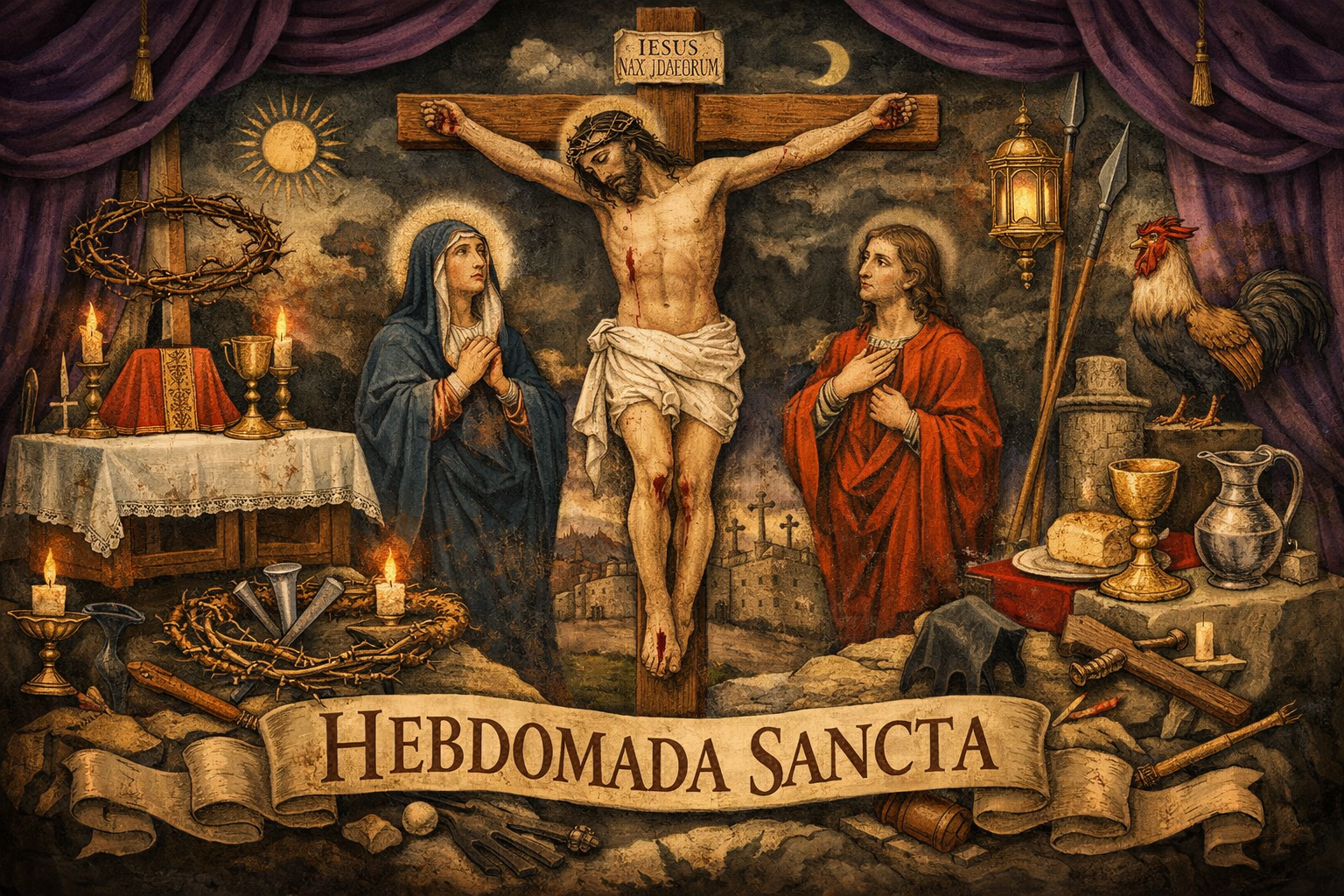
This present edition of Nuntiatoria is framed not by commentary alone, but by contrast—indeed, by confrontation. It places before the reader two realities which cannot be reconciled: the ordered, sacrificial, Christocentric world disclosed in the sacred liturgy of the Passion, and the disordered, restless, and ideologically unstable condition of the modern West, mirrored with increasing clarity within the postconciliar Church herself. What emerges is not merely tension, but incompatibility. One is governed by truth received; the other by meaning constructed. One is oriented toward God; the other increasingly toward the self.
Holy Week, as preserved in the traditional Roman Rite, does not merely recount events; it manifests a reality. Every gesture is governed, every silence is intentional, every omission speaks. The gradual withdrawal of doxology, the deepening austerity, the veiling of images, and the intensification of prayer all draw the soul into a single, unambiguous truth: that redemption is wrought not through affirmation, adaptation, or accommodation, but through sacrifice—through the obedience of the Son unto death, even death on a Cross. The liturgy does not explain this; it forms the soul to perceive it. It imposes order where the modern world invites fragmentation. It teaches hierarchy where contemporary culture insists upon flattening. It binds the intellect to truth and the will to charity.
Here there is no confusion of categories. Love is not sentiment, but self-offering. Freedom is not autonomy, but conformity to the will of God. Truth is not negotiated, but revealed. And because these realities are enacted rather than merely asserted, they stand as a living contradiction to the dominant assumptions of the age.
Set against this is the prevailing condition of our time, which this edition examines across ecclesial, legal, cultural, and intellectual domains—not as a collection of isolated disturbances, but as manifestations of a coherent and deepening disorder. The articles gathered here do not merely report developments; they interpret them within a common framework. What becomes evident is that the crisis is not episodic but structural, not accidental but principled.
Within the Church, the analysis of synodality and the forthcoming global episcopal assembly reveals the continued institutionalisation of a pastoral method increasingly detached from doctrinal precision. The anniversary of Amoris Laetitia is not treated as a moment of clarification, but as a consolidation of ambiguity, particularly where sacramental discipline and moral theology intersect. The unresolved tension with the teaching of Familiaris Consortio remains not only unresolved, but effectively normalised. The language of accompaniment, while pastorally attractive, is shown to risk becoming a vehicle for doctrinal elasticity, wherein exception gradually assumes the force of principle.
The treatment of the Traditional Mass further sharpens this point. The persistent claim that attachment to the older rite is merely aesthetic is revealed as inadequate and, at times, disingenuous. What is at stake is not preference but principle: the continuity of liturgical theology, the integrity of sacrificial worship, and the coherence of the Church’s lex orandi with her lex credendi. The reluctance of many to articulate this openly—preferring instead to affirm both continuity and rupture simultaneously—is identified as a significant factor in the present confusion.
In the civil sphere, the edition turns to emerging legal conflicts which mirror these same patterns of instability. The forthcoming High Court case concerning single-sex provision in schools, rooted in policies first developed and implemented at local authority level, exposes the growing tension between legal clarity and ideological assertion. What was once assumed—indeed, what was foundational to safeguarding—is now contested, redefined, and subjected to administrative reinterpretation.
Similarly, legislative developments concerning digital regulation and age verification are examined not simply as matters of policy, but as indicators of a broader shift toward centralised control. The expansion of ministerial powers to regulate speech, access information, and enforce compliance without proportional safeguards signals a movement away from principled governance toward discretionary authority. The language of protection—particularly of children—is shown to function increasingly as a justificatory mechanism for measures that would otherwise invite serious scrutiny.
International parallels reinforce this pattern. Developments in Canada, Iceland, and across parts of Europe demonstrate that these are not isolated national phenomena but expressions of a shared ideological trajectory. Whether in the restriction of religious expression, the reframing of conscience rights, or the legal normalisation of assisted death, the same underlying logic is at work: the redefinition of fundamental human realities according to subjective criteria, enforced through institutional power.
Yet beneath these legal and ecclesial developments lies a deeper anthropological crisis, which several articles address directly. The redefinition of love as affirmation detached from truth, of freedom as self-determination without reference to nature, and of identity as self-constructed rather than received, represents not merely a shift in emphasis but a rupture in understanding. The critique of revisionist approaches to Scripture highlights the extent to which even the most stable interpretive traditions are now subjected to ideological re-reading, often under the guise of compassion or inclusion. What was once understood across centuries is now declared uncertain; what was once clear is now rendered ambiguous.
The retraction of widely publicised data concerning religious revival serves as a further illustration of the fragility of contemporary narratives. The eagerness with which such claims were received, and the relative quiet with which they were withdrawn, underscores the need for intellectual discipline and evidential integrity. In an age shaped by perception and amplification, the distinction between reality and narrative becomes increasingly difficult to maintain.
And yet, this edition does not confine itself to critique. The account of missionary development in Japan offers a necessary counterpoint: a quiet, deliberate, and faithful growth rooted not in adaptation to prevailing trends, but in fidelity to what has been received. Emerging from modest beginnings and sustained through perseverance rather than institutional support, this mission stands as a witness to the enduring vitality of tradition when it is lived rather than negotiated. It demonstrates that clarity does not repel, but attracts; that integrity does not diminish, but strengthens.
The temptation in such a moment is either despair or retreat into abstraction—either to concede the inevitability of decline or to escape into theoretical purity divorced from lived reality. But the liturgy of the Passion admits neither. It does not argue; it reveals. It does not accommodate; it orders. It does not seek relevance; it demands conversion. And in so doing, it provides not merely a critique of the present crisis, but its only adequate remedy.
For the disorder we witness is not fundamentally political, cultural, or procedural—it is theological. It is the loss of a right vision of God, and therefore of man. It is the eclipse of sacrifice, the rejection of hierarchy, and the refusal of the Cross. Where God is no longer understood as He is, man cannot understand himself; where worship is disordered, life follows.
This edition therefore proposes no novelty, no programme, no strategy of adaptation. It returns, rather, to first principles: to the Cross as the axis of reality, to the liturgy as the school of truth, and to the Passion as the definitive revelation of what is. In that light, the confusions traced throughout these pages are neither surprising nor ultimate. They are symptoms of a deeper rupture—one that can be healed only by restoration, not reinvention.
Holy Week does not flatter the world. It judges it. And in that judgment, it offers mercy—not as indulgence, but as transformation. It calls man out of himself and into the order of divine charity. It reveals that suffering, rightly understood, is not meaningless but redemptive; that obedience is not servility but freedom; that love is not affirmed in isolation but proven upon the Cross.
Here, then, is the clarity so conspicuously absent elsewhere: that man is not saved by aligning himself with the spirit of the age, but by being conformed to the Crucified. In that conformity alone is found the restoration of order—within the soul, within the Church, and, by consequence, within the world.
IN THIS EDITION
- Cardinal Roche’s Disclosure: Traditionis Custodes, Écône and the Limits of Leo XIV’s Reconciliation
- 26.04.26 Nuntiatoria CIII: Editorial
- 19.04.26 Nuntiatoria CII: Editorial
- Easter Saturday in the Tridentine Rite: The Consummation of the Paschal Mystery in Ecclesial Life
- Silencing the Mother: Rome, Marian Doctrine, and the Limits of What May Be Said
- Easter Friday in the Tridentine Rite: The Eucharistic Presence of the Risen Lord
- Easter Thursday in the Tridentine Rite: The Apostolic Mission of the Risen Christ
- Easter as Judgment and Renewal: The Resurrection Against Nominal Christianity
- Easter Wednesday in the Tridentine Rite: The Manifestation of the Risen Christ in the Breaking of Bread
- The Sisters and the State: Conscience, Compulsion, and the Last Freedom
- Easter Tuesday in the Tridentine Rite: The Recognition of the Risen Lord
- The Finnish Reckoning: Gender Medicine, Mental Health, and the Moral Limits of Affirmation
- Abandon the Desire for Conflict: Power, Peace, and the Resurrection in the Easter Message of Pope Leo XIV
- The Inflation of Sanctity: Canonisation, Credibility, and the Crisis of Authority
- 05.04.26 Nuntiatoria C: Editorial
- Recycling Dei Verbum’s Errors: Leo XIV and the Repackaging of Revelation
- The Women’s Institute Fractures: When Legal Clarity Meets Cultural Collapse
- Holy Saturday: The Silence of the Tomb, the Descent into Hell, and the Expectation of Resurrection
- The One Pasch: Sacrifice, Supper, and Consummation in the Pre-1955 Roman Rite
- Today’s Liturgy & Mass: April 4 Holy Saturday
- Sermon for Holy Saturday
- Good Friday: The Sacrifice Consummated, the Priesthood Fulfilled, and the Redemption Accomplished
- Good Friday Sermon: “Behold the Wood of the Cross, on Which Hung the Saviour of the World”
- Today’s Liturgy: April 3 Good Friday
- Sermon for Good Friday
- The Day of the Lamb: The Coherence of Holy Week in the Traditional Roman Rite and Its Disruption in Modern Reform
- The Return of the Young Through Tradition: Holy Week in the Philippines as a Sign of Renewal
- Maundy Thursday: The Institution of the Sacrifice, the Priesthood, and the Mandate of Charity
- Maundy Thursday Sermon: “Having Loved His Own, He Loved Them Unto the End”
- Today’s Mass: April 2 Maundy Thursday
- Sermon for Maundy Thursday
- Spy Wednesday: Betrayal Conceived, Mercy Rejected, and the Price of Treachery
- The Restoration of the Mandatum: Leo XIV and the Recovery of Holy Thursday’s Priestly Meaning
- Station Spy Wednesday: Statio ad St Mariam Majorem
- Tradition as Concession? Cardinal Roche, Traditionis Custodes, and the Crisis of Liturgical Continuity
- A Door Closed in Lent: The SSPX Pilgrimage and the Crisis of Catholic Inclusion
- Today’s homily: Spy Wednesday
- Stational Reflection Spy Wednesday: Statio ad St Mariam Majorem
- Sermon for Wednesday in Holy Week
- Today’s Mass: April 1 Spy Wednesday
- Holy Tuesday: The Day of Contestation, Prophecy, and Final Appeal
- Station Holy Tuesday: Statio ad Sanctam Priscam
- Broadcasting Ideology: The BBC, Ofcom, and the Failure of Cultural Stewardship
- Stational Reflection Holy Tuesday: Statio ad St Priscam
- Today’s Mass: March 31 Holy Tuesday
- Sermon for Tuesday in Holy Week
- Holy Monday: Judgment, Fruitfulness, and the Purification of Worship
- Station Holy Monday: Statio ad St Praxedem
- A Crisis of Authority and the Last Refuge of Faith: Bishop Anthony Ward’s Passion Sunday Address
- Fr Reid Hennick’s Reception into the Apostolate of Bishop Donald Sanborn: Context, Consequence, and the Unresolved Crisis
- Today’s homily: Holy Monday
- Stational Reflection Holy Monday: Statio ad St Praxedem
- Today’s Mass: March 30 Holy Monday
- Sermon for Monday in Holy Week
- Caiaphas and the Calculus of War: Just Cause, Disordered Ends, and the Discipline of Constraint
- A Palm Sunday Without the Patriarch
- Station Palm Sunday: Statio ad St Ioannem Laterano
- Today’s Mass: March 29 Palm Sunday
- Sermon for Palm Sunday
- Station Passion Saturday: Statio ad St Ioannem ante Portam Latinam
- Palm Sunday: The Royal Entry and the Way of the Cross
- Emotionalism and the End of Rational Society
- 29.03.26 Nuntiatoria XCIX: Editorial
- ORDO w/c 29.03.26
- Landmark Euthanasia Case in Spain: Autonomy, Suffering, and the Limits of Law
- The Collapse of a Convenient Myth
- Apostolic Succession, Sacred Power, and the Nature of the Priesthood: Pope Leo XIV’s Reassertion of Catholic Order
- The School of Sorrows: Standing with the Mother beneath the Cross
- “Generous Inclusion” and the Illusion of Change
- The Algorithmic Child: Safeguarding Failure in the Age of Engineered Influence
- “Generous Inclusion” or Liturgical Containment?
- Landmark High Court Case to Decide Future of Single-Sex Spaces in Schools
- Criminalising Conscience: The Iceland Warning and the Path Already Prepared in Britain
- Canterbury Without Faith: Defensor Fidei and the Hollowing of Christian England
- The Illusion of Necessity: From Bonn to Antwerp and the Crisis of Ecclesial Identity
- Prince William, the Crown, and the Crisis of Defensor Fidei





Leave a Reply