
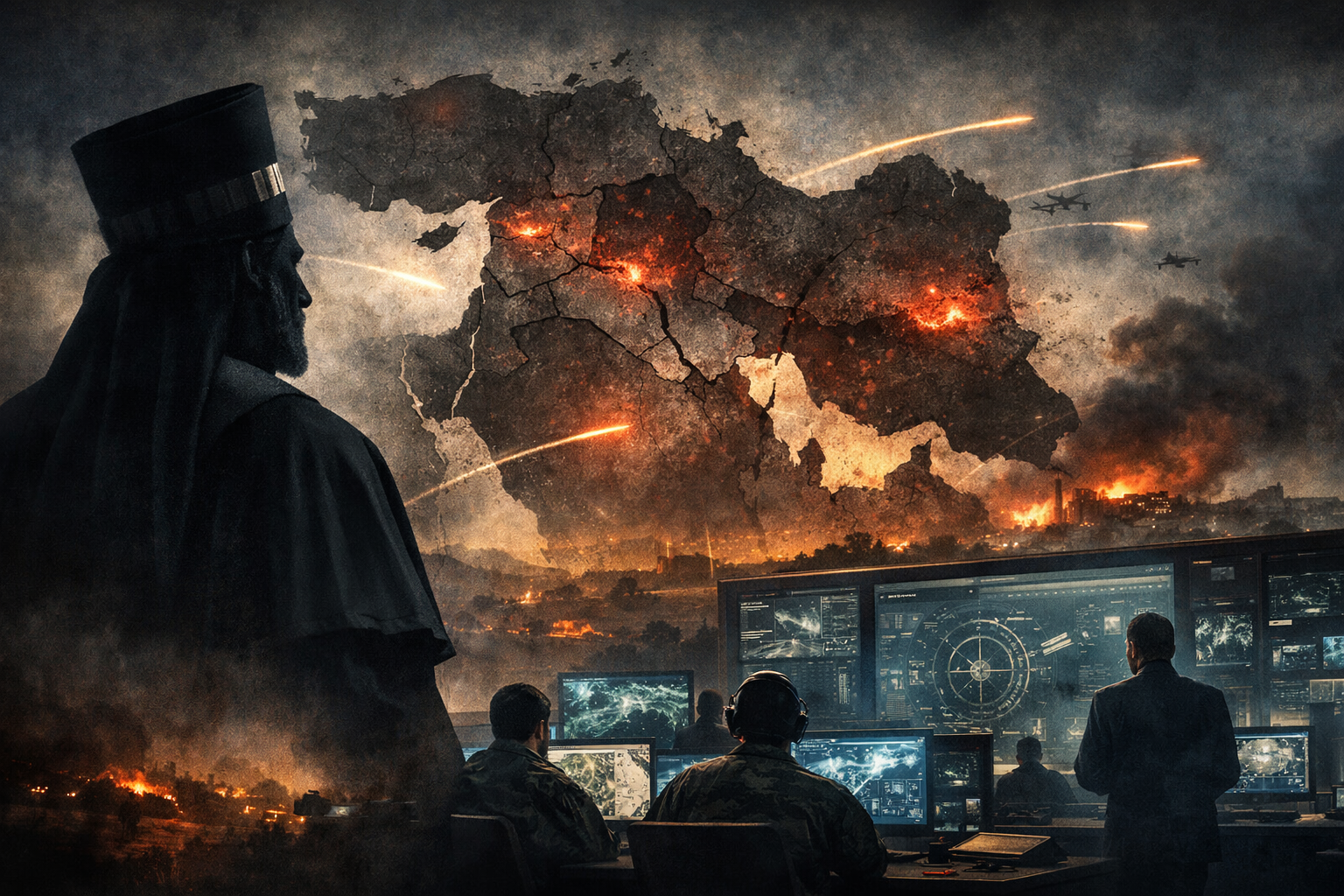
Caiaphas and the Calculus of War: Just Cause, Disordered Ends, and the Discipline of Constraint
In an age of proxy warfare, ideological conflict, and escalating confrontation, the Church’s doctrine of Just War endures—but only where intention is governed by restraint, and not absorbed into the logic of power.
War Under Judgment
In the days immediately preceding Holy Week, Pope Leo XIV delivered a series of remarks that, taken together, amount to a profound theological intervention into contemporary geopolitics. Declaring that wars arise from the “idolatry of power and money,” and that God does not hear those who invoke Him while waging violence, he has unsettled the complacency with which modern conflicts are often narrated.¹ These statements are not the utterances of a pacifist rupture with tradition, nor are they rhetorical gestures intended merely to console. They are a judgment upon the moral condition in which war is conceived, justified, and prosecuted in the modern world.
What is at stake is not the existence of conflict—an inevitability in a fallen world—but the integrity of the moral reasoning that accompanies it. For it is one thing to acknowledge that war may be necessary; it is another to assume that necessity confers righteousness. The Pope’s intervention, read in continuity with the Church’s tradition, presses precisely this point: that the justification of war must remain under judgment, even—and especially—when its cause appears most compelling.
Caiaphas and Political Necessity
The figure of Caiaphas, to whom the Pope explicitly alludes, stands as the archetype of political reasoning under the pressure of perceived necessity. “It is expedient for us, that one man should die for the people” (John 11:50).² The brilliance—and the danger—of this reasoning lies in its plausibility. Caiaphas does not act from arbitrary cruelty or blind hatred; he acts from calculation, from a desire to preserve order, to avert instability, to maintain the fragile equilibrium of a nation under foreign domination.
Yet in this very calculation, the moral order is inverted. The innocent is condemned not because he is guilty, but because his death is judged useful. Prudence, which ought to be ordered toward the good, becomes instrumentalised toward preservation of power. Justice is not denied; it is redefined in terms of expediency.
This pattern has not receded into antiquity. It persists wherever the language of necessity is employed to justify the elimination of the innocent, wherever the preservation of order is allowed to override the demands of truth, and wherever political calculation is cloaked in moral inevitability. In the context of modern warfare, this logic manifests itself not only in overt acts of violence, but in the framing of those acts—in the narratives that render them intelligible, and therefore acceptable.
The Enduring Doctrine of Just War
Against both naïve pacifism and unrestrained realism, the Catholic tradition has maintained a principled middle path. From St. Augustine of Hippo, who first articulated the moral conditions under which war might be licit, to St. Thomas Aquinas, who gave those conditions systematic form, the Church has insisted that war, while sometimes necessary, is always morally perilous.³
The Catechism of the Catholic Church preserves this inheritance with clarity and sobriety. War may be justified only where the damage inflicted by the aggressor is lasting, grave, and certain; where all other means of redress have been exhausted; where there is a serious prospect of success; and where the use of force does not produce evils greater than those it seeks to remedy.⁴ These criteria are not procedural formalities. They are moral boundaries designed to prevent precisely the collapse into the logic of Caiaphas—to ensure that necessity does not become licence.
Yet the application of these criteria in the modern world has become increasingly fraught. The scale of contemporary warfare, the complexity of political motivations, and the entanglement of civilian and military realities all conspire to erode the clarity upon which the doctrine depends. It is here that the Pope’s warning acquires its urgency.
Iran, Proxy Warfare, and the Reality of Threat
No honest assessment of the present conflict can ignore the long-standing pattern of Iranian regional strategy. The Islamic Republic has, for decades, extended its influence through a network of proxy actors, including Hezbollah and Hamas, supported, trained, and in many cases directed by elements of the Islamic Revolutionary Guard Corps.⁵ These groups have engaged in sustained hostilities, including rocket attacks on civilian populations, cross-border incursions, and the destabilisation of neighbouring states.⁶
In recent developments, Israel has faced not a singular threat but a convergence of pressures: active conflict in Gaza alongside sustained attacks from the north, thereby reinforcing the immediacy and seriousness of the defensive claim.⁷ The situation is not one of abstract hostility, but of tangible and ongoing aggression.
At the same time, the internal condition of Iran cannot be excluded from moral consideration. Reports from international bodies document restrictions on religious freedom, including the persecution of Christian converts and the suppression of dissent.⁸ The suffering of these populations, and their desire for relief, constitute a genuine moral claim—one that cannot be dismissed without indifference to justice.
Taken together, these realities establish that the appeal to defense is not illusory. There exists a real threat, a real pattern of aggression, and real human suffering. Any theological analysis that fails to acknowledge these facts risks collapsing into abstraction.
From Defense to Escalation: The Moral Threshold
Yet it is precisely at the point where justification appears strongest that moral scrutiny must be most exacting. The movement from defending against proxy attacks to initiating direct strikes against Iranian territory marks a transition that cannot be treated as morally neutral. It raises questions not only of strategy, but of intention.
The requirement of last resort demands that force be employed only when all other means have been exhausted.⁴ The requirement of proportionality demands that the harm inflicted not exceed the harm prevented. Where military action expands beyond the neutralisation of immediate threats toward broader objectives—whether framed as deterrence, degradation of long-term capability, or regional reconfiguration—the intention of the war becomes more difficult to define.
Modern warfare intensifies this difficulty. Precision weapons coexist with mass destruction; targeted strikes occur alongside civilian casualties; limited operations risk cascading escalation. In such a context, the boundary between necessity and excess becomes perilously thin.
Secondary Benefits and the Disorder of Ends
It is not contrary to moral theology that a just war may yield benefits beyond its immediate aim. Strategic advantage, political consolidation, and even economic gain may follow from the successful prosecution of a just cause. These do not, in themselves, invalidate the justice of the war.
The decisive question is not whether such benefits exist, but what role they play in the formation of intention. Where they remain subordinate—where they are accepted as consequences rather than pursued as ends—the moral order is preserved. But where they become determinative—where the pursuit of power, influence, or security begins to shape the conduct of the war—they risk displacing the original justification.
This is what the Pope names as idolatry: not the presence of power, but its elevation to the status of an ultimate good.¹ In such a condition, means are justified by outcomes, and moral limits are reinterpreted as obstacles rather than obligations.
Constraint as the Guardian of Justice
If Just War doctrine is to remain operative in more than name, it must be embodied not in declarations, but in disciplines. A just war is not maintained by the sincerity of belief, but by the imposition of limits upon action.
Objectives must remain clearly defined and strictly limited. Means must be constrained by the demands of discrimination and proportionality. Decisions must be subject to continuous re-evaluation, not justified by past sacrifice or anticipated gain. The distinction between military necessity and political ambition must be actively preserved.
Without such constraints, intention inevitably drifts. What begins as defense expands into dominance; what is undertaken for protection becomes a vehicle for reordering; what is justified by necessity becomes sustained by interest.
The Illusion of Moral Certainty
The greatest danger, therefore, is not the absence of justification, but the presence of certainty. When a nation comes to regard its cause as wholly righteous, it becomes insulated from critique. Actions that would otherwise be questioned are absorbed into a narrative of necessity. It is at this moment that the logic of Caiaphas reasserts itself—when conscience is subordinated to calculation, and the elimination of the innocent is rendered acceptable by the promise of stability.
The Church does not demand an impossible purity of motive. It recognises that human action is invariably mixed, that even the just are not free from self-interest. But it does demand that intention remain ordered, that limits remain intact, and that judgment remain open to correction. It is precisely this humility that is endangered in the rhetoric of modern war.
Conclusion: Justice Under Discipline
The present conflict resists reduction to simple categories. There are real injustices to be resisted, real threats to be addressed, and real claims to defense. Yet these do not absolve it from scrutiny. A war may begin in justice and yet become unjust through excess, expansion, or disordered intention.
The teaching of Pope Leo XIV does not abolish the doctrine of Just War; it recalls its gravity. It insists that justice in war is not secured by assertion, nor guaranteed by cause, but preserved only where intention is disciplined by constraint.
A war remains just only so long as it refuses to exceed the justice that first justified it.
- Pope Leo XIV, Homily at Mass, Stade Louis II, Monaco, 28 March 2026, Vatican Media transcript.
- John 11:50 (Douay-Rheims Bible).
- Augustine, Contra Faustum, XXII.74; Thomas Aquinas, Summa Theologiae, II–II, q. 40, a. 1.
- Catechism of the Catholic Church, §§2309–2310 (Vatican.va official text).
- U.S. Department of State, “Country Reports on Terrorism”; Congressional Research Service, Iran’s Foreign and Defense Policies.
- Council on Foreign Relations, “Hezbollah” and “Hamas” backgrounders; International Crisis Group reports.
- Institute for the Study of War, regional conflict updates (2025–2026).
- U.S. Commission on International Religious Freedom, Annual Report on Iran; Amnesty International, country reports.
RELATED ARTICLES


LATEST ARTICLES
- CARDINAL CUPICH AND THE REORDERING OF CATHOLIC PRIORITIESThe article scrutinises Cardinal Blase Cupich’s advocacy of synodality, diversity and ecclesial unity alongside his restrictions on the traditional Roman liturgy in Chicago. It argues that his priorities understate the Church’s supernatural mission, that consultation may be largely predetermined, and that selective liturgical restrictions have produced pastoral harm without sufficient explanation or evidence.
- A MOTHER UNDER SUSPICIONBaroness Cass has withdrawn support for Labour’s draft Conversion Practices Bill, warning that vague definitions could draw legitimate parental and clinical decisions into safeguarding investigations. Family-law experts echo concerns about unclear thresholds and preventive protection orders, while Archbishop Lloyd urges stronger safeguards for parental, medical and religious freedoms. The Committee must clarify the Bill before proceeding.
- Who Holds the Keys? Fr Marco Begato, the SSPX and the Responsibility of RomeThe article argues that papal authority, as defined by Vatican I, must be distinguished from the prudence, legality and theological justification of individual decisions. Rome may lawfully discipline the SSPX, yet its doctrinal and canonical reasoning remains examinable. It advocates episcopal involvement under papal authority, clearer treatment of disputed teachings, and proper review of sacramental provisions.
- Today’s homily: St Clement of RomeThe homily commemorates St Clement of Rome, highlighting his defence of apostolic succession, ecclesial order and reverent worship during an early Corinthian dispute. Christ’s authority, entrusted through Peter and the Apostles, must be faithfully preserved with humility and charity. Christians are urged to fulfil their vocations, pursue heavenly citizenship and persevere in the received Faith.
- Today’s Mass: November 23 St Clement I of RomePope Saint Clement I, martyr and third pope, succeeded St. Cletus in 90 AD and is recognized for his significant role in the early Church. Today, the commemoration of St. Felicitas, mother of seven martyrs, is also observed. Both are honored for their unwavering faith and devotion to Christ.






Leave a Reply