
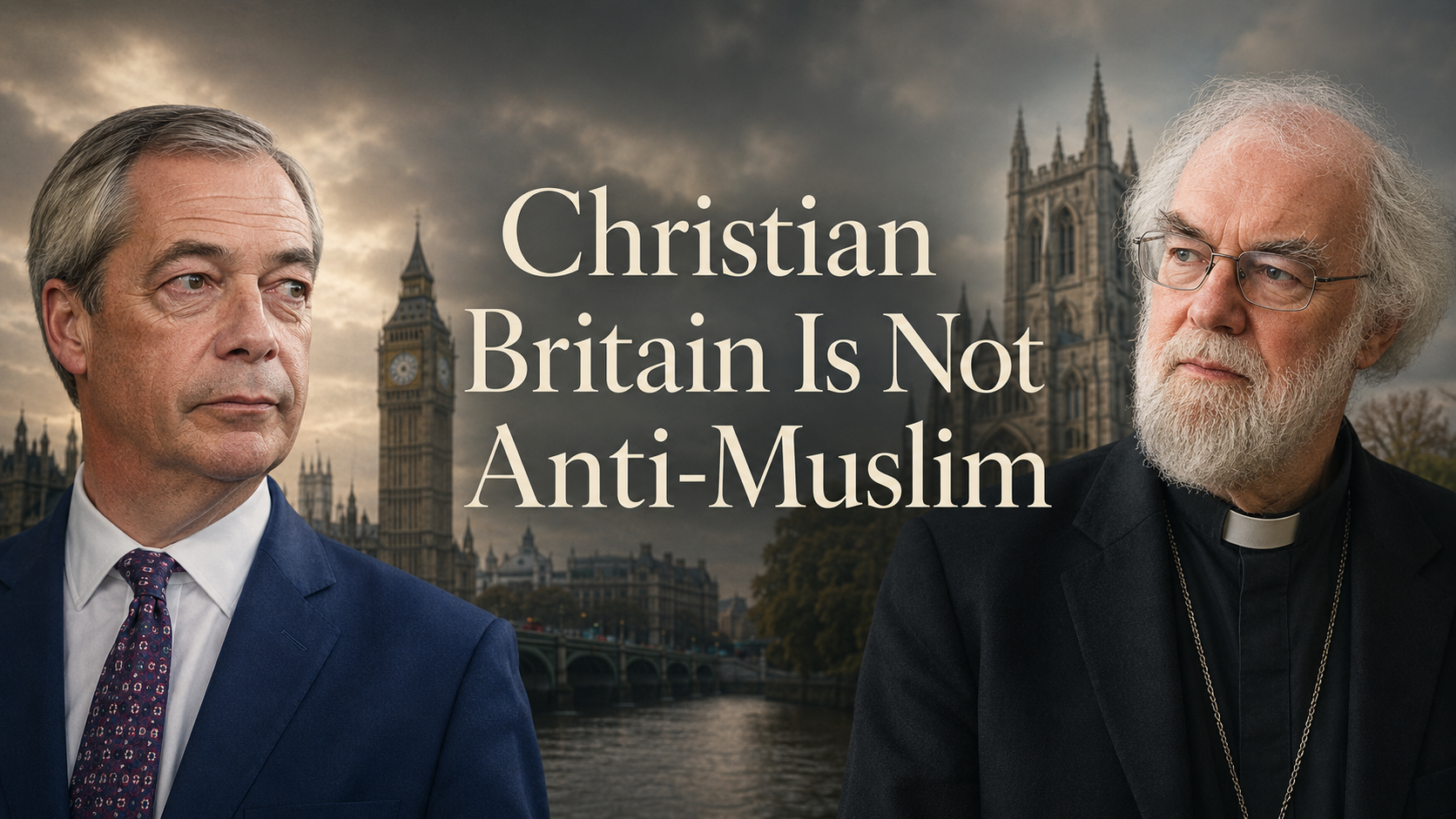
Christian Britain Is Not Anti-Muslim: Rowan Williams, Nigel Farage and the increasingly dangerous confusion between Christian identity and hostility to Islam
Rowan Williams has accused Nigel Farage of using Christianity to “channel anti-Muslim feeling”. The former Archbishop of Canterbury is right about one thing: Christianity must never be reduced to an ethnic badge or weaponised against Muslims. But his accusation depends upon a speculative judgment of motive and risks reinforcing an increasingly familiar confusion. Muslims are persons entitled to justice and charity; Islam is a religion whose claims may be criticised; and Britain’s Christian inheritance remains an historical fact whether Nigel Farage is personally devout or not.

Rowan Williams has returned to a subject with which readers of Nuntiatoria will already be familiar. In an extended conversation with Andrew Copson, chief executive of Humanists UK, published by New Humanist on 19 August, the former Archbishop of Canterbury considered the growth of what is increasingly called “Christian nationalism” in Britain. The discussion ranged across American politics, Catholic integralism, nationalism, immigration, Tommy Robinson and Reform UK before Williams arrived at Nigel Farage. His conclusion was striking: **“I suspect really that Farage and others want to channel anti-Muslim feeling.”**¹ The significance of the sentence lies not merely in the accusation but in its first two words. Williams does not claim knowledge of Farage’s intention. He suspects it. A judgment about another man’s motive is then made the interpretative key through which his public use of Christian language is understood.
That distinction matters because Farage is plainly open to criticism without imputing motives which cannot be demonstrated. Earlier this year he described the Ramadan iftar gathering in Trafalgar Square as an attempt to intimidate and dominate British life, rhetoric which Christians are perfectly entitled to regard as excessive or imprudent. Likewise, proposals to restrict mass public religious observances should make Christians cautious: a legal power constructed against Muslim prayer today could easily become the precedent invoked against Corpus Christi processions, outdoor Masses, evangelical rallies or public Rosaries tomorrow. Religious liberty cannot be defended selectively. But criticism of such rhetoric is one thing; concluding that an assertion of Britain’s Christian inheritance is therefore essentially a vehicle for hostility towards Muslims is another. The latter proposition requires evidence. Williams offers suspicion.
This is particularly important because Farage’s actual Easter formulation was hardly revolutionary: “The Christian values on which our country is built are something to be proud of.”² Reform UK’s present published policy goes further, but also adds a qualification conspicuously absent from the suggestion that Christian identity is being deployed simply against Muslims. Under “Defend and Protect British Culture and Traditions”, the party says that religious freedom is a core feature of British culture while maintaining that the culture itself was built upon Christian values.³ One may dispute the party’s policies, challenge what it means by “Christian values”, or question how consistently those values appear elsewhere in its programme. But an official position explicitly affirming religious freedom alongside Christian cultural inheritance is at least relevant evidence when assessing the accusation that the latter exists merely to generate hostility towards another religion.
There is a further complication. Premier Christian News reports that Zia Yusuf, Reform’s Muslim home-affairs spokesman, has himself spoken of restoring Britain’s Christian heritage.² That does not prove that Reform’s rhetoric is always wise, still less that every concern surrounding migration or Islam is well founded. It does, however, make the simple interpretation of “Christian Britain” as code for animosity towards Muslims considerably harder to sustain. A Muslim politician may believe that the preservation of Britain’s inherited Christian character is preferable to a culturally deracinated state. The categories “Christian inheritance” and “Muslim citizen” are not natural enemies unless we first make them so.
The factual proposition itself should not be controversial. Britain has an objectively Christian inheritance. Christianity shaped the monarchy, the coronation, the universities, the parish system, the development of hospitals and charitable institutions, the calendar, the literature, the architecture, the understanding of marriage and family, and much of the moral vocabulary through which British public life continues to speak. Williams himself effectively acknowledges the constitutional residue of this inheritance in the New Humanist conversation, observing that Britain retains a Christian head of state, clerics in Parliament and a significant Christian educational establishment. His disagreement is not therefore principally about whether the inheritance exists. It is about what may legitimately be inferred from it and how politically potent it ought to remain.
Here the argument begins to touch a question Nuntiatoria has explored before. In November 2025, The Cross and the Flag: Christian Nationalism, Anglican Confusion, and the Kingship of Christ responded to an earlier intervention by Williams and other Anglican figures warning against the misuse of Christian symbolism within nationalist politics.⁴ The concern expressed there remains valid: the Cross must never be degraded into an ethnic marker, partisan logo or talisman of resentment. Christianity does not baptise racial supremacy, tribal hostility or the idea that non-Christian citizens possess lesser human dignity. The nation is a natural community deserving ordered affection, not an idol. But Nuntiatoria argued then that there is an opposite danger as well: the category of “Christian nationalism” can become so elastic that it ceases identifying an actual distortion of Christianity and instead begins rendering Christianity’s public claims themselves suspicious. That distinction is even more important now.
Catholicism supplies categories considerably more exact than the vocabulary of contemporary culture war. St Thomas Aquinas treats love of one’s country under the virtue of pietas, because alongside our parents our country is among those communities from which we receive the goods necessary for our earthly life. Such affection is therefore capable of being virtuous, while remaining subordinate to the higher duties owed to God and governed by justice.⁵ Patriotism is not transformed into idolatry merely by being patriotism. Nor does the universal character of Christianity require the abolition of particular peoples, histories and cultures. Catholic universality orders these realities; it does not pretend they do not exist.
The same Catholic tradition also makes it impossible to reduce Christianity to a private spirituality permitted no corporate claim upon society. Pius XI’s Quas Primas could hardly be clearer that Christ’s sovereignty does not concern private devotion alone. The encyclical expressly rejects the proposition that Christ possesses no authority in civil affairs and teaches that individuals, families and states alike fall beneath His dominion.⁶ Whatever contemporary political arrangements prudently require, Catholic theology cannot simply adopt the secular assumption that Christianity becomes improper whenever it speaks about the ordering of public life. To desire a society more visibly conformed to Christian moral truth is not, by definition, either theocracy or ethnic nationalism. A very considerable argument would have to take place before those concepts could legitimately be treated as interchangeable.
Equally, religious liberty is not contradicted by the confession that Christianity is true. Dignitatis Humanae, whatever debates surround its relationship to earlier teaching, expressly grounds civil religious liberty in the dignity of the human person and speaks of the freedom owed both to individuals and religious communities from coercion within the civil order.⁷ A Christian may therefore defend a Muslim’s freedom from coercion without believing Islam to be true. Religious liberty concerns what the state may compel; it does not require the believer to suspend theological judgment. That distinction is indispensable to any serious pluralism.
At this point another distinction becomes essential: Muslims are persons; Islam is a religion. Muslims possess human dignity and are owed justice, charity and protection from violence precisely because they are human beings created by God. Islam consists of theological, moral, historical and juridical propositions which may be accepted or rejected, analysed or criticised. Christianity and Islam make contradictory claims about matters at the very centre of revelation: the Trinity, the Incarnation, the divine Sonship of Christ, the Crucifixion and Resurrection, and the nature of revelation itself. A Christian who sincerely professes the Nicene Creed necessarily believes propositions incompatible with Islamic theology. That is not hostility towards Muslims. It is what believing a religion means.
Nuntiatoria confronted the practical consequences of this distinction in Misplaced Hospitality: Why Ramadan Iftars Do Not Belong in Consecrated Churches.⁸ That article did not argue against friendship with Muslim neighbours or against feeding them. It argued that authentic hospitality does not require a Christian church to behave as though theological differences were unreal. Christians can welcome Muslims, defend their persons and possessions, and cooperate with them for the common good without treating the Christian and Islamic understanding of God as interchangeable. Indeed, genuine respect requires exactly such honesty. A Muslim ought to be permitted to believe Christianity false; a Christian must be permitted to say the same about Islam. Anything less is not dialogue but managed ambiguity.
This is why Williams’s movement between “anti-Islamism” and “anti-Muslim feeling” deserves particular scrutiny. The expressions are not synonyms. Hostility towards Muslims describes an attitude towards people. Opposition to Islam may describe an intellectual or theological judgment about a religion. Concern about Islamism may describe an objection to a political ideology derived from particular interpretations of Islam. Anxiety about migration may concern numbers, integration, social cohesion, public expenditure, national continuity or any number of other questions, some reasonable and some unreasonable. These things may certainly overlap. Criticism of Islam may sometimes conceal racial hatred, just as language about Christianity may sometimes conceal nationalism emptied of Christian content. But the possibility of bad faith cannot abolish conceptual distinctions without making honest discussion impossible.
Indeed, Williams himself says something later in the interview which ought to govern the whole controversy. He laments a public discourse in which holding the wrong opinion on one question can mean that a person is regarded as beyond conversation altogether.¹ That is perceptive. Yet attributing an unstated anti-Muslim purpose to an assertion about Christian Britain risks reproducing exactly that problem. The proposition ceases to be examined on its merits because the speaker’s presumed motive has already morally disqualified it.
The phenomenon is not new. Nuntiatoria identified much the same mechanism in December 2025 when Tommy Robinson adopted the familiar Christian slogan “Put Christ back into Christmas”. The resulting article did not ask readers to endorse Robinson’s politics. It asked why words heard for decades from pulpits and church noticeboards suddenly acquired an intrinsically extremist character when spoken by an unpopular political activist.⁹ The legitimate question is always whether a speaker is actually misusing Christianity, and evidence may well establish that he is. What cannot be intellectually respectable is reasoning backwards from the identity of the speaker to the meaning of otherwise ordinary Christian propositions.
Williams’s criticism of Farage’s personal religious seriousness illustrates the danger. He says he doubts that Farage is deeply preoccupied with his soul or with profound theological questions, while acknowledging that this judgment may be unjust.¹ He may well be correct that Farage’s Christianity is more cultural than devotional. Many Britons’ Christianity undoubtedly is. But Farage’s personal sanctity is almost completely irrelevant to the proposition that Britain possesses a Christian inheritance. A bad Christian may state a true proposition about Christianity. An unbeliever may accurately describe Christian history. Whether England was converted by Augustine of Canterbury does not depend upon the sacramental life of the politician currently mentioning him.
This does not mean Christians should become uncritical auxiliaries of Reform UK. Quite the contrary. The more eagerly politicians invoke Christianity, the more vigorously Christians should ask what they understand by it. The Faith is not an aesthetic of village churches, Christmas carols, St George’s flags and nostalgic national feeling. Christianity brings inconvenient moral demands: the sanctity of unborn life, chastity, permanence of marriage, responsibility towards the poor, justice in economic affairs, truthfulness, protection of the weak, obligations towards strangers, the duties of rulers, repentance from sin and the sovereignty of God. A politician who wants the prestige of Christian civilisation without the discipline of Christian morality is indeed instrumentalising Christianity.
Nor may “Christian Britain” become a euphemism for “Britain without Muslims”. Christianity’s missionary claim is universal. The Muslim is not outside the horizon of Christian charity but precisely within it. Christians should desire his temporal good, protect him from injustice and, because Christianity takes religious truth seriously, desire also that he come to know Christ. Evangelisation and hatred are opposites. One seeks another man’s highest good; the other seeks his diminishment. A Christianity which merely dislikes Muslims is not more orthodox for its militancy. It has misunderstood the Gospel.
Yet the correction must operate in both directions. Christian charity towards Muslims cannot mean Christian silence about Islam. Protecting Muslim citizens cannot mean establishing a social taboo against examining Islamic doctrine or practice. Respecting religious liberty cannot mean pretending Britain has no particular religious history of its own. And opposing racial nationalism cannot mean accepting the secular doctrine that the nation must be religiously empty before minorities can be treated justly.
Williams’s own history makes the present asymmetry especially noteworthy. In 2008, while Archbishop of Canterbury, he provoked an enormous controversy by discussing the accommodation of aspects of sharia within English legal arrangements. His position was considerably subtler than contemporary headlines sometimes suggested: he was considering forms of supplementary religious jurisdiction and arbitration rather than proposing the replacement of English law by an Islamic penal system. Serious treatment of Williams requires acknowledging that distinction. Academic analysis of the controversy has likewise noted that his underlying argument concerned accommodating certain religious commitments within the framework of the civil law.¹⁰
But precisely because Williams was prepared to ask in 2008 how British institutions might accommodate the distinctive religious consciousness of Muslim communities, his present suspicion towards the political assertion of Britain’s own Christian inheritance deserves examination. Why is Muslim religious particularity naturally approached in the language of accommodation while Christian particularity is so readily approached through the language of nationalism, exclusion and scapegoating? Why may pluralism require British society to make space for Islam but apparently also require Christianity to become progressively less confident about describing the civilisation it historically formed?
There is no necessary contradiction between a nation possessing a particular religious inheritance and citizens of other religions possessing equal civil dignity. Williams himself acknowledges that Britain remains constitutionally Christian while evidently not claiming that non-Christians thereby cease to be citizens. The real question is whether that Christian inheritance is to remain substantive or merely ceremonial: bishops without doctrine, coronations without Christ’s Kingship, prayers without belief, schools without catechesis, churches without confidence. A purely ornamental Christianity is easily tolerated because it makes no serious claim upon anyone.
That deeper problem was the subject of Nuntiatoria’s Can You Build a Future on Borrowed Faith? Civilisational Exhaustion and the Moral Credit of Britain.¹¹ Britain continues to employ moral concepts formed within a Christian civilisation while becoming increasingly detached from the theological account which gave those concepts coherence. Human dignity, moral responsibility, the family, duties towards the vulnerable, limits upon power, charity and the accountability of rulers did not arrive from nowhere. One need not claim Christianity as the sole historical influence upon Britain to recognise its extraordinary formative role. The question is whether a civilisation can indefinitely preserve Christian moral consequences after repudiating Christian metaphysical premises.
The current controversy therefore concerns considerably more than Nigel Farage. Farage will eventually leave politics; the question will remain. Can Christianity speak publicly about the nation without being presumed hostile to those who do not share the Faith? Can a Christian affirm the particular history of his country while recognising the universal dignity of mankind? Can Islam be subjected to theological and political criticism without Muslims being subjected to hatred? Can Christian politicians be challenged when they misuse religion without allowing the accusation of misuse to become a mechanism by which Christianity itself is removed from public argument?
A mature society should be able to answer yes to all four.
Rowan Williams is right to warn that Christianity can be instrumentalised. History supplies ample examples. Christians themselves should be the first to resist it, because the Cross belongs to Christ and cannot be reduced to the electoral property of any party. But the former Archbishop’s criticism becomes much less persuasive when a speculative judgment — “I suspect” — is made to carry the burden of proving that an assertion of Christian Britain is really directed against Muslims. That method risks pathologising the proposition before it has been examined.
Britain does not have to choose between Muslim dignity and Christian identity. A Muslim family can live securely beside a Christian church whose bells proclaim an inheritance older than either Reform UK or the modern British state. A Christian can defend his Muslim neighbour from hatred while telling him frankly that Jesus Christ is the eternal Son of God. Parliament can protect the free exercise of religion without declaring every religion equally true. A country can welcome citizens of many faiths without pretending that its history was written on a blank religious page.
The alternative is not pluralism but amnesia.
The Cross must never be turned into a weapon against Muslims. But neither should the presence of Muslims be invoked as a reason why the Cross, Christian truth or Britain’s Christian inheritance must become embarrassing subjects which may be mentioned only under suspicion.
The proper answer to racial nationalism is not national self-erasure.
The proper answer to religious hatred is not religious indifferentism.
The proper answer to political Christianity is authentic Christianity.
And the proper answer to somebody misusing the Christian inheritance is to expose the misuse — not to pretend that there was no Christian inheritance to misuse in the first place.
Britain is not made anti-Muslim by remembering that it was Christian.
The real challenge is whether it can remember what Christian actually means.
¹ New Humanist, “Is Christian nationalism a threat to the UK?”, conversation between Rowan Williams and Andrew Copson, 19 August 2026. Original interview
² Premier Christian News, “Reform UK hits back at claim Farage uses Christianity for ‘anti-Muslim feeling’”, 20 August 2026. Report and Reform response
³ Reform UK, “Defend and Protect British Culture and Traditions”, current party policy, accessed 20 August 2026. Reform UK policies
⁴ Nuntiatoria, “The Cross and the Flag: Christian Nationalism, Anglican Confusion, and the Kingship of Christ”, 7 November 2025. Nuntiatoria article
⁵ St Thomas Aquinas, Summa Theologiae, II–II, q.101, a.1, on pietas towards parents and country. Summa Theologiae II–II, q.101
⁶ Pius XI, Quas Primas, 11 December 1925, especially §§17–18, 31–32. Vatican text
⁷ Second Vatican Council, Dignitatis Humanae, 7 December 1965, §1 and following. Vatican text
⁸ Nuntiatoria, “Misplaced Hospitality: Why Ramadan Iftars Do Not Belong in Consecrated Churches”, 12 March 2026. Nuntiatoria article
⁹ Nuntiatoria, “Put Christ back into Christmas: When naming the Saviour is called extremism”, 8 December 2025. Nuntiatoria article
¹⁰ Rowan Williams, “Civil and Religious Law in England: A Religious Perspective”, Royal Courts of Justice, 7 February 2008; Robin Griffith-Jones, discussion of the ensuing sharia controversy in Islam and English Law: Rights, Responsibilities and the Place of Shari‘a; subsequent academic analysis of Williams’s argument and its reception.
¹¹ Nuntiatoria, “Can You Build a Future on Borrowed Faith? Civilisational Exhaustion and the Moral Credit of Britain”, 13 February 2026. Nuntiatoria archive entry
related articles


Latest articles
- Today’s Mass: October 07 Pope St Mark, ConfessorSt Mark’s brief pontificate teaches that God measures fidelity, not duration or worldly achievement. Christ alone possesses the everlasting priesthood; His servants are stewards of what they have received. With the commemorated martyrs, St Mark reminds us to persevere faithfully, so that when the Lord comes, He finds us “so doing.”
- Omnia autem probate: quod bonum est tenete ~ Prove all things; hold fast that which is good: Spiritual Conference for Nuntiatoria CXXVIThe conference reflects on St Paul’s assertion to “prove all things” in relation to self-judgement and the Church. It explores themes of synodality, ecumenism, and the importance of discernment, emphasising the need for humility in understanding truth and the challenge of maintaining genuine holiness in the midst of contemporary ecclesiastical crises.
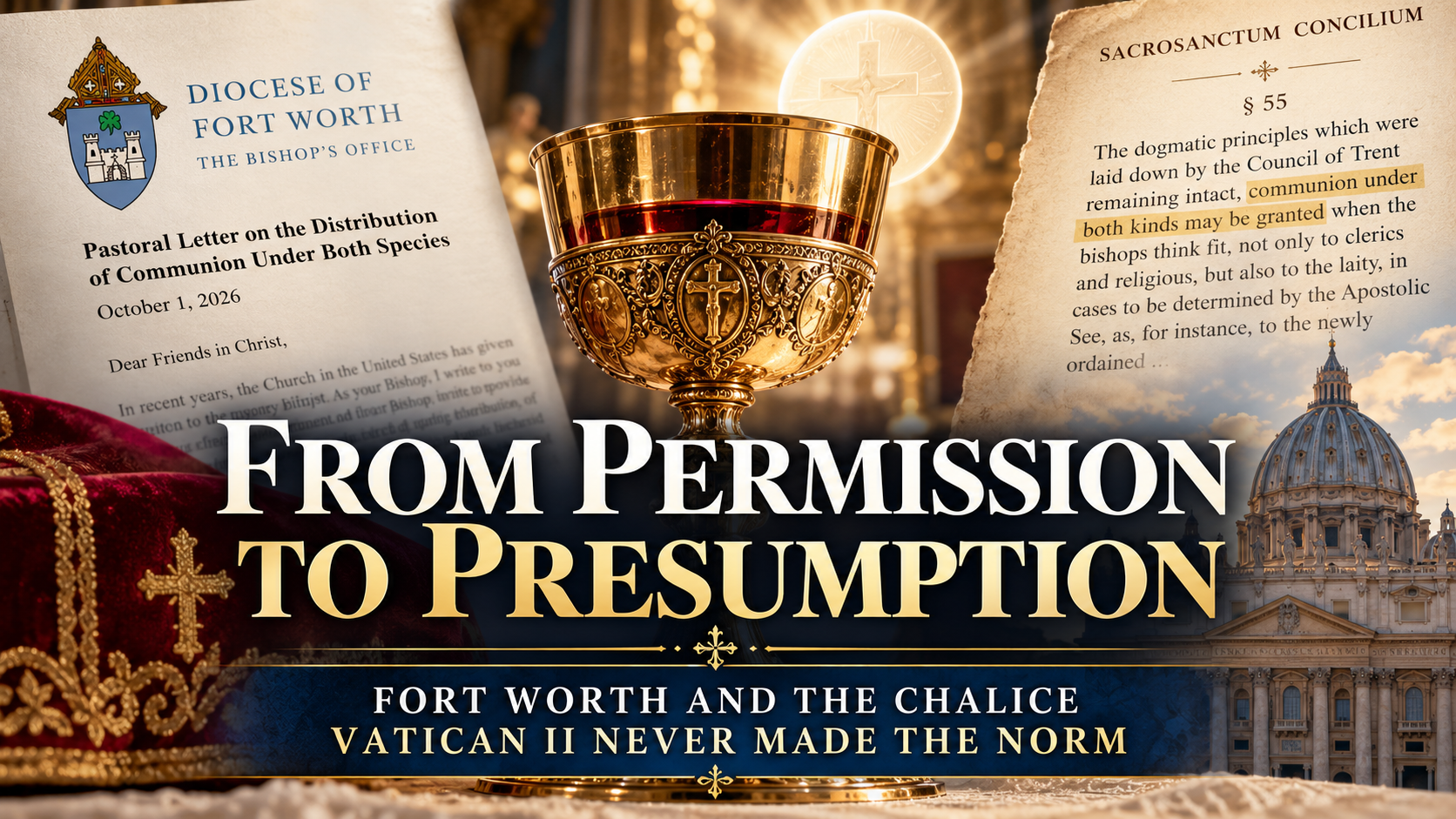
- FROM PERMISSION TO PRESUMPTION: Fort Worth and the Chalice Vatican II never made the NormBishop Michael Olson has implemented strict limitations on the distribution of Communion under both species in the Diocese of Fort Worth, prompting a discussion on the historical evolution of liturgical practices following Vatican II. This decision aims to reaffirm the doctrine of the Eucharist, emphasising that Christ is fully present under either species, while addressing misconceptions surrounding modern practices.
- AUGSBURG 2030: Can Rome commemorate a Confession it once confuted?Pope Leo XIV aims to revitalise the ecumenical spirit of the Augsburg Confession for its 2030 anniversary. However, historical responses from Rome highlight significant doctrinal differences between Catholics and Lutherans. True reconciliation must acknowledge these unresolved issues, as merely celebrating commonality risks glossing over critical theological distinctions that led to the Reformation.
- Today’s homily: St BrunoThe text reflects on Saint Bruno’s journey towards a life of solitude, prayer, and contemplation, emphasising the importance of genuine pursuit of God amidst distractions. It highlights that true spiritual growth requires silence and self-examination, urging believers to reclaim quiet moments for reflection, repentance, and devotion in daily life.



Leave a Reply