
The Great Reversal: Europe’s Deportation Turn, Britain’s Silence, and the Politics of Selective Outrage

There are moments in the life of a political order when its language gives way before reality. Not through confession, nor through apology, but through a quiet abandonment of yesterday’s certainties. Words once deployed with moral force begin to fade, their meanings softened, their urgency diminished. Policies once denounced as unthinkable reappear, not as admissions of error, but as necessities of governance. And those who once spoke of them are neither vindicated nor answered; they are simply overtaken by events.
Europe has entered such a moment.
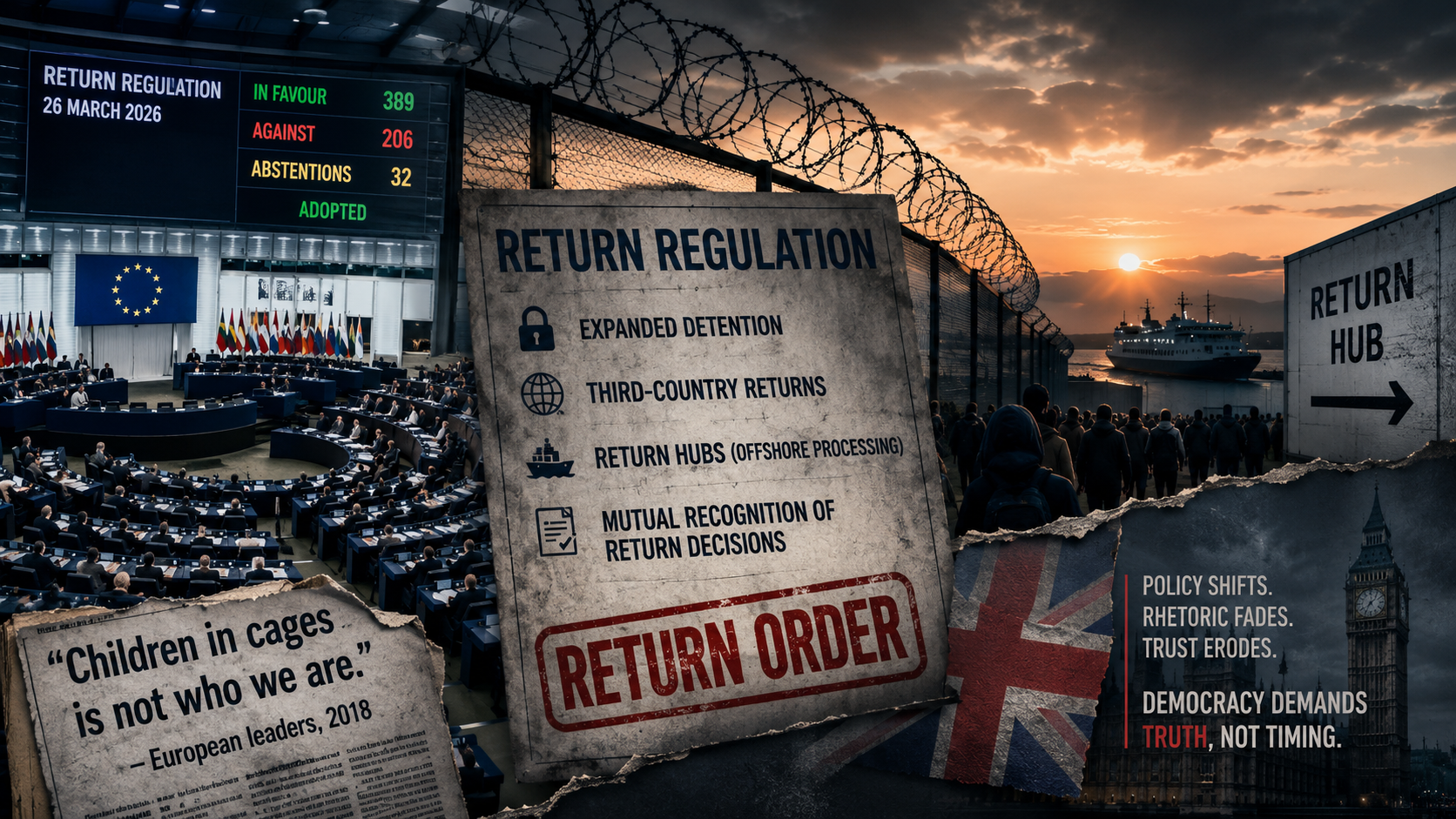
On 26 March 2026, the European Parliament voted by 389 to 206, with 32 abstentions, to advance its position on the proposed Regulation on common standards and procedures in Member States for returning illegally staying third-country nationals—the revised “Return Regulation.”¹ The proposal forms part of the Commission’s broader Pact on Migration and Asylum implementation, and is intended to address a persistent structural failure: the inability of Member States to give effect to their own deportation orders. The measures are substantial. They include expanded grounds and duration for detention pending removal, the mutual recognition of return decisions across Member States, accelerated procedures for individuals deemed non-cooperative, the facilitation of removals to designated “safe third countries” without a prior substantive connection, and the development of externalised processing arrangements—now termed, with studied neutrality, **“return hubs.”**²
This is not administrative tinkering. It is the construction of an enforcement architecture.
What gives the moment its force is not merely what is proposed, but what was so recently said.
For much of the past decade, comparable mechanisms were not simply debated but morally condemned—particularly when associated with the immigration policies of the United States under Donald Trump. The expansion of immigration detention, the use of third-country agreements, the prioritisation of removals, and the effort to render deportation orders operational rather than declaratory were presented across European institutions and media as evidence of democratic and humanitarian regression. Amnesty International described U.S. border enforcement practices as producing “deliberate policies of cruelty” and documented what it termed arbitrary detention and ill-treatment of asylum seekers.³ The Office of the United Nations High Commissioner for Human Rights warned in 2018 that the separation and detention of migrant families could constitute “serious violations of the rights of the child.”⁴ Political rhetoric followed suit. Across Europe, the phrase “Trumpian” became shorthand not merely for a policy approach, but for a moral boundary that ought not to be crossed.
The moral clarity of that moment was emphatic. The imagery of “children in cages,” repeated across political discourse, functioned as a civilisational indictment: enforcement itself was placed on trial.
And yet the mechanisms now being advanced in Brussels bear a structural resemblance that is difficult to ignore.
Externalised processing—once rejected in European debate—returns as the “return hub.” Detention expansion, once treated as presumptively inhumane, is recast as a necessary instrument of compliance. Third-country removals, once framed as legally suspect, become tools of cooperative migration management. The underlying logic remains constant: deterrence, enforceability, and the restoration of credibility to a system in which legal orders have too often failed to produce practical outcomes.
It is not necessary to assert identity to recognise convergence. It is enough to observe that the distance between what was condemned and what is now proposed has narrowed to the point of political discomfort.
What has changed is not the structure of policy, but the structure of necessity.
Since the migration crisis of 2015, European states have been forced to confront a series of realities that moral language alone could not resolve. The declaration of Angela Merkel—“Wir schaffen das,” delivered on 31 August 2015—captured a moment of expansive confidence: the belief that Europe possessed both the capacity and the moral duty to absorb large-scale migration.⁵ That moment has not been repudiated, but it has been revised by experience. Asylum systems proved slower than anticipated. Integration outcomes varied widely across regions. Localised pressure on housing, schooling, and public services intensified. And, most consequentially, the divergence between law and enforcement became increasingly visible.
According to Eurostat, in 2023 approximately 484,000 third-country nationals were ordered to leave the European Union, yet only around 91,000 were effectively returned to a third country—a return rate of roughly 19 per cent.⁶ Similar ratios have persisted across recent years. The implication is not merely administrative weakness but normative erosion. A legal system in which the majority of removal decisions are not executed risks forfeiting both deterrent effect and public credibility.
A law that cannot be enforced is eventually treated as a suggestion.
Political systems rarely sustain such contradictions without consequence. Across Europe, the electoral landscape has shifted accordingly. In Italy, the government of Giorgia Meloni concluded a 2023 agreement with Albania to process certain categories of migrants offshore, explicitly seeking to deter irregular crossings in the central Mediterranean.⁷ In Denmark, reforms enacted between 2019 and 2024—including the possibility of external processing of asylum claims—reflect a cross-party consensus that migration control is integral to the maintenance of the welfare state.⁸ In Sweden, the 2022 Tidö Agreement, incorporating the influence of the Sweden Democrats, marked a decisive turn toward restrictive migration policy after years of liberal orthodoxy.⁹ Even in Germany and the Netherlands, where political culture remains more cautious, the pressure to demonstrate enforceable border control has become increasingly difficult to resist.
The European Parliament’s vote is the institutional expression of this wider trajectory: from the moral universalism of 2015, through the populist backlash that produced Brexit and strengthened the Visegrád position, to a present convergence toward enforcement realism. What appears sudden is, in truth, the cumulative effect of a decade in which political rhetoric has been gradually overtaken by administrative necessity.
And yet the central question is not merely what has changed, but what has not been said about the change.
For years, those who argued that migration systems required enforceability—that deportation orders must result in deportation, that irregular entry must carry consequences, that integration has limits—were not simply opposed but morally categorised. The debate was not conducted on neutral ground. To articulate such concerns was often to risk association with extremism. Language did not merely describe positions; it policed them.
The present moment exposes the fragility of that settlement.
If detention expansion, third-country removals, and external processing are now deemed necessary to preserve the integrity of migration systems, then the earlier claim—that such measures were inherently beyond the moral horizon—becomes difficult to sustain. Either the policies themselves were always unacceptable, in which case their adoption now requires justification, or they were always within the legitimate range of democratic choice, in which case the moral condemnation directed at their advocates demands reconsideration.
A political culture that condemns a proposition as immoral, only to adopt it later as necessary, does more than change its policy. It teaches its citizens that morality itself is contingent upon timing.
This is not a theoretical concern. It bears directly upon trust.
Democratic legitimacy depends not only upon outcomes, but upon the perceived integrity of public language. When governments speak in absolutes—declaring certain approaches unthinkable—and later implement variants of those same approaches without acknowledgment, they risk conveying that moral claims are instruments of convenience rather than expressions of conviction. The result is not merely disagreement, but cynicism.
Britain provides a particularly revealing case study of how such tensions are managed—and often obscured.
Unlike the European Union, where migration policy is now debated with increasing explicitness at the institutional level, the United Kingdom continues to exhibit a marked reluctance to engage openly with the deeper dimensions of immigration. Policy exists, certainly. Governments legislate, announce enforcement initiatives, and negotiate international agreements. But the language in which these policies are presented remains strikingly indirect. Ministers speak of “system integrity,” “operational capacity,” and “smashing the gangs.” These formulations are not without content, but they function as proxies—linguistic devices that allow discussion of enforcement without confronting the underlying questions that concern the public.
Those questions are not obscure. They concern integration, social cohesion, demographic change, labour markets, housing capacity, and the cultural preconditions of trust. They concern, in short, the conditions under which a society remains recognisably itself while accommodating change. Yet in contemporary British discourse, such questions are rarely addressed directly within official channels. When they are raised, they are often reframed in terms that neutralise their force, or else treated as socially hazardous.
The effect is cumulative.
The handling of group-based child sexual exploitation—investigated by the Independent Inquiry into Child Sexual Abuse (IICSA) between 2014 and 2022—left a widespread public perception that concerns about community relations and reputational risk had, at times, inhibited frank discussion and timely intervention.¹⁰ The Prevent Duty Guidance, introduced under the Counter-Terrorism and Security Act 2015, while designed to counter radicalisation, has been criticised by parliamentary committees and civil liberties groups for creating uncertainty around the boundaries of permissible speech in educational and public-sector contexts.¹¹ The broader application of equality and non-discrimination frameworks within public institutions has, in certain instances, reinforced a culture of caution in which the avoidance of offence becomes a governing imperative.
These phenomena are not identical, but they share a common effect: the narrowing of the discursive field.
When the range of what can be said contracts, the range of what can be debated contracts with it. Concerns do not disappear; they relocate. They move into informal networks, alternative media, and political movements less constrained by institutional norms. The result is not consensus but divergence—a widening gap between public perception and official language.
And where language diverges from perception, trust erodes.
This is the deeper significance of Europe’s deportation turn. It is not merely a policy recalibration, but a moment of exposure. The accumulated pressures of a decade have forced a reconsideration of what can be acknowledged openly. Enforcement, once rhetorically disfavoured, has reasserted itself as a practical necessity. The vocabulary has shifted accordingly.
What remains uncertain is whether that shift will be accompanied by reflection.
A more honest debate about migration—one that acknowledges both humanitarian obligation and administrative limitation—would strengthen democratic legitimacy. It would allow citizens to engage with trade-offs openly, to weigh competing goods, and to hold their leaders accountable. But such a debate requires candour. It requires a willingness to revisit earlier assumptions and to recognise that dissent may, at times, have been more prescient than is comfortable to admit.
Whether European and British institutions are prepared for such candour remains an open question.
What is clear is that the present moment cannot be reduced to migration policy alone. It reveals a deeper tension within Western democracies: between the desire to maintain moral clarity and the necessity of confronting complex realities. When those realities can no longer be deferred, language adapts. The question is whether it adapts honestly.
For a democracy may revise its policies without weakening. It may change course, and in doing so demonstrate resilience. But it cannot indefinitely sustain a disjunction between what it says and what it does. When citizens come to believe that yesterday’s impossibility can become today’s policy without explanation, they draw conclusions not only about governance, but about truth itself.
And a political order that renders truth contingent—dependent upon timing, convenience, or necessity—does not merely risk confusion. It risks dissolution.
- European Parliament, Outcome of vote on the Proposal for a Regulation on Returns, 26 March 2026 (389–206–32).
- European Commission, Proposal for a Regulation on common standards and procedures in Member States for returning illegally staying third-country nationals (recast), COM(2025) XXX final; see also Commission communications on external “return hubs,” 2025–2026.
- Amnesty International, USA: “You Don’t Have Any Rights Here”: Illegal Pushbacks, Arbitrary Detention and Ill-Treatment of Asylum Seekers, 2020, pp. 4–6.
- UN High Commissioner for Human Rights, Zeid Ra’ad Al Hussein, statement on U.S. border family separation policy, 18 June 2018.
- Angela Merkel, Federal Press Conference, Berlin, 31 August 2015.
- Eurostat, Third-country nationals ordered to leave—annual data (migr_eiord) and Third-country nationals returned following an order to leave (migr_eirtn), 2023 release.
- Government of Italy and Republic of Albania, Protocol on Migration Cooperation, Rome/Tirana, November 2023.
- Danish Ministry of Immigration and Integration, Agreements on Asylum and External Processing, 2019–2024 policy documents.
- Tidö Agreement (Sweden), October 2022, sections on migration and integration policy.
- Independent Inquiry into Child Sexual Abuse (IICSA), Investigation into Child Sexual Exploitation by Organised Networks, Final Report, 2022.
- UK Home Office, Revised Prevent Duty Guidance for England and Wales, 2023; see also Joint Committee on Human Rights, Report on Counter-Extremism Policy, HC 1050, 2016–17.
RELATED ARTiCLES


LATEST ARTICLES
- Today’s Mass: September 07 Feria of Sunday XV Post PentecostThe Sunday XV Post Pentecost Mass emphasises the importance of living a life governed by the Holy Spirit, encouraging Christians to act with grace, charity, and humility. St Paul’s teachings remind believers to bear one another’s burdens and avoid self-deceit, ultimately striving for spiritual growth and communion with God through the Eucharist.
- Crisis is the Cause; Necessity is the EffectThe SSPX has clarified its rationale for episcopal consecrations, arguing that a crisis in the Church has led to a “state of necessity” for preserving the Catholic Faith. This distinction stresses the need to prove the necessity and proportionality of their measures against church law, highlighting a significant theological and canonical issue that requires serious examination from both SSPX and Rome.
- A Name on the Letterhead: Grech, Farrell and the Synodalisation of Amoris LaetitiaAdVaticanum reports that Cardinal Farrell’s dicastery might lack substantial input into the October Amoris Laetitia meeting, with Cardinal Grech’s Synod Secretariat effectively leading preparations. This raises concerns about the balance of roles, highlighting potential tensions in handling doctrinal issues, particularly regarding the sacramental practice stemming from Amoris Laetitia.
- Today’s homily: Fifteenth Sunday Post PentecostIn the Gospel of Naim, two processions converge—one of life led by Christ and another of death following a young man. Christ’s compassion interrupts the funeral, symbolising hope amid despair. This message resonates today as Catholics face challenges, encouraging perseverance in faith, tradition, and prayer for revival in families and community.
- Today’s Mass: September 06 Sunday XV Post PentecostThe Fifteenth Sunday After Pentecost’s Mass emphasises the importance of living in accordance with the Holy Spirit, cultivated through the Eucharist. It reflects on Jesus’ compassion for humanity, recalling His miracles. The readings encourage believers to prioritise spiritual matters over worldly anxieties and to embody love for one another, resonating with St. Paul’s teachings.
CURRENT EDITION


DAILY MASS ONLINE
One of the earliest online apostolates dedicated to the Traditional Latin Mass, Old Roman TV began broadcasting the Holy Sacrifice on the Feast of the Assumption, 15 August 2008. During the COVID-19 pandemic, additional programming — devotions, catechesis, and conferences — was added to support the faithful in prayer and formation.
Support the daily Holy Mass on Old Roman TV by offering a Mass intention — for loved ones, thanksgiving, or the repose of souls. Your intention helps sustain the sacred liturgy and brings grace to those you remember before God’s altar.
SUPPORT THE DAILY MASS ONLINE
Likely the world’s longest-running daily online broadcast of the
Traditional Latin Mass, streaming faithfully since the
Feast of the Assumption 2008.

This apostolate cannot continue without immediate help
Please support us with a contribution toward
chapel rent, sacristy supplies, operating costs, and web-hosting.
Our essential monthly costs reach £1,000.
MASS INTENTIONS
If your offering is for a Mass Intention, kindly complete the form below in full so we may correctly match it to your donation. For anniversary intentions — birthdays, wedding anniversaries, anniversaries of death — please be sure to include the relevant date.


Today’s Mass Propers
- Today’s Mass: September 07 Feria of Sunday XV Post Pentecost
 The Sunday XV Post Pentecost Mass emphasises the importance of living a life governed by the Holy Spirit, encouraging Christians to act with grace, charity, and humility. St Paul’s teachings remind believers to bear one another’s burdens and avoid self-deceit, ultimately striving for spiritual growth and communion with God through the Eucharist.





Leave a Reply