

Governance Without Limit: The Rescript of Leo XIV and the Quiet Dissolution of Ecclesial Order

There are acts in the life of the Church which do not announce themselves as turning points, yet in retrospect are seen to have altered the very grammar of governance. They are not councils, nor dogmatic definitions, nor public controversies. They are texts—brief, technical, almost administrative—yet carrying within them a shift of principle. The Rescriptum ex Audientia Sanctissimi of 25 March 2026 is such an act.
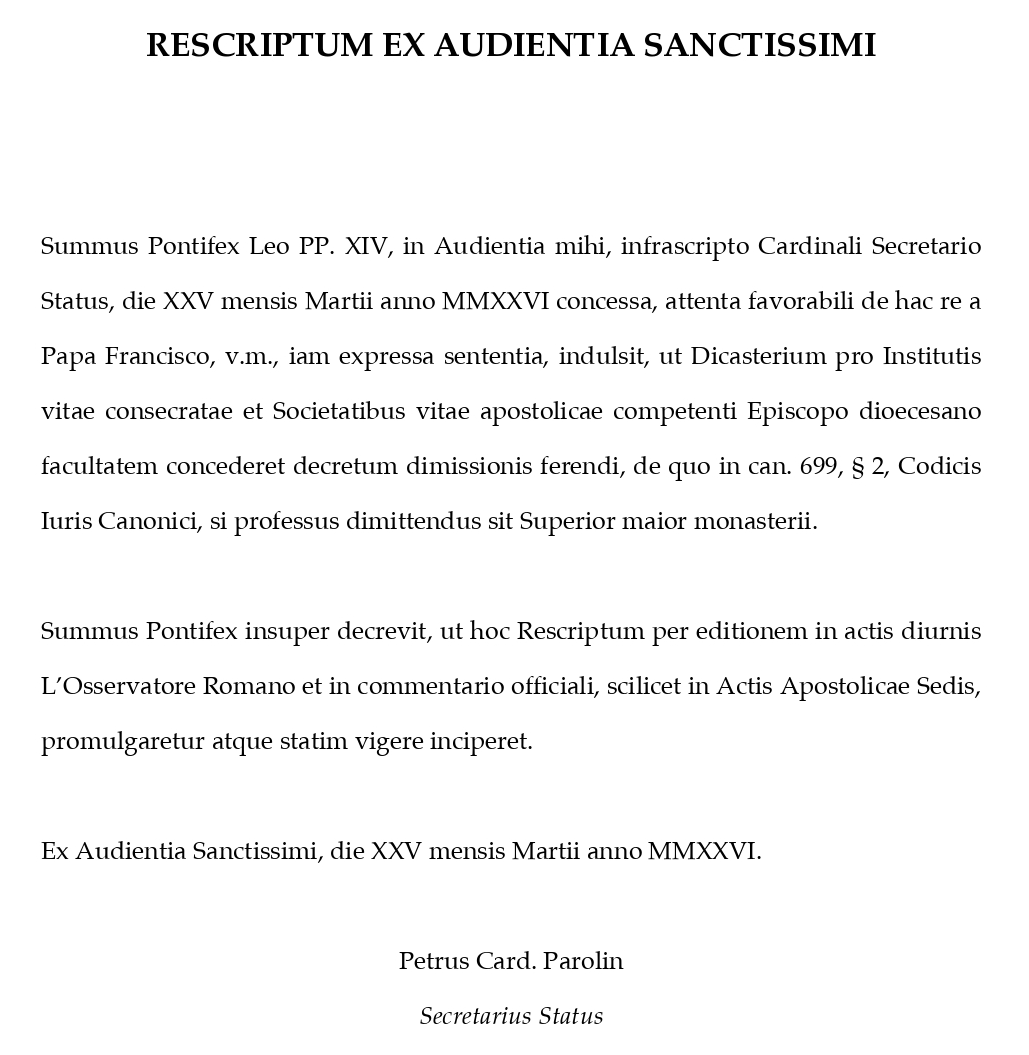
Issued under the authority of Pope Leo XIV and signed by Cardinal Pietro Parolin, the rescript concerns the application of Canon 699 §2. Its operative clause is spare: the Dicastery for Institutes of Consecrated Life may grant to a diocesan bishop the faculty to issue a decree of dismissal in cases where the subject is himself a major superior of a monastery. The provision is framed as a clarification. In reality, it is a reallocation of authority.
The text situates itself explicitly within continuity: attenta favorabili… iam expressa sententia a Papa Francisco, v.m.—taking into account the favourable judgment already expressed by Pope Francis of venerable memory. This is not incidental attribution. It is juridical genealogy. The rescript does not innovate; it consolidates. What had been exercised under the late pontificate as intervention becomes, under Leo XIV, structure. Continuity, however, is not neutrality. It can be the vehicle of transformation.
Canon 699 §2, properly understood, presumes that dismissal is an act internal to the institute, undertaken by the supreme moderator with his council, or—where gravity requires—reserved to the Holy See.¹ Even in its exceptional provisions, the canon preserves a fundamental principle: that religious life is governed from within according to its proper law. The rescript introduces a third actor. The diocesan bishop, not by inherent right but by delegated faculty, may now issue the decree of dismissal against the highest internal authority of the institute. This is not an extension of existing competence; it is the creation of a new juridical pathway.
For the major superior is not simply another subject of discipline. He is the juridical head of the community, often elected, frequently stable, always constitutive of the institute’s internal order. To subject him to removal by an external authority is to alter the locus of governance itself. Authority has not merely been exercised. It has been repositioned.
The Church has never reduced herself to administrative efficiency. Her governance reflects a theological reality: that authority is distributed, ordered, and proportionate. This is expressed, in social doctrine, as the principle of subsidiarity. Pius XI’s formulation remains definitive: it is an injustice for higher authority to absorb what lesser bodies can rightly accomplish.² In ecclesial terms, this principle has long safeguarded the autonomy of religious institutes. Wernz and Vidal, writing within the classical canonical tradition, insist that religious life possesses a vera autonomia iuridica—a true juridical autonomy—flowing from its rule, constitutions, and recognised superiors.³ This autonomy is not a concession; it is constitutive.
The rescript does not formally deny this. It renders it conditional. For when the highest authority within an institute may be removed from without, autonomy persists only insofar as it is not exercised. The structure remains; the principle is hollowed. Subsidiarity, once a limit on authority, becomes a permission granted by it.
The theological tradition is unambiguous: authority is not absolute. St Thomas Aquinas defines law—and by extension governance—as an ordinance of reason directed to the common good.⁴ Authority that exceeds its proper measure ceases to be an instrument of order and becomes a source of it. The Church has always recognised the necessity of extraordinary intervention. There are circumstances—grave scandal, doctrinal deviation, moral collapse—where external authority must act. But such intervention has traditionally been exceptional, precisely because it disrupts the ordinary order.
The rescript shifts the centre of gravity. What was exceptional is now juridically routinised. When the extraordinary becomes normal, order is no longer assumed—it is imposed.
The explicit reference to Pope Francis invites a broader reading. The late pontificate was marked by a pattern: when internal structures faltered, they were not reformed but superseded. Commissariaments replaced governance. Visitations replaced correction. Authority flowed downward from Rome, often bypassing intermediate structures entirely. Leo XIV’s rescript does not replicate these acts in their visible form. It does something more enduring. It translates them into law. What had been contingent becomes permanent. What had been discretionary becomes normative. In this sense, the rescript is not a departure from the previous pontificate. It is its juridical crystallisation.
One of the most revealing features of the rescript is what it does not say. There is no elaboration of criteria, no specification of procedural thresholds, no articulation of safeguards beyond those already contained in general canon law. The diocesan bishop is granted faculty; the conditions of its exercise are largely unstated. This is not accidental. It reflects a contemporary juridical style in which authority is defined minimally and exercised maximally. The rescript is promulgated with immediate effect—statim vigere inciperet. Authority moves first; interpretation follows. But law that precedes its own explanation invites its own expansion.
The deeper issue is not disciplinary but ecclesiological. What vision of the Church is presupposed by this rescript? Pius XII, in Mystici Corporis, presents the Church as a living body, hierarchically ordered yet organically structured, in which each part possesses its proper function and dignity.⁵ Authority, in this vision, is not merely directive but coordinative—it preserves the integrity of the whole by respecting the identity of the parts. The rescript gestures toward a different model. Authority is no longer primarily coordinative but corrective, no longer preserving structure but overriding it. The internal life of the institute is no longer the first locus of resolution; it is a problem to be solved.
Where this logic prevails, the Church risks becoming administratively coherent but organically diminished. For when every level of authority may intervene in every other, hierarchy remains—but order dissolves.
It would be facile to deny that the rescript may serve legitimate ends. There will be cases where such intervention is necessary, even salutary. The Church is not preserved by procedural rigidity. But neither is she preserved by the erosion of principle. The rescript of 25 March 2026 marks a threshold. It does not abolish subsidiarity, but it places it under erasure. It does not deny the autonomy of religious life, but it renders it contingent upon external approval. It does not redefine authority explicitly, but it reconfigures its exercise.
And this is the danger: authority that no longer recognises limits no longer recognises order.
The Church does not require less authority. She requires authority rightly ordered—authority that governs without absorbing, corrects without replacing, and intervenes without redefining the structure it serves. Whether this rescript will be remembered as a prudent clarification or as a quiet step toward centralisation depends not on its text alone, but on its application. Yet even now, its direction is clear.
It is not merely a juridical act. It is a sign of how the Church is being governed—and of how she may yet be governed.
¹ Codex Iuris Canonici (1983), can. 699 §2.
² Pius XI, Quadragesimo Anno (1931), §79.
³ Wernz–Vidal, Ius Canonicum, vol. II (Rome: Gregorian Press).
⁴ Thomas Aquinas, Summa Theologiae, I–II, q. 90, a. 1–2.
⁵ Pius XII, Mystici Corporis Christi (1943), §§17–18.
RELATED ARTiCLES


LATEST ARTICLES
- Today’s Mass: October 24 St Raphael the ArchangelThe Feast of Saint Raphael the Archangel highlights his healing powers as depicted in the Book of Tobit, where he aids Tobit and his son, Tobiah. Venerated as a protector of travellers and the blind, Raphael is celebrated for his miraculous interventions. His legacy includes support for nurses, matchmakers, and Catholic studies.
- 25.10.26 Nuntiatoria CXXIX: CHRISTUS REXThe text discusses the relationship between Christ’s kingship and authority within the Church amidst contemporary challenges. It contrasts ecclesiastical power with genuine faith, emphasising that authority must protect divine truth rather than alter it. The witness of imprisoned priests illustrates the enduring significance of fidelity to Christ over institutional conformity.
- THE DOMESTIC CHURCH: 25 October – 2 November 2026 A Home with Room for Heaven: Preparing for All Saints and All SoulsThe content outlines a week’s plan for traditional Catholic families to prepare for the feasts of All Saints and All Souls. Emphasising daily prayers, remembrance of the deceased, and engagement with children’s activities, it aims to integrate Catholic customs into family life, enriching spiritual practices and fostering a shared faith experience.
- ORDO w/c 25.10.26The text outlines the liturgical calendar for the last week of October and the beginning of November, highlighting key celebrations. Notable events include the Feast of Christ the King, St Evaristus, the Vigil of Saints Simon and Jude, and the Feast of All Saints, emphasising themes of holiness, unity in faith, and the Church’s teachings.
- Christ the King: The Sovereignty of the Crucified RedeemerThe Mass of Christ the King articulates core Catholic beliefs about Jesus’ divine authority, redemptive sacrifice, and the essence of His Kingdom. It emphasises Christ as Prophet, Priest, and King, whose sovereignty is inseparable from His mission of reconciliation, calling the faithful to acknowledge His authority and embrace moral duties rooted in divine truth.
CURRENT EDITION


DAILY MASS ONLINE
One of the earliest online apostolates dedicated to the Traditional Latin Mass, Old Roman TV began broadcasting the Holy Sacrifice on the Feast of the Assumption, 15 August 2008. During the COVID-19 pandemic, additional programming — devotions, catechesis, and conferences — was added to support the faithful in prayer and formation.
Support the daily Holy Mass on Old Roman TV by offering a Mass intention — for loved ones, thanksgiving, or the repose of souls. Your intention helps sustain the sacred liturgy and brings grace to those you remember before God’s altar.
SUPPORT THE DAILY MASS ONLINE
Likely the world’s longest-running daily online broadcast of the
Traditional Latin Mass, streaming faithfully since the
Feast of the Assumption 2008.

This apostolate cannot continue without immediate help
Please support us with a contribution toward
chapel rent, sacristy supplies, operating costs, and web-hosting.
Our essential monthly costs reach £1,000.
MASS INTENTIONS
If your offering is for a Mass Intention, kindly complete the form below in full so we may correctly match it to your donation. For anniversary intentions — birthdays, wedding anniversaries, anniversaries of death — please be sure to include the relevant date.


Today’s Mass Propers
- Today’s Mass: October 24 St Raphael the Archangel
 The Feast of Saint Raphael the Archangel highlights his healing powers as depicted in the Book of Tobit, where he aids Tobit and his son, Tobiah. Venerated as a protector of travellers and the blind, Raphael is celebrated for his miraculous interventions. His legacy includes support for nurses, matchmakers, and Catholic studies.


Leave a Reply