

The Courage to Speak: Maeve Halligan, Cambridge, and the Collapse of Managed Truth

There are moments in public life—rare enough to be unmistakable—when the prevailing script does not so much collapse as quietly fail to hold. Not through confrontation, nor through the force of superior argument, but through a subtle and disarming refusal to proceed along its expected lines. A speaker rises, the audience anticipates the familiar signals—the calibrated disclaimers, the moral positioning, the careful alignment with the dominant language of the age—and instead encounters something that does not conform: a voice that does not ask permission before it speaks. Such moments are often described as controversial, but the description is inadequate. Controversy belongs to the ordinary rhythm of disagreement; what is revealed in such instances is something deeper—an exposure of the conditions under which disagreement itself has become constrained. The recent speech by Maeve Halligan at the Cambridge Union Society belongs unmistakably to this latter category. It did not merely advance a position within a debate; it illuminated the environment in which that debate was taking place, and in doing so revealed the extent to which the formal structures of intellectual exchange can persist even as their underlying substance is gradually altered.
The significance of the setting is not incidental but determinative. The Cambridge Union, since its foundation in 1815, has stood as one of the last recognisable institutional embodiments of a distinctly British intellectual inheritance: the public testing of ideas through adversarial reasoning, conducted not for the purpose of affirmation but for the clarification of truth through contest. Within its chamber have stood figures who did not merely echo the assumptions of their time, but challenged them—sometimes at considerable cost.¹ It is, or has been, a place in which the risk of disagreement is not only tolerated but expected, and in which the legitimacy of a claim is understood to depend not upon its popularity but upon its capacity to withstand scrutiny.
Yet institutions are rarely transformed by formal decree. More often, they are reshaped by the gradual recalibration of the conditions under which they operate. The outward forms remain—the motions are proposed, the speakers invited, the votes cast—but the atmosphere within which these acts occur begins to shift. What was once a forum for intellectual risk becomes, incrementally, a space in which such risk must be carefully managed. The range of permissible conclusions narrows, not by prohibition, but by the accumulation of social signals: which arguments are greeted with warmth, which with unease, and which with a silence that communicates more effectively than censure. Contemporary reporting on British universities has increasingly documented precisely this dynamic, noting a growing reluctance among students to express dissenting views on contested social issues for fear of reputational or social consequences.²
It is within this altered atmosphere that Halligan’s intervention must be understood.

Her opening line—“I don’t think that you’re bad people”—appears almost disarmingly simple, yet it performs decisive intellectual work. In contemporary discourse, disagreement is frequently neutralised by the attribution of motive; positions are dismissed not because they are weak, but because they are presumed to arise from moral deficiency. By refusing this move at the outset, Halligan removes the most efficient mechanism by which her argument might otherwise be dismissed. If opponents are not malicious, then their claims must be engaged.
From this point, she advances the central diagnosis of her speech: that a generation has been “sold a story… in which compassion is equated with compliance.” What is described here is not merely rhetorical habit, but a structural transformation in moral reasoning. If compassion is understood primarily as affirmation—if to care for a person is to validate every claim made in their name—then the distinction between the good of the person and the truth of the proposition collapses. To question becomes to harm; to dissent becomes to wound. The result is not the elimination of disagreement, but its displacement into silence.
Halligan refuses this displacement. When she asserts that “real compassion asks hard questions,” she restores an older understanding—one in which the good of the person may require scrutiny rather than affirmation, and in which care is inseparable from truth. Her argument does not remain abstract. It moves directly into areas where the consequences of this inversion are most acute: the treatment of children experiencing gender distress, the interpretation of same-sex attraction, and the legal implications of redefining sex-based categories. These concerns are not speculative. The Cass Review identified “remarkably weak” evidence for certain medical pathways and highlighted serious safeguarding concerns.³ The Equality Act 2010 continues to provide for single-sex spaces and protections where justified.⁴
The response from the opposition, articulated most prominently by Dr Helen Webberly, does not so much refute this diagnosis as illustrate it. The speech begins with apology—“I would like to apologize… to any transgender person”—framing the act of debate itself as something potentially harmful. The centre of gravity shifts immediately: from whether a claim is true to whether it is permissible. What follows proceeds through assertion and emotional framing. Language is regulated for its impact; biological realities are acknowledged and then softened through emphasis on variation; and the cumulative appeal is directed toward harm, fear, and exclusion. These are real experiences, but within the argument they function as limits upon inquiry rather than subjects of it. By the conclusion—where dissenters are warned that they will have “blood dripping down their hands” —the argument has shifted from persuasion to moral pressure.
The appeal to medical authority within this framework invites contextual consideration. Dr Helen Webberly has had a controversial professional history within the United Kingdom. She was suspended by the General Medical Council following findings related to prescribing practices, and she has not returned to licensed medical practice in the UK.⁵ Her subsequent work has been conducted through private gender-related services operating outside NHS structures, typically on a fee-paying basis, reflecting a broader landscape of private provision that has itself attracted scrutiny in the UK press and policy discussions.⁶ These facts do not determine the truth of her claims, but they form part of the context in which those claims are advanced—particularly when professional authority is invoked to discourage scrutiny.
At this point, the deeper divergence becomes clear. One approach insists that claims must be tested, even when testing is uncomfortable; the other treats certain claims as morally settled, such that testing them becomes suspect. This is not merely a disagreement over policy. It is a disagreement over the conditions of knowledge itself.
The classical tradition remains instructive. Thomas Aquinas defines truth as adaequatio rei et intellectus—the conformity of the mind to reality.⁷ It is not generated by consensus, nor secured by intensity of feeling. Likewise, John Henry Newman reminds us that conscience is ordered toward truth, not toward the approval of others.⁸ These principles, far from being abstract, constitute the intellectual foundation upon which institutions such as Cambridge were built.
It is in this light that Halligan’s speech acquires its full significance. She does not claim final answers. She restores the possibility of asking questions that had begun to seem unaskable. In doing so, she recalls a tradition in which the dignity of the person and the truth of the proposition are not confused, and in which the refusal to question is recognised not as compassion, but as evasion.
A culture that equates questioning with harm will, in time, render itself incapable of correction. A university that fears dissent will continue to host debate—but only as performance.
Maeve Halligan did not create this tension. She made it visible.
The question that remains is whether those who witnessed it are prepared to act upon what they have seen—not merely by speaking, but by thinking.
¹ Historical records and archives of the Cambridge Union Society.
² See e.g. UK university free speech surveys and reporting in Times Higher Education and related academic commentary.
³ Cass Review, 2024 Summary Report.
⁴ Equality Act 2010, Schedule 3, Part 7; see also Equality and Human Rights Commission guidance.
⁵ General Medical Council tribunal findings (2018–2020).
⁶ UK media reporting on private gender clinics and regulatory concerns (e.g. The Times, Telegraph, policy commentary).
⁷ Summa Theologiae, I, q.16, a.1.
⁸ Letter to the Duke of Norfolk (1875).
RELATED ARTiCLES


LATEST ARTICLES
- Today’s Mass: September 07 Feria of Sunday XV Post PentecostThe Sunday XV Post Pentecost Mass emphasises the importance of living a life governed by the Holy Spirit, encouraging Christians to act with grace, charity, and humility. St Paul’s teachings remind believers to bear one another’s burdens and avoid self-deceit, ultimately striving for spiritual growth and communion with God through the Eucharist.
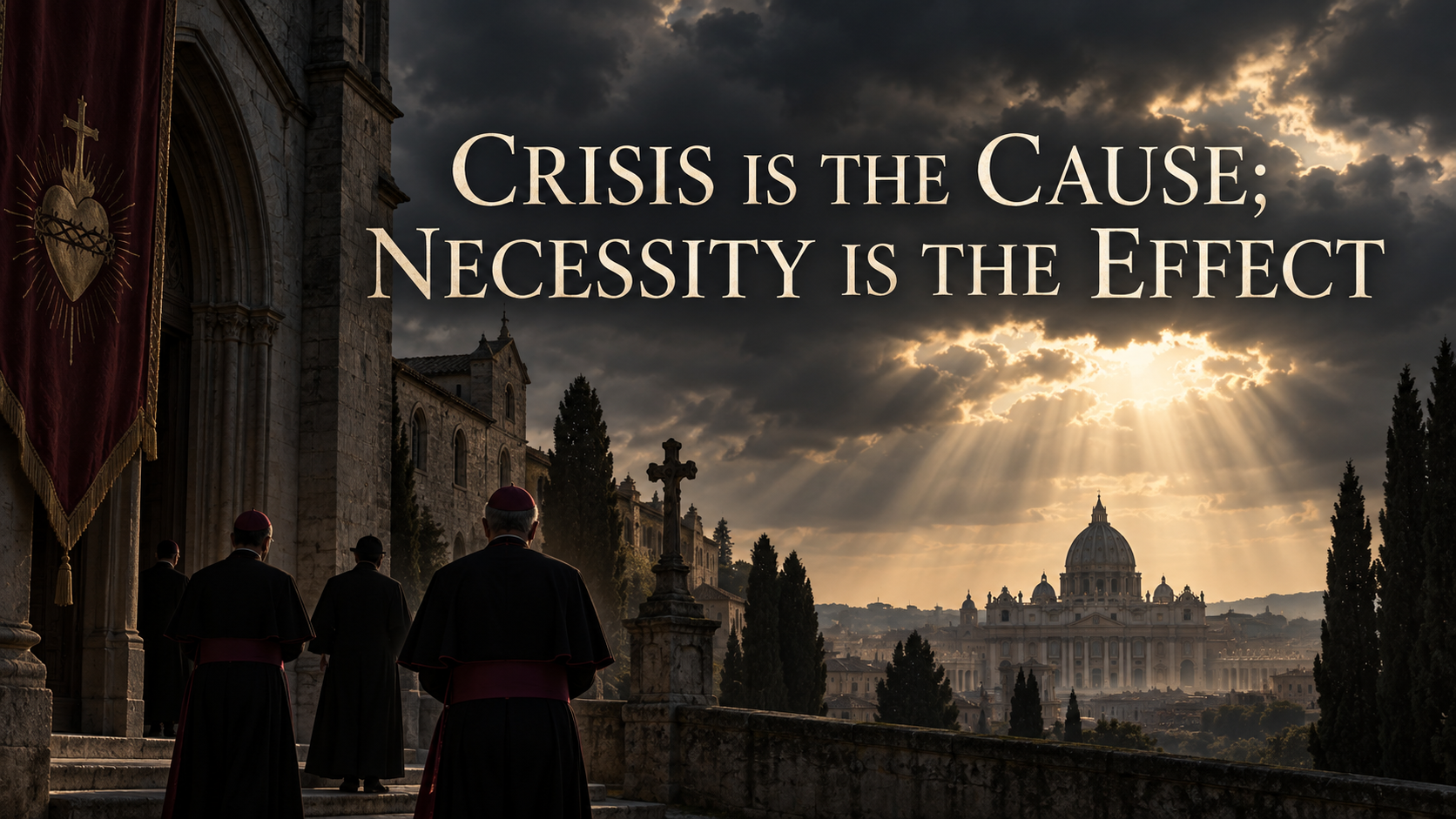
- Crisis is the Cause; Necessity is the EffectThe SSPX has clarified its rationale for episcopal consecrations, arguing that a crisis in the Church has led to a “state of necessity” for preserving the Catholic Faith. This distinction stresses the need to prove the necessity and proportionality of their measures against church law, highlighting a significant theological and canonical issue that requires serious examination from both SSPX and Rome.
- A Name on the Letterhead: Grech, Farrell and the Synodalisation of Amoris LaetitiaAdVaticanum reports that Cardinal Farrell’s dicastery might lack substantial input into the October Amoris Laetitia meeting, with Cardinal Grech’s Synod Secretariat effectively leading preparations. This raises concerns about the balance of roles, highlighting potential tensions in handling doctrinal issues, particularly regarding the sacramental practice stemming from Amoris Laetitia.
- Today’s homily: Fifteenth Sunday Post PentecostIn the Gospel of Naim, two processions converge—one of life led by Christ and another of death following a young man. Christ’s compassion interrupts the funeral, symbolising hope amid despair. This message resonates today as Catholics face challenges, encouraging perseverance in faith, tradition, and prayer for revival in families and community.
- Today’s Mass: September 06 Sunday XV Post PentecostThe Fifteenth Sunday After Pentecost’s Mass emphasises the importance of living in accordance with the Holy Spirit, cultivated through the Eucharist. It reflects on Jesus’ compassion for humanity, recalling His miracles. The readings encourage believers to prioritise spiritual matters over worldly anxieties and to embody love for one another, resonating with St. Paul’s teachings.
CURRENT EDITION


DAILY MASS ONLINE
One of the earliest online apostolates dedicated to the Traditional Latin Mass, Old Roman TV began broadcasting the Holy Sacrifice on the Feast of the Assumption, 15 August 2008. During the COVID-19 pandemic, additional programming — devotions, catechesis, and conferences — was added to support the faithful in prayer and formation.
Support the daily Holy Mass on Old Roman TV by offering a Mass intention — for loved ones, thanksgiving, or the repose of souls. Your intention helps sustain the sacred liturgy and brings grace to those you remember before God’s altar.
SUPPORT THE DAILY MASS ONLINE
Likely the world’s longest-running daily online broadcast of the
Traditional Latin Mass, streaming faithfully since the
Feast of the Assumption 2008.

This apostolate cannot continue without immediate help
Please support us with a contribution toward
chapel rent, sacristy supplies, operating costs, and web-hosting.
Our essential monthly costs reach £1,000.
MASS INTENTIONS
If your offering is for a Mass Intention, kindly complete the form below in full so we may correctly match it to your donation. For anniversary intentions — birthdays, wedding anniversaries, anniversaries of death — please be sure to include the relevant date.


Today’s Mass Propers
- Today’s Mass: September 07 Feria of Sunday XV Post Pentecost
 The Sunday XV Post Pentecost Mass emphasises the importance of living a life governed by the Holy Spirit, encouraging Christians to act with grace, charity, and humility. St Paul’s teachings remind believers to bear one another’s burdens and avoid self-deceit, ultimately striving for spiritual growth and communion with God through the Eucharist.





Leave a Reply