
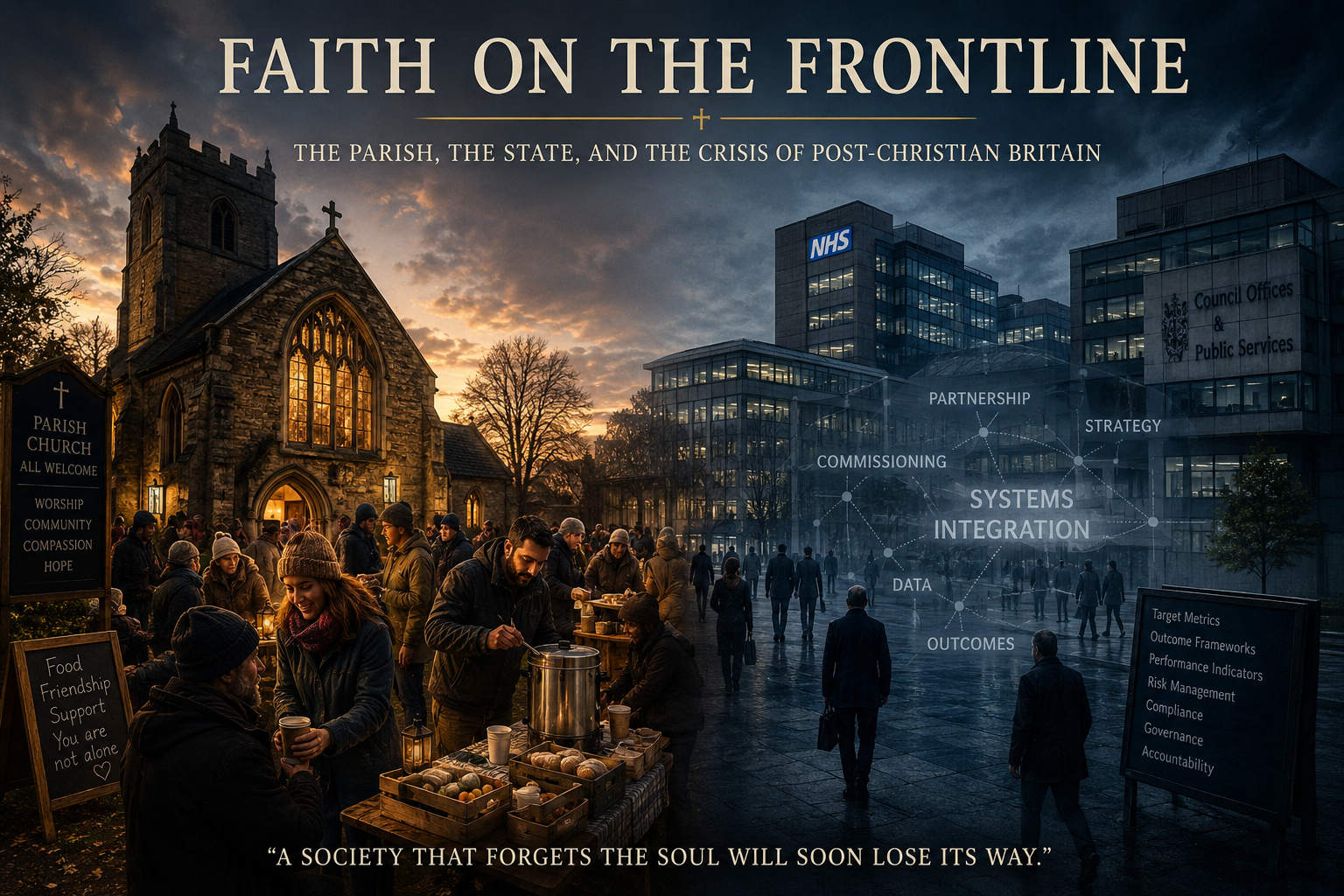
Faith on the Frontline — The Parish, the State, and the Crisis of Post-Christian Britain
Britain’s governing institutions are beginning, quietly and reluctantly, to rediscover something earlier generations once understood instinctively: societies cannot survive on administration alone.

After decades spent constructing an increasingly centralised, managerial, and secular public order, the British state now finds itself confronting a reality it can no longer easily avoid. The welfare state is exhausted. Local government is financially depleted. Social trust is collapsing. Loneliness has become epidemic. Mental-health crises proliferate across all age groups. Communities are fragmented. Civic participation has withered. The intermediary institutions that once connected individual persons to a larger moral and communal order — parish churches, neighbourhood associations, family networks, local charities, mutual societies, guilds, clubs, and voluntary organisations — have steadily weakened across the late twentieth and early twenty-first centuries.
And so, in a striking historical irony, the modern state increasingly turns back toward the very institutions it once assumed history would gradually render obsolete.
Churches.
The recently published Faith and Social Prescribing Roundtable Report, produced through collaboration between the National Academy for Social Prescribing, the Good Faith Partnership, NHS-linked partners, local government representatives, and faith leaders, reveals just how significant this shift has become. The report openly describes faith communities as “trusted anchor institutions with multi-generational presence in every neighbourhood,” possessing unique assets including buildings, volunteers, pastoral expertise, convening power, and deep reservoirs of local trust.¹
That language matters.
For most of Britain’s post-war secular era, religion was typically framed as either a private matter of personal belief or a residual cultural inheritance surviving from an older society. Increasingly, however, policymakers speak of churches not merely as religious bodies but as strategic civic infrastructure. Faith communities are now being integrated into conversations concerning:
- neighbourhood health systems,
- social prescribing,
- resilience planning,
- youth support,
- mental-health provision,
- crisis response,
- community wealth initiatives,
- and preventative public health models.²
In effect, Britain’s governing institutions are beginning to acknowledge that churches continue to perform social functions the modern bureaucratic state itself cannot adequately reproduce.
The report’s examples are revealing. Temples host GP clinics and health programmes. Mosques operate neighbourhood health hubs. Sikh community centres coordinate pandemic relief. Church buildings function as mental-health cafés, warm spaces, food distribution points, and volunteer mobilisation centres.³ During Covid, faith communities frequently became the first functioning layer of local response — organising vaccine outreach, delivering food parcels, supporting the isolated, and maintaining neighbourhood networks long before larger systems could respond effectively.⁴
This is not accidental.
The parish historically existed precisely as a local structure of human solidarity.
Before the emergence of the modern welfare state, the parish formed one of the principal organising realities of English social life. It was not merely a place of worship. It was a locus of memory, welfare, moral instruction, social obligation, charity, education, burial, identity, and belonging. The parish connected the intimate scale of ordinary life to a transcendent moral order. It taught persons not merely that they possessed rights, but that they owed duties — to God, neighbour, family, community, and the dead who came before them.
The English parish system, especially before the post-war expansion of central government welfare structures, functioned as a genuinely local ecology of care. Clergy visited the sick, organised relief for the poor, mediated disputes, buried the dead, educated children, and maintained communal continuity across generations. Even where Victorian Britain industrialised at extraordinary speed, parish structures frequently remained among the few stabilising realities preventing total social atomisation. The great nineteenth-century Christian social movements — Anglican slum missions, Catholic charitable societies, Methodist welfare networks, temperance campaigns, settlement houses, orphanages, ragged schools, and guild associations — emerged not from state planning but from theological conviction translated into organised local action.
This is one reason why the contemporary rediscovery of faith communities carries such historical significance. Britain’s governing institutions increasingly appear to recognise that the welfare state alone cannot sustain the moral and relational foundations necessary for social order. Administrative systems may distribute resources, but they struggle to create meaning, trust, duty, or belonging. They can alleviate crises temporarily while remaining unable to generate the social cohesion required to prevent those crises from multiplying.
Alexis de Tocqueville famously observed that democratic societies survive not merely through laws or institutions but through habits of association: the learned capacity of persons to act together voluntarily in pursuit of common goods.⁵ Robert Putnam later described this accumulated trust, reciprocity, and communal participation as “social capital.”⁶ What Britain increasingly confronts today is not merely economic strain but the erosion of the social capital upon which liberal democratic societies themselves ultimately depend.
The modern state can redistribute money. It struggles far more to generate solidarity.
That is why the language emerging from contemporary policy circles has become so striking. The report repeatedly emphasises “trust,” “relationships,” “local knowledge,” “continuity,” and “community presence.”⁷ These are not bureaucratic achievements. They are organic social realities built slowly across generations.
And herein lies the deeper contradiction at the heart of modern Britain.
The state increasingly desires the social effects of Christianity while remaining profoundly uncertain about Christianity itself.
It wants:
- the volunteers,
- the buildings,
- the welfare networks,
- the local legitimacy,
- the sacrificial ethos,
- the intergenerational continuity,
- the pastoral care,
- the stabilising moral influence.
But it does not always appear equally willing to tolerate the theological and anthropological convictions from which those things historically arose.
This contradiction is no longer abstract. It has become increasingly visible in the operation of modern civic partnership structures themselves.
In Brighton and Hove, for example, the Titular Archbishop of Selsey had been engaged for years in precisely the sort of neighbourhood and civic work now nationally praised within policy frameworks concerning resilience and community wellbeing: local partnership, social engagement, faith-sector cooperation, and civic participation. Yet conflict emerged in the context of consultation responses concerning proposed “conversion therapy” legislation and wider questions surrounding gender identity, equality frameworks, and public-sector partnership environments.⁸
The significance of that controversy extends well beyond any single local dispute.
It reveals a structural instability within the modern British model of “inclusive partnership.”
Because contemporary public institutions increasingly operate within ideological assumptions concerning sex, gender, sexuality, safeguarding, and identity that are frequently presented not as contested moral positions but as settled administrative norms. Within such systems, orthodox Christian anthropology may become tolerated only so long as it remains private, symbolic, or silent.
Yet the state simultaneously continues relying upon churches precisely because those churches retain distinctive moral cultures capable of generating social trust and sacrificial service.
The contradiction is profound:
Britain increasingly depends upon communities whose deepest convictions parts of the governing culture increasingly regard with suspicion.
The language of the report unintentionally reveals this tension repeatedly. Faith communities are encouraged to integrate into:
- commissioning structures,
- neighbourhood governance boards,
- reciprocal training systems,
- “cultural competency” frameworks,
- and strategic health partnerships.⁹
None of this is inherently unreasonable. Public accountability matters. Cooperation matters. Yet there remains a genuine danger that churches become progressively transformed from independent moral communities into managed delivery mechanisms within an increasingly therapeutic administrative state.
The parish becomes not a spiritual society but a neighbourhood service provider.
This is not merely a practical change. It represents a profound anthropological shift.
Historically, Christian charity emerged from theological conviction: from beliefs concerning the image of God in man, the obligation of neighbour-love, the reality of sin, the necessity of sacrifice, and the spiritual dignity of every human person. The Christian conception of charity was never reducible to outcome metrics or service efficiency. It understood man not merely as a biological or psychological subject requiring management, but as a moral and spiritual being ordered toward transcendent ends.
The principle underlying this older vision was what Catholic social thought later articulated formally as subsidiarity: the conviction that social life functions best when responsibilities are carried at the lowest competent and most local level possible, rather than absorbed unnecessarily into distant bureaucratic systems. The parish, family, guild, local association, and voluntary society were not accidental survivals of pre-modern life. They were understood as natural mediating structures protecting both human dignity and communal responsibility against excessive centralisation.
Modern Britain increasingly exhibits the opposite tendency.
As intermediary institutions weaken, individuals become progressively isolated while the state assumes ever greater responsibility for functions once exercised organically through family, parish, and community life. Yet the expansion of administrative oversight frequently coincides with a paradoxical decline in actual social cohesion. Bureaucratic management can coordinate services. It cannot easily cultivate virtue, affection, duty, or mutual obligation.
This is one reason why the contemporary “social prescribing” model carries such symbolic importance. On the surface, social prescribing attempts to reconnect healthcare with community life by recognising that loneliness, isolation, unemployment, bereavement, and social fragmentation possess profound health consequences.¹⁰ Yet beneath the policy language lies a tacit admission that purely clinical or administrative systems are insufficient because many contemporary crises are not merely medical in nature. They are civilisational.
A lonely society cannot medicate itself back into cohesion.
An atomised culture cannot bureaucratise its way back into belonging.
And a population deprived of shared moral frameworks eventually begins losing the social trust upon which democratic society itself depends.
Modern bureaucratic systems, however, increasingly reinterpret these same realities through managerial categories:
- “preventative wellbeing,”
- “social prescribing,”
- “community assets,”
- “resilience infrastructure,”
- “health outcomes,”
- “stakeholder engagement.”
The language itself reveals the transformation.
The Church once understood itself as cura animarum — the cure of souls.
The managerial state increasingly understands it as an instrument of neighbourhood stabilisation.
And yet the state may ultimately discover that the two cannot be entirely separated.
Because the social strength of churches does not arise accidentally. It emerges precisely from convictions, disciplines, moral frameworks, sacramental life, and communal identities that transcend administrative systems. Once those convictions are weakened, instrumentalised, or subordinated entirely to prevailing ideological frameworks, the social capital built upon them gradually erodes also.
The report itself hints at this anxiety in a remarkably candid line:
“Partnership cannot mean faith communities filling gaps or volunteer labour substituting for paid professionals.”¹¹
That sentence reveals the underlying concern plainly. Faith communities fear becoming useful instruments rather than equal partners — relied upon to repair social fragmentation while possessing diminishing freedom to articulate the moral vision necessary to prevent fragmentation in the first place.
There is also a deeper political irony at work.
Many of the same governing and cultural elites now advocating renewed partnership with churches spent decades dismissing traditional Christianity as socially regressive, morally outdated, or historically obstructive to progress. Religious conviction was frequently tolerated only insofar as it remained privatised and detached from public moral claims. Yet as Britain’s secular settlement increasingly struggles to maintain cohesion, the institutions most capable of generating local trust and communal solidarity are often precisely those older religious structures previously regarded as residual or obsolete.
The modern state, having weakened many of the mediating institutions that once restrained both atomisation and excessive centralisation, now seeks to reconstruct social cohesion through partnership with the remnants of those same institutions.
This is not merely a British phenomenon. Across Europe and North America, governments increasingly rely upon churches, charities, and faith-based organisations to address crises of loneliness, addiction, mental health, migration, youth disengagement, and neighbourhood breakdown. Yet simultaneously, orthodox Christian moral anthropology often finds itself increasingly excluded from respectable public discourse. The result is a peculiar arrangement in which religious institutions are welcomed as providers of welfare but regarded suspiciously whenever they speak authoritatively about morality, family, sexuality, or human nature itself.
The danger for churches is therefore not simply persecution in the classical sense. It is gradual instrumentalisation.
The Church becomes useful.
Useful institutions are tolerated.
Useful institutions may even receive praise, funding, consultation status, and ceremonial recognition.
But usefulness is not the same thing as freedom.
And institutions valued primarily for their utility eventually find themselves pressured to conform to the priorities of those funding, regulating, and managing the surrounding system.
This is precisely why the preservation of genuine institutional independence matters so profoundly. A Church absorbed entirely into the machinery of therapeutic governance ceases fully to function as a prophetic moral authority capable of critiquing the surrounding culture. It risks becoming another administrative partner within the same ideological framework whose failures generated the fragmentation it is now asked to repair.
The warning signs are already visible across the West. In many countries, religious institutions increasingly survive not as independent moral authorities but as semi-managed adjuncts to state or corporate ideology: permitted to provide welfare and pastoral care so long as they remain aligned with prevailing moral orthodoxies.
But genuine pluralism cannot function on those terms.
A society that welcomes religious communities only insofar as they mirror dominant ideological assumptions is not practising pluralism at all. It is practising conditional toleration.
Nor can a healthy democratic order survive indefinitely once every institution standing between the isolated individual and the central administrative state has been weakened, absorbed, or bureaucratised. The collapse of intermediary institutions leaves persons increasingly atomised and politically dependent. Tocqueville warned precisely of this danger: a soft despotism in which central systems gradually absorb the functions once carried by local communal life.¹²
Britain now stands dangerously close to that condition.
And so the state returns once more to the parish door.
Not because it has rediscovered theology.
Not because it suddenly believes in transcendence.
But because, after decades of social fragmentation, it increasingly recognises that societies cannot survive without institutions capable of teaching solidarity, obligation, sacrifice, memory, and belonging.
The tragedy is that modern Britain still often struggles to understand that those institutions cannot indefinitely retain their social power once severed from the moral and spiritual convictions that created them.
The parish was never merely a convenient welfare mechanism.
It was a moral ecology.
It formed persons before it served systems.
It cultivated virtues before it delivered outcomes.
It taught that freedom without responsibility becomes licence, that rights without duties become unsustainable, and that communities cannot endure where obligation has been replaced entirely by administration.
And a civilisation that attempts to preserve the fruits of that ecology while uprooting the beliefs beneath it may eventually discover that social capital, like faith itself, cannot survive indefinitely on inherited memory alone.
¹ Faith and Social Prescribing Roundtable Report: Building Strategic Partnerships for Neighbourhood Health (National Academy for Social Prescribing and Good Faith Partnership, 10 December 2025), 3.
² Ibid., 4–5.
³ Ibid., 7–9.
⁴ Ibid., 9.
⁵ Alexis de Tocqueville, Democracy in America, trans. Henry Reeve (New York: Vintage Classics, 1945), Vol. II, Part II, ch. 5.
⁶ Robert D. Putnam, Bowling Alone: The Collapse and Revival of American Community (New York: Simon & Schuster, 2000), 18–28.
⁷ Faith and Social Prescribing Roundtable Report, 6–7.
⁸ “Concerning the Minister’s Consultation Response,” Selsey.org; “Erased for Believing: What the Smith Judgment Means for Me,” Selsey.org.
⁹ Faith and Social Prescribing Roundtable Report, 13–16.
¹⁰ Ibid., 4.
¹¹ Ibid., 15.
¹² Tocqueville, Democracy in America, Vol. II, Part IV, ch. 6.
RELATED ARTICLES


LATEST ARTICLES
- Today’s homily: St Nicholas TolentinoThe reflection celebrates Saint Nicholas of Tolentino, emphasising that holiness is achieved not through personal efforts but through grace. It highlights his life of service, prayer, and self-discipline, suggesting that his true sanctity stems from dependence on God. The message reinforces the importance of a single-hearted focus on God in one’s spiritual journey.
- Today’s Mass: September 10 St Nicholas of TolentinoSaint Nicholas of Tolentino, born around 1246 in Italy, became a devout Augustinian hermit known for his piety and dedication to preaching. He spent his later years in Tolentino, promoting virtue, and maintaining his chastity until his death in 1306. Canonised in 1446, his tomb is revered by the faithful.
- Today’s Mass: September 09 Day II in the Octave of The Nativity of the Blessed Virgin MaryThe feast of Our Lady’s Nativity, of ancient Eastern origin and established at Rome by the time of Pope St Sergius I, celebrates Mary as the immaculate New Eve and the dawn of salvation, the chosen tabernacle from whom the Redeemer would take His flesh. Today the Church also commemorates St Gorgonius, an officer of the imperial household at Nicomedia who, with his companion Dorotheus, embraced the Faith and suffered martyrdom under Diocletian in A.D. 303; his relics were later translated to Rome.
- NOMEN MANET, RES DEEST ~ The Name Remains; the Reality Is Lacking: Spiritual Conference for Nuntiatoria CXXIIThe content emphasises the disconnect between the names associated with Catholicism and the actual practices of faith. It highlights the importance of embodying belief through genuine actions, urging self-examination rather than mere external observance. Ultimately, it advocates for a restoration of sincerity in faith, calling individuals to authentically reflect their beliefs through their lives and worship.
- Mary Is Co-Redemptrix: Cardinal Burke Reopens Rome’s Marian ControversyCardinal Raymond Leo Burke has declared the Virgin Mary as “Co-Redemptrix” amidst controversy over the Vatican’s restriction on this title. The debate revolves around the appropriateness of certain theological language and whether terminology historically used can still accurately express Marian cooperation in Redemption without compromising Christ’s unique role.




Leave a Reply