
The Loneliest Generation
Scotland’s young are more connected than any generation in history — and more alone than any that came before them

Scotland has spent years speaking the language of wellbeing.
Governments produce strategies for inclusion. Universities establish wellbeing departments. Councils appoint mental health coordinators. Public bodies speak endlessly of empowerment, resilience, and connected communities. The vocabulary of therapeutic governance now permeates almost every level of public life.
And yet, beneath the language of compassion and inclusion, Scotland is becoming an increasingly lonely country.
Not lonely in the old sense alone — the isolated pensioner, the widower eating in silence, the elderly woman trapped indoors after dark — but lonely in a newer, deeper, and more unsettling sense: a society in which growing numbers of people no longer know where they belong.
Most alarming of all, the crisis is now concentrated among the young.
A major new report by Logos Scotland, Seen and Known: Rebuilding Belonging in Modern Scotland, has exposed the scale of the problem with unusual honesty and clarity. Contrary to long-standing assumptions, the loneliest people in Scotland are no longer the elderly but those aged between sixteen and thirty-four.¹ The generation raised amid smartphones, social media, instant communication, and permanent digital connection is simultaneously becoming the generation most emotionally isolated from family, community, permanence, and one another.
The report’s conclusions are deeply unsettling because they reveal something larger than a mental health trend. They reveal the quiet erosion of the social foundations upon which stable societies depend.
For years, loneliness policy focused primarily upon pensioners. Britain even appointed a Minister for Loneliness in 2018. The assumption was understandable. Old age often brings bereavement, physical decline, reduced mobility, and shrinking social circles.
Yet the figures now point elsewhere.
Office for National Statistics data cited within the report found that 27 per cent of Britons aged sixteen to twenty-nine experience loneliness “often, always or some of the time,” compared with only sixteen per cent of those over seventy.² Logos Scotland’s own polling found that young adults reported loneliness at substantially higher levels than any other demographic group.³
That reversal should provoke serious alarm. A society in which the young feel disconnected from stable relationships, uncertain of identity, detached from institutions, and unconvinced they belong anywhere at all is not merely experiencing a temporary social problem. It is entering a period of profound cultural instability.
The paradox, of course, is obvious.
No previous generation has enjoyed greater technological access to communication. Young Scots carry within their pockets devices capable of instantaneous contact with virtually anyone on earth. They inhabit permanently networked digital environments. They can communicate continuously through text, image, video, gaming, livestreaming, and social platforms.
And yet many increasingly describe themselves as unseen, emotionally detached, anxious, and profoundly alone.
The report identifies this contradiction directly. Young people are now “super-connected,” yet increasingly isolated.⁴ Social media offers visibility without recognition. One may accumulate followers, reactions, and messages while remaining fundamentally unknown as a person.
Indeed, the report cites research describing social media itself as “social pressure,” compelling users to curate idealised versions of themselves while intensifying fear of missing out, anxiety, and emotional inadequacy.⁵ The result is comparison without intimacy, exposure without trust, and communication without communion.
The effects are visible across Scotland.
In Edinburgh and St Andrews, university staff increasingly speak privately of unprecedented levels of student anxiety and emotional isolation. Young adults arrive surrounded by thousands of peers yet struggle to establish meaningful friendships. Many spend evenings alone in accommodation blocks despite being immersed in supposedly vibrant social environments.
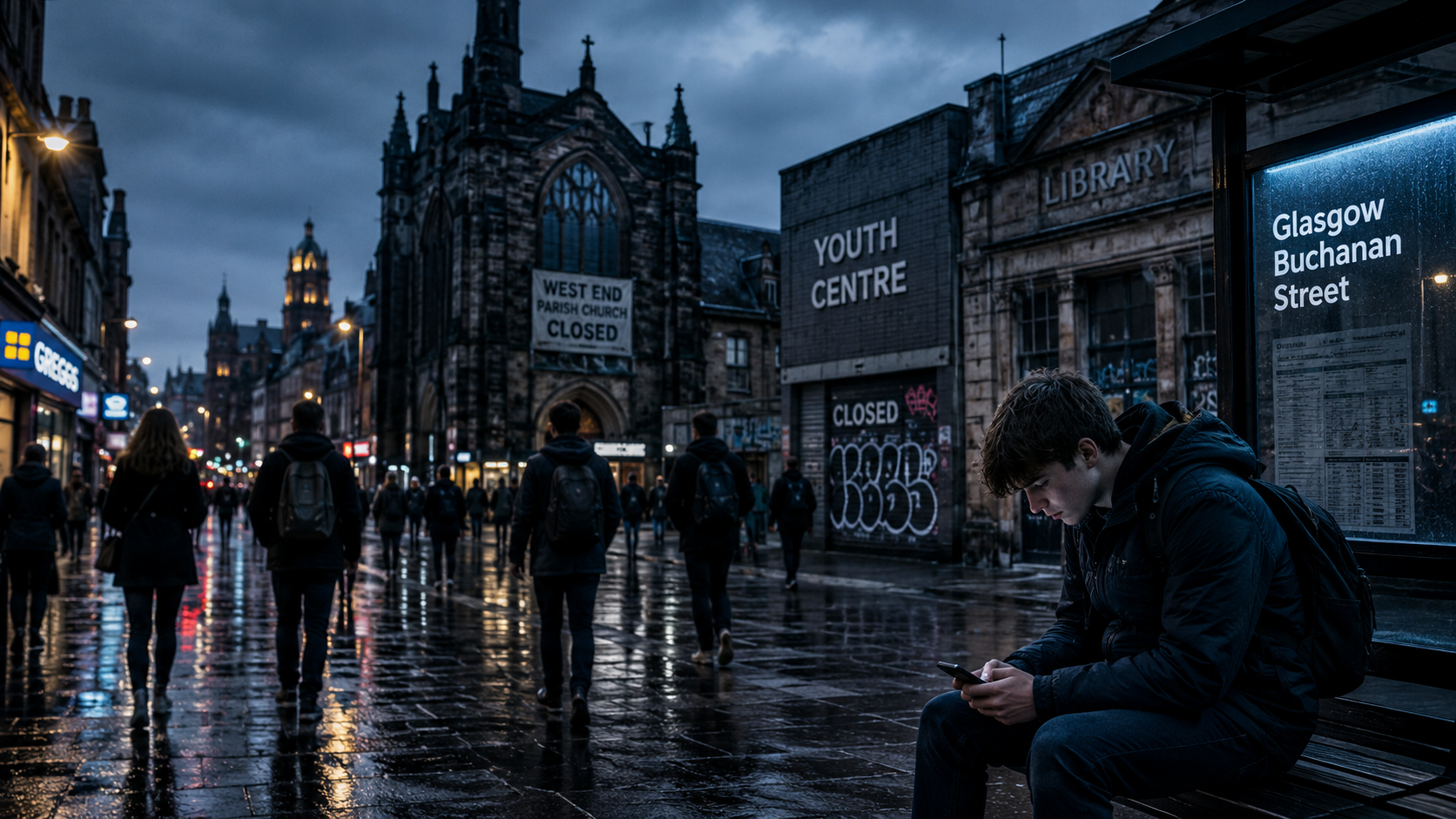
In Glasgow city centre, cafés and bars fill with young professionals staring silently into glowing screens. New housing developments create dense populations with remarkably little actual neighbourhood life. In Aberdeen and Dundee, transient rental culture and economic instability weaken long-term communal roots.
Meanwhile, across parts of the Highlands and Islands, a different form of loneliness is emerging. Young people leave for the Central Belt, London, or abroad, often never returning. Villages lose schools, shops, transport links, churches, banks, and meeting places. Ageing populations remain while communal continuity slowly dissolves.
The report recounts the remarkable case of the Zielsdorf family in Laggan, whose local shop and café — a vital social anchor within a remote Highland community — faced destruction through inflexible immigration policy designed far from the realities of rural Scottish life.⁶ The episode symbolised something larger than bureaucracy. It revealed a political culture increasingly incapable of understanding the fragile local ecosystems upon which genuine community depends.
This is where the report becomes far more significant than a conventional social affairs study.
Unlike many governmental or academic analyses, Logos Scotland refuses to treat loneliness merely as a medical or psychological pathology. Instead, it asks a much more uncomfortable question: what kind of civilisation produces such loneliness in the first place?
Its answer is devastating.
Modern Scotland, like much of the West, has steadily dismantled the institutions that historically taught human beings how to belong.
Churches have closed. Libraries have disappeared. Youth clubs have vanished. Local pubs continue to shut in alarming numbers. Community halls struggle to survive. Voluntary associations weaken. Civic participation declines. High streets empty. Families fragment geographically and emotionally.
The report notes that Britain has lost more than 14,500 youth and community worker posts since 2007, alongside the closure of more than 750 youth centres since 2013.⁷ Such statistics represent far more than administrative restructuring. They describe the slow destruction of the ordinary places where human beings once encountered one another naturally and repeatedly.
A generation ago, belonging was learned almost unconsciously.
The parish church.
The scout troop.
The football club.
The youth fellowship.
The choir.
The local pub.
The church fête.
The village gala.
The library reading group.
The extended Sunday lunch.
These were not merely activities. They were rituals of social continuity. They embedded individuals within webs of memory, obligation, familiarity, affection, and identity.
Increasingly, those structures no longer exist.
The report draws heavily upon thinkers such as Charles Taylor and Rowan Williams in arguing that loneliness is inseparable from the rise of radical individualism.⁸ Modern Western societies increasingly teach individuals to understand themselves as autonomous, self-creating beings detached from inherited duties, traditions, communal identities, and transcendent meaning.
The self becomes a personal project rather than a shared inheritance.
The consequences are now visible everywhere.
When autonomy becomes the supreme cultural good, permanence begins to appear oppressive. Relationships become conditional. Community becomes transactional. Human beings become consumers rather than members.
And loneliness follows naturally.
The report is unusually candid in identifying secularisation as central to this transformation. Drawing upon Charles Taylor’s account of the “immanent frame,” it argues that modern society increasingly situates individuals within a world stripped of transcendence, sacred order, and divine meaning.⁹ Earlier generations generally understood themselves as existing within a larger moral and spiritual cosmos. Modern society increasingly encourages individuals to construct meaning internally while navigating a universe perceived as emotionally indifferent.
Previous generations looked upward and believed themselves connected to something enduring: God, parish, nation, family, inheritance, history.
Modern society increasingly teaches people to look inward instead.
Yet inwardness proves a poor substitute for belonging.
What emerges is not liberation but fragility. Young people are encouraged endlessly toward self-expression while simultaneously deprived of the stable structures necessary for psychological security and communal rootedness.
Modern Scotland celebrates autonomy while presiding over epidemic levels of anxiety, purposelessness, depression, and loneliness.
Particularly striking is the report’s treatment of marriage and family life. At a time when many public institutions avoid speaking clearly about family stability for fear of appearing exclusionary, Logos Scotland argues openly that stable marriage and strong families remain among the greatest protections against loneliness and social fragmentation.¹⁰
Marriage, the report argues, functions as “societal glue.”¹¹ It binds together not merely husband and wife but wider networks of kinship, memory, obligation, and mutual support. Stable families provide children with continuity, rootedness, and emotional security while creating durable structures of care that persist through hardship, illness, ageing, and grief.
This is not nostalgic sentimentality. It is social reality.
The report notes that stronger and more stable family structures consistently correlate with lower levels of loneliness, while family fragmentation significantly increases vulnerability to isolation.¹² Yet contemporary politics often prefers to discuss wellbeing while avoiding serious discussion about the institutions that actually sustain it.
One of the report’s most powerful sections concerns what Rowan Williams termed the “institutions of charity.”¹³ These are the ordinary places where human beings gather not primarily to compete, consume, or perform, but simply to share life together: churches, libraries, cafés, youth clubs, museums, charities, choirs, and civic associations.
Such institutions matter because belonging cannot be manufactured through slogans or policy frameworks alone. Human beings require repeated embodied participation within communities where they are recognised over time.
The report’s defence of churches is especially important here. Its polling found that those attending church regularly report substantially lower levels of loneliness than those who never attend.¹⁴ This should surprise nobody familiar with functioning parish life.
A parish once provided something modern Britain increasingly struggles to offer: a place where one was known before one had achieved anything at all.
One was baptised there.
Married there.
Mourned there.
Buried from there.
The elderly widow, the anxious student, the struggling labourer, the businessman, and the child all occupied the same pews beneath the same prayers and within the same moral world.
Modern secular society often dismisses such structures as outdated while quietly wondering why loneliness continues to rise.
The report’s central insight is therefore profoundly simple: loneliness is not merely the absence of company. It is the absence of recognition.¹⁵
Human beings require more than economic provision or digital communication. They require to be seen, known, remembered, and situated within relationships that possess permanence and meaning.
This is why the report warns against reducing loneliness purely to a medical or psychological category.¹⁶ Such approaches risk treating symptoms while leaving causes untouched. One cannot permanently solve social fragmentation through therapy alone while continuing simultaneously to weaken the institutions that generate belonging in the first place.
The political implications are considerable.
Modern Scotland increasingly possesses a bureaucratic language of compassion alongside a lived reality of fragmentation. Governments speak endlessly about inclusion while presiding over the collapse of many of the structures through which people actually become included within stable communities.
Citizens are increasingly treated as consumers of services rather than members of a shared civic inheritance.
The report therefore calls for substantial policy change: renewed investment in youth work, protection of local civic institutions, support for volunteering, stronger recognition of family stability, decentralisation of decision-making, and recognition of churches as contributors to social cohesion rather than embarrassing relics of a religious past.¹⁷
Yet ultimately the report points beyond policy alone.
It asks whether modern Scotland still possesses a coherent understanding of what human flourishing actually means.
Economic growth matters. Mental healthcare matters. Technology matters. But none can compensate fully for the collapse of rooted belonging.
Human beings are not merely autonomous economic units. They are relational creatures who require memory, duty, affection, continuity, and shared meaning.
And therein lies the deeper warning contained within this report.
The tragedy of modern loneliness has emerged precisely at the moment when Western societies possess more wealth, stimulation, convenience, and technological sophistication than any civilisation in history.
And yet increasing numbers of young people feel invisible within it.
Scotland now faces a profound choice. It may continue treating loneliness primarily as a technical problem requiring managerial adjustment and therapeutic intervention. Or it may confront the deeper truth this report reveals: that societies collapse first spiritually, then socially, and only later politically.
For loneliness is not merely about being alone.
It is about no longer knowing where one belongs.
¹ Logos Scotland, Seen and Known: Rebuilding Belonging in Modern Scotland (2026), p. 7.
² Ibid., p. 8.
³ Ibid., p. 7.
⁴ Ibid., p. 7.
⁵ Ibid., pp. 11–12.
⁶ Ibid., pp. 10–11.
⁷ Ibid., p. 9.
⁸ Ibid., pp. 19–23.
⁹ Ibid., pp. 16–18.
¹⁰ Ibid., pp. 31–36.
¹¹ Ibid., p. 31.
¹² Ibid., p. 31.
¹³ Ibid., pp. 19–21.
¹⁴ Ibid., p. 21.
¹⁵ Ibid., p. 48.
¹⁶ Ibid., pp. 13–14.
¹⁷ Ibid., pp. 44–49.
related articles


Latest articles
- Today’s homily: St Nicholas TolentinoThe reflection celebrates Saint Nicholas of Tolentino, emphasising that holiness is achieved not through personal efforts but through grace. It highlights his life of service, prayer, and self-discipline, suggesting that his true sanctity stems from dependence on God. The message reinforces the importance of a single-hearted focus on God in one’s spiritual journey.
- Today’s Mass: September 10 St Nicholas of TolentinoSaint Nicholas of Tolentino, born around 1246 in Italy, became a devout Augustinian hermit known for his piety and dedication to preaching. He spent his later years in Tolentino, promoting virtue, and maintaining his chastity until his death in 1306. Canonised in 1446, his tomb is revered by the faithful.
- Today’s Mass: September 09 Day II in the Octave of The Nativity of the Blessed Virgin MaryThe feast of Our Lady’s Nativity, of ancient Eastern origin and established at Rome by the time of Pope St Sergius I, celebrates Mary as the immaculate New Eve and the dawn of salvation, the chosen tabernacle from whom the Redeemer would take His flesh. Today the Church also commemorates St Gorgonius, an officer of the imperial household at Nicomedia who, with his companion Dorotheus, embraced the Faith and suffered martyrdom under Diocletian in A.D. 303; his relics were later translated to Rome.
- NOMEN MANET, RES DEEST ~ The Name Remains; the Reality Is Lacking: Spiritual Conference for Nuntiatoria CXXIIThe content emphasises the disconnect between the names associated with Catholicism and the actual practices of faith. It highlights the importance of embodying belief through genuine actions, urging self-examination rather than mere external observance. Ultimately, it advocates for a restoration of sincerity in faith, calling individuals to authentically reflect their beliefs through their lives and worship.
- Mary Is Co-Redemptrix: Cardinal Burke Reopens Rome’s Marian ControversyCardinal Raymond Leo Burke has declared the Virgin Mary as “Co-Redemptrix” amidst controversy over the Vatican’s restriction on this title. The debate revolves around the appropriateness of certain theological language and whether terminology historically used can still accurately express Marian cooperation in Redemption without compromising Christ’s unique role.




Leave a Reply