

15–22 November 2026 | In Festo S. Gertrudis Virginis — In Dedicatione Basilicarum Ss. Petri et Pauli — Dominica XXVI et Ultima post Pentecosten
The final fortnight of the ecclesiastical year brings together the contemplative life of St Gertrude the Great, the apostolic foundations of the Roman Church, the charity of St Elizabeth of Hungary and the Marian devotion of the Presentation. The week concludes with St Cecilia, Virgin and Martyr, and the commemoration of the Last Sunday after Pentecost, whose Gospel announces the judgement of God and the consummation of earthly history.
TABULA HEBDOMADIS
| DIES | DOM XV XI | FER II XVI XI | FER III XVII XI | FER IV XVIII XI | FER V XIX XI | FER VI XX XI | SAB XXI XI | DOM XXII XI |
|---|---|---|---|---|---|---|---|---|
| OFFICIUM | S. Gertrudis V.; com. Dom. XXV post Pent. | Feria II post Dom. XXV post Pent. | S. Gregorii Thaumaturgi Ep. C. | In Dedicatione Basilicarum Ss. Petri et Pauli App. | S. Elisabeth Vid.; com. S. Pontiani Papæ M. | S. Felicis de Valois C. | In Præsentatione B. Mariæ Virginis | S. Cæciliæ V. M.; com. Dom. XXVI et Ult. post Pent. |
| CLASSIS | Duplex | Feria | Semiduplex | Duplex | Duplex | Duplex | Dupl. majus | Duplex |
| COLOR | Albus | Viridis | Albus | Albus | Albus | Albus | Albus | Rubeus |
| MISSA | Dilexisti | Dicit Dominus | Statuit ei | Terribilis est locus iste | Cognovi, Domine | Justus ut palma | Salve sancta Parens | Loquebar |
| ORATIONES | 2a Dom. XXV | 2a A cunctis; 3a ad libitum | 2a A cunctis; 3a ad libitum | Propria | 2a S. Pontiani | Propria | Propria | 2a Dom. Ult. post Pent. |
| RUBRICÆ | Gl. Cr.; Præf. Ss. Trinitatis; Ult. Ev. Dom. | Sine Gl. et Cr.; præf. comm.; Psalt. ant. | Gl.; præf. comm.; Psalt. ant. | Gl. Cr.; præf. comm. | Gl.; præf. comm. | Gl.; præf. comm. | Gl. Cr.; Præf. B.M.V. | Gl. Cr.; Præf. Ss. Trinitatis; Ult. Ev. Dom. |
| VESPERÆ | II de S. Gertrude; com. Dom. | I de S. Gregorio | I de Dedicatione; com. præc. | A cap. de seq.; com. præc. | A cap. de seq.; com. præc. | I de Præsentatione; com. præc. | II de Præsentatione; com. seq. et Dom. | A cap. de seq.; com. præc. et Dom. |
Abbreviationes: Dupl. = Duplex; Gl. = Gloria; Cr. = Credo; Dom. = Dominica; Pent. = Pentecosten; com. = commemoratio; Præf. = Præfatio; Psalt. ant. = Psalterium antiquum; Ult. Ev. = Ultimum Evangelium; Mm. = Martyres; M. = Martyr; C. = Confessor; Ep. = Episcopus; V. = Virgo; Vid. = Vidua; App. = Apostoli; seq. = sequens; præc. = præcedens; A cap. = a capitulo.
Color: Albus = White; Rubeus = Red; Viridis = Green; Purpura = Purple; Niger = Black.
Nota: The table follows the earlier Roman calendar established in last week’s Ordo. Under this arrangement, St Gertrude is celebrated on 15 November, rather than 16 November, and St Cecilia takes precedence on 22 November, with commemoration of the occurring Sunday. The Monday feria is replaced in the traditional English particular calendar by St Edmund of Canterbury, Bishop and Confessor; on Tuesday, St Hugh of Lincoln takes precedence over St Gregory Thaumaturgus. These English observances, and their consequences for Vespers and the Mass, are explained below.¹ ² ³
DAILY LITURGICAL COMMENTARY
Sunday, 15 November — St Gertrude the Great, Virgin; Commemoration of the Twenty-fifth Sunday after Pentecost
Sanctæ Gertrudis Virginis — Dominica XXV post Pentecosten
Double — White — Missa Dilexisti
St Gertrude the Great belongs to that remarkable company of medieval contemplatives whose writings reveal the profound theological and spiritual culture cultivated within the monasteries of Western Christendom. Born in 1256, she entered the monastery of Helfta as a child and received an education embracing literature, philosophy and the liberal arts. Her intellectual formation subsequently became directed towards the study of sacred theology and the mysteries of divine revelation.
Her writings, particularly The Herald of Divine Love, bear witness to an intimate devotion to Our Lord, especially His Sacred Heart, His Passion and the Blessed Sacrament. Long before the revelations associated with St Margaret Mary Alacoque, Gertrude was contemplating the love of Christ manifested through His human Heart, understanding that devotion within the wider mystery of the Incarnation and Redemption.
There is considerable significance in the fact that her spirituality was so thoroughly liturgical. The Divine Office, the Holy Sacrifice of the Mass and the Church’s sacramental life provided the language and substance of her contemplation. Her mystical experiences did not lead her away from the ordinary means of sanctification. They deepened her appreciation of them.
St Gertrude’s association with prayer for the faithful departed gives her feast particular appropriateness during November. Her writings encourage confidence in divine mercy and intercession for those undergoing purification. The widely circulated prayer attributed to her, accompanied by a promise concerning the liberation of a specified number of souls from Purgatory, does not possess the historical authentication or ecclesiastical authority sometimes claimed for it. The Church’s established prayers and indulgenced devotions provide more than sufficient grounds for encouraging the faithful in this work of charity.
Under the earlier Roman calendar retained in this Ordo, St Gertrude is celebrated on 15 November as a Double, with commemoration of the Twenty-fifth Sunday after Pentecost. Her feast was subsequently transferred to 16 November following the insertion of St Albert the Great into the universal calendar.
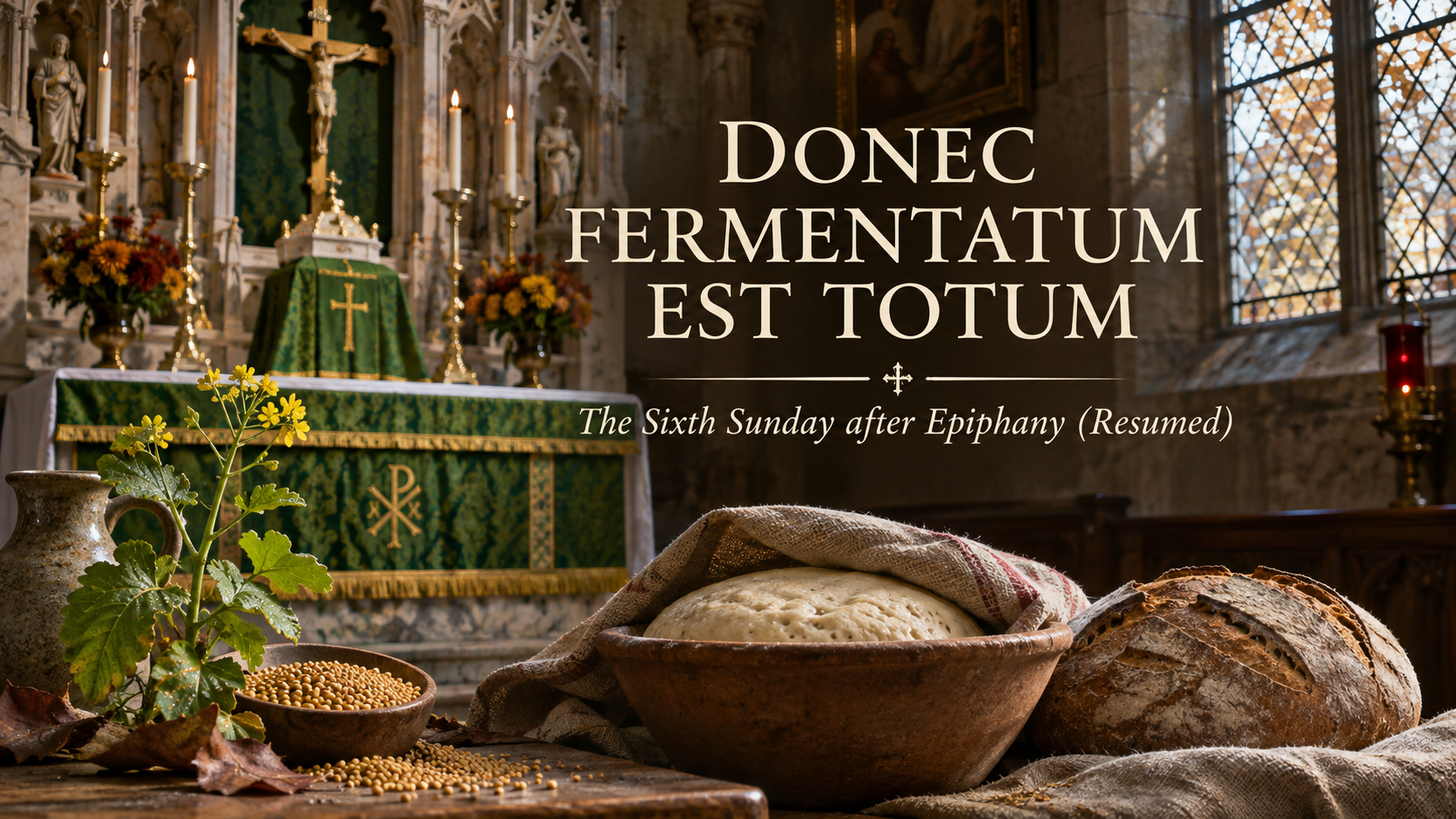
The Sunday employs the formulary of the Sixth Sunday after Epiphany, resumed after Pentecost. Its Gospel, Matthew 13:31–35, contains the parables of the mustard seed and the leaven.
Both parables describe the operation of God’s kingdom through apparently modest beginnings. The mustard seed grows into a great plant, while a small quantity of leaven gradually permeates the whole measure of dough. The Church has always recognised in these images the efficacy of divine grace and the expansion of the Gospel through apostolic labour.
The juxtaposition with St Gertrude’s feast is particularly appropriate. Her influence arose from the hidden life of a religious community, rather than from the exercise of public office. Yet her writings have nourished Catholic devotion for centuries. The spiritual fruitfulness of the Church cannot be assessed simply by what is immediately visible or measurable.
The Mass is Dilexisti, with Gloria and Creed. The Sunday is commemorated by its Collect, Secret and Postcommunion; the Preface of the Most Holy Trinity is used, and the Sunday Gospel is read as the proper Last Gospel.
Monday, 16 November — Feria after the Twenty-fifth Sunday after Pentecost
Feria II post Dominicam XXV post Pentecosten
Feria — Green — Missa Dicit Dominus
The universal Roman calendar prior to the insertion of St Albert the Great leaves 16 November without an obligatory sanctoral feast. The ferial Office and Mass therefore follow the occurring week, with the formulary of the resumed Sixth Sunday after Epiphany.
The Sunday Gospel of the mustard seed and the leaven remains a suitable subject for meditation. Our Lord’s account of the growth of the kingdom is particularly instructive at a time when the external condition of Catholic institutions can appear discouraging. The expansion of the Gospel has never depended exclusively upon numerical prosperity or favourable political circumstances. Its progress has frequently been accomplished through the perseverance of comparatively small communities, whose fidelity was tested by difficulties which appeared almost insurmountable.
The same principle applies to the ordinary Christian life. A family’s regular prayers, the faithful observance of Sunday, the worthy reception of the sacraments and the careful religious education of children constitute genuine participation in the Church’s mission. Their influence may extend considerably beyond the immediate household.
The older ferial discipline retains the additional prayers A cunctis and ad libitum. The Gloria and Creed are omitted, and the Common Preface is used.
English particular calendar — St Edmund of Canterbury, Bishop and Confessor. In the traditional English calendar, the feria gives way to St Edmund of Abingdon, Archbishop of Canterbury, who died in 1240. A distinguished scholar and former teacher at Oxford, he became Archbishop in 1233 and encountered serious difficulties in defending ecclesiastical rights against royal interference.
His conflict with King Henry III belongs to a period when the English episcopate was frequently required to defend the legitimate independence of ecclesiastical government. Edmund’s ministry illustrates that episcopal office carries responsibilities which cannot be abandoned merely because their fulfilment is politically inconvenient.
The English proper celebrates him as a Double, in white, with the Mass Statuit ei. The corresponding proper Office and Vespers replace the universal ferial arrangement where that calendar applies.³
Tuesday, 17 November — St Gregory Thaumaturgus, Bishop and Confessor
Sancti Gregorii Thaumaturgi Episcopi et Confessoris
Semidouble — White — Missa Statuit ei
St Gregory Thaumaturgus, Bishop of Neocaesarea in Pontus, was one of the notable missionary bishops of the third century. Born into a pagan family, he received an education in Greek philosophy and rhetoric before encountering the Christian scholar Origen at Caesarea in Palestine.
His conversion was accompanied by a serious intellectual engagement with the claims of Christianity. Gregory recognised that Christian doctrine answered questions concerning God, creation and man’s ultimate destiny which could not be adequately resolved by the philosophical and religious systems of his upbringing.
His subsequent episcopal ministry was exercised among a population in which pagan religion remained deeply rooted. The traditional accounts of his life describe numerous miracles, from which he received the title Thaumaturgus, or Wonderworker. Although particular hagiographical details cannot always be independently established, his reputation as a missionary bishop and teacher of the faith is firmly established.
The conversion of the people entrusted to his care required more than the introduction of new religious ceremonies. Christianity demanded the rejection of idolatry and the acceptance of divine revelation, together with the moral transformation arising from baptism and incorporation into the Church.
The lesson retains its force wherever the Gospel encounters an established religious culture. Legitimate local customs may be preserved where they are compatible with Catholic faith and morals, but the Church cannot treat contradictory religious doctrines as equally valid expressions of the truth revealed by Christ.
The Mass is Statuit ei, with Gloria and Common Preface. The additional prayers are A cunctis and ad libitum.
English particular calendar — St Hugh of Lincoln, Bishop and Confessor. In England, St Hugh of Lincoln, who died in 1200, takes precedence under the older particular calendar. A Carthusian monk appointed Bishop of Lincoln in 1186, Hugh became distinguished for his pastoral diligence, concern for justice and willingness to confront royal authority when the rights of the Church required defence.
His memory is particularly associated with the defence of the vulnerable, including Jewish communities subjected to persecution. His episcopal courage was exercised through practical government and personal intervention rather than merely through public declarations.
The English proper celebrates him as a Double, in white, with the Mass Sacerdotes. Where the English calendar is observed, the corresponding Office and Mass replace those of St Gregory.³
Wednesday, 18 November — Dedication of the Basilicas of Saints Peter and Paul
In Dedicatione Basilicarum Sanctorum Apostolorum Petri et Pauli
Double — White — Missa Terribilis est locus iste
Ten days after commemorating the Dedication of the Lateran Basilica, the Roman liturgy celebrates the two great churches raised over the traditional burial places of Saints Peter and Paul. The association of these basilicas with the martyrdom and burial of the Apostles gives the feast an importance extending far beyond the architectural history of Rome.
The present Basilica of St Peter was solemnly dedicated by Pope Urban VIII on 18 November 1626, following more than a century of construction. The ancient Constantinian basilica which it replaced had stood for approximately twelve centuries above the site associated with the Apostle’s tomb. The new building was intended to preserve that apostolic continuity while providing a monumental setting for the worship of God and the exercise of the Roman pontifical office.⁵
The Basilica of St Paul Outside-the-Walls likewise stands upon a site venerated since Christian antiquity. The ancient church suffered catastrophic damage in the fire of July 1823 and was subsequently rebuilt. Pope Pius IX consecrated the restored basilica on 10 December 1854, two days after defining the dogma of the Immaculate Conception.⁶
The feast expresses the Church’s veneration for the Apostles whose ministry and martyrdom established the particular authority of the Roman See. St Peter received from Christ the commission to strengthen his brethren and shepherd His flock. St Paul, the Apostle of the Gentiles, carried the Gospel throughout the Mediterranean world and bore witness to Christ at Rome through his martyrdom.
Their common commemoration recalls that the Church’s unity is inseparable from her apostolic faith. The Roman primacy exists for the preservation of that faith and the maintenance of ecclesiastical communion. Its authority cannot properly be understood apart from the revelation entrusted to the Apostles and handed down through their successors.
The Mass begins Terribilis est locus iste, the words of Jacob upon recognising the presence of God at Bethel. The Epistle, Apocalypse 21:2–5, describes the heavenly Jerusalem, while the Gospel, Luke 19:1–10, recounts the conversion of Zacchaeus.
These readings explain the purpose of a consecrated church. The sacred building is set apart for divine worship because the faithful are called to encounter Christ through the means He has established. The altar is the place of sacrifice; the church is the house of prayer where the supernatural life received in baptism is nourished through the sacraments.
The dedication of a church therefore concerns the sanctification of its people. Sacred architecture and ceremonial possess their proper dignity because they serve divine worship and express Catholic doctrine. Their beauty is directed towards the glory of God.
The Mass has Gloria and Creed, with the Common Preface. The earlier calendar consulted for the present Ordo records the feast as a Double; later traditional calendars commonly assign it the rank of Greater Double.²
Thursday, 19 November — St Elizabeth of Hungary, Widow
Sanctæ Elisabeth Viduæ
Double — White — Missa Cognovi, Domine
St Elizabeth of Hungary was born in 1207 into the Hungarian royal family and married Louis IV, Landgrave of Thuringia. Her life united the responsibilities of marriage and motherhood with an extraordinary commitment to prayer, penance and the corporal works of mercy.
Although surrounded by the privileges of princely life, Elizabeth recognised that temporal wealth imposed serious obligations towards those in need. She provided food and assistance to the poor, established charitable institutions and devoted herself personally to the care of the sick.
The traditional accounts of her life describe the suspicion and hostility which her generosity sometimes provoked within the court. Her conduct did not correspond to the expectations of those who regarded princely dignity chiefly in terms of wealth, ceremony and social distinction.
Her marriage to Louis was marked by affection and mutual respect, but his death in 1227 brought a profound alteration to her circumstances. During the remaining years of her short life she pursued a more austere dedication to prayer and charity, influenced by the ideals of the Franciscan movement.
St Elizabeth died in 1231, aged only twenty-four, and was canonised by Pope Gregory IX in 1235.
Her sanctity illustrates the proper relationship between Christian charity and the possession of temporal goods. Wealth is morally indifferent in itself, but its acquisition and employment are subject to the obligations of justice and charity. The Christian is required to recognise the needs of others and to act according to his circumstances and responsibilities.
Elizabeth’s service to the sick and poor was sustained by a supernatural motive. She recognised in those who suffered the presence of Christ, whose teaching identifies acts of mercy towards the least of His brethren with service rendered to Himself.
The Mass is Cognovi, Domine, with Gloria and Common Preface. St Pontian, Pope and Martyr, is commemorated through the appointed prayers.
Pontian governed the Roman Church during the third century and was exiled under the Emperor Maximinus Thrax. His sufferings and death are remembered among the testimonies of fidelity given by the early Roman pontiffs.
Friday, 20 November — St Felix of Valois, Confessor
Sancti Felicis de Valois Confessoris
Double — White — Missa Justus ut palma
St Felix of Valois is traditionally associated with St John of Matha and the foundation of the Order of the Most Holy Trinity, established for the redemption of Christians held captive by hostile powers.
The Order received papal approval from Innocent III in 1198. Its work answered a particular necessity of medieval Christendom, when warfare and raiding around the Mediterranean frequently resulted in Christians being taken into captivity and sold into slavery.
The Trinitarians collected alms, negotiated ransoms and organised the return of captives to their homes. Their charitable work required considerable resources, practical organisation and, frequently, personal courage. Religious life was thus directed towards a concrete work of mercy which also preserved the freedom of Christians to practise their faith.
The early biographical record concerning Felix is less secure than the later tradition, and historians have questioned elements of the accounts which identify him as a co-founder. The documentation of the Order’s origins is centred principally upon St John of Matha. Felix’s cult was nevertheless formally recognised in the seventeenth century, and his feast was extended to the universal Roman calendar.⁷
The historical difficulty concerning particular details of his life does not diminish the significance of the charitable work with which his feast is associated. The redemption of captives was regarded as an obligation arising from Christian charity and solidarity with those suffering persecution or enslavement.
There is also a theological meaning in the language of redemption. The liberation of those held in human bondage recalls the greater deliverance accomplished by Christ, who frees man from the captivity of sin through His Passion and death.
The Collect of the Mass asks that, through the saint’s intercession, the faithful may be delivered from the captivity of their sins and brought to their heavenly homeland.
The Mass is Justus ut palma, with Gloria and Common Preface.
Friday retains its traditional penitential character. The faithful should observe the applicable discipline of abstinence and may appropriately unite their penance with prayer for persecuted Christians, those unjustly imprisoned, and the Holy Souls.
Saturday, 21 November — Presentation of the Blessed Virgin Mary
In Præsentatione Beatæ Mariæ Virginis
Greater Double — White — Missa Salve sancta Parens
The feast of the Presentation of the Blessed Virgin Mary commemorates the ancient tradition that Our Lady was dedicated to God from her childhood and brought to the Temple at Jerusalem.
The narrative appears in early Christian apocryphal writings, particularly the Protoevangelium of James. These texts are not part of the canonical Scriptures, and their historical details do not possess the authority of divine revelation. The Church’s celebration of the feast expresses the theological significance of Mary’s complete dedication to God, rather than requiring the acceptance of every circumstance found in those early accounts.
The feast developed within the Christian East before becoming more widely established in the Western liturgical calendar. It honours the singular vocation of the Blessed Virgin, chosen from all eternity to become the Mother of the Incarnate Word.
The doctrine of Mary’s Immaculate Conception provides the proper theological foundation for understanding her holiness. Preserved from original sin through the anticipated merits of Christ, she was endowed with grace in preparation for her divine maternity. Her obedience throughout life corresponded perfectly to that privileged vocation.
The Gospel, Luke 11:27–28, records a woman praising the womb which bore Our Lord. Christ responds by declaring blessed those who hear the word of God and keep it. The Church sees in these words a particular confirmation of the Blessed Virgin’s holiness, since she received the divine word with perfect faith and obedience.
Mary’s greatness cannot be separated from her relationship to her Son. Every authentic Marian devotion must therefore lead the faithful more deeply into the mystery of Christ and His work of salvation.
The feast provides an appropriate occasion for Catholic parents to consider the religious formation of their children. The responsibility for their Christian education belongs primarily to the family, assisted by the Church and by institutions which faithfully uphold Catholic doctrine and morals.
Children should be introduced early to the habits of prayer, the lives of the saints and the truths of the catechism. Their participation in the sacramental life of the Church should be accompanied by an understanding suited to their age and capacity.
The Mass is Salve sancta Parens, with Gloria and Creed, and the Preface of the Blessed Virgin Mary, with the proper reference to the Presentation.
At Vespers, the liturgical year approaches its final Sunday. The Church’s contemplation of the Blessed Virgin’s consecration to God gives way to the remembrance of St Cecilia and the solemn Gospel of the Last Sunday after Pentecost.
Sunday, 22 November — St Cecilia, Virgin and Martyr; Commemoration of the Last Sunday after Pentecost
Sanctæ Cæciliæ Virginis et Martyris — Dominica XXVI et Ultima post Pentecosten
Double — Red — Missa Loquebar
St Cecilia is among the most celebrated virgin martyrs of ancient Rome. Her name appears in the Roman Canon, and her cult has been associated from early centuries with the church dedicated in her honour at Trastevere.
The precise historical circumstances of her martyrdom remain uncertain. The familiar narrative of her life, preserved in the Passio Sanctæ Cæciliæ, relates her consecration to virginity, her marriage to Valerian, the conversion of her husband and his brother Tiburtius, and her eventual martyrdom under Roman persecution.
Although the surviving account contains hagiographical features which cannot all be treated as contemporary historical testimony, Cecilia’s ancient cult and enduring veneration in the Roman Church are well established.
Her association with sacred music developed from the liturgical tradition surrounding her feast, particularly the account of her wedding, during which she is represented as singing to God in her heart amid the sounding of musical instruments.
The Church honours her as a patroness of musicians and singers, recognising the proper place of sacred music in the worship of God. The beauty of music employed in the liturgy serves the sacred text and the action of divine worship. Its purpose is to assist the faithful in prayer and to give fitting expression to the truths of the faith.
This understanding of sacred music differs from the treatment of church services as occasions for entertainment or emotional stimulation. The liturgy is an act of public worship offered to God according to the Church’s authority. Music possesses its dignity through participation in that worship.
The older Roman calendar celebrates St Cecilia as a Double on 22 November, with commemoration of the Last Sunday after Pentecost.
The Sunday Gospel, Matthew 24:15–35, contains Our Lord’s solemn discourse concerning the tribulations associated with Jerusalem and the final consummation of history.
The destruction of Jerusalem by the Roman armies in AD 70 provides an essential historical context for the passage. Catholic interpretation has also understood the discourse as possessing an eschatological significance extending towards the end of the world and the final judgement.
Our Lord warns His disciples against deception, false prophets and the presumption that earthly arrangements will endure indefinitely. The passing of the present world is set against the permanence of His divine word.
The Church places this Gospel at the conclusion of the liturgical year because the Christian life must be understood in relation to its final end. Men are created for eternal communion with God, and their earthly conduct will be judged according to the truth revealed by Christ.
The closing weeks of the year consequently invite serious examination of conscience. Another year of grace has been given, another cycle of the sacred mysteries has been celebrated, and the faithful have once more been instructed in the life, Passion, Resurrection and Ascension of Our Lord.
The question for each Christian concerns the use he has made of those graces. The external difficulties confronting the Church, however serious, cannot absolve anyone from the obligation to pursue personal holiness and the salvation of souls.
The Mass is Loquebar, with Gloria and Creed. The Last Sunday after Pentecost is commemorated through its Collect, Secret and Postcommunion. The Preface of the Most Holy Trinity is used, and the Sunday Gospel is read as the proper Last Gospel.
The following Sunday, 29 November, begins Advent and the new ecclesiastical year.
NOTA BENE — RUBRICAL AND PASTORAL OBSERVATIONS
The earlier calendar and St Gertrude. The arrangement retained from the preceding Ordo places St Gertrude on Sunday, 15 November. Her feast is celebrated as a Double, with commemoration of the Twenty-fifth Sunday after Pentecost. The later transfer of her feast to 16 November, following the insertion of St Albert the Great on the fifteenth, is not applied. Consequently, the Sunday remains commemorated rather than becoming the principal Office and Mass.¹ ²
The Monday feria and English particular calendar. The universal calendar leaves Monday, 16 November, as a feria, with the Mass of the preceding Sunday and the ferial Office. In England, St Edmund of Canterbury is celebrated on that date as a Double. The local proper therefore replaces the ferial celebration, including the applicable Mass and Vespers arrangements. The traditional English calendar also celebrates St Hugh of Lincoln on 17 November, taking precedence over the universal observance of St Gregory Thaumaturgus. These particular feasts should be retained where authorised.³
The Dedication of Saints Peter and Paul. Wednesday, 18 November, commemorates the dedication of the two great apostolic basilicas. The older rank used here is Double, although later calendars frequently describe the feast as a Greater Double. The Mass is Terribilis est locus iste, with Gloria, Creed and Common Preface. The Gospel is Luke 19:1–10, recounting the conversion of Zacchaeus. The feast should not be confused with the Dedication of the Lateran Basilica on 9 November.
The Presentation of Our Lady. Saturday, 21 November, is observed as a Greater Double under the older arrangement. The Mass Salve sancta Parens includes the Gloria and Creed, with the proper Marian Preface. The retained rank is important when determining concurrence with St Cecilia and the Sunday at Vespers.
St Cecilia and the Last Sunday after Pentecost. The final Sunday of the ecclesiastical year falls on 22 November. Under the earlier precedence followed in this Ordo, St Cecilia is the principal celebration, with commemoration of the Sunday. The Mass of the saint is Loquebar, and the Gospel of the Last Sunday is read as the proper Last Gospel. Later rubrical arrangements which give the Sunday precedence are not applied here.
The Sunday numbering. The Twenty-fifth Sunday after Pentecost, on 15 November, uses the formulary of the Sixth Sunday after Epiphany, while the Twenty-sixth and Last Sunday after Pentecost, on 22 November, takes the proper Mass traditionally assigned to the Twenty-fourth and Last Sunday after Pentecost. The apparent variation in numbering arises from the number of Sundays between Pentecost and Advent and the established Roman arrangement for resuming the omitted Sundays after Epiphany.
November suffrages and Requiem Masses. The Church’s prayers for the faithful departed continue throughout November. Members and supporters of the Guild of Holy Souls within the Old Roman Apostolate are encouraged to submit names for the Chantry Books, arrange Mass intentions for deceased relatives and benefactors, and recite the De profundis for those undergoing purification. Requiem Masses remain subject to the restrictions governing the ranks of the occurring feasts and Sundays.
Friday penance. Friday, 20 November, retains its penitential character. Abstinence should be observed according to the applicable discipline, and the faithful may unite their penance with an act of charity for the Holy Souls or for Christians suffering persecution.
St Martin’s Lent and the approach of Advent. The period following Martinmas, 11 November, retains a historical association with preparation for Christmas. In parts of the Western Church a longer Advent fast was formerly observed, while Eastern Christian traditions continue to maintain their own pre-Nativity fasting discipline. Such practices may inform voluntary penance and household preparation, without being represented as universal obligations of the Latin Church.
Preparation for the new ecclesiastical year. Advent begins on Sunday, 29 November 2026. The intervening week offers an appropriate opportunity for the faithful to make their confession, renew their daily prayers and prepare the household for the coming season. Particular attention may be given to the examination of conscience suggested by the Gospel of the Last Sunday after Pentecost, together with the continuing November obligation of charity towards the faithful departed.
¹ Nuntiatoria, Traditional Roman Liturgy Ordo: 8–15 November 2026 NUNTIATORIA
² Breviarium Romanum (1888), Calendar for November, Source Library Source Library
³ The Muniment Room, Pre-1910 Calendar for Week Beginning 12 November ttonys-blog.blogspot.com
⁴ Maternal Heart of Mary, Mass Propers of the Saints Maternal Heart of Mary
⁵ Holy See Press Office, The Dedication of St Peter’s Basilica in 1626 Vatican Press
⁶ Basilica of St Paul Outside-the-Walls, The Fire and Reconstruction Saint Paul Outside-the-Walls
⁷ Catholic Encyclopedia, St Felix of Valois newadvent.org



Leave a Reply