
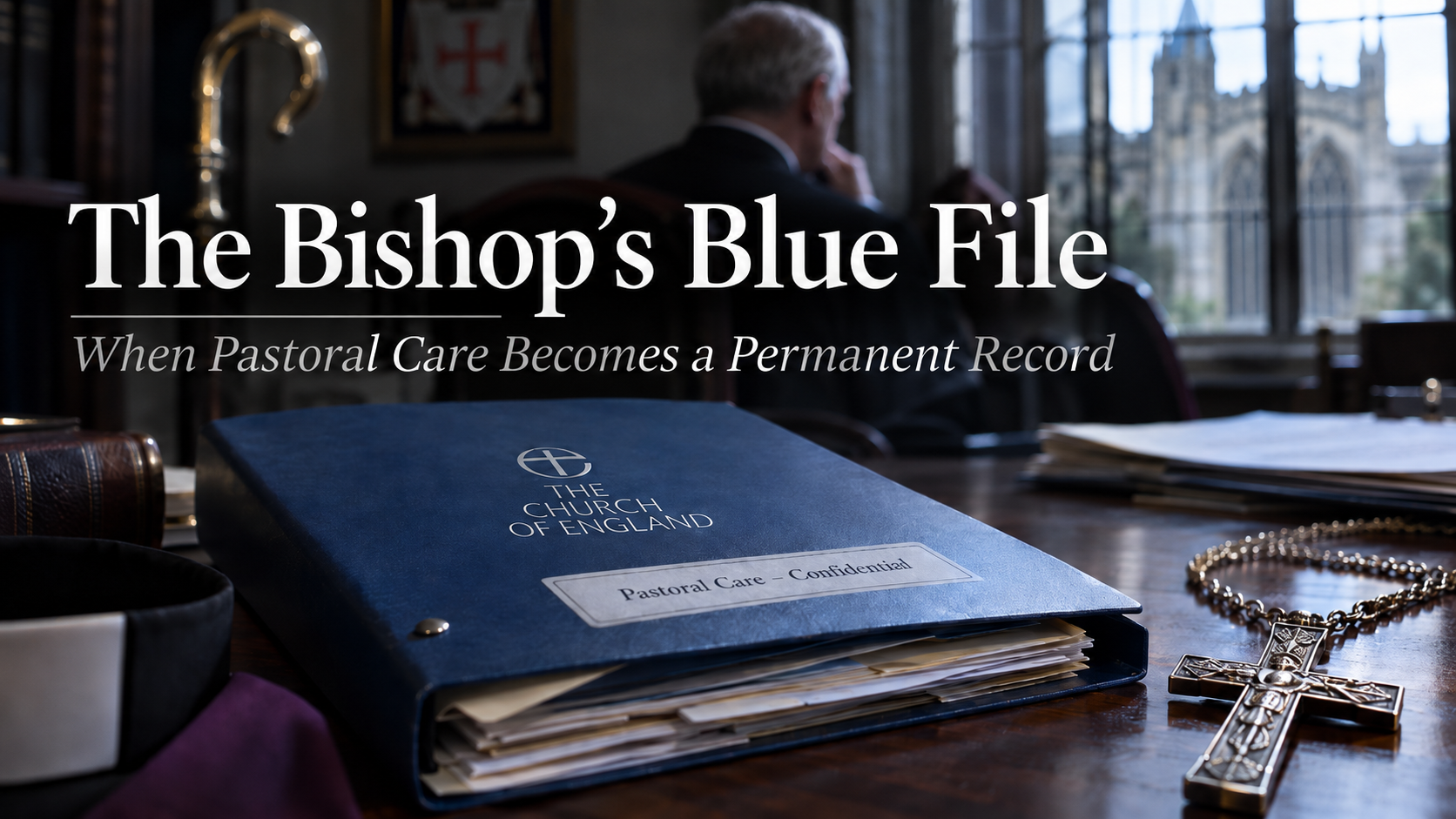
The Church of England’s revised clergy files policy permits dismissed complaints, financial difficulties and sensitive personal information to follow ministers throughout their careers and for decades afterwards. Approved by the House of Bishops in June 2026, the regulations raise serious questions about the administration of justice, episcopal authority and the peculiar vulnerability of clergy whose reputations depend upon the very officials responsible for maintaining their records.
A clergyman experiencing financial difficulties might reasonably approach his bishop for assistance. He might also seek advice about a troubled marriage, an illness affecting his ministry or difficulties with a parishioner. These are precisely the circumstances in which the bishop’s pastoral responsibility ought to become most apparent. Under the Church of England’s revised clergy records policy, however, information arising from such difficulties may enter a file that accompanies the clergyman between dioceses, remains in existence throughout his ministry and is preserved for 75 years after its permanent conclusion, ordinarily his death.
The files are known as blue files, and they have existed for years. What has changed is the comprehensive policy governing their contents, retention and management, approved by the House of Bishops in June 2026 and published on the Church of England’s website in October. The accompanying guidance runs to dozens of pages, establishing requirements for everything from ministerial appointments and references to health information, disciplinary proceedings and safeguarding concerns.¹
On 9 November, Ian Paul published a detailed examination of the arrangements on Psephizo, drawing attention to contradictory instructions, questionable claims concerning data protection exemptions and the limited opportunities afforded to clergy to examine or contest what is recorded about them. His investigation deserves attention beyond the Church of England, partly because the difficulties it identifies are common to many institutions whose internal systems have grown substantially more complicated than their arrangements for holding those responsible to account.²
The House of Bishops has good reason to insist upon accurate records. The Independent Inquiry into Child Sexual Abuse exposed the consequences of information being lost, concealed or inadequately transferred when clergy moved between jurisdictions. One of the most elementary requirements of safeguarding is that a person entrusted with responsibility for others should not be able to escape legitimate scrutiny merely by moving elsewhere. Bishops have a duty to know whether those seeking appointments have previously been subject to serious disciplinary findings or credible safeguarding concerns.
The trouble begins when that legitimate requirement becomes a justification for preserving almost everything that might conceivably be thought relevant to a person’s ministerial history. The policy’s mandatory documentation includes records of sickness absence, occupational health assessments, financial difficulties, grievances, complaints, ministerial reviews and aspects of family circumstances. Its definition of a file note extends to any interaction or behaviour relevant to a cleric’s ministry, wellbeing or conduct. Much of this material is to remain in the file for its entire existence.
The distinction between what a future bishop needs to know and what an earlier bishop happened to record is insufficiently developed. There is a considerable difference between preserving evidence of established misconduct and retaining the details of a financial problem resolved thirty years earlier. One concerns a demonstrable question of fitness for ministry. The other may concern nothing more than the ordinary misfortunes of life. The difficulty becomes particularly acute when the records concern allegations which have never been substantiated.
Under the policy, formal complaints made through the Clergy Discipline Measure are retained in sealed envelopes, including complaints dismissed without a finding of misconduct. Informal complaints may also generate permanent records, including witness statements and the bishop’s decision. The guidance specifies that the clergyman’s answer should be included if any. There is no corresponding general obligation in the policy requiring the bishop to notify him whenever an adverse note is added, provide him with a copy or ensure that his account accompanies it when the file is transferred.³
This matters because an allegation, once recorded, acquires a form of administrative permanence quite separate from its evidential value. A complaint may have been dismissed because it was unsupported, misconceived or demonstrably false. Those are materially different outcomes. Yet the existence of the allegation may remain apparent to future bishops, who possess the authority to grant permissions and appointments. The recipient may know that a complaint was dismissed without knowing precisely why it was dismissed or appreciating the circumstances in which it arose.
Safeguarding authorities must sometimes retain information about allegations which have not been proved. That is essential where there remains a genuine concern about possible patterns of behaviour, particularly involving children or vulnerable adults. But the classification of such material, the reasons for retaining it and the limits upon its subsequent use are part of safeguarding justice itself. A record which does not distinguish properly between suspicion, investigation and determination can mislead the very person it is supposed to inform.
There is an additional difficulty particular to ecclesiastical life. A bishop is expected to be the pastor of his clergy, yet he also exercises considerable authority over their ministerial circumstances. He may determine appointments, exercise disciplinary powers and provide references that influence whether a clergyman can continue his vocation elsewhere. He now presides over a system in which pastoral information, employment-related records and disciplinary material are gathered within a single administrative structure, albeit with restrictions upon access to particular categories.
A prudent clergyman might therefore wonder whether seeking pastoral assistance will create a record which could subsequently affect his prospects. It is an unfortunate condition of pastoral government when those who most need support have reason to consider the possible consequences of asking for it.
The problem is hardly theoretical. Nuntiatoria has previously examined the treatment of the Revd Dr Bernard Randall, the former school chaplain whose difficulties began after a sermon defending the Church of England’s own teaching on marriage and Christian belief. The Diocese of Derby’s subsequent safeguarding actions were subjected to an independent legal review by Gregory Jones KC and Dame Sarah Asplin, which identified serious procedural deficiencies. Randall’s case concerned the application of safeguarding procedures, rather than the new blue-file policy, but it demonstrated how readily an adverse institutional assessment could affect a clergyman’s ministry even when the underlying allegations were contested.⁴
It is particularly troubling that the revised policy appears to place substantial barriers between clergy and some of the records which may influence decisions about them. Although subject access rights exist under data protection legislation, the policy states that material relating to the Clergy Discipline Measure is exempt from Articles 5 and 12–21 of the UK GDPR under paragraph 14 of Schedule 2 to the Data Protection Act 2018. It further directs that such material should not be included in individual rights requests unless the data controller chooses to waive the exemption.
That is an exceptionally broad statement of the law. Paragraph 14 contains distinct provisions concerning persons acting in a judicial capacity and the protection of judicial independence or proceedings. The Information Commissioner’s guidance makes clear that an organisation which is not itself exercising a judicial function cannot automatically invoke the exemption merely because the information concerns legal or disciplinary proceedings. In such circumstances, the relevant question is whether compliance with the particular data protection right would be likely to prejudice judicial independence or proceedings. Furthermore, any restriction upon Article 5 operates within the limits established by the legislation; the fundamental obligations of accuracy, fairness and lawful processing do not simply disappear.⁵
There is a substantial legal difference between protecting the confidentiality of proceedings before an ecclesiastical tribunal and withholding from a clergyman an informal allegation which never reached a tribunal at all. The policy’s treatment of historical pastoral-discipline material, particularly records described as Part 2 misconduct, makes that distinction all the more important. It is precisely the sort of question which ought to have received independent legal examination before the House of Bishops approved the regulations.
The documents contain inconsistencies which suggest that such examination, if undertaken, failed to resolve some rather elementary problems. The guidance states that confidential Clergy Current Status Letters may be sent outside the United Kingdom without informing the person concerned of the applicable safeguards. The model privacy notice states the opposite. The provisions governing capability proceedings likewise require careful reconciliation between the preservation of an account of previous difficulties and the eventual disposal of records whose continued retention is no longer justified.¹
Neither discrepancy is trivial when the material concerned may affect a clergyman’s reputation or prospects. A status letter is potentially decisive in determining whether another bishop will accept him for ministry. An old capability record may influence an appointment long after the circumstances which gave rise to it have ceased to exist. Accuracy is therefore essential, including accuracy about the outcome of proceedings and the subsequent relevance of their contents.
The Department for Education’s Keeping Children Safe in Education 2026 provides an instructive comparison. Its provisions governing allegations against teachers and other school staff require clear records of the allegations, investigations and outcomes. Where appropriate, the person concerned is provided with the relevant summary, subject to agreement from the police or children’s social care. Allegations found to be false, unfounded, unsubstantiated or malicious must not be included in employment references. The guidance also distinguishes the proper retention of safeguarding records from their subsequent use against an individual.⁶
The Church of England’s policy appears considerably less satisfactory in its treatment of these distinctions, although clergy status letters and school employment references are governed by different arrangements. Indeed, the Church of England seems to have managed the considerable feat of developing a more elaborate administrative system without providing an equally elaborate explanation of how its subjects are to protect themselves from errors within it.
The comparison becomes more uncomfortable when the retention period is considered. The House of Bishops has adopted a general period of 75 years after the permanent conclusion of ministry, invoking the recommendations of the Independent Inquiry into Child Sexual Abuse. But the inquiry’s concern was the preservation of records necessary to investigate allegations of abuse, including historical allegations which might emerge many decades afterwards. It did not establish that every detail of an individual’s financial, medical and pastoral history should consequently remain available for the same period.
The policy does provide for the removal of certain documents, including unsuccessful applications and some superseded records. Those exceptions should be acknowledged. Nevertheless, the mandatory list preserves substantial categories of personal information for the life of the file, and the 75-year rule applies to the file as a whole. The underlying principle of data minimisation requires a more convincing explanation of why all these categories need to be retained together.
The question of proportionality is made more pressing by the extraordinary position occupied by bishops within this system. A diocesan bishop may be the person to whom the clergyman turns for pastoral assistance, the official whose decision is challenged in a grievance, the authority responsible for disciplinary action and the person entrusted with the resulting information. The rules are framed principally around the obligations of those holding the files. They devote considerably less attention to the possibility that an episcopal decision might itself have been mistaken, unjust or influenced by personal considerations.
Here Catholic doctrine offers a principle which ought to be familiar to any ecclesiastical authority claiming continuity with historic Christianity. The good name of a person is entitled to protection, and the exercise of authority must respect the demands of justice. Canon 220 of the 1983 Code of Canon Law expressly prohibits illegitimate injury to a person’s reputation and violation of the right to privacy. Canon 221 recognises the right of the faithful to defend their rights before a competent ecclesiastical forum.⁷
These provisions do not govern the Church of England, nor should the differences between Catholic canon law and Anglican ecclesiastical legislation be overlooked. They express, however, obligations grounded in natural justice which no episcopal office can dispense with merely by adopting an administrative policy.
There is an older Catholic principle worth recalling. The bishop’s jurisdiction exists for the spiritual good of the faithful entrusted to his care, and his authority over the clergy of his diocese carries corresponding obligations towards them. The canonical tradition has never regarded the exercise of ecclesiastical government as an unrestricted personal discretion. Even where a superior possesses considerable authority, the requirements of justice remain. The faithful have rights, accusations require examination, and penalties cannot legitimately be imposed without regard to law and equity.
This understanding makes the present controversy relevant to Catholic readers without suggesting that the disciplinary arrangements of the two communions are interchangeable. Catholic dioceses also maintain extensive personnel and safeguarding records. They, too, must distinguish information necessary for protecting the faithful from material whose indefinite preservation serves no legitimate pastoral or administrative purpose. Nor does the sacred character of the episcopal office make its holder incapable of exercising authority badly. On the contrary, the greater the authority entrusted to him, the more serious are the consequences of its misuse.
There is a revealing connection with Nuntiatoria’s recent examination of the Church of England’s administrative expenditure. In our editorial on Bishop Philip North’s defence of diocesan structures, we considered the increasingly uncomfortable relationship between an expanding ecclesiastical bureaucracy and the declining numbers of clergy and worshippers for whom it supposedly exists.⁸ The blue-file policy illustrates another aspect of that development. An institution may become exceptionally diligent in collecting information, establishing procedures and protecting its administrative continuity while remaining remarkably inattentive to the experience of those governed through those arrangements.
The House of Bishops’ approval process raises further questions. According to the published revision history, the policy was trialled during 2025, amended following subsequent consideration and approved in June 2026. Ian Paul’s examination found no publicly documented consultation with clergy representatives or the House of Clergy concerning the completed arrangements. This does not establish that consultation never occurred. It does mean that the House of Bishops has yet to demonstrate publicly how the views of those whose personal information will be retained were incorporated into the policy.
It would be helpful to know what data protection impact assessment was undertaken, what objections were raised during the trial and whether the Information Commissioner’s advice was sought concerning the disputed exemptions. Equally, there is an obvious case for revisiting the policy before the replacement Clergy Conduct Measure comes fully into operation. The guidance itself anticipates further amendments when the disciplinary framework changes.
None of this requires a weakening of safeguarding protections. Accurate records, properly retained, are indispensable to the prevention and investigation of abuse. A bishop who ignores credible evidence of serious misconduct may expose others to grave harm. But a bishop who permits unsubstantiated accusations or irrelevant personal difficulties to influence appointments without providing adequate safeguards may inflict another kind of injustice. Both failures arise from an inadequate exercise of responsibility.
The regulations could be improved considerably by requiring notification of adverse entries, making provision for a cleric’s response to accompany contested material, recording the precise findings of complaints and establishing independent review of disputed records. Retention periods should be justified by the particular purpose served by the information concerned. Confidentiality exemptions should be applied according to the law rather than asserted in language which suggests that entire categories of documents are automatically beyond scrutiny.
Ian Paul concludes his examination with a personal observation about his campaign concerning clergy pensions and stipends. He recounts an archbishop who thanked him for his efforts while candidly acknowledging that he had done nothing to assist. The exchange is memorable because it exposes the difference between pastoral expressions of concern and the practical responsibilities which make those expressions meaningful.
The Church of England speaks frequently about trust, accountability and the wellbeing of its clergy. Its bishops have now approved a system under which a minister’s financial troubles, personal difficulties and disputed allegations may be preserved long after his death, while the safeguards enabling him to examine and contest the record remain insufficiently defined. The House of Bishops ought to explain why it considers this a proportionate exercise of its authority, and why the people most directly affected appear to have had so little influence over the arrangements.
After all, a bishop who can preserve a complaint against a clergyman for 75 years beyond his death should be capable of preserving the clergyman’s answer alongside it.
¹ Church of England, Clergy File Policy and Guidance 2026, approved June 2026, published October 2026, especially Policy §§16, 33–50 and Guidance pp. 12–15, 30–32.
² Ian Paul, The Secret Files of the Church of England, Psephizo, 9 November 2026.
³ Church of England, Clergy File Policy and Guidance 2026, Policy §§42–50, 57–60; Guidance, sections on informal complaints and mandatory documentation.
⁴ Nuntiatoria, A Risk to Children: The Church of England’s Silencing of Rev Dr Bernard Randall, 10 August 2025.
⁵ Data Protection Act 2018, Schedule 2, paragraph 14; Information Commissioner’s Office, Judicial Exemption: Information Disclosure Guidance.
⁶ Department for Education, Keeping Children Safe in Education 2026, September 2026, especially §§498–502.
⁷ Code of Canon Law (1983), Canons 220–221.
⁸ Nuntiatoria, The Gospel Is Not an Alibi for Bureaucracy, 2 November 2026.






Leave a Reply