
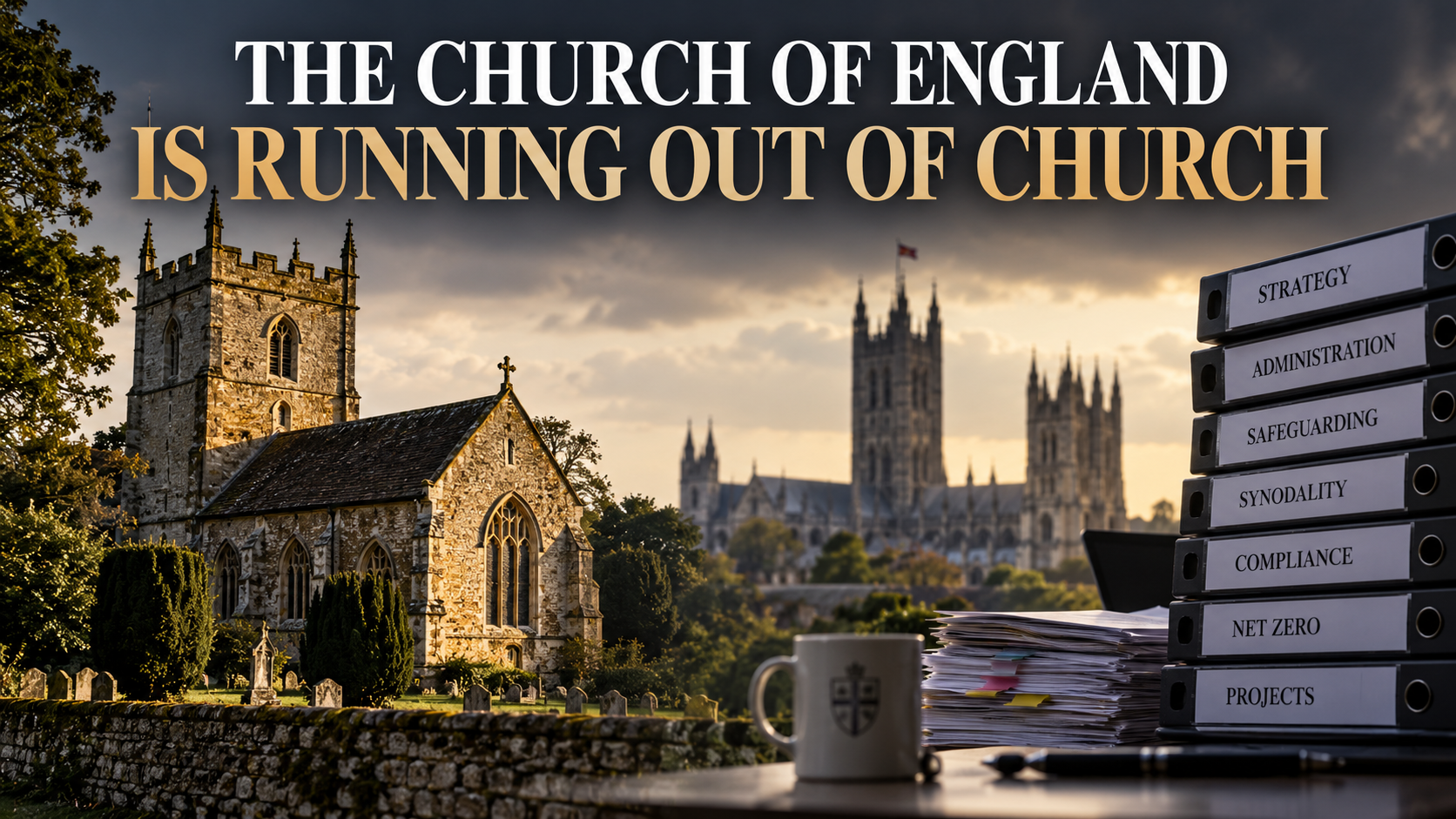
From Victorian bishops administering extensive dioceses by railway and handwritten correspondence to a modern hierarchy supported by computers, professional staff and substantial financial resources, the Church of England has acquired extraordinary administrative capacity while losing much of its pastoral constituency. A new academic report exposes the cost of this contradiction. But the Catholic hierarchy in England and Wales faces an increasingly similar predicament, while the development of Synodality raises further questions about the priorities and authority governing its future.
The Church of England has become remarkably expensive to administer for an institution with progressively fewer clergy and worshippers. Its diocesan bureaucracy has expanded, its episcopal establishment has multiplied, and its administrative ambitions have grown increasingly elaborate, while congregations have diminished and ordinary parish ministry has become more difficult to sustain. This is no longer merely the complaint of traditionalists dismayed by the direction of Anglicanism. Two established academics, drawing upon centuries of ecclesiastical history and extensive financial evidence, have documented the imbalance and concluded that the present arrangements are unsustainable. Their findings deserve attention beyond Canterbury, not least because the Catholic hierarchy in England and Wales confronts many of the same difficulties. As both institutions reorganise their pastoral provision around diminishing resources, the question is whether their administrative structures remain subordinate to the transmission of Christianity or whether maintaining those structures has progressively become an end in itself.
Canon Robin Gill, Emeritus Professor of Applied Theology at the University of Kent, and Professor John Craven, a former professor of economics, have published Wasted Money in a Diminishing Church, a substantial examination of the financial and institutional history of the Church of England. Gill advised successive Archbishops of Canterbury, while Craven served on the Archbishops’ Council between 2006 and 2013. Their report examines the development of ecclesiastical wealth, attendance and administration from before the Reformation to the present, concluding with twelve recommendations based upon localism, efficiency and transparency. Its central finding is that the established Church has entered a damaging cycle in which declining congregations generate less income, diminishing income reduces the availability of parish clergy, and the contraction of ordinary ministry further weakens the congregations upon which future support depends. Meanwhile, expenditure upon episcopal government, diocesan administration and centrally determined initiatives continues to absorb substantial resources. Over the first quarter of the twenty-first century, the report records a reduction of approximately one-third in stipendiary clergy, a fall of around forty per cent in attendance, an eighty per cent increase in diocesan employees and a twenty per cent reduction in inflation-adjusted parish-share income. Diocesan staffing increased from approximately 1,300 in 2005 to 2,300 in 2025. The statistical categories are not interchangeable, and diocesan accounting methods are not entirely consistent, but their combined significance is difficult to evade: the machinery surrounding the Church has expanded while the ministry it exists to sustain has contracted.¹
The financial details make the contradiction particularly uncomfortable. According to Gill and Craven, the Church Commissioners allocated £53 million in 2025 towards bishops’ and archbishops’ ministry, including stipends, accommodation, office expenditure and associated costs. Across approximately one hundred bishops, this represents an average approaching half a million pounds annually for each episcopal establishment. The figure does not represent personal remuneration, and confusing institutional costs with salaries would distort the argument. Nevertheless, it requires justification when measured against the resources available for ordinary parish provision. The Commissioners also made provision for £122 million in historic clergy pension liabilities, £202 million for diocesan and local Church support, and £18 million for cathedral ministry. At least 800 people are employed within the national Church institutions, in addition to diocesan staff. These sums are not all discretionary, nor are their purposes equivalent, but they illustrate the scale of expenditure sustained by an institution whose congregations and clergy have substantially diminished. The authors’ challenge concerns the ordering of priorities rather than the indiscriminate abolition of administrative functions, and it is precisely this distinction which gives their criticism its force.²
The nineteenth-century comparison is especially revealing. In 1860, the Church of England still included Wales and was united by law with the established Church of Ireland, although the Irish hierarchy must be counted separately when comparing episcopal numbers. The English and Welsh diocesan establishment, including Sodor and Man, was considerably smaller than today’s, and the modern system of suffragan bishops had not yet been revived. Bishops administered extensive territories and substantial clerical establishments through handwritten correspondence, the postal service, railway timetables and horse-drawn carriages. They had chaplains, archdeacons, rural deans, registrars and clerical assistance, but none of the technological resources which contemporary administrators regard as indispensable. The report’s account of John Bird Sumner, Bishop of Chester from 1828 until 1848, demonstrates what episcopal government could accomplish under such circumstances. His diocese then encompassed considerable territory subsequently divided among Manchester, Liverpool and Blackburn, yet during his episcopate 170 additional churches were opened over twelve years to serve rapidly expanding industrial communities. Gill and Craven estimate that the resources raised during his tenure for church-building and endowment amounted to approximately £100 million in contemporary purchasing-power terms. The nineteenth-century Church was neither uniformly prosperous nor universally successful, and the authors identify serious inequalities of provision alongside the beginnings of widespread decline. Nevertheless, Sumner’s achievement illustrates an episcopal establishment directing substantial resources towards the extension of ordinary ministry rather than merely the management of its contraction.³
The contrast with modern administration becomes still more striking when the technological advantages available today are considered. A bishop can communicate almost instantaneously with every incumbent, conduct meetings remotely, examine accounts electronically and delegate routine correspondence to systems which accomplish in minutes what once occupied several clerks for days. Yet the Church apparently requires an expanding administrative establishment to oversee a diminished pastoral constituency. Gill and Craven identify considerable economies of scale among larger dioceses: the twelve largest mainland dioceses serve approximately half the population covered by the Church of England, but account for only forty per cent of bishops and archdeacons and thirty-seven per cent of diocesan employees. The remaining twenty-eight dioceses serve the other half of the population while employing sixty-three per cent of diocesan staff. The customary defence is that contemporary ecclesiastical government must contend with safeguarding, employment legislation, charity regulation, property compliance and financial accountability. Such obligations are real, and safeguarding cannot be treated as an expendable luxury given the Church’s failures in that field. But the existence of necessary administration does not justify every additional department, advisory post or replicated procedure. Indeed, the report questions why approximately 220 people are employed in diocesan safeguarding teams when a national organisation might reasonably seek a more consistent and economical arrangement. The issue is not whether administration is necessary, but whether its multiplication has become a substitute for examining how much of it actually serves the parishes.⁴
The authors’ recommendations follow logically from this evidence. They propose reducing the forty mainland dioceses to approximately thirty by 2032, substantially cutting managerial and administrative posts, transferring greater responsibility for budgets and clergy deployment to deaneries, and requiring remaining suffragan bishops and archdeacons to undertake part-time parish ministry. They also recommend reducing national allocations to strategic investment by at least three-quarters and subjecting projects to regular independent evaluation. The experience of the Diocese of Leeds, formed by the amalgamation of three dioceses in 2014, demonstrates why structural change must entail more than rearranging boundaries. Gill and Craven record that the predecessor dioceses employed seventy-five staff in 2011, while the combined organisation employed eighty in 2017, hardly evidence of immediate administrative economies. Their proposals consequently challenge the assumption that central initiatives deserve priority merely because they carry the language of mission or renewal. The report examines strategic investment, the proposed £100 million commitment to Project Spire, the Net Zero programme and the administrative consequences of disputes concerning ministry and sexual morality. Its governing principle is that every allocation involves an opportunity cost: money committed to one purpose cannot simultaneously support another. A strategy may be socially desirable or institutionally fashionable, but its adoption does not exempt the Church from demonstrating what it achieves and what ordinary ministry must forgo to finance it.⁵
The report is careful to acknowledge that even the implementation of all its recommendations would be unlikely to reverse the long historical decline in churchgoing. Its purpose is to identify administrative decisions which may be accelerating deterioration and to establish the conditions under which genuine renewal might become possible. That limitation is important, because reducing bureaucracy cannot itself restore religious conviction. Nuntiatoria’s previous examinations of Anglicanism, particularly Not Fit for Purpose, The Endangered Vicar and The Anglicanism of Exhaustion, have repeatedly distinguished institutional efficiency from ecclesiastical purpose. The parish minister is not simply a community organiser employed by a religious corporation, but one charged with preaching Christianity, conducting worship, instructing the faithful and exercising pastoral care. His disappearance signifies more than a reduction in staffing; it represents the withdrawal of organised Christianity from ordinary neighbourhood life. Yet preserving his appointment cannot itself ensure that the religion he professes will be believed. Where an ecclesiastical institution has become uncertain about the supernatural claims which distinguish Christianity from secular humanitarian activity, more efficient administration may prolong its existence without recovering its purpose.⁶
Catholics should hesitate before drawing satisfaction from Canterbury’s predicament, because Gill and Craven’s historical analysis itself recognises the deterioration of Catholic life in England and Wales. Their account describes the development of a Catholic community which, following emancipation and the restoration of the hierarchy in 1850, established a substantial network of churches serving predominantly urban and migrant populations. Catholic practice proved comparatively resilient during periods when older Protestant denominations were already experiencing serious contraction, but that resilience subsequently weakened. The Catholic Bishops’ Conference recorded average weekly Mass attendance of 575,453 in 2024, while the Church of England reported approximately 581,000 attending on an average Sunday in the same year. The figures cover different geographical populations and employ different methods of counting, so they cannot be treated as a precise measure of relative denominational strength. Their broad similarity is nevertheless striking. In Liverpool, the Archdiocese acknowledged in June 2026 that its number of diocesan priests was projected to fall from approximately one hundred to fewer than sixty within seven years. Its Parish Development Strategy asks deaneries to consider how future ministry should be organised around this anticipated contraction. The resemblance to the Anglican proposals is unmistakable: both hierarchies are reorganising pastoral provision around diminishing resources while describing the process in terms of mission, renewal and sustainability.⁷
The Catholic predicament is theologically more demanding because the Church does not claim merely to preserve a national religious inheritance. She claims to possess the apostolic priesthood, the sacramental economy and the authority to teach revealed truth entrusted to her by Christ. Her bishops are therefore responsible for considerably more than the management of diocesan institutions. Their principal obligations concern the preservation of doctrine, the provision of the sacraments and the sanctification of souls. A shortage of priests cannot be treated simply as a staffing problem, since the priesthood is not an occupation which can be replaced by another category of ecclesiastical employee. Nor can diminishing access to the Mass and other sacraments be adequately explained as an unavoidable consequence of administrative modernisation. Nuntiatoria’s recent examinations of Glasgow and Portsmouth have insisted that parish amalgamation, the redistribution of clergy and the closure of churches may sometimes be necessary, but do not themselves constitute spiritual renewal. The hierarchy must examine the pastoral, liturgical and doctrinal decisions which have accompanied declining practice, including its treatment of communities attached to traditional Catholic worship. Where the inherited liturgy continues to sustain serious religious commitment, episcopal responsibility requires that such vitality be understood and fostered rather than regarded principally as an administrative inconvenience.⁸
The developing programme of Synodality introduces a further question, and one which makes the Anglican comparison particularly consequential. The Church is now proceeding towards diocesan evaluation assemblies in 2027, national and continental assemblies thereafter, and an Ecclesial Assembly in Rome in October 2028. The Vatican presents these stages as an evaluation of implementation already undertaken rather than another worldwide consultation, and their existence does not establish that every diocese must create an entirely new bureaucracy. Nevertheless, the arrangements require preparation, coordination, reporting and sustained institutional attention. In dioceses already experiencing reductions in priestly numbers and sacramental provision, it is entirely reasonable to ask what resources will be required, what existing responsibilities may be displaced and how the resulting arrangements will strengthen the ordinary transmission of the Faith. But the more serious question concerns the assumptions which will govern the decisions emerging from these processes. The distinction between Catholic ecclesiastical discernment and the parliamentary, campaign-driven practices familiar within Anglican synodical government is not merely procedural. It concerns the source and limits of the authority being exercised.⁹
Remarkably, this very warning appears in the Catholic Bishops’ Conference’s own National Synthesis Document of June 2022. Paragraph 17, on page eight, records the mistrust expressed by some former Anglican priests who had experienced the Church of England’s synodical parliamentary government, with its motions, votes, pressure groups and campaigns. Their recollections were sufficiently troubling to be singled out in the national report, which also recorded fears among other participants that the Catholic Church might follow a similar Anglican direction despite the differences between the two traditions. Some believed that organised interests wished to alter settled doctrine and discipline, and consequently either declined to participate or entered the process primarily to express their concerns. The significance of this testimony is difficult to exaggerate. Men who had actually experienced Anglican ecclesiastical government were warning Catholics against reproducing aspects of the system Gill and Craven now criticise for its administrative and institutional consequences. The synthesis does not adopt their fears as established conclusions, but neither can the hierarchy pretend that such concerns arise merely from ignorance of Synodality or hostility towards consultation. They were recorded within the very process whose future direction is now under consideration.¹⁰
The same synthesis offers a further reason for caution. It estimated that approximately 30,000 people had participated in the initial consultations, fewer than ten per cent of the Mass-going population used as its contemporary reference point. This does not render the exercise worthless, but it limits any suggestion that the resulting document constitutes a representative expression of Catholic belief in England and Wales. The synthesis records testimony concerning women, those identifying as LGBTQ+, young people and others who considered themselves marginalised, alongside the grievances of traditional Catholics who believed that restrictions upon the inherited liturgy and hostility towards received teaching had left their own concerns disregarded. These experiences deserve to be heard accurately. But hearing testimony and accepting the ideological interpretation attached to it are different matters. A consultation may reveal genuine suffering without establishing that the doctrine blamed for that suffering is erroneous. Equally, the sincerity of a participant’s convictions cannot establish the theological legitimacy of every proposed institutional remedy. The Church’s responsibility is to judge experience in the light of revelation, not to determine which elements of revelation should survive according to the experience of those consulted.¹¹
This distinction becomes especially important where contemporary activist methodologies are employed in ecclesiastical settings. Secular institutions increasingly organise policy around questions of identity, inclusion and lived experience, sometimes treating personal testimony not merely as evidence requiring consideration but as authority for the interpretation attached to it. Such methods may expose genuine injustice, but they become problematic when disagreement with an interpretation is itself treated as exclusion or harm. Within the Church, a woman may sincerely believe she possesses a vocation to the priesthood, yet her conviction cannot confer upon the Church an authority she does not possess. John Paul II declared in Ordinatio Sacerdotalis that the Church has no authority to confer priestly ordination upon women and that this judgement is to be definitively held by the faithful. Similarly, testimony concerning personal relationships, moral difficulties or the painful reception of particular doctrines requires pastoral charity without becoming an independent source of doctrinal authority. The principle is expressed in Dei Verbum §10, which teaches that the Magisterium is not above the Word of God but serves it by guarding and faithfully explaining what has been handed down. The supernatural sensus fidelium described in Lumen Gentium §12 likewise presupposes fidelity to apostolic teaching; it is not an aggregation of opinions obtained through consultation.¹²
The danger is therefore not that Catholics are being invited to speak, but that the methods through which their contributions are organised and interpreted may gradually influence ecclesiastical policy without sufficient theological scrutiny. Someone must select participants, frame questions, assess submissions and determine which conclusions are presented to the competent authority. These functions are unavoidable, but their significance increases when the resulting documents are described as expressing what the faithful have discerned together. A doctrine need not be formally repudiated to become progressively absent from catechesis, preaching or ordinary pastoral expectations, just as a disputed innovation may become familiar through repeated administrative decisions before its compatibility with Catholic teaching has been established. Nuntiatoria’s previous examinations of proposals to incorporate synodal structures into canon law and of Cardinal José Cobo’s account of episcopal appointments have raised precisely this concern. Extensive consultation cannot substitute for sound episcopal judgement, and formal authority may remain with the bishop while substantial practical influence moves towards committees, facilitators and professional advisers. The proper function of consultation is to assist the Church’s pastors in fulfilling their responsibilities, not to transform the source or limits of those responsibilities.¹³
Gill and Craven’s report makes this question especially urgent because it demonstrates how administrative systems can acquire priorities increasingly detached from the work they were instituted to support. The Catholic hierarchy should not assume that the multiplication of synodal processes necessarily produces the renewal their advocates anticipate, any more than the Church of England should assume that strategic investment, diocesan amalgamation or the appointment of additional professional staff will reverse declining religious practice. The comparison does not establish that Catholic Synodality is equivalent to Anglican parliamentary government, nor that activist interpretations have already become binding Catholic policy. It does establish the need for rigorous scrutiny before particular methods of governance acquire greater permanence and influence. Such scrutiny is not opposed to genuine consultation. It is required precisely because the preservation of Catholic doctrine, the exercise of episcopal authority and the provision of the sacraments are too important to be subordinated to fashionable organisational methods or the demands of competing pressure groups.
The report’s essential distinction between institutional expenditure and pastoral purpose therefore acquires a still greater significance when applied to Catholicism. A bishop may require professional advisers, financial officers and carefully designed consultative arrangements, but none of these can replace his obligation to teach, sanctify and govern. A diocese may need to amalgamate parishes, close buildings and redistribute priests, but such measures cannot themselves recover the religious life which once sustained those institutions. The Church of England’s predicament demonstrates that organisational sophistication does not guarantee ecclesiastical vitality, while the testimony of former Anglican priests recorded in the Catholic national synthesis warns against assuming that parliamentary-style consultation offers a reliable remedy for failures of ecclesiastical judgement. The distinction between Anglican and Catholic ecclesiology remains fundamental, but it makes the responsibility of Catholic bishops greater rather than less. Their task is not to preserve an institution capable of accommodating every passing theory, but to hand on faithfully what the Church has received.
The nineteenth-century Anglican bishop administered an extensive diocese through handwritten correspondence, the postal service and the railway timetable. His modern successor possesses extraordinary technological resources and professional assistance, yet governs an ecclesiastical system whose ordinary pastoral provision has substantially contracted. The lesson for Canterbury is that forty mainland dioceses could become thirty without recovering the religious purpose for which any of them exists. The warning for the Catholic hierarchy is more serious still: its institutions may remain financially viable and administratively elaborate while their doctrinal and sacramental character is progressively weakened by the assumptions governing their use. England does not need increasingly sophisticated machinery for administering the disappearance of Christianity. It needs Christianity preached, believed and practised, with bishops and priests whose first responsibility is the preservation and transmission of revealed truth. The resources of the modern world may enable them to communicate more efficiently than any previous generation, but neither technology nor consultation can compensate for uncertainty about what a bishop is for. The future of Christianity will not be secured by institutions becoming more proficient at managing decline, but by their recovering confidence in the Faith they exist to proclaim.
¹ Robin Gill and John Craven, Wasted Money in a Diminishing Church: A Report on the Church of England, Centre for Anglican History and Theology, Universities of Kent and Canterbury Christ Church, 2026, pp. 4–8, 42–46.
² Gill and Craven, Wasted Money in a Diminishing Church, pp. 43–45.
³ Gill and Craven, Wasted Money in a Diminishing Church, pp. 19–27.
⁴ Gill and Craven, Wasted Money in a Diminishing Church, pp. 43–44, 48.
⁵ Gill and Craven, Wasted Money in a Diminishing Church, pp. 41–42, 49–52, 63–66.
⁶ Nuntiatoria, “Not Fit for Purpose: Clergy, Secularisation, and the Institutional Exhaustion of the Church of England”, 24 April 2026; “The Endangered Vicar: When a Church Forgets What It Is For”, 11 September 2026; “The Anglicanism of Exhaustion”, 8 May 2026.
⁷ Gill and Craven, Wasted Money in a Diminishing Church, pp. 29–32, 45–46; Catholic Bishops’ Conference of England and Wales, “Statistics – 2024”; Church of England, “Attendance at Church of England Churches Rises for the Fourth Year in a Row”, 27 October 2025; Archdiocese of Liverpool, “Parish Development Strategy: Continuing the Journey of Renewal”, 29 June 2026.
⁸ Nuntiatoria, “Glasgow: You Cannot Restructure a Church Back to Life”, 9 October 2026; “Portsmouth’s Missing Generation”, 19 October 2026.
⁹ General Secretariat of the Synod, “Towards the Ecclesial Assembly of October 2028”, 20 May 2026; “Towards the 2027 Assemblies of the Local Churches”, 27 July 2026.
¹⁰ Catholic Bishops’ Conference of England and Wales, National Synthesis Document, 22 June 2022, p. 8, §17.
¹¹ Catholic Bishops’ Conference of England and Wales, National Synthesis Document, pp. 7, 16–22, §§13, 54–72.
¹² John Paul II, Ordinatio Sacerdotalis, 22 May 1994, §4; Second Vatican Council, Dei Verbum, §10; Lumen Gentium, §12.
¹³ Nuntiatoria, “Synodality’s Next Step: Writing the Revolution into Canon Law”, 1 October 2026; “Synodality Cannot Substitute for Good Bishops”, 19 October 2026.




Leave a Reply