
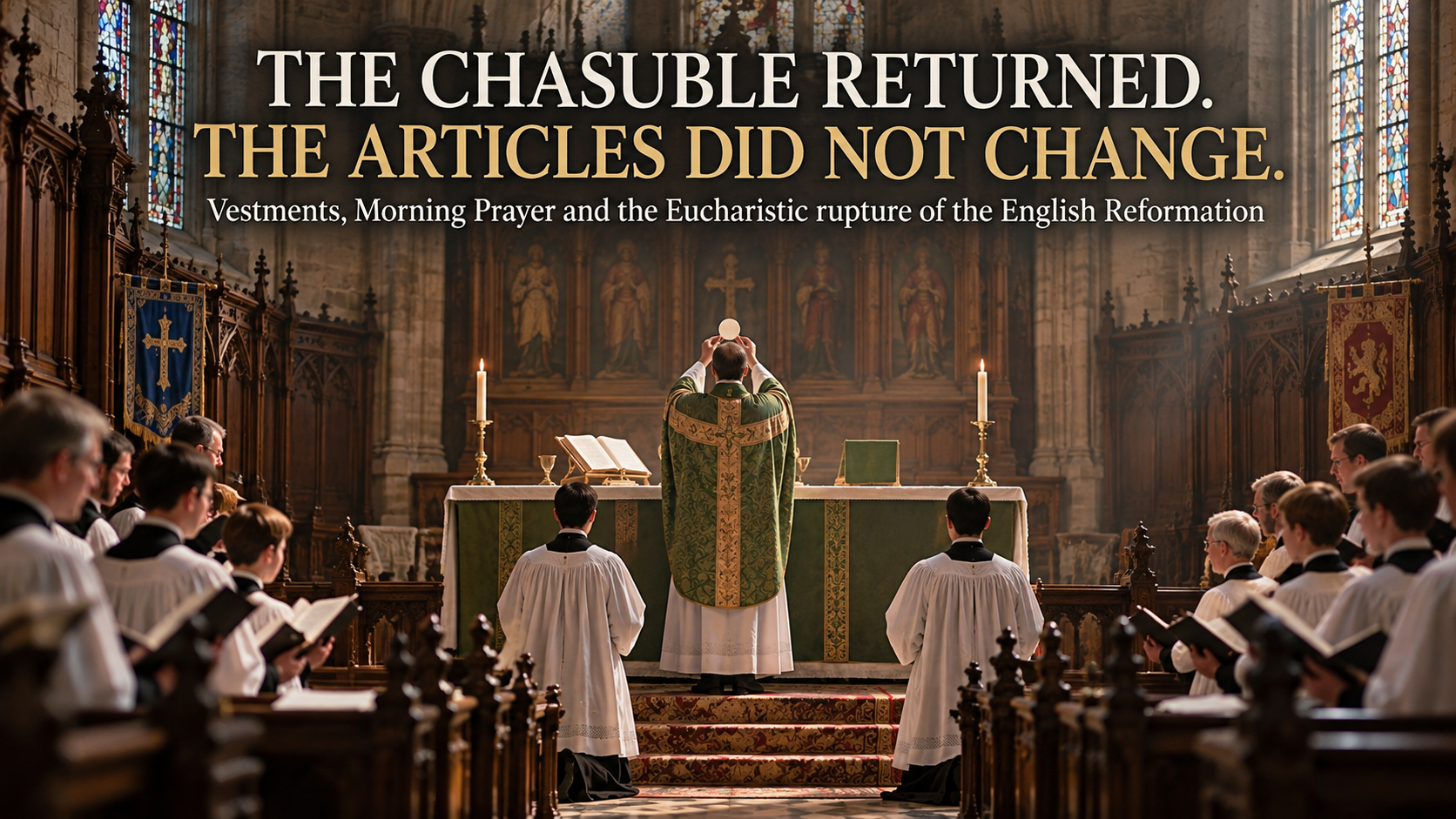
Vestments, Morning Prayer and the Eucharistic rupture of the English Reformation
The English Reformation did more than alter ecclesiastical clothing. It transformed the ordinary pattern of Sunday worship, permitting parish services to proceed without the celebration of the Eucharist, while repudiating doctrines central to the sacramental inheritance of the apostolic Churches. Four centuries later, the Church of England regularised the use of traditional Eucharistic vestments while expressly preserving its Reformation formularies. John Henry Newman’s eventual acknowledgement that the Thirty-Nine Articles condemned the Catholic doctrine of the Mass, rather than merely abuses associated with it, exposes the fundamental difficulty confronting claims to unbroken Catholic continuity.
In July 1964, the British Parliament considered legislation concerning the vestments worn by Church of England clergy. The controversy was centuries old, but one detail in the proceedings deserves particular attention. The Bishop of London informed the House of Lords that traditional Eucharistic vestments, including the alb and chasuble, were already being worn in a substantial number of Anglican churches. He estimated that approximately a quarter of parish churches used them at least occasionally. His purpose was not to propose an unprecedented revival of medieval ceremonial, but to regularise practices already widespread and remove the legal uncertainties which had troubled Anglican clergy since the nineteenth century. The resulting Vestures of Ministers Measure permitted different forms of liturgical dress while expressly maintaining that their use authorised no doctrines beyond those contained in the Church of England’s existing formularies.¹ The chasuble could be worn without any corresponding change in the official theology of the Church which had once prohibited it.
The significance of that distinction was not lost upon Parliament. In the House of Commons, supporters of the Measure insisted that its provisions represented no departure from the Church of England’s rejection of transubstantiation. Opponents questioned whether vestments historically associated with the Catholic Mass could genuinely be separated from the doctrines they had been used to express.² The disagreement was revealing. One side feared that restoring the garments might encourage the restoration of Catholic belief; the other reassured Parliament that the garments could be permitted precisely because no such doctrinal restoration was required. The Church of England’s legal settlement could accommodate a minister vested in a chasuble while continuing to maintain formularies which repudiated the Catholic understanding of the Eucharistic sacrifice.
That episode provides a particularly instructive conclusion to the history of the English vestments controversy. But it becomes more significant when considered alongside another feature of post-Reformation Anglican worship: the displacement of the Eucharistic celebration from the principal Sunday service in many parishes. For several centuries, Morning Prayer, commonly accompanied by the Litany, sermon and sometimes portions of the Communion Office, occupied a place which the parish Mass had previously held in Catholic England. The congregation gathered for Scripture, prayer, confession and preaching, but frequently without any Eucharistic consecration taking place. The distinction was not simply between more elaborate and less elaborate worship. It concerned what the Church understood to constitute its principal act of worship.
The 1662 Book of Common Prayer expressly provided that no celebration of the Lord’s Supper should take place unless a suitable number of communicants were prepared to receive with the minister. In smaller parishes, where no more than twenty persons were eligible to communicate, the rubric required at least three or four communicants in addition to the priest. On Sundays and holy days when there was no Communion, the appointed portions of the Communion Office were to be read only as far as the prayer for the Church militant, followed by the prescribed conclusion. The same Prayer Book required every parishioner to communicate at least three times annually, including Easter.³ These provisions did not command that Communion be celebrated only occasionally, nor did they prevent frequent celebrations where communicants were available. They did, however, permit the ordinary Sunday worship of a parish to proceed without the Eucharistic action itself.
Recent historical scholarship has clarified the importance of this arrangement. Catherine Haynes, writing in the 2026 Oxford Handbook of the Book of Common Prayer, traces the varying frequency of Communion from 1549 onwards and demonstrates that Thomas Cranmer’s original expectation of weekly celebration was constrained by the Prayer Book’s rubrics and by the religious habits of clergy and congregations. The subsequent predominance of non-Eucharistic Sunday worship resulted from an interaction between official provisions, theological assumptions and popular practice, rather than from a single instruction that the Eucharist should cease to be celebrated weekly.⁴ That qualification matters. The historical case is sufficiently serious without attributing every subsequent development to one reformer or confusing the intentions of the Prayer Book’s compilers with everything that occurred under their settlement.
Nevertheless, the outcome is beyond reasonable dispute. Writing in 1944, the Anglican liturgical scholar C. Kilmer Myers described Morning Prayer as having become the principal service in the average Anglican parish, apart from designated Communion Sundays. He observed that the nineteenth-century pattern of an early Eucharist followed by a more heavily attended Morning Prayer had become customary, and identified the restoration of the Sunday Eucharist to its central place as a principal objective of the Parish Communion movement.⁵ His testimony is especially valuable because it comes from within Anglican liturgical renewal. The predominance of Morning Prayer was not merely a Catholic accusation against Anglican practice; it was a condition which Anglican reformers themselves sought to remedy.
To understand why this matters, a distinction must be established which is frequently obscured in accounts of English religious history. Infrequent reception of Holy Communion is not the same thing as infrequent celebration of the Eucharist.
It is perfectly true that many lay Catholics in medieval England received Holy Communion relatively infrequently. The Fourth Lateran Council of 1215 required the faithful who had reached the age of discretion to receive at least annually at Easter, and the practice of communicating principally at major festivals remained widespread.⁶ But the infrequency of lay reception did not ordinarily mean that the Sunday Mass was omitted. The priest celebrated the Holy Sacrifice whether or not many members of the congregation approached to receive. Attendance at Mass and sacramental Communion were distinct, although intimately related, acts. The faithful could assist at Mass, unite themselves spiritually to the offering, adore Christ truly present and receive the fruits of the sacrifice without necessarily communicating sacramentally on that occasion.
This distinction reflects the Catholic understanding of what the Mass actually is. The Eucharistic sacrifice is not constituted by the number of people who receive Communion. Its objective reality is not dependent upon a congregation sufficiently numerous to justify its celebration. The priest offers the sacrifice of Christ as a minister of the Church, and the Mass is directed first towards Almighty God. The faithful should receive frequently and worthily, but their reception is not what makes the Mass a Mass.
The Council of Trent addressed this question directly in September 1562, during the very period in which the Elizabethan religious settlement was consolidating itself. In Session XXII, Chapter VI, the Council expressed its desire that the faithful should communicate sacramentally at every Mass. It nevertheless defended celebrations in which only the priest received, explaining that such Masses remained truly common acts of worship because the people participated spiritually and because the sacrifice was offered by a public minister of the Church for all the faithful. Canon VIII condemned the proposition that Masses in which the priest alone communicated were unlawful and should be abolished. The same session, in Chapter V, explicitly defended the Church’s use of ceremonies, including lights, incense and vestments, as visible expressions of the sacred mysteries.⁷
The contrast with the reformed English settlement could scarcely be clearer. Trent insisted that the Eucharistic sacrifice remained the Church’s objective act of worship even when the faithful did not receive sacramentally. The Anglican Prayer Book made the celebration of the Lord’s Supper conditional upon the participation of communicants. That provision did not, by itself, define every aspect of Anglican Eucharistic theology, and it should not be made to do so. But read alongside the revised Communion Office and the Articles of Religion, it reflects a substantial alteration in the relationship between the Eucharist, the ordained minister and the assembled congregation.
What had changed was not simply the frequency with which Christians approached the altar. In many parishes, the sacramental offering which had formerly occupied the centre of Sunday worship ceased to take place on an ordinary Sunday at all.
The vestments controversy belongs within this larger transformation. Before the Reformation, England participated in the sacramental civilisation of Western Christendom. The Sarum Use and other ancient English liturgical traditions possessed distinctive local characteristics, but remained forms of the wider Roman liturgical inheritance. Their vestments expressed the offices and functions of sacred ministry, particularly the priest’s celebration of the Mass. The chasuble was not itself a dogma, nor had its precise historical form been instituted by Christ. It had developed within a settled liturgical order in which the priest approached the altar to offer the Eucharistic sacrifice. The garment was intelligible because of the ministry and sacred action with which it was associated.
The first Edwardian Book of Common Prayer, introduced in 1549, retained the alb and either the vestment, meaning the chasuble, or the cope for Holy Communion. Yet the continued use of familiar garments did not signify that Catholic worship had survived unchanged. The Communion Office itself had already undergone extensive revision. By 1552, the reformers made their rejection of the older ceremonial more explicit, prohibiting the alb, vestment and cope and requiring priests and deacons to wear the surplice.⁸ The corresponding changes to the Communion service, altar arrangements and language of worship belonged to a broader theological reconstruction. The removal of distinctive Eucharistic vesture was not the cause of that reconstruction, but one of its most visible expressions.
Queen Mary’s accession in 1553 interrupted the Edwardian programme and restored the Catholic Mass, traditional ecclesiastical rites and communion with Rome. Elizabeth’s accession reversed that restoration, although the religious settlement of 1559 retained a reference to the ornaments authorised during Edward VI’s second regnal year. This Ornaments Rubric created an enduring difficulty because it appeared to preserve earlier ceremonial within a liturgical and doctrinal settlement substantially derived from the Protestant Prayer Book of 1552. The precise relationship between the rubric, royal injunctions, episcopal regulations and customary practice became a controversy which would continue into the nineteenth century.
The Puritans understood the implications of these surviving garments. Archbishop Matthew Parker’s attempts to enforce conformity culminated in the Vestiarian Controversy of 1564–1566. In March 1566, thirty-seven London ministers were suspended for refusing prescribed clerical dress. Edmund Grindal, Bishop of London, reported the resulting protests to William Cecil, including the remarkable intervention of parishioners who objected to the suspension of their ministers.⁹ These disputes concerned more than ecclesiastical fashion. For many Puritans, the retained vestments perpetuated associations with a religious system whose doctrines and authority the Reformation was intended to overthrow. Parker, by contrast, treated conformity in such matters as a legitimate exercise of ecclesiastical discipline within the Elizabethan establishment.
The disagreement itself demonstrates the nature of the rupture. The reformers did not regard inherited Catholic ceremonial as religiously neutral. Nor did their opponents within the Protestant settlement necessarily wish to restore the Catholic doctrines historically associated with it. They were disputing how much of the older ecclesiastical culture could survive within a Church whose doctrinal and jurisdictional foundations had been transformed.
The wider Christian world makes the significance of that transformation still more apparent. Liturgical vestments were not a peculiarity of medieval England, nor were they simply an invention of Roman ecclesiastical administration. Across the Christian East, the Byzantine, Armenian, Syriac, Coptic and other ancient apostolic traditions developed distinctive garments for bishops, priests and deacons, particularly for the celebration of the Eucharist. Their forms and historical development differed, but their symbolism belonged to a recognisable understanding of sacred ministry. The Byzantine sticharion, epitrachelion and phelonion, for example, express the dignity and responsibilities of the priestly office, while the prayers accompanying their use invoke divine grace and spiritual preparation for the holy mysteries.¹⁰
It would be historically indefensible to claim that the Apostles themselves wore medieval chasubles or that every ancient Church developed identical vestments. Neither proposition is necessary. The more significant point is that independently developing apostolic traditions came to distinguish their Eucharistic ministers through sacred vesture within a common sacramental understanding. East and West confessed the true Body and Blood of Christ and celebrated the Eucharist as an offering inseparable from His one redeeming sacrifice. Their theological explanations were not identical, but the Orthodox understanding of the Divine Liturgy as a holy oblation cannot reasonably be equated with a merely commemorative understanding of the Lord’s Supper.¹¹
It was therefore not simply a peculiarly Roman ceremonial inheritance which the English reformers were challenging. Their alterations concerned doctrines and practices belonging, in differing forms, to the wider sacramental inheritance of the historic apostolic Churches.
The Thirty-Nine Articles provide the clearest evidence of the resulting doctrinal departure. Article XXVIII explicitly rejects transubstantiation and describes the reception of Christ’s Body in heavenly and spiritual terms, with faith as the means of participation. It also repudiates reservation, elevation and adoration as ordinances of Christ. Article XXXI condemns the sacrifices of Masses, in which Christ was said to be offered for the living and the dead for the remission of pain or guilt.¹² These statements were not incidental opinions advanced by a minority of Anglican clergy. They belonged to the established Church’s official doctrinal formularies.
The distinction must nevertheless be made carefully. The Articles do not describe the Eucharist as an empty memorial devoid of sacramental significance. Nor have Anglican theologians subsequently maintained a uniform understanding of Eucharistic presence and sacrifice. Some have defended doctrines considerably closer to Catholic teaching than those associated with the Edwardian reformers. It was precisely this possibility which John Henry Newman attempted to explore in 1841, when he published Tract 90, seeking to demonstrate that the Thirty-Nine Articles could receive an interpretation consistent with Catholic antiquity.
Newman’s treatment of Article XXXI was particularly ingenious. He proposed that the Article’s condemnation of the sacrifices of Masses referred to corrupt practices and mistaken popular beliefs, rather than the authentic Catholic doctrine of the Eucharistic sacrifice. He distinguished between the Mass itself and particular abuses associated with Masses, arguing that the language of the Article need not be interpreted as repudiating the dogmatic teaching of Rome. The distinction was central to the Tractarian effort to recover Catholic sacramental theology while remaining within the doctrinal obligations of the Church of England.¹³
Yet the subsequent history of Newman’s own judgment is decisive. Having entered the Catholic Church in 1845, he eventually reconsidered this interpretation and found it untenable. In a note dated 14 June 1883, subsequently included with Tract 90, Newman expressly withdrew his defence of that section of his argument. He distinguished it from other portions of the Tract which he continued to consider defensible, acknowledging that the interpretation of Article XXXI had been mistaken. His conclusion was unequivocal: the Article’s condemnation extended beyond alleged abuses to the Catholic Eucharistic doctrine itself. He specifically rejected the attempted distinction between the Mass and the sacrifices of Masses, arguing that the wording of the Article could not be separated from the doctrine solemnly affirmed by Trent.¹⁴
This is an admission of exceptional historical importance. Newman was not a superficial controversialist seeking to discredit Anglicanism through caricature. He had been the most influential advocate of interpreting its formularies in a Catholic sense. Yet his mature judgment recognised that the particular interpretation upon which his defence of the Mass had depended could not be sustained. The Article did not merely condemn corruptions which Catholics themselves might readily repudiate. Its language reached the doctrinal substance of the sacrifice of the Mass as understood and defined by the Catholic Church.
Newman’s reassessment cannot, of course, be treated as though it constituted a new juridical interpretation imposed upon the Church of England. It was his own considered theological and historical conclusion, written after decades of reflection. But its authority as evidence is considerable precisely because it came from the author of the earlier argument. He understood both the attraction of the Tractarian interpretation and the reasons for its eventual failure. The man who had sought to reconcile the Articles with Catholic Eucharistic doctrine finally acknowledged that Article XXXI repudiated what the Council of Trent affirmed. His mature conclusion therefore supplies a powerful answer to the contention that the apparent doctrinal rupture of the English Reformation can be explained away through a sufficiently sympathetic interpretation of its formularies.
The earlier Nuntiatoria examination of Anglican Orders bears directly upon this question. Anglican Orders I: The Rite, the Rupture and Apostolicae Curae traced the replacement of the received Catholic rites of ordination by the Edwardine Ordinal and the distinctions drawn during the Marian restoration between those ordained according to the customary Catholic rites and those whose purported Orders derived from the reformed forms.¹⁵ The importance of that history lies in the difference between continuity of ecclesiastical office and continuity of sacramental ministry. A bishop could occupy a historic see, possess the customary title and exercise the functions of episcopal government without those circumstances alone establishing the sacramental validity of his consecration.
The companion study, Anglican Orders II: Saepius Officio — Anglicanism’s Strongest Reply to Apostolicae Curae, examined the substantial defence issued by the Archbishops of Canterbury and York in 1897.¹⁶ Their case deserves more attention than is frequently accorded to it in Catholic polemic. Nevertheless, its central difficulty remained the historical and theological character of the Edwardine Ordinal itself. Leo XIII’s judgment in Apostolicae Curae concerned the objective sacramental significance of the rite, its form and intention, rather than the personal sincerity of individual ministers or the outward appearance of their worship.¹⁷ Later developments in Anglican ceremonial and Eucharistic devotion could not, according to that judgment, retroactively confer the sacramental Orders which the reformed rite had failed to communicate.
This is why the nineteenth-century Oxford Movement and its ritualist successors encountered difficulties more profound than opposition to beautiful worship. Their recovery of patristic scholarship, Eucharistic devotion, ancient ceremonial and elements of medieval English religious life represented a serious attempt to reclaim the Catholic inheritance. Much of their learning deserves recognition, and the sincerity of their religious aspirations should not be questioned without cause. But they sought to recover Catholic practices within an institution whose Reformation formularies remained authoritative. Victorian ecclesiastical litigation exposed the resulting tension. In Clifton v. Ridsdale, decided in 1877, the Judicial Committee of the Privy Council upheld the prohibition of Eucharistic vestments while allowing the eastward position of the celebrant under specified conditions. The subsequent Royal Commission on Ecclesiastical Discipline examined the difficulties arising from these conflicting interpretations of Anglican liturgical law.¹⁸
The crucial question was not whether a chasuble, altar candles or incense could make Anglican worship resemble the Roman Mass. Clearly they could. It was whether such ceremonial could establish that the ecclesiastical body employing it had preserved the doctrines of the Catholic Eucharistic sacrifice and the sacramental priesthood. These questions are not interchangeable.
The legislation of 1964 supplies an unusually revealing answer. By then traditional vestments had already returned to many Anglican churches. Parliament was informed that their use was estimated to extend to approximately a quarter of parish churches, while the stole was employed far more widely. The Measure regularised these existing practices rather than inaugurating their revival. Yet the institutional position was explicit: varieties of vesture were permissible without altering the Church of England’s doctrinal commitments. The parliamentary debate therefore recorded two competing perceptions of the same garments. Traditionalists within Anglicanism might regard them as expressions of Catholic sacramental theology; the ecclesiastical authorities could permit them without requiring that theology to be professed.
In that distinction lies the historical irony. The sixteenth-century reformers removed Eucharistic vestments because of their association with a sacramental order they intended to alter. The nineteenth-century ritualists recovered them because they wished to express elements of the Catholic inheritance which the Reformation had obscured. The twentieth-century settlement permitted their use precisely without requiring any fundamental reversal of the Reformation’s doctrinal decisions.
The garments had returned. The Articles had not changed.
The same process can be observed in other aspects of the English Reformation. As Nuntiatoria argued in The Bible Tyndale Did Not Liberate, the alteration of religious vocabulary was part of a wider theological reconstruction. The preference for “elder” rather than “priest”, and “congregation” rather than “church”, could be defended through particular linguistic arguments, but their cumulative effect disclosed a changed conception of ecclesiastical authority and ministry.¹⁹ The significance of the vestments controversy is analogous. The replacement of the chasuble by the surplice was not an isolated cause of theological change. It formed part of an interconnected reform of language, worship, ecclesiastical discipline and sacramental understanding.
The same relationship between ceremonial and doctrine remains relevant to contemporary Catholic discussions, although historical distinctions must be preserved. In The Reform Before the Reform, this journal examined how successive post-conciliar liturgical changes reshaped the practical formation of clergy and the expectations of the faithful.²⁰ The reforms introduced within the Roman Catholic Church after the Second Vatican Council cannot simply be equated with the Protestant Reformation, nor does the modification of Catholic ceremonial automatically entail sacramental invalidity or doctrinal repudiation. Nevertheless, the underlying principle remains applicable: liturgical forms are not meaningless accessories. They communicate, reinforce and help form religious understanding. Their alteration may have consequences extending beyond the immediate rubrical change.
Indeed, the principle lex orandi, lex credendi is indispensable to understanding both the original controversy and its later developments. The Church’s worship expresses her faith, while the faith received from the Apostles establishes the meaning of her worship. Vestments possess significance within that relationship. They are not substitutes for doctrine, but visible expressions of a sacred ministry whose nature is defined by doctrine. Once detached from the sacramental order in which they developed, they may retain beauty, antiquity and devotional associations without establishing the continuity of the faith they originally expressed.
There is also a necessary distinction between the preservation of elements of Christian doctrine and the preservation of the Catholic faith in its integrity. The English Reformation did not abolish every belief inherited from Christian antiquity. The Church of England retained baptism, the Scriptures, the ancient creeds and the confession of the Holy Trinity and Incarnation. Its Prayer Book contained substantial devotional and biblical material, and generations of Anglicans practised their religion with seriousness and sincerity. These facts should be acknowledged without reservation. But the preservation of some doctrines cannot establish the preservation of the entire Catholic faith where other essential doctrines concerning sacramental priesthood, Eucharistic sacrifice and ecclesiastical authority had been rejected or substantially reinterpreted.
Nor can the recovery of a more frequent Eucharistic celebration resolve those doctrinal questions by itself. The nineteenth-century Oxford Movement, the subsequent Parish Communion movement and twentieth-century liturgical reforms progressively restored the Eucharist to a more prominent position in Anglican Sunday worship. That development was important, and in many churches it corrected the long-standing predominance of Morning Prayer. But the frequency of a religious ceremony does not settle the sacramental character of the ministry through which it is performed. A weekly celebration may be conducted with dignity, reverence and sincere belief in the Real Presence, yet the Catholic question concerning Orders, ecclesiastical authority and Eucharistic doctrine remains.
The implications extend beyond Anglican ecclesiastical history. In England Must Be Converted — Not Merely Re-Enchanted, Nuntiatoria argued that the rediscovery of Christian buildings, music, ceremonies and historical memory cannot be treated as equivalent to the recovery of Christian faith.²¹ Such things possess genuine value. Sacred beauty may awaken devotion and draw souls towards religious truth. But the Catholic faith is not an aesthetic atmosphere capable of being reconstructed through the arrangement of familiar objects. It is a supernatural revelation entrusted to the Church, transmitted through apostolic authority, professed in doctrine and communicated through the sacraments.
This also recalls the argument developed in The Gilded Gesture: Ceremony Without Conversion in the Quest for Communion. Ecclesiastical magnificence may create an appearance of religious agreement which does not correspond to the underlying theological realities.²² A procession, an ancient chant or a splendidly vested celebrant can evoke the common Christian inheritance. Such ceremonies cannot, however, establish sacramental communion or resolve doctrinal disagreements merely by presenting a compelling image of continuity.
The history of English Morning Prayer makes this distinction particularly difficult to evade. The medieval parish church was ordered around the celebration of Mass, even when relatively few parishioners communicated sacramentally. The post-Reformation parish could conduct its principal Sunday worship without the Eucharist being celebrated at all. The distinction was not merely disciplinary, because it belonged to a broader settlement which had revised the Communion Office, the Ordinal and the Church’s doctrinal formularies. The Reformation did not simply preserve the same religious system with fewer ceremonies. It established a different theological framework within which inherited forms were retained, abandoned or subsequently reinterpreted.
The Catholic criticism of Anglican claims to continuity therefore need not depend upon denying the sincerity of Anglican believers, disparaging the beauty of their worship or suggesting that nothing of the ancient Christian inheritance survived the Reformation. Its central contention is more substantial: continuity in buildings, titles, ceremonial and selected doctrines does not establish continuity in the full sacramental faith and apostolic ministry of the Catholic Church.
The ancient Churches of East and West bear witness to an inheritance in which the Eucharistic sacrifice occupies the centre of Christian worship and sacred vesture expresses the ministry entrusted with celebrating the holy mysteries. The English reformers did not merely alter the appearance of that inheritance. They disputed and reconstructed essential elements of its sacramental meaning. Their successors could subsequently recover its outward expressions without thereby undoing the theological decisions through which the rupture had occurred.
A chasuble does not confer priesthood. A cope does not establish episcopal succession. Incense does not constitute a Eucharistic sacrifice. Morning Prayer, however devoutly recited, does not become the Mass. And the restoration of ancient ceremonial cannot, of itself, restore the doctrines and sacramental authority which gave that ceremonial its original significance.
The most revealing evidence comes from the Church of England’s own history. For centuries, many of its congregations assembled on Sundays without the celebration of the Eucharist. When traditional Eucharistic vestments eventually received clear statutory permission, their use was expressly separated from any obligation to accept doctrines beyond the existing Anglican formularies. Between those developments stands Newman’s remarkable admission that the Articles themselves could not be reconciled, as he had once attempted, with the Catholic doctrine of the Mass.
The English Reformation did not merely change what the clergy wore. It changed the theology governing what they did at the altar — and helped establish a pattern in which, on many Sundays, no Eucharistic celebration took place there at all.
England does not need merely to dress once more as Catholic England dressed. Nor will the recovery of ceremonial splendour, however beautiful, suffice to restore the sacramental inheritance of the Church which formed its saints and martyrs.
The vestments may have returned, and the Sunday Eucharist may once again occupy a prominent place in Anglican worship. But Catholic continuity cannot be established by restoring the forms of a faith while retaining the formularies which repudiated essential elements of its sacramental doctrine.
- UK Parliament, Vestures of Ministers Measure, House of Lords Hansard, 13 July 1964.
- UK Parliament, Vestures of Ministers Measure, House of Commons Hansard, 30 July 1964.
- Church of England, The Lord’s Supper or Holy Communion, Book of Common Prayer, 1662, concluding rubrics.
- Catherine Haynes, From Week to Week? The Book of Common Prayer and Frequency of Communion from 1549 to Today, The Oxford Handbook of the Book of Common Prayer, 2026, pp. 425–438.
- C. Kilmer Myers, The Liturgical Movement, 1944.
- Fourth Lateran Council, Canon 21: Omnis utriusque sexus, 1215.
- Council of Trent, Session XXII: Doctrine and Canons on the Sacrifice of the Mass, Chapters V–VI and Canon VIII, 17 September 1562.
- R. A. S. Macalister, Ecclesiastical Vestments: Their Development and History, 1896.
- The National Archives, Vestments Dispute: Edmund Grindal to William Cecil, SP12/39/66, 4 May 1566.
- Orthodox Church in America, Vestments.
- Orthodox Church in America, The Divine Liturgy: Eucharistic Canon — Anaphora.
- Church of England, The Thirty-Nine Articles of Religion, Articles XXVIII and XXXI.
- John Henry Newman, Tract 90: Remarks on Certain Passages in the Thirty-Nine Articles, §9, 1841.
- John Henry Newman, Tract 90, Note 2 on Section 9, 14 June 1883, Via Media, vol. II, pp. 351–353.
- Nuntiatoria, Anglican Orders I: The Rite, the Rupture and Apostolicae Curae, 11 September 2026.
- Nuntiatoria, Anglican Orders II: Saepius Officio — Anglicanism’s Strongest Reply to Apostolicae Curae, 13 September 2026.
- Pope Leo XIII, Apostolicae Curae, 13 September 1896.
- Royal Commission on Ecclesiastical Discipline, Report on Ecclesiastical Discipline, 1906.
- Nuntiatoria, The Bible Tyndale Did Not Liberate, 4 September 2026.
- Nuntiatoria, The Reform Before the Reform, 9 October 2026.
- Nuntiatoria, England Must Be Converted — Not Merely Re-Enchanted, 14 August 2026.
- Nuntiatoria, The Gilded Gesture: Ceremony Without Conversion in the Quest for Communion, 4 November 2025.



Leave a Reply