

When ‘Grave’ Costs Nothing
Maura Healey has signed away Massachusetts’s remaining statutory restraints on abortion after twenty-four weeks. Her bishops call the measure “gravely immoral”; her archbishop calls its enactment a “grave offense”; the president of the US bishops calls it a “scandal”. Yet the Catholic governor who signed it has, so far as the public can see, suffered no ecclesiastical consequence at all.

There is something almost surreal about the photographs from Boston. Governor Maura Healey sits at her desk, pen in hand, surrounded by smiling politicians and abortion activists. The document before her bears the soothing bureaucratic title An Act Prioritizing Patient Access to Care. Applause follows the signature. Another legislative victory has been won. Another “protection” has been secured.
What has actually happened is rather less antiseptic. On 10 August 2026, Healey signed Chapter 188 of the Acts of Massachusetts. The previous law provided that, once a pregnancy had reached twenty-four weeks, abortion could be performed only by a physician and only for specified reasons: to preserve the mother’s life or physical or mental health, or because of a lethal or grave fetal diagnosis. Healey’s law strikes those conditions out. In their place are fifteen extraordinary words: “an abortion may be performed by a physician based upon the professional judgment of the physician.”¹ The legislation also prevents a medical-review process from overriding that judgment and removes the requirement that these abortions be performed in an obstetrically equipped hospital. It takes effect on 8 November.
There is therefore no longer an upper gestational limit written into Massachusetts abortion law. Twenty-four weeks remains the point at which the statutory provision changes, but beyond it the legislature has prescribed no further week at which abortion must cease. The child may be viable. He may be thirty weeks old. Thirty-five. Thirty-eight. He may be capable of living independently of his mother with ordinary neonatal care. The statute sets no upper boundary. The decision has been transferred to the professional judgment of the physician.¹
Accuracy matters here, not least because the reality is sufficiently appalling without embellishment. Massachusetts has not enacted a law permitting doctors to kill a baby after a live birth. The existing provision requiring appropriate steps to preserve the life and health of a child born alive following an abortion remains on the statute book.² That distinction is legally important. Morally, however, it reveals the obscenity at the heart of the arrangement. A viable child may be intentionally killed as the object of an abortion before birth; if the child instead emerges alive, the law recognises an obligation to preserve his life. Nothing has changed in the child’s humanity. Nothing has changed in his genetic identity, his capacity to feel, his dependence upon others or his membership of the human family. What has changed is his location.
Bishop Robert Barron therefore had ample reason to describe what Massachusetts has embraced as something that “can only be called infanticide”.³ He was not offering a technical definition from the Massachusetts criminal code. He was making a moral judgment about the deliberate destruction of a fully formed and potentially viable infant immediately before birth. The distinction between such a child and the newborn whom the law commands the doctor to preserve may be legally intelligible. It is morally grotesque.
And Maura Healey is not merely the governor who happened to be holding the pen. She is Catholic. She is a longstanding public advocate of legal abortion. At the signing ceremony she pledged that, whatever might be done by Washington, Congress or the Supreme Court, Massachusetts would continue ensuring access to abortion.³ She knew the position of her Church because the bishops of Massachusetts had told her, publicly and unmistakably, before she signed the bill.
Their words could hardly have been stronger. Archbishop Richard Henning of Boston, Bishop Robert McManus of Worcester, Bishop Edgar da Cunha of Fall River and Bishop William Byrne of Springfield described the “elimination of any legal restraint on late-term abortion” as “a radical measure which is gravely immoral”.⁴ They did not identify this as an area in which Catholics might legitimately differ over the application of prudential principles. They invoked the God-given dignity of human life from conception until natural death. Healey signed the measure anyway.
The following day Archbishop Henning spoke again. “The passage and signing of a bill radically expanding abortion in the Commonwealth of Massachusetts,” he said, “is a grave offense against the sanctity and dignity of every person.”⁵ Archbishop Paul Coakley, president of the United States Conference of Catholic Bishops, subsequently called what Massachusetts had done “shocking” and “horrendous”, and spoke explicitly of the scandal involved. The question of disciplinary action against Healey, he correctly observed, belongs not to the episcopal conference but to the competent local ecclesiastical authority.⁶
So we have the vocabulary.
Gravely immoral. Grave offense. Scandal.
What we do not yet have is a publicly visible consequence.
As of 15 August, no excommunication of Governor Healey has been publicly declared. No interdict has been announced. There has been no public direction that she is not to receive Holy Communion. No application of Canon 915 has been announced. There may, of course, have been private communications between the governor and her pastors; none of us is entitled to invent what has occurred in the internal forum or behind episcopal doors. Nor should canonical discipline be reduced to instant punishment by press release. But the absence of an announced public consequence is precisely what has prompted Catholic organisations and commentators to ask what the bishops intend to do.⁷
There has been much talk of excommunication. Some have argued that Healey incurred it automatically by signing the legislation. That proposition ought not simply to be asserted as though the canon were self-applying. Canon 1397 §2 attaches latae sententiae excommunication to one who actually procures a completed abortion; Canon 1329 can in certain circumstances extend a penalty to accomplices without whose assistance the offence would not have been committed.⁸ Whether signing a general law authorising future abortions constitutes the necessary canonical participation in a particular completed abortion is a serious juridical question. It is not necessary to resolve it in order to recognise the much larger problem before us.
For the Church is not faced with a choice between excommunication and doing nothing.
Canon 915 says something very simple: those “obstinately persevering in manifest grave sin are not to be admitted to holy communion”.⁹ The canon does not say that they should privately be advised that their conduct is regrettable. It does not say that bishops should issue a statement affirming Catholic teaching while leaving sacramental practice untouched. It says non admittantur: they are not to be admitted.
That provision exists for a reason. Holy Communion is not merely a private devotional act between the communicant and God. It is the sacramental sign of communion with Christ and His Church, including communion in the faith and moral life she professes. Saint John Paul II explicitly connected Canon 915 with situations in which there is a manifest lack of proper moral disposition.¹⁰ A public contradiction between Catholic profession and objectively grave conduct therefore creates something more than a problem for the politician’s private conscience. It creates scandal for the Church.
The moral teaching itself admits of no serious doubt. In Evangelium Vitae, John Paul II taught that laws authorising abortion are radically contrary to the right to life and the common good. When confronted with an intrinsically unjust law permitting abortion, he wrote, Catholics have a “grave and clear obligation” to oppose it. It is never licit to campaign in favour of such a law or vote for it.¹¹ The Congregation for the Doctrine of the Faith made the same point when addressing Catholic participation in political life: political freedom does not mean freedom from the moral law, and the protection of human life is not one preference among several equally Catholic political options.¹²
Healey went further than casting one vote in a legislature. A bill designed specifically to make the abortion regime more permissive reached her desk. She possessed the executive power either to approve it or to withhold her signature. She chose approval. She did so publicly. She defended the result publicly. And she did so after the bishops of her state had already described the substance of the measure as gravely immoral.
One may therefore leave Canon 1397 to the canonists and still be confronted by Canon 915 in enormous letters.
This is where the scandal moves beyond Healey.
If the bishops tell the faithful that an action is gravely immoral, then the word grave must mean something. If the archbishop tells them that signing the law is itself a “grave offense”, then offense must mean something. If the president of the national episcopal conference calls the resulting situation a scandal, then the Church cannot behave indefinitely as though the only remedy for scandal were another press statement.
A Catholic governor has publicly rejected the Church’s moral teaching in the exercise of public office and has used the coercive authority of the state to give legal effect to that rejection. Yet if she may then present herself publicly at the altar and receive the Blessed Sacrament without any visible intervention from ecclesiastical authority, what precisely has the ordinary Catholic been taught?
Not what the bishops intended to teach. What he has actually been taught.
He has been taught that abortion is “gravely immoral”, but apparently not so grave that publicly facilitating it necessarily alters one’s sacramental treatment. He has been taught that signing this legislation is a “grave offense”, but an offense apparently compatible with remaining, for all outward purposes, a Catholic in good standing. He has been taught that the Church possesses a canon explicitly concerning those obstinately persevering in manifest grave sin, but that its words become strangely difficult to pronounce when the person concerned occupies high political office.
This is how doctrine can be emptied of practical meaning without changing a word of doctrine.
A Church may publish impeccable statements on the sanctity of life. She may condemn abortion in episcopal letters, preach against it on designated Sundays, maintain pro-life offices, organise vigils and quote Evangelium Vitae. Every sentence can remain orthodox. Yet if prominent Catholics may repudiate that teaching publicly, repeatedly and consequentially while their ecclesiastical status appears untouched, another doctrine is being communicated by practice: that these things are, ultimately, negotiable.
Lex vivendi, lex credendi. What is tolerated teaches.
Nor is public discipline incompatible with pastoral charity. The entire point of ecclesiastical discipline is pastoral. A censure is traditionally medicinal because the Church desires repentance, not destruction. A prohibition upon receiving Communion is not a declaration that a sinner is beyond mercy; it is precisely the opposite. It insists that sin is real, repentance is necessary, sacramental communion means something and reconciliation remains possible. To permit an objective contradiction to continue indefinitely because confronting it might appear “unpastoral” is to replace Catholic mercy with indifference.
There is an additional difficulty which bishops should not underestimate. Catholics have recently been given abundant evidence that ecclesiastical authority retains both the appetite and the machinery for discipline. When the SSPX proceeded with episcopal consecrations without pontifical mandate on 1 July, the Dicastery for the Doctrine of the Faith responded within a day with a decree declaring excommunications, naming those affected and spelling out the canonical consequences.¹³
The cases are not canonically identical and should not be pretended to be. Illicit episcopal consecration has a specific canonical penalty; signing an abortion statute raises different provisions and different juridical questions. But precisely because they are different, the contrast is illuminating. When ecclesiastical jurisdiction is violated, the institutional reflex is swift, juridical and unmistakable. When a Catholic politician deliberately facilitates legislation which her bishops themselves describe as gravely immoral and a grave offence against human dignity, the reflex is a statement.
Canon law suddenly becomes complicated when the unborn child is the injured party.
That is not an argument for reckless excommunications. It is an argument against the increasingly incredible pretence that the only alternatives available to a bishop are automatic excommunication or silence. They are not. There are pastoral admonitions. There are canonical warnings. There is Eucharistic discipline. There is the public clarification of a public situation. Above all, there is the bishop’s responsibility to prevent scandal and to make clear that communion with the Church cannot be reduced to an identity claimed independently of the faith and morals of the Church herself.
Private correction may properly come first. But a public scandal eventually requires public repair. If Healey repents privately of what she has done, that repentance cannot remain wholly private while the law bearing her signature remains her publicly celebrated achievement. If she persists publicly, episcopal silence likewise acquires a public meaning.
This is what makes Massachusetts such an important test.
The state has been brutally clear about what it believes. It no longer places a statutory upper gestational boundary upon abortion. Its governor is equally clear. She has signed that policy, celebrated it and promised to defend abortion access against attempts to restrict it.
The Catholic Church has also been clear, verbally. The law is gravely immoral. Its signing is a grave offense. The situation is scandalous.
Only one question remains.
What consequence follows from any of those words?
For if a Catholic politician may knowingly place her signature beneath legislation authorising the destruction of viable unborn children, do so in open defiance of the teaching of her bishops, celebrate the achievement before the cameras, and continue to incur no publicly visible ecclesiastical consequence, then it is not Maura Healey alone who has made a statement about Catholicism.
The Church will have made one too.
And hers will be the more dangerous statement: that one may call an evil grave while ensuring that, in practice, being responsible for it costs nothing.
¹ Massachusetts General Court, Acts of 2026, Chapter 188: An Act Prioritizing Patient Access to Care, approved 10 August 2026, §§1–3.
² Massachusetts General Laws, ch. 112, §12O; Acts of 2020, Chapter 263, provisions governing preservation of the life and health of a live birth following abortion.
³ The Catholic Herald, “Catholic group asks Massachusetts bishops to excommunicate Governor Healey,” 14 August 2026.
⁴ Massachusetts Catholic bishops, joint statement of 29 July 2026; reported by OSV News, 11 August 2026.
⁵ Archbishop Richard G. Henning, statement of 11 August 2026; The Boston Pilot, 14 August 2026.
⁶ Archbishop Paul S. Coakley, remarks concerning the Massachusetts legislation and ecclesiastical discipline; EWTN News, 15 August 2026.
⁷ CatholicVote request to the Massachusetts bishops concerning Governor Healey and subsequent public discussion of Canon 915, 13–15 August 2026.
⁸ Codex Iuris Canonici, canons 1397 §2 and 1329.
⁹ Codex Iuris Canonici, canon 915.
¹⁰ St John Paul II, Ecclesia de Eucharistia, 17 April 2003, §37.
¹¹ St John Paul II, Evangelium Vitae, 25 March 1995, §§72–74, especially §73.
¹² Congregation for the Doctrine of the Faith, Doctrinal Note on Some Questions Regarding the Participation of Catholics in Political Life, 24 November 2002.
¹³ Dicastery for the Doctrine of the Faith, decree of 2 July 2026 concerning the SSPX episcopal consecrations of 1 July 2026.
RELATED ARTICLES


LATEST ARTICLES
- Veritas non mutatur consensu ~ Truth is not altered by agreement: Spiritual Conference for Nuntiatoria CXXVThe text explores the theme of enduring truth amidst changing societal values, particularly within the Catholic faith. It emphasises that truth remains unchanged irrespective of popular opinion or individual feelings, urging believers to receive and embody divine teachings faithfully. The article concludes with a call to act upon this truth in daily life and relationships.
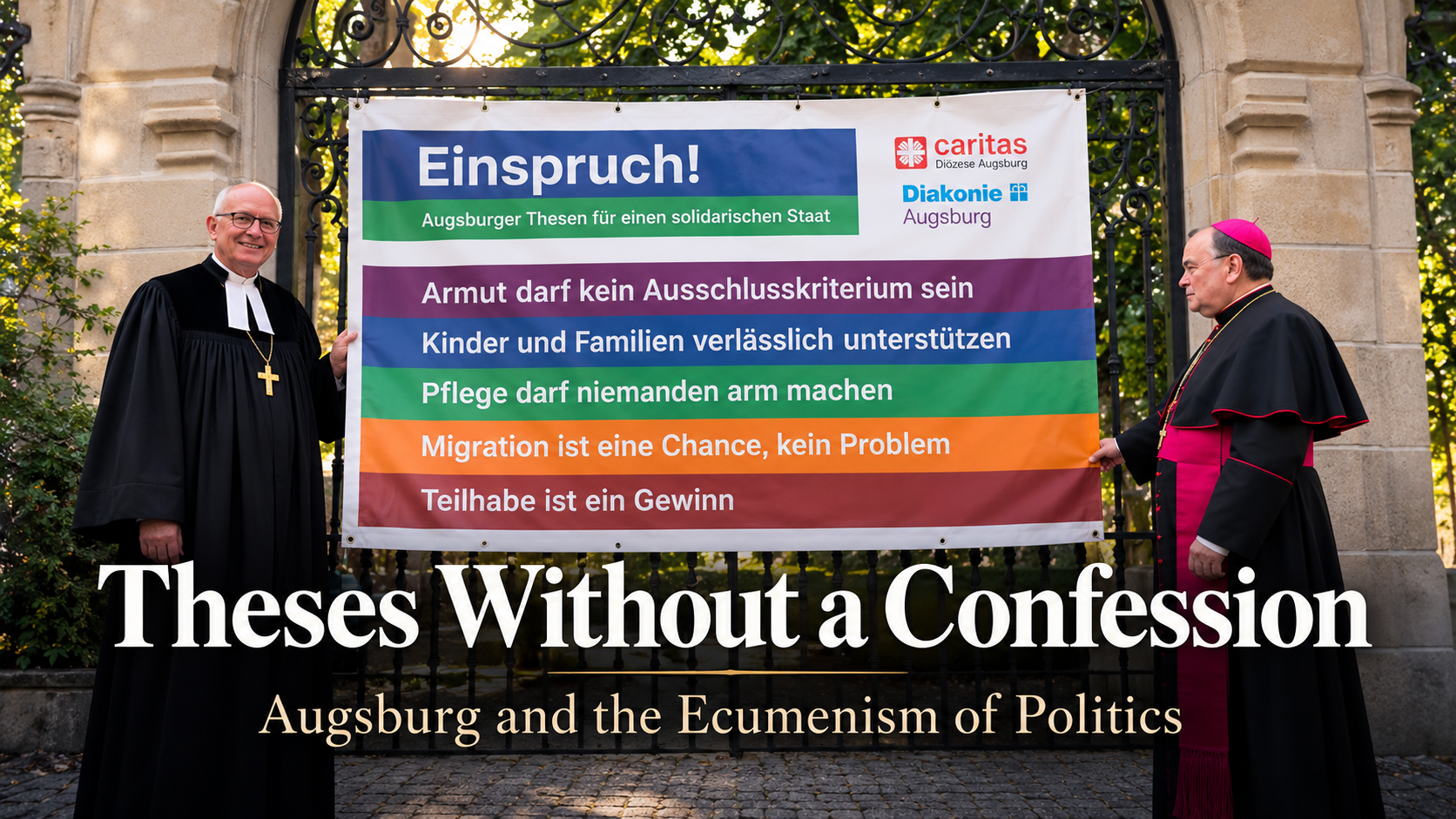
- Theses Without a Confession: Augsburg and the Ecumenism of PoliticsIn Augsburg, Catholic and Lutheran leaders have symbolically reposted theses on social issues like poverty and migration, reflecting Christian social teaching. This event highlights a growing divide where churches confidently address social policies while unresolved doctrinal differences remain. Cooperation on such issues is valuable but should not replace the pursuit of true Christian unity.
- Quis ut Deus? Michaelmas and the Order of HeavenThe Dedication of Saint Michael, celebrated on 29 September, highlights the Archangel’s role within divine order, illustrating humility and obedience before God. Rooted in ancient Roman traditions, the feast contrasts human pride with the recognition of God’s sovereignty. It underlines the importance of worship that connects earthly life to heavenly realities, centering around God’s presence.
- Today’s homily: The Dedication of S. Michael, ArchangelThe Apostles ask, “Who is greatest in the kingdom of heaven?” Saint Michael’s very name supplies the answer: Quis ut Deus? — “Who is like unto God?” From the angelic rebellion to Daniel’s vision of spiritual warfare, from Christ’s victory over Satan to the Guardian Angels and the worship surrounding the altar, the feast teaches that victory begins with humility, obedience and adoration. The Christian defeats the logic of Lucifer whenever he ceases to enthrone himself and kneels before God.
- Today’s Mass: September 29 Dedication of Saint Michael the ArchangelThe Feast of the Dedication of Saint Michael the Archangel highlights St. Michael’s role as the leader of heavenly armies and protector of the Church. He is revered for defeating evil spirits and is traditionally invoked for defence against sin. The liturgy honours his significant role alongside other angels in spiritual warfare and the protection of believers.



Leave a Reply