
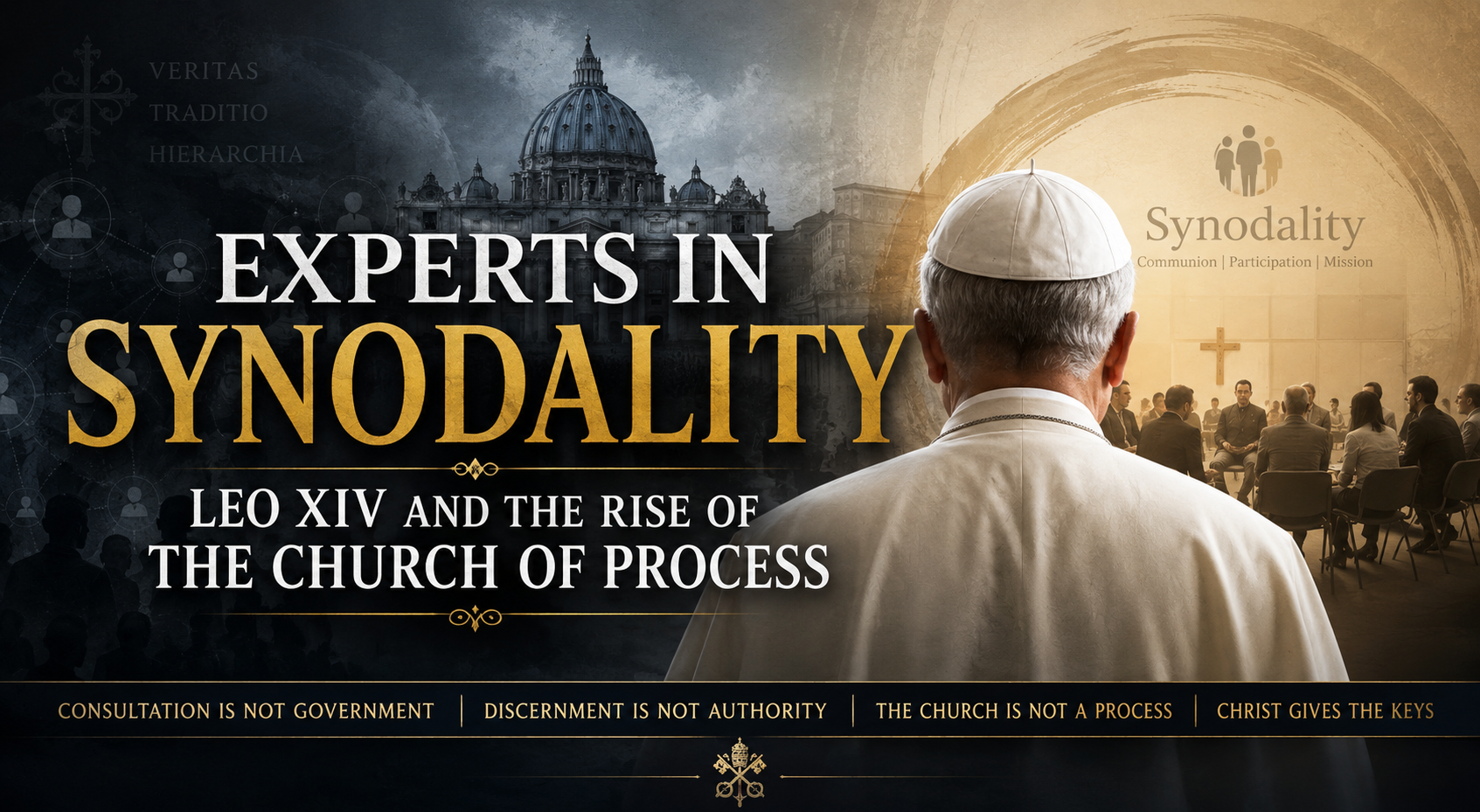
Experts in Synodality: Leo XIV and the Rise of the Church of Process

There are occasions when two sentences, spoken weeks apart and without any intention of answering one another, illuminate an ecclesiastical problem better than a library of official documents. On 6 July, Archbishop Paul Coakley of Oklahoma City, president of the United States Conference of Catholic Bishops, offered an unusually candid assessment of the reception of synodality. It was, he acknowledged, frequently perceived as a “cumbersome and complicated process” conducted in terminology unfamiliar to ordinary Catholics. Unless it could be simplified, he warned, synodality risked becoming “the exclusive domain of specialists or ‘the initiated’.”¹ On 12 August, Pope Leo XIV addressed the Leadership Conference of Women Religious and declared that those living the religious life are called, “in a special way”, to become “experts in synodality.”²
The juxtaposition deserves serious attention. It would be cheap polemic to pretend that Coakley and Leo flatly contradict one another. They do not. Coakley was warning against an ecclesiastical method becoming unintelligible to ordinary believers; Leo was arguing that religious community life gives its members particular opportunities to practise synodal listening and discernment. Yet precisely because there is no simple contradiction, the two statements reveal something more important. The contemporary synodal project has acquired a sufficiently distinctive vocabulary, spirituality and methodology that senior churchmen can speak naturally of formation in it, specialists in it, those initiated into it, and people becoming experts in it. We are no longer speaking merely about the perennial Christian duties of listening, taking counsel and exercising prudence. We are dealing with an identifiable ecclesiastical culture.
Leo’s words were deliberate. Addressing the American religious on the seventieth anniversary of the LCWR, he said that Christians are called to build Christ’s communion, “formed in a synodal Church in which everyone cooperates in the same mission according to their own charism and ministry”. He then commended the assembly’s planned “synodal method of listening, discussion and discernment”.² Two features of the formulation deserve to be kept together. The Pope retains differentiated charisms and ministries; nothing in the message warrants the simplistic claim that he has proposed an ecclesiastical democracy in which sacramental order and canonical office disappear. But he also speaks without hesitation of “a synodal Church”, of expertise in synodality, and of a recognisable synodal method. Synodality is therefore neither an adjective of convenience nor the fading slogan of the previous pontificate. It is being presented as a characteristic of the Church in which Catholics are to be formed.
That conclusion cannot rest upon a single video message. It does not. At his extraordinary consistory on 26 June, Leo told the cardinals that the Church would continue the process of implementing the Synod and described synodality as pointing to a “way forward”, specifying “listening, discerning, and taking responsibility together for the choices that the Lord entrusts to us”.³ At the Mass opening that consistory, he connected the collegial cooperation of the cardinals with the wider synodality of the baptised.⁴ The following month Archbishop Coakley, after participating in meetings in Rome concerned precisely with implementation of the 2024 Synod Final Document, said that Leo “clearly wants to build on the synodal vision outlined and presented by Pope Francis”.¹ Whatever other differences of emphasis may emerge between the two pontificates, it is becoming increasingly difficult to sustain the hope that synodality will simply be allowed to expire.
For Traditional Catholics, the useful question is therefore no longer whether Leo will retain the word. He plainly will. The real question is what the word is being made to carry.
The Catholic Church has never lacked consultation. Popes have consulted cardinals and theologians; bishops their chapters, clergy and advisers; religious superiors their councils and communities. Diocesan synods, provincial councils, cathedral chapters, Roman congregations and the general chapters of religious orders did not await the twenty-first century to discover that rulers ought to hear prudent counsel. St Thomas Aquinas treats counsel as an indispensable act of practical reason preceding right judgement; St Benedict requires an abbot to summon the brethren when matters of importance are to be decided, while nevertheless leaving responsibility for the decision with the superior. Consultation belongs naturally to ordered government because authority is not omniscience.
Nor is there anything intrinsically novel in episcopal cooperation. In 1965 Paul VI established the Synod of Bishops precisely to give the bishops of the world a regular means of assisting the Roman Pontiff. Yet the juridical architecture of Apostolica Sollicitudo is remarkably clear. The Synod was erected as a permanent institution, but its assemblies would act for a time when convoked. Its ordinary function was to provide information and advice; it could exercise deliberative power only when the Pope explicitly conferred it, and its decisions would then require his ratification. It remained “directly and immediately subject” to the Roman Pontiff.⁵ Permanence belonged to the institution, not to a permanently diffused mode of ecclesiastical government.
That distinction is increasingly important.
The contemporary project proposes something broader than the Synod of Bishops Paul VI created. Synodality is no longer merely the periodic act of an episcopal assembly assisting the Pope. It is presented as a habitual manner in which the Church at every level should listen, discern, deliberate, plan and proceed. Parish, diocesan, national, continental and universal stages interact. Laity, clergy, religious and bishops participate in differentiated ways. Facilitators oversee “conversations in the Spirit”; reports are gathered; syntheses are written; priorities are extracted; teams are trained; implementation structures continue after Roman assemblies have ended. The Synod has ceased to describe only an event. Synodality describes an ecosystem.
This does not prove that the ecosystem is illegitimate. It does mean that appeals to the antiquity of councils and consultation do not answer the actual question. Of course Christians met at Jerusalem in Acts 15. Of course bishops have deliberated together from antiquity. Of course a wise superior listens before deciding. The disputed proposition is not whether consultation belongs to Catholic life. It is whether this extraordinarily expanded network of consultation, mediation, synthesis and continuing implementation should itself become an organising principle of ecclesial government.
Here the controversy over episcopal collegiality at Vatican II becomes relevant, not because synodality and collegiality are identical, but because one of the central anxieties expressed during the Council concerned the transformation of an undeniable theological reality into a permanent governmental mechanism. Archbishop Marcel Lefebvre’s intervention during the second session in October 1963 distinguished the episcopal college, rightly understood, from what he feared could become an habitual form of collective government weakening both papal authority and the proper authority of individual diocesan bishops.⁶ Whatever judgement one reaches concerning Lefebvre’s broader critique of Vatican II, it is historically inaccurate to portray the traditionalist objection as hostility to bishops communicating or cooperating with one another. The objection concerned the juridical consequences of making collegiality permanent.
The Council itself recognised that the terminology required safeguards. Lumen Gentium teaches both that the episcopal college possesses authority only with its head, the Roman Pontiff, and that the individual bishop is the visible principle and foundation of unity within his particular Church.⁷ Paul VI required the Nota Explicativa Praevia to be attached to the constitution precisely to prevent collegiality being construed in a manner incompatible with papal primacy and the distinct responsibility of the members of the hierarchy. John Paul II would return to the difficulty in Apostolos Suos, insisting upon careful limits to the doctrinal and juridical authority of episcopal conferences.⁸ Catholic ecclesiology has therefore encountered this problem before: cooperation is genuine, but the mechanisms created to facilitate cooperation must not acquire an authority different from, or intermediate between, the offices Christ instituted.
Synodality carries the problem beyond episcopal collegiality because the question now concerns not simply bishops but the whole “People of God”. And this is where Leo’s apparently benign phrase “experts in synodality” becomes unexpectedly important.
Every large consultation requires mediation. Someone frames the questions. Someone chooses the participants. Someone moderates the discussion. Someone records what was said. Someone decides which remarks represent recurring themes and which are exceptional. Someone compresses thousands of pages into hundreds, hundreds into dozens, and dozens into conclusions manageable by an assembly. At every stage, selection occurs. Selection is unavoidable. But selection is not neutral.
This is the largely neglected problem of synodal mediation.
Suppose one thousand Catholics speak. A diocesan team reduces their contributions to a synthesis. A national team then combines dozens of diocesan syntheses. A continental body combines several national documents. A Roman secretariat produces working papers from the continental texts. Assembly participants then deliberate upon documents already produced through multiple acts of selection before another drafting committee prepares a final synthesis. At the end of such a process, it is possible to say that the faithful have been consulted. It is much harder to say, without qualification, that the resulting document is simply “what the faithful said”.
Between the Catholic in the parish hall and the document on the Vatican desk stands an interpretative chain.
That chain may be honest, conscientious and prayerful. Its members may work with exemplary integrity. The difficulty remains structural. The further the final synthesis stands from the original testimony, the greater the interpretative authority exercised by those who select, classify and formulate what survives the journey. This authority is neither sacramental nor ordinarily juridical. It is methodological. It belongs to those who understand the process sufficiently well to operate it.
In other words, to the experts.
That does not make expertise sinister. The Church needs experts in canon law, theology, liturgy, finance, safeguarding, architecture and innumerable other fields. What makes synodal expertise unusual is that the expert may exercise considerable influence over an ostensibly representative process without himself possessing representative or governing authority. A theologian’s argument can be examined as a theological argument. A canon lawyer’s advice can be checked against the law. A bishop’s decree identifies the person responsible for deciding. But when a synthesis declares that “the consultation revealed”, “the People of God expressed”, or “the Spirit is calling the Church to recognise”, responsibility becomes much less easy to locate. Who decided that this was the authentic voice emerging from the process rather than that? By what criterion? With what authority?
The language of spiritual discernment makes this problem more, not less, serious. Leo told the LCWR that its synodal method should help participants “discern what the Holy Spirit is saying” concerning the present and future of consecrated life.² In proper Catholic spirituality, discernment is indispensable. But no methodology gives human synthesis the charism of inspiration. The invocation of the Holy Ghost cannot remove the ordinary requirements of evidence, prudence, doctrinal conformity and accountable authority. Otherwise disagreement with the interpretation of a process becomes dangerously easy to recast as resistance to what “the Spirit” is supposedly saying.
The participation problem sharpens the difficulty further. Archbishop Timothy Broglio acknowledged after the 2024 Roman assembly that fewer than one per cent of Catholics in the United States had participated in the earlier consultation, adding that participation rates in other developed countries had been similarly low.⁹ The American national synthesis itself recorded approximately 700,000 participants from a Catholic population numbering tens of millions. Low participation does not make consultation worthless. It does make grand claims of representativeness precarious.
Indeed, the smaller the number participating, the greater the relative authority of the synthesiser. If ninety-nine Catholics remain silent and one speaks, the words of the one may deserve attention. They do not become the voice of the hundred. If the one person’s remarks then pass through several layers of editorial compression before reaching Rome, the final formulation cannot reasonably acquire greater representative authority merely because more processes have intervened.
This is why Coakley’s warning about “specialists” and “the initiated” was more profound than perhaps he intended. He was describing a communications problem: synodality appears complicated, its terminology unfamiliar, its spirituality insufficiently understood. His proposed remedy included more formation.¹ Leo now tells religious to become experts in it. But the more formation required to participate properly in something described as the ordinary mode of the whole Church, the more obvious the paradox becomes. Synodality is offered as an antidote to exclusion while acquiring an increasingly specialised language through which inclusion is administered.
There is an irony here which should not be overstated but cannot honestly be ignored. One of the recurring aspirations of the synodal movement has been opposition to “clericalism”. Yet an ecclesiastical system can generate elites without ordaining them. A functional interpretative class may arise whose influence rests neither upon Holy Orders nor canonical jurisdiction but upon expertise in facilitation, consultation, synthesis, formation and the accepted language of discernment. Such people need not consciously seek power. Structures distribute power irrespective of personal intention.
That is the stronger objection to the emerging synodal culture. It is not that laymen or religious are suddenly “running the Church”, because formally they are not. It is that authority risks becoming difficult to see. A bishop who makes a decision can be praised or blamed for it. A superior who commands assumes responsibility. A Pope who legislates signs the act. But a recommendation said to have “emerged from the synodal process” arrives clothed in the prestige of collective discernment while frequently concealing how much depended upon those who designed and interpreted the process.
Catholic government ought not become government by passive voice.
To his credit, Leo’s own wording contains material from which a necessary correction could be made. He does not abolish distinction. Everyone cooperates, he says, “according to their own charism and ministry”.² That phrase should be pressed to its theological conclusion. Baptism establishes a true equality of dignity among Christians, but it does not abolish the distinction between the common and ministerial priesthood; Lumen Gentium itself says they differ “in essence and not only in degree”.¹⁰ Episcopal consecration confers the offices of teaching, sanctifying and governing, exercised in hierarchical communion. The diocesan bishop is not merely chairman of a diocesan conversation. The priest is not merely one voice among stakeholders. The lay apostolate is genuine precisely because it is proper to the laity rather than an imitation of clerical jurisdiction. Religious life has its own charisms, rule and supernatural purpose.
The Church can therefore listen widely without pretending that listening confers jurisdiction. She can consult without confusing counsel with consent. She can discern without treating a facilitated method as sacramental. She can hear the faithful without inventing fictional representation. She can receive expert advice without allowing expertise to become anonymous government.
There is, moreover, a straightforward test of the project available in its own claims. If synodality means that bishops should listen more carefully, religious communities should deliberate prudently, priests should be heard, lay Catholics should speak frankly, and all should pray before important decisions, then nobody needs a revolution in ecclesiology. The Church already possesses the theological principles necessary for all of that. If, however, synodality means something more — a permanent redistribution of practical influence through newly institutionalised processes of co-responsibility, synthesis and collective discernment — then the additional element must be defined with considerably greater precision than it has been.
For authority in the Church is not created by process. Christ gave the keys to Peter. He sent the Apostles to teach and baptise. Through apostolic succession, bishops govern particular Churches; priests cooperate in their ministry; the faithful, incorporated into Christ through Baptism, participate according to their proper state and vocation in the Church’s mission. These are not competing dignities requiring reconciliation through a management technique. They constitute an ordered communion.
That is why older Catholic vocabulary was often more exact. Counsel was counsel. Government was government. A chapter was a chapter. A council was a council. A bishop was a bishop. A layman was a layman. Nobody was demeaned because things were called by their names.
Leo XIV has now made one major point clear. Synodality has survived Pope Francis. It appears increasingly likely to become one of the governing ecclesiological themes of his successor’s pontificate. The Pope speaks of the “synodal Church”; his consistories connect synodality with the exercise of ecclesiastical responsibility; the worldwide implementation process continues; and religious are now positively encouraged to become expert practitioners of its method. The argument that Catholics should simply wait for the vocabulary to disappear has become untenable.
The appropriate response is therefore neither panic nor acquiescence but theological precision. Catholics should ask what synodality adds to the Church’s existing doctrine of communion, consultation, episcopal collegiality and lay apostolate. They should ask where counsel ends and government begins. They should ask how a synthesis acquires its authority, who is answerable for its interpretations, how dissenting voices are preserved, and what is meant when conclusions are attributed to the “People of God”. Above all, they should insist that no methodology, however prayerful, be permitted to blur the sacramental and juridical constitution of the Church.
Coakley feared that synodality might become the domain of “the initiated”. Leo hopes religious will become its “experts”. Both statements may be perfectly sincere, and both may be reconciled by saying that experts should serve a process accessible to everyone.
But that does not dispose of the deeper difficulty. It identifies it.
A Church increasingly dependent upon experts to explain what synodality means, experts to teach Catholics how to practise it, facilitators to conduct it, and synthesis teams to determine what emerged from it risks placing enormous practical influence in precisely the layer of ecclesiastical life that possesses the least clearly defined authority.
The question, then, is not whether Catholics ought to walk together. They always have.
The question is who tells the Church where the walk has led — and by what authority they speak.
¹ Carol Glatz, “Church needs simpler language to explain synodality, U.S. bishops’ president says”, Catholic News Service, 6 July 2026; Archbishop Paul S. Coakley’s comments following the 23–25 June 2026 meeting in Rome of continental synodal representatives.
² Pope Leo XIV, Video Message to Participants in the 2026 Annual Assembly of the Leadership Conference of Women Religious in the United States of America, 12 August 2026, Holy See.
³ Pope Leo XIV, Opening Address to the Extraordinary Consistory, 26 June 2026, Holy See.
⁴ Pope Leo XIV, Homily at Mass with the College of Cardinals on the opening of the Extraordinary Consistory, 26 June 2026, Holy See.
⁵ Paul VI, Apostolic Letter Apostolica Sollicitudo, 15 September 1965, I–III. The Synod was established as a permanent central institution, while its assemblies functioned when convoked; its ordinary function was informational and consultative, with deliberative authority dependent upon an express grant from the Roman Pontiff.
⁶ Marcel Lefebvre, Third Intervention during the Second Session of the Second Vatican Council, October 1963, subsequently published in J’accuse le Concile / I Accuse the Council.
⁷ Second Vatican Council, Dogmatic Constitution Lumen Gentium, 21–23; Nota Explicativa Praevia.
⁸ John Paul II, Apostolic Letter issued motu proprio Apostolos Suos: On the Theological and Juridical Nature of Episcopal Conferences, 21 May 1998, especially 12, 20–23.
⁹ John Lavenburg, “Leader of US bishops says involving more laity critical to implementing synod”, Crux, 30 October 2024; Archbishop Timothy Broglio stated that fewer than one per cent of American Catholics had participated and that similarly low proportions were found in other developed countries. The United States national synthesis recorded approximately 700,000 participants.
¹⁰ Second Vatican Council, Lumen Gentium, 10, 18–27.
RELATED ARTiCLES


LATEST ARTICLES
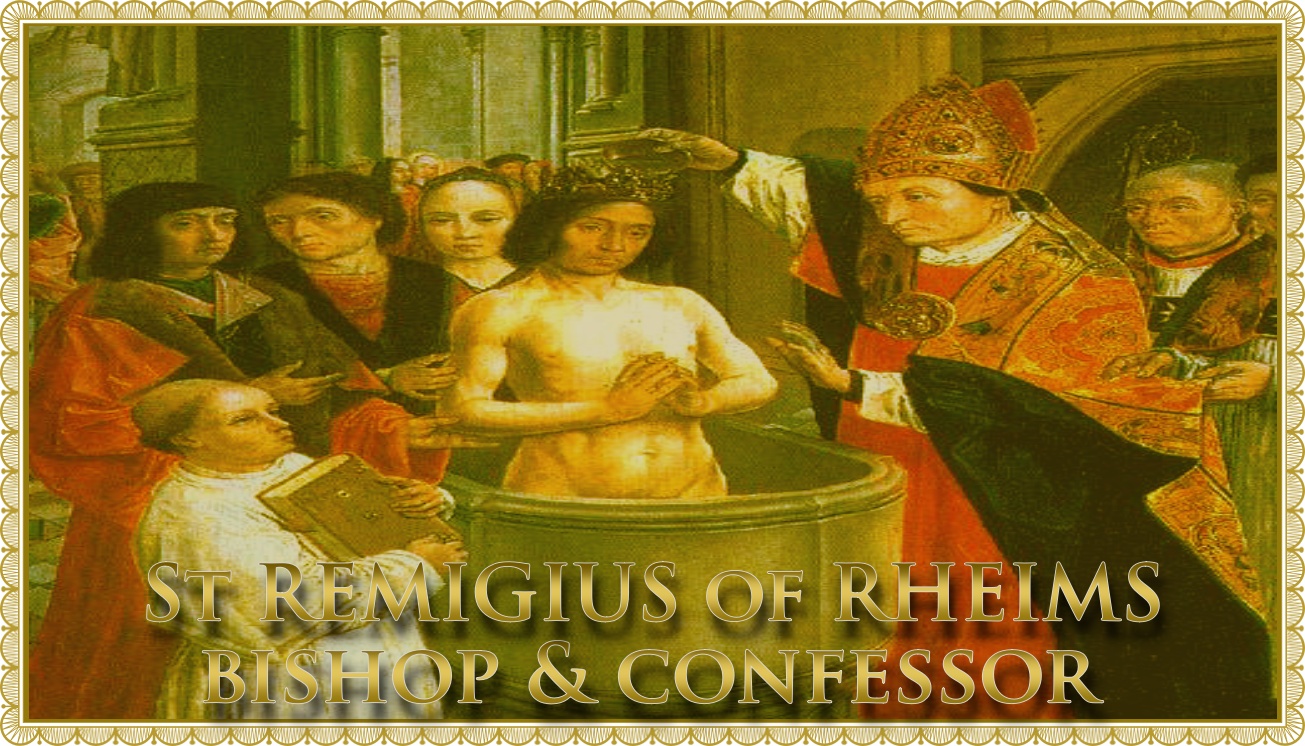
- Today’s Mass: October 01 St Remigius of RheimsSt Remigius of Rheims, a significant bishop and apostle of the Franks, was renowned for his learning, holiness, and miraculous deeds during his seventy-plus years of episcopacy. He was instrumental in spreading Christianity under King Clovis and left a lasting legacy before his death around 530.
- October Beneath Our Lady’s StandardThe Feast of the Most Holy Rosary commemorates the 1571 victory at Lepanto and evolved through papal endorsements, especially under Pope Leo XIII in the late 19th century. October, dedicated to the Rosary, serves as a reminder of prayer’s significance during trials, fostering both personal and communal spiritual resilience in Catholic life.
- Marriage Endures as Britain’s Common Christian Framework RecedesRecent ONS data indicates that 83.7 per cent of couples married in 2015 remained together by their tenth anniversary. However, Britain faces declining fertility rates, increasing abortion statistics, an ageing Christian demographic, and a reliance on migration for population growth. The critical challenge lies in transmitting family, faith, and culture across generations.
- Vatican III by Stealth? When “Reception” Becomes RevisionArchbishop Anthony Randazzo warns against the misuse of synodality as a means to eliminate perceived “dead wood” from the Church, stressing the importance of faithfully interpreting Vatican II. He argues that authentic renewal relies on the continuity of the Church’s doctrine, warning that unchecked synodality may lead to revisions of established teachings rather than genuine reception.
- Today’s homily: St Jerome of BethlehemThe homily reflects on St Jerome’s profound transformation from a scholar enamoured with classical literature to a devoted servant of Christ. It highlights the necessity of allowing faith to permeate one’s life, emphasising that merely possessing knowledge of doctrine is insufficient without a corresponding internal change. Jerome’s legacy urges believers to let Scripture guide their lives authentically.
CURRENT EDITION


Today’s Mass Propers
- Today’s Mass: October 01 St Remigius of Rheims
 St Remigius of Rheims, a significant bishop and apostle of the Franks, was renowned for his learning, holiness, and miraculous deeds during his seventy-plus years of episcopacy. He was instrumental in spreading Christianity under King Clovis and left a lasting legacy before his death around 530.

Leave a Reply