

Reverence Cannot Rewrite History — Leo XIV and the Unanswered Question of Liturgical Reform
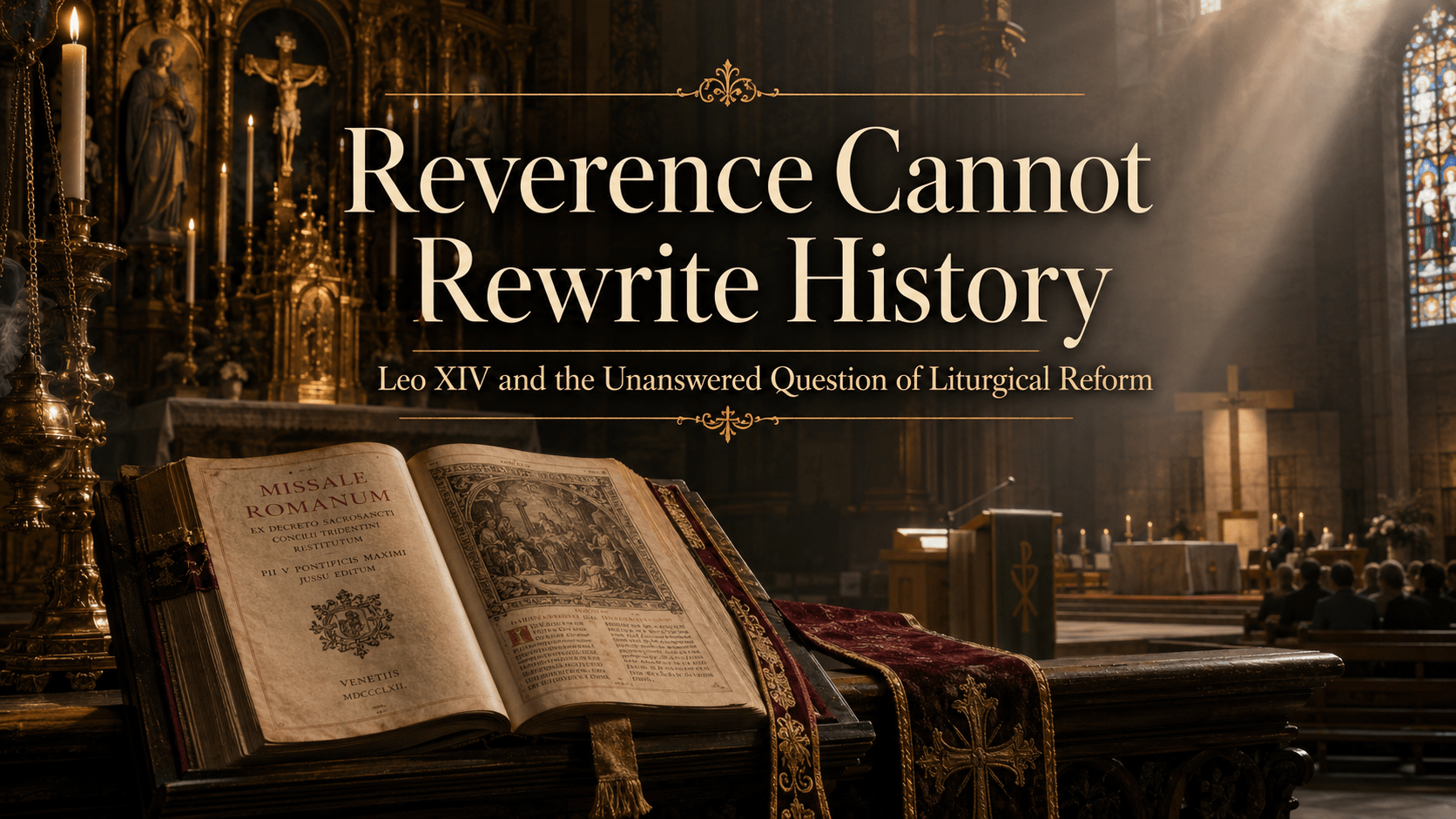
Pope Leo XIV has now made his liturgical policy rather clearer. In his letter to Cardinal Arthur Roche for the Mount Angel Abbey liturgical conference, dated 29 June and published on 14 August, he calls for the “dignified celebration of the sacred mysteries,” insists upon “fidelity to the approved texts and instructions,” and directs particular attention to respect for the rites promulgated by Paul VI and John Paul II.¹ Nobody committed to the Catholic understanding of the sacred liturgy can object to priests observing the liturgical books rather than treating the sanctuary as a theatre for personal invention. The difficulty lies elsewhere. For the argument now being advanced from Rome does something much more consequential than demand obedience to rubrics: it quietly identifies the post-conciliar liturgical settlement with the faithful implementation of the Second Vatican Council itself. That identification must be challenged.
There is an increasingly obvious strategy behind the present Roman emphasis upon ars celebrandi, formation and reverence. For decades the liturgical crisis was impossible to conceal: improvisation, desacralisation, dreadful music, casual handling of the Blessed Sacrament, architecturally devastated sanctuaries and a general collapse of ritual seriousness accompanied the implementation of the new liturgy throughout much of the Western Church. Now that a generation too young to remember the pre-conciliar Church has nevertheless discovered the traditional Roman Rite, the old explanation that attachment to it is merely nostalgia has become implausible. The answer is therefore changing. The problem, we are increasingly told, was not the reform but the way the reform was celebrated. Celebrate the new Mass reverently; teach priests to obey its rubrics; recover silence, dignity and beauty; form the faithful properly — and the attraction of the older Rite will supposedly lose much of its force. It is a clever response. It is also inadequate.
The serious Traditional Catholic critique has never depended upon whether the Novus Ordo is celebrated badly. A clown Mass and a solemn Latin Mass according to the Missal of Paul VI may differ from one another aesthetically almost beyond recognition, but they employ the same reformed liturgical structure. Strip away every abuse. Restore incense, chant, Roman vestments and a properly ordered sanctuary. Celebrate ad orientem. Give Holy Communion kneeling and upon the tongue. Sing the Ordinary in Latin. Observe every rubric scrupulously. None of this answers the historical question which precedes all questions of ceremonial execution: is the Novus Ordo Missae actually the reform that Sacrosanctum Concilium prescribed? That is the question the new emphasis upon reverence threatens to obscure.
It must first be conceded, because accuracy demands it, that Vatican II unquestionably ordered a reform of the Roman liturgy. Traditionalists do themselves no service by pretending otherwise. Sacrosanctum Concilium decreed that the rite of Mass should be revised; called for the removal of genuine duplications and the restoration of certain ancient elements; required a richer use of Sacred Scripture; restored the Prayer of the Faithful; extended certain possibilities for concelebration; and allowed a controlled enlargement of the vernacular.² The proposition that Vatican II ordered no liturgical reform at all is therefore indefensible. But that is not the proposition at issue. The question is whether the particular reform subsequently devised by the Consilium and promulgated under Paul VI can simply be equated with what the Council Fathers authorised. To say that the Council ordered a reform does not prove that the Council ordered this reform. Still less does it demonstrate that every substantial innovation introduced between 1964 and 1970 was required by the conciliar Constitution.
The distinction is decisive because Sacrosanctum Concilium itself established the principles by which the reform was to be judged. Paragraph 23 could scarcely have been more cautious. Before any part of the liturgy was revised there was to be careful theological, historical and pastoral investigation. Innovation was not the presumption but the exception: there must be no innovations unless the good of the Church genuinely and certainly requires them; and whatever new forms were adopted were to grow organically from forms already existing.² The Council therefore authorised development while placing a brake upon reconstruction. Tradition was not raw material from which experts might construct an improved liturgy. It was the living organism from which legitimate development had to arise. The proper test is therefore not whether the reformers possessed authority to undertake a revision, but whether the revision they produced can be shown to have remained within those governing principles.
Begin with the Eucharistic Prayer. Sacrosanctum Concilium nowhere orders the creation of alternative Canons. It does not ask that the immemorial Roman Canon cease to be the unique Eucharistic Prayer of the Roman Mass. Yet when Paul VI promulgated the new Missal he himself identified the Eucharistic Prayer as its “major innovation.” He noted that the Roman Canon had acquired an effectively fixed form in late antiquity and then announced the addition of three newly provided Eucharistic Prayers.³ Whatever theological or pastoral defence one subsequently makes of those prayers, their creation cannot honestly be described as the execution of an explicit command given by the Council Fathers. It was a post-conciliar decision. That distinction is fundamental: Vatican II authorised reform, while the Consilium subsequently made choices within — and, at least in some cases, arguably beyond — that mandate.
The same analytical discipline must be applied elsewhere. The Council certainly ordered that the treasures of Scripture be opened more lavishly and that a more representative portion of the Bible be read over a prescribed number of years.² A substantial enlargement of the lectionary therefore possesses an explicit conciliar warrant. But the particular three-year Sunday cycle, the organisation of readings adopted, and the wholesale construction of the resulting lectionary were choices about how that mandate should be implemented. Paul VI himself records that the Sunday readings were divided into a three-year cycle and describes the extensive resulting biblical arrangement.³ To say that Vatican II wanted more Scripture is correct. To say that the Fathers themselves prescribed the precise lectionary subsequently produced is not.
The calendar requires similar precision. Sacrosanctum Concilium expressly called for revision of the liturgical year and directed that many saints whose cult was not genuinely universal should be left to particular Churches.² A revision of the calendar therefore clearly belonged to the Council’s programme. But again, the exact decisions embodied in the 1969 General Roman Calendar were made afterwards. Paul VI expressly approved the new calendar prepared by the Consilium.⁴ A conciliar mandate establishes an objective; it does not render every subsequent implementation decision identical with the Council’s own act. The same applies to the reconfiguration of texts, propers, votive Masses and other elements of the Missal. Each may be defended as a legitimate post-conciliar decision, but that is a different claim from saying that the Council Fathers themselves demanded it.
Latin presents an even more uncomfortable comparison. The Council did not decree the abolition of Latin from the Mass. It said the opposite. Sacrosanctum Concilium 36 states that “the use of the Latin language is to be preserved in the Latin rites.” Paragraph 54 permits a “suitable place” for the vernacular in Masses with the people, mentioning in the first instance the readings and Prayer of the Faithful and allowing wider use under specified conditions; but in the very same paragraph the Council requires that provision be made so that the faithful can say or sing together in Latin those parts of the Ordinary which belong to them.² Compare that with Paul VI’s own description on the eve of the new rite’s introduction. On 26 November 1969 he told the faithful that Latin would no longer be the principal language of the Mass but would give way to the spoken language. He acknowledged the magnitude of the sacrifice, including what would be lost of the Gregorian inheritance, while defending the change on pastoral grounds.⁵ One may defend the post-conciliar vernacularisation as a legitimate development permitted by conciliar authority; one cannot plausibly pretend that the resulting linguistic settlement is simply what the text of Sacrosanctum Concilium says.
Gregorian chant provides an equally awkward comparison. The Council did not merely tolerate it. It declared chant specially suited to the Roman liturgy and required it, other things being equal, to enjoy “pride of place”; the treasury of sacred music was to be preserved and fostered with great care.² Yet Paul VI himself recognised in November 1969 that the linguistic transformation would entail the loss of a considerable part of the Gregorian inheritance.⁵ Once again, whatever pastoral argument is made for the decision, it cannot reasonably be suggested that the liturgical culture which subsequently displaced Latin chant throughout enormous portions of the Church was demanded by Vatican II. The subsequent history may be explained, defended or regretted, but it must not be retrospectively placed into the mouths of the Council Fathers.
Nor did Vatican II order Mass facing the people. Sacrosanctum Concilium says nothing whatever requiring the Eucharistic Prayer to be offered versus populum. The phenomenon which eventually became so closely identified with “the Vatican II Mass” therefore supplies a particularly vivid example of how easily post-conciliar custom became retrospectively attributed to the Council. Even the contemporary General Instruction continues to contain rubrical language in which the priest turns towards the people at specified moments, reflecting a ritual structure perfectly compatible with the priest and faithful otherwise facing the same liturgical direction.⁶ The Council cannot have mandated something it never mentioned.
Then there is the Order of Mass itself. Paul VI’s promulgating Constitution does not describe a minor tidying of rubrics. It speaks of the “new composition” of the Roman Missal; identifies the Eucharistic Prayer as its principal innovation; describes substantial changes to the rites surrounding the offering of bread and wine, the fraction and Communion; records the new biblical arrangement; and finally states that, beyond these changes, the Proper of Seasons, Proper of Saints, Commons, ritual Masses and votive Masses had all been “reviewed and considerably modified.”³ These are Paul VI’s descriptions, not Traditionalist polemic. His audiences immediately before the new rite came into effect are more revealing still. On 19 November 1969 he told Catholics that the Mass would now be celebrated in a form different in a number of ritual respects from that known since St Pius V, while assuring them that its substance remained unchanged.⁷ A week later he spoke explicitly of a change touching a venerable centuries-old tradition, acknowledged the disturbance it would cause, and prepared pious Catholics themselves for the scale of the alteration.⁵
None of this proves invalidity. None of it, standing alone, proves doctrinal heterodoxy. None of it settles every disputed question surrounding the authority by which the reform was promulgated. But it does destroy the lazy historical fiction that nothing occurred except the straightforward execution of instructions which the Council Fathers had explicitly written into Sacrosanctum Concilium. They had not. The Council Fathers prescribed principles and certain reforms. The Consilium subsequently designed a liturgical settlement. Paul VI reviewed and authorised that work. Those are related historical acts. They are not one and the same act.
This distinction becomes particularly important because Rome itself has increasingly sought to erase it. Traditionis Custodes declared the liturgical books promulgated by Paul VI and John Paul II to be “in conformity with the decrees of Vatican Council II” and required bishops to ensure that communities using the older Missal did not deny the “validity and legitimacy of the liturgical reform, dictated by Vatican Council II and the Magisterium of the Supreme Pontiffs.”⁸ Pope Francis subsequently made the identification still more explicit in Desiderio Desideravi, arguing that one could not recognise the validity of the Council while refusing to accept the reform said to have been born from Sacrosanctum Concilium.⁹ Notice what has happened. A historical proposition has gradually acquired the force of an ecclesiastical loyalty test.
The question is no longer simply whether Paul VI promulgated new liturgical books. It becomes whether questioning the correspondence between those books and the Council’s actual prescriptions amounts to questioning Vatican II itself. That does not follow. A Catholic can read Sacrosanctum Concilium, read Missale Romanum, examine the work carried out between 1964 and 1969, and conclude that the eventual reform went substantially beyond what the conciliar text explicitly demanded. Indeed, the documentary evidence obliges anyone discussing the matter seriously at least to recognise that distinction. One may argue that the additional developments were legitimate exercises of papal and curial authority. One may argue that they represented reasonable applications of general conciliar principles. One may even maintain that the reform was entirely beneficial. But one cannot make the historical distance disappear simply by attaching the words “Vatican II” to everything which happened afterwards.
This is why Leo XIV’s present language is potentially more troublesome for defenders of the settlement than they appear to realise. On 27 May the Pope himself returned to Sacrosanctum Concilium 23. He praised the Council’s attempted balance between sound tradition and legitimate progress and recalled that authentic development must remain rooted in tradition.¹⁰ He has now followed this by demanding fidelity to authorised liturgical texts and instructions.¹ Taken together, the principle is admirable. But principles apply backwards as well as forwards. If a parish priest in 2026 must justify his liturgical behaviour by the authorised books, then the reformers of the 1960s may fairly be judged by the Constitution which authorised their work. If innovation today requires ecclesiastical warrant, innovation then required the conditions imposed by Sacrosanctum Concilium. If organic development is again the criterion, then the question is not whether the Consilium possessed experts, papal approval or pastoral aspirations. The question is whether the innovations themselves satisfy the criterion the Council laid down: were they genuinely and certainly required for the good of the Church, and did they grow organically from forms already existing? Those are not Lefebvrist criteria. They are not Traditionalist inventions. They are the words of Sacrosanctum Concilium.
This is where the current campaign for a reverent Novus Ordo begins to look less like an answer to Traditionalism than an attempt to neutralise it. The reasoning is understandable. If Catholics are fleeing banal, irreverent and undisciplined celebrations for the traditional Mass, remove the banality. Train priests properly. Enforce the rubrics. Recover beauty. Insist that Paul VI’s Missal can be solemn, sacred and doctrinally serious. Once the sensory contrast is reduced, perhaps attachment to the old Rite will appear unnecessary. But that strategy answers only the weakest traditional objection. If someone says that he prefers the old Mass because his parish Mass is ugly, then a beautiful Novus Ordo may indeed answer him. If he objects because Father improvises everything, strict rubrical fidelity may answer him. If he desires Latin, chant, incense, silence and ad orientem worship, a carefully celebrated Novus Ordo can reproduce a considerable portion of that outward experience. But if he asks why the inherited Roman Rite was reconstructed to this extent in the first place, none of those things supplies an answer.
A beautifully sung Eucharistic Prayer II remains Eucharistic Prayer II; its beauty does not show that Vatican II requested its composition. An exquisitely celebrated preparation of the gifts does not establish that the Council required the older offertory rites to be replaced or radically simplified. A solemn three-year lectionary does not prove that its particular architecture was ordained by the Council rather than devised afterwards as one means of implementing SC 51. A Latin Novus Ordo does not alter the historical fact that the post-conciliar settlement resulted in a vernacularisation far beyond the linguistic balance actually expressed by SC 36 and 54. Gregorian chant sung magnificently in a seminary chapel does not erase the fact that the Council gave it pride of place while the reform as ordinarily received throughout much of the Church effectively displaced it. Celebrating Paul VI’s Missal ad orientem demonstrates something particularly embarrassing: one of the practices most popularly associated with “Vatican II” — the priest facing the congregation throughout the Eucharistic liturgy — was never required by Vatican II at all. Reverence therefore improves the celebration. It cannot rewrite the history of the reform.
That is the fundamental weakness in Rome’s present approach. The liturgical establishment increasingly appears willing to concede that much went wrong after the Council, provided the concession ends before the reform itself is examined. Abuses may be criticised. Bad music may be criticised. Improvisation may be criticised. Poor formation may be criticised. Perhaps even certain fashionable liturgical practices may now quietly be reconsidered. But the reform itself must remain axiomatic. It must remain “the reform of Vatican II,” and because it is identified with Vatican II, questioning its construction can then be represented as questioning the Council. Once that identification is established, Traditionis Custodes follows naturally: attachment to the antecedent Roman Rite is no longer merely attachment to an ancient liturgical form; it becomes potentially suspicious because it may signify refusal of the allegedly indivisible package of Council-and-reform.
That is precisely the premise which must be refused. Not the Council. Not legitimate ecclesiastical authority. Not liturgical discipline. The false equivalence. Vatican II ordered reform; it did not compose the Missal of Paul VI. Vatican II demanded more Scripture; it did not vote upon the finished three-year lectionary. Vatican II ordered revision of the calendar; it did not approve, feast by feast, the calendar subsequently prepared by the Consilium. Vatican II permitted wider use of the vernacular; it simultaneously commanded the preservation of Latin. Vatican II gave Gregorian chant pride of place; it did not order its practical eclipse. Vatican II said nothing requiring versus populum celebration. Vatican II did not order the creation of three new Eucharistic Prayers. Nor did it require the traditional Roman Offertory prayers to be replaced by formulas modelled upon Jewish table blessings. And above all, Vatican II required that innovations be admitted only where genuinely and certainly necessary and that new forms grow organically from existing forms.
The burden of proof therefore belongs not merely to the Traditionalist who questions the reform. It belongs also to those who insist that the reform is the faithful embodiment of the Council. For each substantial innovation, show where the Council required it. Where the Council did not require it, demonstrate why the good of the Church genuinely and certainly demanded it. Then demonstrate how the new form grew organically from what preceded it. That is the discussion Rome ought to permit. Instead we are offered formation, ars celebrandi and injunctions to follow the rubrics. All excellent things — and none of them an answer.
Indeed, there is something almost paradoxical about Leo XIV’s appeal to Sacrosanctum Concilium. If Catholics actually take him at his word and return to the text rather than to sixty years of accumulated mythology about “what Vatican II wanted,” they may discover that the traditional criticism is considerably stronger than they had been told. They may discover a Council which said preserve Latin, a Council which said give Gregorian chant pride of place, a Council which said make no innovations unless genuinely necessary, and a Council which said let new forms grow organically from existing forms. Then they may look at what happened between 1964 and 1970 and ask the question which all the incense, Latin and beautiful vestments in the world cannot make disappear: how did we get from that text to this Missal?
Until Rome is prepared to answer that question historically rather than rhetorically, a reverent Novus Ordo will remain what it ought in any event to be — a more reverent celebration of the Novus Ordo. It will not prove that the Novus Ordo is what Vatican II ordered. And if the present insistence upon reverence is intended to quieten opposition to the reformed rite by removing its most conspicuous ugliness, then it mistakes the nature of the opposition. Traditional Catholics are not merely protesting bad celebrations of the new liturgy. They are questioning the principles, extent and historical legitimacy of the reconstruction itself. One cannot answer a question about what was done to the Roman Rite by demanding that what replaced it be done more beautifully. That is not an answer. It is a diversion.
¹ Leo XIV, Letter to Cardinal Arthur Roche on the occasion of the Liturgical Conference at Mount Angel Abbey, 29 June 2026, published 14 August 2026.
² Second Vatican Council, Constitution Sacrosanctum Concilium (4 December 1963), especially nn. 21–25, 36, 47–58, 102–116.
³ Paul VI, Apostolic Constitution Missale Romanum (3 April 1969).
⁴ Paul VI, Apostolic Letter Mysterii Paschalis (14 February 1969).
⁵ Paul VI, General Audience, 26 November 1969.
⁶ General Instruction of the Roman Missal, rubrics specifying occasions on which the priest faces the people.
⁷ Paul VI, General Audience, 19 November 1969.
⁸ Francis, Apostolic Letter Traditionis Custodes (16 July 2021), arts. 1 and 3 §1.
⁹ Francis, Apostolic Letter Desiderio Desideravi (29 June 2022), especially n. 31.
¹⁰ Leo XIV, General Audience, 27 May 2026, on Sacrosanctum Concilium, tradition and liturgical development.
RELATED ARTiCLES


LATEST ARTICLES
- Omnia autem probate: quod bonum est tenete ~ Prove all things; hold fast that which is good: Spiritual Conference for Nuntiatoria CXXVIThe conference reflects on St Paul’s assertion to “prove all things” in relation to self-judgement and the Church. It explores themes of synodality, ecumenism, and the importance of discernment, emphasising the need for humility in understanding truth and the challenge of maintaining genuine holiness in the midst of contemporary ecclesiastical crises.
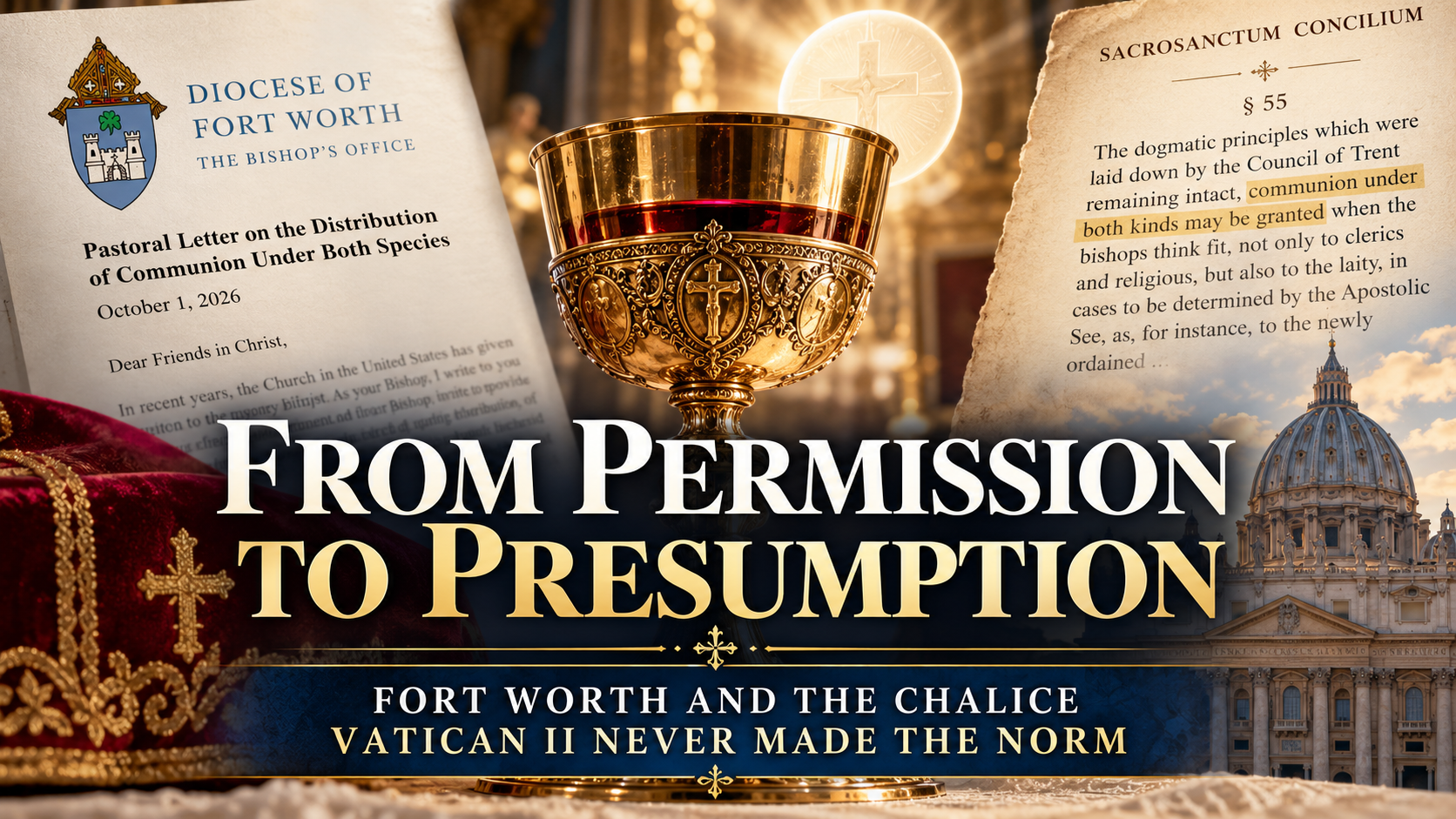
- FROM PERMISSION TO PRESUMPTION: Fort Worth and the Chalice Vatican II never made the NormBishop Michael Olson has implemented strict limitations on the distribution of Communion under both species in the Diocese of Fort Worth, prompting a discussion on the historical evolution of liturgical practices following Vatican II. This decision aims to reaffirm the doctrine of the Eucharist, emphasising that Christ is fully present under either species, while addressing misconceptions surrounding modern practices.
- AUGSBURG 2030: Can Rome commemorate a Confession it once confuted?Pope Leo XIV aims to revitalise the ecumenical spirit of the Augsburg Confession for its 2030 anniversary. However, historical responses from Rome highlight significant doctrinal differences between Catholics and Lutherans. True reconciliation must acknowledge these unresolved issues, as merely celebrating commonality risks glossing over critical theological distinctions that led to the Reformation.
- Today’s homily: St BrunoThe text reflects on Saint Bruno’s journey towards a life of solitude, prayer, and contemplation, emphasising the importance of genuine pursuit of God amidst distractions. It highlights that true spiritual growth requires silence and self-examination, urging believers to reclaim quiet moments for reflection, repentance, and devotion in daily life.
- Today’s Mass: October 06 St Bruno, ConfessorSaint Bruno, born in 1030 in Cologne, founded the Carthusian Order, embracing solitude and prayer. After studying theology and serving as a chancellor, he established a hermitage in the Chartreuse Mountains, combining hermitic and monastic lives. Bruno died on October 6, 1101, leaving a legacy of asceticism and contemplation.
CURRENT EDITION


Today’s Mass Propers
- Today’s Mass: October 06 St Bruno, Confessor
 Saint Bruno, born in 1030 in Cologne, founded the Carthusian Order, embracing solitude and prayer. After studying theology and serving as a chancellor, he established a hermitage in the Chartreuse Mountains, combining hermitic and monastic lives. Bruno died on October 6, 1101, leaving a legacy of asceticism and contemplation.


Leave a Reply