
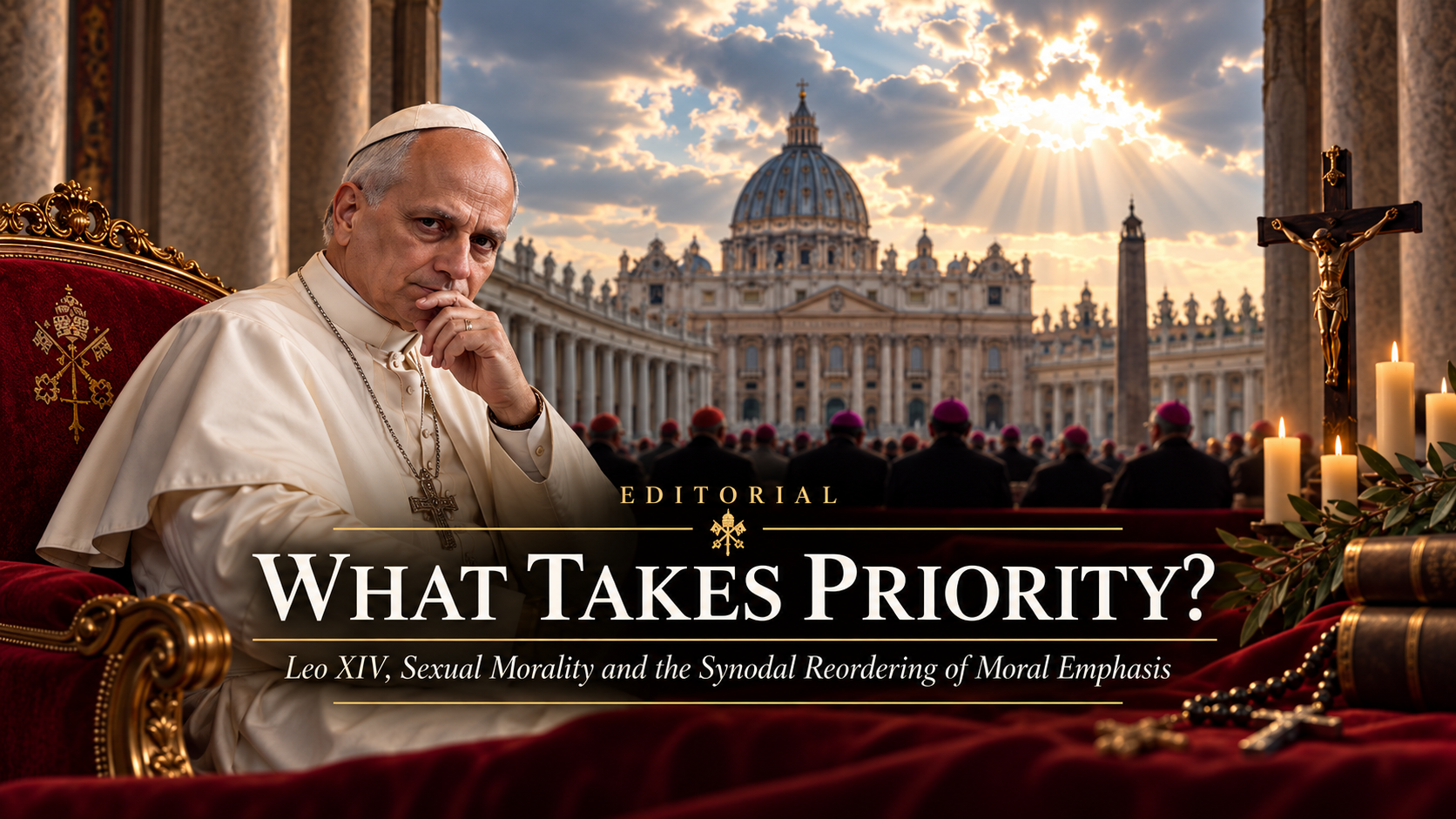
Pope Leo XIV has not repudiated Catholic sexual morality. The more consequential question is whether he is establishing a pastoral hierarchy in which its doctrines remain formally intact while becoming progressively less determinative. With October’s synodally structured Amoris Laetitia meeting approaching, an apparently incidental remark made in April now deserves much closer attention.
The most consequential words in Pope Leo XIV’s April in-flight answer were not those concerning blessings. Returning to Rome from Equatorial Guinea on 23 April, the Pope was asked about Cardinal ✠Reinhard Marx’s decision to permit blessings of homosexual couples in Munich and Freising and about the implications of such divergent practices for the unity of the universal Church. Leo made clear that the Holy See did not agree with formalised blessings of homosexual couples, or of couples in irregular situations, beyond the kind of non-ritualised blessing permitted under Pope Francis. He also spoke of the universal call to follow Christ and to conversion. Those qualifications matter. Yet between them came another proposition whose significance has become clearer as the October meeting on Amoris Laetitia has taken shape. Leo said that the Church should not allow its unity or division to revolve around sexual questions and described justice, equality, the freedom of men and women and religious freedom as “much greater, more important issues” which “would all take priority” over the particular sexual question he was discussing.¹
Had the remark stood alone, it might reasonably have been treated as an imprecise answer given during the peculiar informality of an airborne press conference. Popes speaking extemporaneously to journalists do not thereby promulgate doctrinal definitions, and Catholic journalism ought not manufacture a magisterial crisis from every awkward formulation. There is also an entirely legitimate point within Leo’s answer. Christianity does not reduce the moral life to the Sixth Commandment. A man who loudly condemns fornication while defrauding his workers, exploiting the poor or destroying another man’s reputation is not practising an integrated Catholic morality. Scripture itself refuses such compartmentalisation. The prophets condemn injustice as fiercely as impurity; Our Lord speaks both of adultery and of the judgment awaiting those who neglect the hungry, the stranger, the naked and the prisoner. The Church is obliged to preach the whole moral law.
The difficulty begins not with Leo’s rejection of a reductionist sexual morality but with the language of priority. It becomes more significant because the Pope who used that language in April is the same Pope who, five weeks earlier, had announced that the presidents of the world’s episcopal conferences and the heads of the Eastern Catholic Churches would gather in Rome from 7–14 October for a “synodal discernment” concerning the proclamation of the Gospel to families specifically “in light of Amoris Laetitia”. Leo called Francis’s exhortation a “luminous message of hope”, thanked God for the impulse it had given to pastoral conversion and asked the Church for courage to persevere along the path it had opened. The thematic framework published in July subsequently described October as an “eminently pastoral journey”, situated within an ongoing process of “pastoral conversion”, and again spoke of persevering on the Amoris Laetitia path.²
Nuntiatoria has been tracing that development for months. In March, “Synodality Entrenched: Leo XIV, Amoris Laetitia, and the Reconfiguration of Family Doctrine” argued that the tenth anniversary was becoming less a moment for settling the controversies created by Chapter VIII than an occasion for consolidating the method through which those controversies had been managed. On 4 September, “Leo XIV Chooses the Path of Amoris Laetitia” examined the Pope’s own decision to make the disputed exhortation the interpretative framework for October rather than first clarifying the doctrinal and sacramental difficulties generated by its reception. Two days later, “A Name on the Letterhead: Grech, Farrell and the Synodalisation of Amoris Laetitia” considered the institutional architecture now surrounding the meeting: the formal responsibility of the Dicastery for the Laity, Family and Life, the methodological involvement of Cardinal ✠Mario Grech’s General Secretariat of the Synod, and reporting that Grech’s office may in practice be undertaking considerably more of the preparation than the official division of responsibilities suggests.³
The April remarks add another piece to that developing picture. They do not prove a hidden programme for October, nor would it be responsible to treat them as though they did. They do, however, tell us something about the Pope’s own way of framing moral controversy. When the dispute concerns sexual ethics, Leo appears anxious that it should not become the principal determinant of ecclesial division and prepared to identify other questions as greater and deserving priority. As an immediate pastoral instinct that may sound attractive. As a principle applied to the questions surrounding marriage, sexuality and sacramental discipline, it requires much more careful examination.
The first problem is conceptual. “Sexual morality” and “justice” are not two self-contained departments of Catholic ethics which can simply be weighed against one another. Sexual conduct can itself involve grave questions of justice. Adultery is an injustice towards a spouse as well as an offence against chastity. Abandoning a family for another sexual relationship wounds children and spouses in ways which cannot be confined to the category of private sexual behaviour. Pornography commodifies persons. Prostitution combines sexual disorder with exploitation. Artificially separating procreation from sexual union changes not merely private conduct but society’s understanding of motherhood, fatherhood and the rights of children. The sexual revolution itself should long ago have cured Christians of the illusion that what happens sexually between individuals remains socially contained.
Nor does Catholic social doctrine place marriage and the family beneath some allegedly higher category of social justice. The Church calls the family founded upon marriage between one man and one woman the “first and vital cell of society” and places it “at the centre of social life”. The Compendium of the Social Doctrine of the Church warns explicitly that relegating the family to a subordinate or secondary position inflicts grave harm upon society as a whole.⁴ That is a striking corrective to the assumption that marriage, chastity and sexual ethics belong to an ecclesiastical preoccupation which can safely yield precedence to the ostensibly more serious business of justice and social organisation. According to the Church’s own social teaching, marriage and family are among the foundations upon which a just social order is built.
There is a further difficulty with grouping “justice, equality and freedom” together as though the terms carried an obvious moral content independent of the Catholic understanding of the human person. Justice is a cardinal virtue with a definite object: rendering to another what is his due. Equality, considered as the equal dignity of human persons before God, is a consequence of creation and redemption; it does not imply the moral equivalence of every relationship, conduct or social arrangement. Freedom is a great human good, but Catholic doctrine has never understood freedom as autonomy from truth or from the moral law. A freedom exercised against the good of the person becomes servitude rather than fulfilment. Detached from these distinctions, the language of equality and freedom can as readily express the assumptions of contemporary liberal culture as the moral theology of the Church.
Classical Catholic morality certainly recognises distinctions among virtues and degrees of gravity among sins. It does not teach that every sin against chastity is graver than every sin against justice, and no serious criticism of Leo should attribute such a caricature to the tradition. Murder is graver than many sexual offences; oppression may constitute an enormous injustice; sins which cry to Heaven for vengeance include both the shedding of innocent blood and the oppression of the poor. Subjective culpability can also be diminished by ignorance, fear, coercion, psychological pressures and other circumstances. Moral theology is considerably more sophisticated than a league table in which “sexual sins” occupy every position above “social sins”.
Yet precisely for that reason, the Pope’s broad comparison is unsatisfactory if treated as a theological proposition. One cannot meaningfully declare “sexual morality” less important than “justice” without first asking which acts, which goods, which obligations and which circumstances are being compared. Categories this wide contain matters of radically different gravity. The Church assesses moral acts according to their object, intention and circumstances; she does not ordinarily rank entire fields of human conduct according to contemporary pastoral urgency. Leo’s remark therefore makes most sense as a statement about emphasis rather than intrinsic moral gravity. It is that pastoral emphasis, rather than any alleged change of doctrine, which concerns us here.
For Catholic moral teaching includes acts whose objective character cannot be altered by competing priorities. St John Paul II addressed precisely this problem in Veritatis Splendor. Some acts, he taught, are intrinsically evil because their object is incapable of being ordered towards God and the true good of the human person. A good intention, desirable consequence or difficult circumstance may affect culpability, but it cannot transform the moral species of the act itself. John Paul cited St Paul’s warning that the sexually immoral and adulterers, alongside thieves and the greedy, will not inherit the Kingdom of God.⁵ The point is not that sexual sins possess some unique ecclesiastical importance. It is that no intrinsically evil act becomes negotiable because attention has shifted towards another desirable good.
This distinction goes directly to the heart of the Amoris Laetitia controversy. St John Paul II’s Familiaris Consortio taught that divorced persons who had entered a new union were not to be admitted to Eucharistic Communion while living sexually as husband and wife because their condition objectively contradicted the union of Christ and His Church signified in the Eucharist. Where serious reasons prevented separation, sacramental reconciliation and Communion could become possible when the couple undertook to live in complete continence. Benedict XVI reaffirmed the substance of that discipline in Sacramentum Caritatis. Both pontiffs combined pastoral solicitude with a clear sacramental consequence arising from the objective situation.⁶
Francis’s Amoris Laetitia retained the Church’s teaching on marriage while introducing in Chapter VIII a different pastoral framework for difficult situations. The distinction between objective disorder and subjective culpability was not new; the controversy arose from the sacramental consequences drawn from it. The Buenos Aires bishops interpreted the exhortation as permitting access to Reconciliation and the Eucharist in certain circumstances even where continence was not maintained. Francis approved their interpretation, saying that it expressed the meaning of Chapter VIII and that there were no other interpretations; the documents were later published in the Acta Apostolicae Sedis with an accompanying rescript identifying them as authentic Magisterium. In 2023 the Dicastery for the Doctrine of the Faith made the practical development still clearer in its response to Cardinal ✠Dominik Duka, acknowledging the former discipline while explaining that Francis permitted sacramental reconciliation in some cases after discernment even where the proposed continence had not been maintained.⁷
This is the field into which Leo’s language about priority now enters. Again, the Pope has not said that adultery ceases to be sinful, that homosexual acts have become morally legitimate or that Catholic teaching concerning marriage has changed. He expressly rejected formalised blessings of homosexual couples in the answer under discussion. Any editorial which claimed otherwise would sacrifice accuracy for drama. The more serious issue is subtler: whether a moral teaching can remain propositionally intact while its pastoral consequences become increasingly secondary to other concerns judged more urgent, more inclusive or more conducive to ecclesial unity.
That possibility is not theoretical. It is already close to the central dispute surrounding Amoris Laetitia. Indissolubility can continue to be affirmed while the sacramental consequences once understood to follow from an objectively adulterous union are qualified through discernment. The necessity of repentance can continue to be affirmed while disagreement persists about what purpose of amendment requires in practice. The objective gravity of an act can remain unchanged while pastoral attention migrates towards diminished culpability, mitigating circumstances and gradual accompaniment. None of those concepts is illegitimate in itself; each belongs to Catholic pastoral theology. The difficulty arises when the qualifications become so determinative that the norm retains its wording but ceases reliably to govern practice.
Yesterday’s Nuntiatoria editorial described this danger through the phrase Nomen manet, res deest: the name remains while the thing is absent. The point was not that Catholic doctrine has already disappeared. It was that doctrinal language can survive even where its practical consequences become progressively negotiable. Leo’s April remarks make that concern more concrete. If sexual questions are regarded as matters around which ecclesial unity should not revolve because greater questions take priority, the temptation will always be to preserve the teaching abstractly while reducing the occasions upon which the Church permits it to become pastorally decisive.
The question of homosexual blessings illustrates the problem particularly well. Leo was not asked a general question about whether Catholics should care about poverty as well as chastity. He was asked how unity could be maintained when a senior cardinal authorised a practice touching directly upon a disputed question of sexual morality. His instinct was partly to answer that unity and division in the Church ought not revolve around sexual issues. There is an understandable pastoral concern beneath that answer: the Catholic Church is universal, cultural attitudes differ greatly, and endless Western fixation upon sexual politics can distort the breadth of her mission. Yet ecclesial unity cannot ultimately be preserved by deciding in advance that some disputed moral teachings are insufficiently important to justify division. The relevant question must first be whether the disputed matter concerns something the Church has received from Christ and is therefore bound to hand on.
Christian history is full of controversies whose apparent narrowness bore little relation to their theological importance. The Arian crisis involved terminology whose significance could seem microscopic to an outsider because what was actually at stake was the divinity of Christ. Sacramental controversies have turned upon words which appeared technical because the underlying issue concerned what the Church believed Christ had instituted. Moral controversies are no different. A dispute concerning the blessing of a relationship cannot be measured merely by asking how prominently sexuality ought to feature among the Church’s public concerns. One must first ask what the blessing signifies, whether the relationship is morally capable of receiving ecclesiastical approbation, and what confusion might be created concerning the moral law.
Our Lord Himself does not permit the Gospel to be divided into a socially important half and a sexually embarrassing remainder. He restores marriage to the order of creation: “male and female he created them”, the two becoming one flesh, and “what therefore God hath joined together, let no man put asunder” (Matt. 19:4–6). He forgives the adulterous woman while commanding her to sin no more. St Paul can condemn exploitation, greed and social injustice without hesitating to name sexual sins as incompatible with inheritance of the Kingdom (1 Cor. 6:9–11). Mercy does not require silence about the act from which the sinner is being delivered. Conversion is not an optional severity added to the Gospel by later moralists; it belongs to the form of the Gospel itself.
This is why October matters. Officially, the gathering from 7–14 October is not a Synodal Assembly. Rome expressly clarified this in April. It is a consultative meeting of Leo XIV with the presidents of episcopal conferences and heads of the Eastern Catholic Churches sui iuris. At the same time, its method is explicitly synodal. Leo called for “synodal discernment”; the General Secretariat of the Synod has been assigned organisational and methodological support; and the thematic framework is structured around mutual listening, lived experience, concrete family situations, pastoral initiatives and discernment.⁸ The juridical distinction should therefore be respected without pretending that the methodology is irrelevant. October is not formally a Synod of Bishops, but synodality determines the manner in which its questions are to be approached.
Among those questions are the accompaniment of cohabiting couples, sexual and affective formation, separation, divorce, fragility within relationships and the gap between the Christian vision of marriage and the actual circumstances in which many families live. These are proper subjects of pastoral reflection. The Church should know why marriages fail, why young people distrust permanence, why cohabitation has become normalised, why pornography deforms relationships, why parents struggle to transmit the Faith and why many who encounter Catholic sexual teaching experience it first as prohibition rather than as part of a coherent vision of the human person. Pastors who refuse to understand those realities will not become more orthodox by their ignorance.
But understanding a situation and discerning how to lead a person out of it are different from allowing the situation to redefine the destination. Catholic pastoral theology begins with the person as he actually is but directs him towards the good for which he was created. The physician must understand the patient precisely because he intends healing. The confessor distinguishes culpability because he seeks reconciliation. The Church accompanies because Christ calls the sinner somewhere. Remove that destination and accompaniment degenerates from pastoral charity into managed coexistence with whatever condition happens to exist.
That is the decisive test for October. If Leo’s hierarchy of “greater, more important issues” means only that Catholics must preach justice, defend the oppressed, protect religious liberty and resist reducing Christianity to sexual controversy, there need be no quarrel with it. The Church should do all those things. If, however, it becomes the pastoral assumption that teachings concerning marriage and sexual morality must yield whenever their consequences threaten institutional unity, cultural accommodation or the dominant language of equality and freedom, the practical effect will be much more serious than a change of emphasis.
For the moral law is an organic whole. Justice towards the poor and fidelity towards a spouse proceed from the same command to love one’s neighbour according to truth. Religious freedom and the freedom required for a valid marriage arise from the same dignity of the human person. The defence of children before birth cannot finally be separated from the meaning of sexual union and procreation. The protection of women from exploitation cannot be disentangled from chastity. The stability of society cannot be detached from the stability of marriage. The modern world has spent sixty years discovering, usually through suffering, that the sexual revolution was never merely about sex.
Nor does Catholicism ask Leo XIV to turn the Church into a permanent tribunal of sexual misconduct. It asks something more demanding: that Peter ensure no part of the moral inheritance entrusted to the Church is quietly deprived of its consequences because another age finds it difficult to hear. The Petrine office does not exist to choose which portions of Christ’s teaching are likely to cause the least friction. It exists so that the brethren may be confirmed in the Faith: “I have prayed for thee, that thy faith fail not: and thou, being once converted, confirm thy brethren” (Luke 22:32).
There remains every possibility that Leo XIV could use October constructively. He could insist that subjective culpability and objective moral reality be distinguished without confusing either. He could restore confidence that sacramental discipline expresses doctrine rather than existing as an independently adjustable pastoral instrument. He could make clear that accompaniment has conversion as its supernatural purpose, that mercy neither humiliates the sinner nor deceives him about sin, and that Amoris Laetitia must be interpreted according to the perennial moral and sacramental teaching of the Church rather than functioning as a prism through which clearer prior doctrine becomes progressively uncertain. That would not abolish discernment. It would give discernment the fixed truths without which it cannot safely operate.
The sequence Nuntiatoria has documented is therefore becoming increasingly coherent. In March, Leo chose Amoris Laetitia as the basis for a worldwide exercise of synodal discernment. The July framework translated that choice into a programme of pastoral conversion, listening and lived experience. The September reporting examined the unusually substantial involvement alleged of Cardinal Grech’s Synod Secretariat in preparing the meeting. Now Leo’s own April remarks reveal something of the moral instinct with which he may approach disputed sexual questions: not denial, but deprioritisation; not doctrinal repudiation, but reluctance to permit those questions to become decisive for ecclesial unity.
That distinction is precisely why the matter deserves attention. An open repudiation of Catholic sexual morality would be obvious and could be answered directly. A pastoral reordering is harder to identify because every doctrine may remain formally professed. Marriage remains indissoluble. Adultery remains sinful. Homosexual acts remain contrary to the moral law. Conversion remains necessary. The Catechism remains unchanged. Yet if other concerns routinely “take priority” whenever those teachings demand difficult consequences, their practical authority can diminish without a single sentence being deleted.
The Church does not need to decide whether justice matters more than chastity, whether freedom matters more than marriage, or whether equality matters more than fidelity. Those are false separations created by a civilisation which has lost sight of the unity of the good. Catholic moral theology offers something richer: one created human nature, one divine law, one order of virtue, one vocation to holiness and one final end in God. The commandments illuminate one another because their Author is one.
October will therefore test more than the legacy of Amoris Laetitia. It will test whether the Church still understands pastoral discernment as the application of received truth or is learning to treat received truth itself according to a hierarchy of contemporary pastoral priorities. Pope Leo XIV has not yet answered that question definitively. He still can.
But the answer cannot be that those teachings which modern culture finds most difficult should simply matter less. Christ did not command Peter to rank His words according to their acceptability. He commanded the Apostles to teach the nations “to observe all things whatsoever I have commanded you” (Matt. 28:20).
That remains the measure. Not which truths are presently easiest to proclaim, nor which controversies Rome would prefer not to divide the Church, but whether what Christ entrusted to His Church is still permitted to govern what she teaches, how she worships and how she calls sinners — every one of us — to conversion.
¹ Pope Leo XIV, Press Conference during the Return Flight from Malabo to Rome, 23 April 2026.
² Pope Leo XIV, Message on the Occasion of the Tenth Anniversary of the Post-Synodal Apostolic Exhortation Amoris Laetitia, 19 March 2026; General Secretariat of the Synod and Dicastery for the Laity, Family and Life, Thematic Framework for the Meeting on the Occasion of the 10th Anniversary of Amoris Laetitia, 6 July 2026.
³ Nuntiatoria, Synodality Entrenched: Leo XIV, Amoris Laetitia, and the Reconfiguration of Family Doctrine, 27 March 2026; Leo XIV Chooses the Path of Amoris Laetitia, 4 September 2026; A Name on the Letterhead: Grech, Farrell and the Synodalisation of Amoris Laetitia, 6 September 2026.
⁴ Pontifical Council for Justice and Peace, Compendium of the Social Doctrine of the Church, nn. 209–214, particularly n. 211.
⁵ St John Paul II, Veritatis Splendor, 6 August 1993, nn. 79–83, particularly nn. 80–81.
⁶ St John Paul II, Familiaris Consortio, 22 November 1981, n. 84; Benedict XVI, Sacramentum Caritatis, 22 February 2007, n. 29.
⁷ Francis, Amoris Laetitia, 19 March 2016, nn. 300–305 and footnote 351; Bishops of the Buenos Aires Pastoral Region, Criterios básicos para la aplicación del capítulo VIII de Amoris Laetitia, 5 September 2016; Francis, Letter approving the criteria, 5 September 2016; Acta Apostolicae Sedis 108 (2016), pp. 1071–1074; Dicastery for the Doctrine of the Faith, Response to a Series of Questions Posed by Cardinal Dominik Duka Regarding the Administration of the Eucharist to Divorced People Living in a New Union, 25 September 2023.
⁸ General Secretariat of the Synod, Meeting of the XVI Ordinary Council of the General Secretariat of the Synod, 20 April 2026; General Secretariat of the Synod and Dicastery for the Laity, Family and Life, Thematic Framework for the Meeting on the Occasion of the 10th Anniversary of Amoris Laetitia, 6 July 2026.



Leave a Reply