
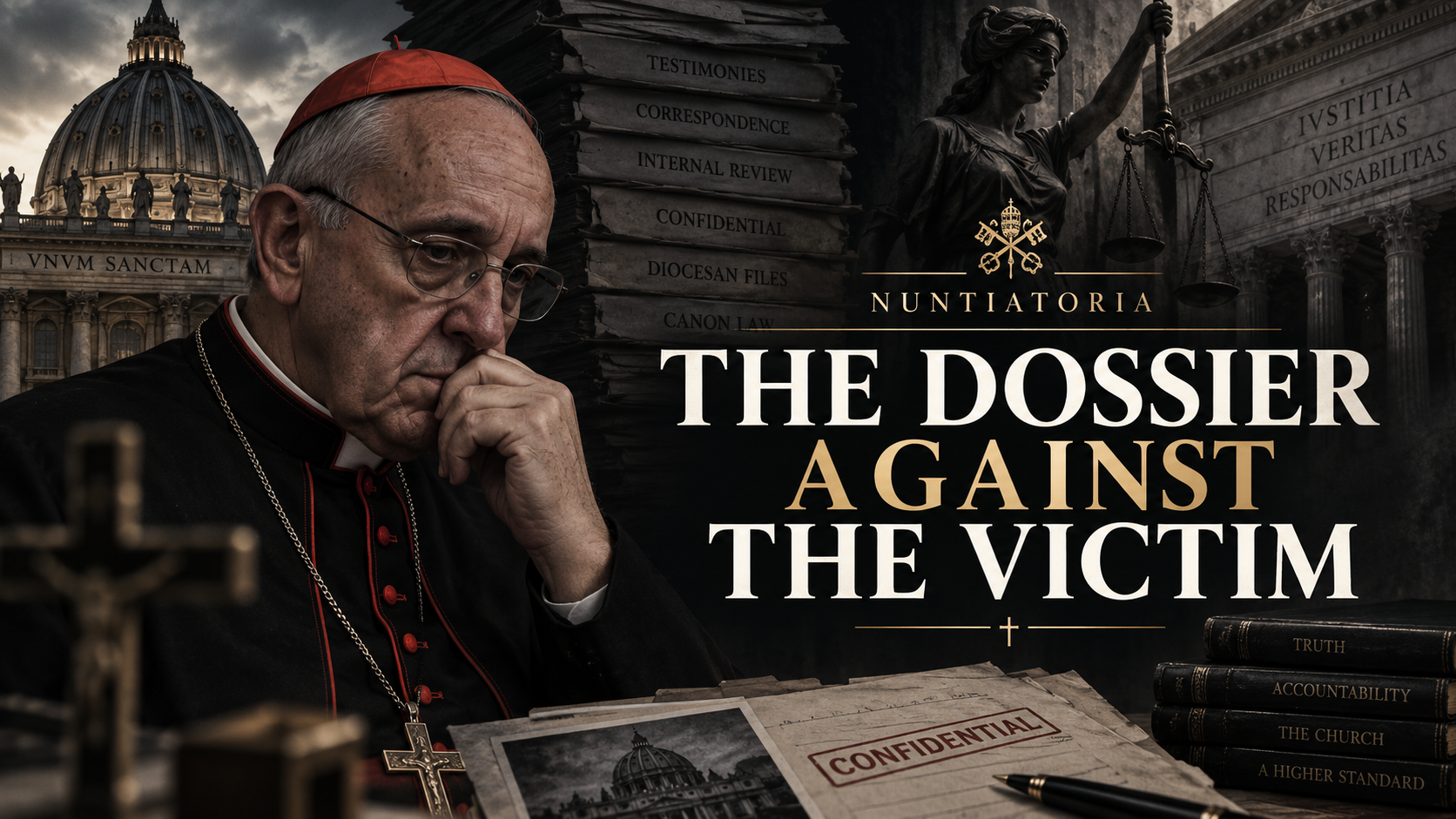
Julio César Grassi was not a stranger to Jorge Mario Bergoglio when Argentina’s most notorious clerical-abuse prosecution erupted. Grassi himself described a “very good relationship” extending over many years, involving confidential conversations about his projects and personal life; a judge later recalled Grassi invoking Bergoglio as his confessor as early as 2000; and Argentine reporting described Bergoglio as a regular visitor to Grassi’s celebrated children’s foundation. After Grassi was convicted and sentenced to fifteen years’ imprisonment for sexually abusing a boy entrusted to his care, the Argentine Episcopal Conference under Bergoglio commissioned a five-volume, 3,204-page examination of the case. The study challenged the conviction and the credibility of the prosecution case. Copies subsequently reached judges considering Grassi’s appeals, and one of those judges later described the exercise as an attempt to exert “subtle pressure” upon the judiciary. What has not been proved is whether Bergoglio personally authorised, directed or knew beforehand of that judicial circulation. Pope Francis denied trying to influence Argentine justice. The documentary record nevertheless leaves a chain of responsibility which has never been satisfactorily explained.
The scandal of Julio César Grassi does not belong merely to the long catalogue of clerical sexual-abuse cases which have disfigured the Church during the past half-century. It raises a more disturbing question: what happens when ecclesiastical authority, confronted not merely with an accusation but eventually with the conviction of an influential priest, directs formidable institutional resources towards re-examining the victim, the evidence and the judgement? In the Grassi affair that question reaches directly into the record of Jorge Mario Bergoglio before he became Pope Francis.
Grassi was no obscure parish priest. Through his Fundación Felices los Niños he became one of Argentina’s best-known clerical personalities, associated publicly with charitable work among disadvantaged children and connected with figures across ecclesiastical, political and media life. In June 2009 the Criminal Court No. 1 of Morón convicted him of aggravated sexual abuse involving a minor who had been entrusted to his care and sentenced him to fifteen years’ imprisonment. After a long appellate process, on 21 March 2017 the Supreme Court of Argentina unanimously rejected the outstanding appeals and left the conviction final.¹ Grassi has consistently maintained his innocence.
The relationship between Grassi and Bergoglio therefore matters. Bergoglio was not simply a distant president of an episcopal conference who first encountered the case after a conviction arrived upon the bishops’ desks. The two men had known one another for years.
In a lengthy interview conducted shortly before the 2009 verdict, Grassi rejected reports that Bergoglio had abandoned him. He described their relationship as “very good” and extending over “many years”, explaining that he spoke to Bergoglio with confidence about his projects and about himself. Grassi expressly added that he did not speak to him in the capacity of confessor.² The qualification matters because another witness later supplied a different account of the spiritual dimension of their association.
In 2000, two years before the abuse allegations against Grassi erupted into a national scandal, an anonymous complaint had prompted Juvenile Court judge Alfredo Meade to inspect Felices los Niños. Meade subsequently recalled that Grassi told him that, if he doubted him, he should speak to Bergoglio, “who was his confessor.”³ That testimony does not prove that Bergoglio was Grassi’s regular confessor. It proves that Grassi was invoking such a relationship to an investigating judge before the public scandal began.
People close to Bergoglio later disputed the characterisation. They denied that he had been Grassi’s regular confessor or that the relationship possessed the degree of intimacy subsequently alleged, while reportedly accepting that Bergoglio may on occasion have heard his confession.⁴ It would therefore be inaccurate to state as an uncontested fact that Bergoglio was Grassi’s confessor. The narrower proposition is sufficient: Grassi and Bergoglio had a long-standing personal relationship, Grassi described conversations of considerable confidence between them, and he regarded Bergoglio as sufficiently close and sufficiently authoritative to invoke his name when questions about Felices los Niños first reached a judge.
There was also reported contact between Bergoglio and Grassi’s institution. In 2006, Página/12 described Bergoglio as a “permanent visitor” to Felices los Niños.³ We do not possess a complete visitors’ register with which to quantify that description, and the same article presented the disputed confessor claim as fact. Its account must therefore be used with appropriate caution. Yet considered alongside Grassi’s own description of their long relationship, it adds to the evidence that Bergoglio knew both the priest and his work well before the criminal proceedings reached their conclusion.
One jurisdictional distinction must nevertheless remain clear. Grassi was not Bergoglio’s diocesan priest. After leaving the Salesians he belonged to the Diocese of Morón. Bergoglio, Archbishop of Buenos Aires from 1998, was not therefore Grassi’s diocesan ordinary and did not possess ordinary canonical jurisdiction over him. Responsibility for governing Grassi as a diocesan priest belonged to the Bishop of Morón. Any suggestion that Bergoglio was his direct ecclesiastical superior would be wrong.
Paradoxically, that makes the personal relationship more significant rather than less. If the two men communicated frequently, if Bergoglio knew Grassi’s projects and visited his foundation, and if Grassi regarded him as someone in whom he could confide, the relationship cannot simply be explained as routine contact between an ordinary and one of his clergy. It crossed diocesan boundaries.
Evidence concerning Bergoglio’s attitude after the allegations became public is more contested. In 2006, while Grassi was accused but remained legally entitled to the presumption of innocence, Grassi claimed that Bergoglio had told him personally: “I believe you.”⁵ Two years later, however, the Argentine Episcopal Conference publicly distanced itself from Grassi’s assertion that he enjoyed Bergoglio’s support. Its spokesman described that claim as Grassi’s own and emphasised both respect for the work of the courts and the presumption of innocence.⁶ Grassi nevertheless continued to insist that Bergoglio remained beside him, telling interviewers in May 2009 that the cardinal had “never let go of my hand”.²
Those statements must remain attributed to Grassi. A defendant facing grave criminal charges had an obvious interest in presenting himself as possessing the confidence of Argentina’s most important churchman. They cannot simply be transmuted into independent evidence of Bergoglio’s private opinions. They nevertheless form part of the relevant chronology because they were made against the background of a relationship demonstrably predating the scandal.
Nor was there anything inherently improper in Bergoglio defending the presumption of innocence before judgement. Catholic morality does not permit guilt to be established by publicity, however horrifying an allegation may be. Justice belongs neither to a television studio nor to an ecclesiastical faction. The moral significance of Bergoglio’s subsequent conduct therefore lies not principally in what he said while Grassi was an accused man, but in what happened after a court heard the evidence and convicted him.
In 2010 the Argentine Episcopal Conference commissioned the distinguished criminal-law professor Marcelo A. Sancinetti to undertake an extensive study of the proceedings. Here the documentary evidence is unusually strong. In his own exhaustive list of publications Sancinetti identifies Estudios sobre el “caso Grassi” as a five-volume work completed between 2010 and 2013. He states expressly that the opinion was commissioned in 2010 by the then President of the Argentine Episcopal Conference, Cardinal Jorge M. Bergoglio. The five volumes listed by Sancinetti contain respectively 430, 646, 659, 740 and 729 pages: 3,204 pages in all. He further states that the work was intended exclusively for the commissioning body, the Episcopal Conference, and was not to be published unless the Conference itself decided otherwise.⁷
That primary evidence is important. The existence of the commission, Bergoglio’s role in commissioning it and the eventual scale of the work are not dependent upon an inference drawn by hostile reporters. They are recorded by the scholar commissioned to produce it.
The France 2 Cash Investigation programme broadcast in March 2017 referred to approximately 2,800 pages of material. The discrepancy with Sancinetti’s final 3,204-page bibliography is not consequential. His own record shows that the project developed across five volumes between 2010 and 2013. What matters is that the eventual undertaking was even more extensive than the material initially described by the television investigation.
More important is its character. This was not simply a short canonical memorandum asking what ecclesiastical consequences ought to follow a civil conviction. Contemporary Argentine reporting described an extensive counter-examination of the evidence and the complainants. In 2011, Página/12 reported that the Episcopal Conference had commissioned a work defending Grassi and that the volumes maintained his innocence.⁸ The France 2 investigators, after examining the material, reported that the complainants were accused of falsifications, lies, deceit and invention, that aspects of their sexual orientation were scrutinised, and that the study concluded that the judicial decision was wrong and Grassi ought to have been acquitted.⁹
The Church unquestionably possesses the right to reach her own canonical judgement. A civil conviction does not automatically substitute for an ecclesiastical penal process, and Catholic doctrine does not subordinate the Church’s entire judicial competence to the State. There could therefore have been legitimate reasons for the bishops to commission expert analysis of a difficult criminal case. The problem lies not merely in the existence of an ecclesiastical study. It lies in its extraordinary scale, its heavily exculpatory character, its treatment of the complainants and, above all, what happened next.
The study did not remain within the institution for whose exclusive use Sancinetti says it had been prepared.
Copies reached members of the secular judiciary while Grassi’s conviction remained under appeal. This was reported contemporaneously in Argentina. In December 2011, Página/12 reported that the work was being distributed to judges of the provincial Supreme Court considering Grassi’s case, while the complainants’ lawyer Juan Pablo Gallego denounced what he regarded as an exercise in lobbying and pressure.⁸ In 2013 Tiempo Argentino similarly reported that copies had reached magistrates required to make decisions in the continuing proceedings.¹⁰
The allegation of pressure did not remain solely the accusation of a lawyer representing the victims. When France 2 later interviewed Carlos Mahiques, a judge who had received the study, he confirmed that the material had arrived in his office. Mahiques said it had not influenced his judgement. His assessment of it was nevertheless striking. He described its legal analysis as partial, in places very partial, and possessing a clear intention favourable to Grassi. He then described what he understood to be an attempt to exercise “subtle pressure” upon the judges.⁹
That testimony changes the evidential character of the affair. It establishes neither corruption nor a criminal conspiracy. But it means that the allegation of attempted influence cannot be dismissed merely as rhetoric from Grassi’s opponents. A judicial recipient of the material himself understood the exercise in terms of pressure.
Here lies the central legal uncertainty, and it should be stated as precisely as the established facts.
Bergoglio → commission is evidenced.
Dossier → judges is evidenced.
Bergoglio → decision to send the dossier to judges is not proved.
That missing link is decisive. The evidence presently available does not establish who made the decision to circulate an internal Episcopal Conference study to members of the judiciary; who actually transmitted it; whether Bergoglio knew beforehand that this would occur; whether he authorised or subsequently approved it; or whether the circulation was undertaken by someone else without his involvement. Nor does the mere fact that a legal study reached judges, without more evidence about the circumstances and purpose of its transmission, itself establish an unlawful act.
France 2 went further than the documentary record presently permits when its narration suggested that Bergoglio himself had sent the material to judges at strategically chosen moments before appeal hearings. The programme had strong evidence that the study had reached the judiciary and direct evidence from Mahiques concerning how he interpreted it. But the transcript itself moves from those facts to the more qualified proposition that Bergoglio was said to have sent it.¹¹ The evidence available to us does not close that gap.
This limitation is important precisely because the underlying facts are already serious enough. There is no need to enlarge them. Bergoglio commissioned the study. The study was produced after Grassi’s conviction and ultimately ran to 3,204 pages. It was substantially favourable to Grassi’s case and challenged the evidential basis of his conviction. Material intended by its author for the Episcopal Conference reached judges considering the appeals. One of those judges perceived an effort at subtle pressure. What remains unknown is who connected the two ends of that chain.
The personal history between Bergoglio and Grassi makes the unanswered question more significant. It does not prove improper motive. Friendship, pastoral concern or personal acquaintance does not make a churchman complicit in another man’s crimes, and neither charity nor priestly fraternity requires abandoning someone merely because he has been accused. But where a senior ecclesiastic has a long-standing relationship with a defendant, subsequent institutional intervention in that defendant’s case requires particular transparency. After conviction, the obligation to distinguish pastoral solicitude from institutional advocacy becomes greater, not smaller.
The experience of the victims supplies the moral perspective which institutional narratives so often obscure. France 2 interviewed clerical-abuse survivors in Buenos Aires who said that they had attempted to contact Bergoglio while he was archbishop and received no response. One spoke of the anguish and disappointment she experienced.¹² Their testimony cannot establish that Bergoglio personally received or knew of every approach made to his offices. But it records the experience of people who believed that the ecclesiastical door was closed to them.
The principal complainant in the Grassi case described something more frightening. He told the investigators that he had received threats, that his home had been broken into and possessions removed, and that the danger surrounding him eventually resulted in his entering a protected-witness programme. Asked about the Church-sponsored study, he recalled Grassi’s claim that “Bergoglio never let go of my hand.”¹³ The statement proves nothing about Bergoglio’s knowledge of threats or criminal conduct, and no such implication should be made. Its significance is that it captures how the institutional alignment appeared from the other side: the convicted priest spoke of the cardinal’s enduring support while the victim lived under protection.
Nuntiatoria has confronted this pattern before. During the 2025 conclave we noted the Grassi affair among several cases which complicated the presentation of Francis’s pontificate as an uncomplicated triumph of safeguarding reform.¹⁴ More recently, in considering the Rupnik scandal at Lourdes, we argued that the credibility of safeguarding is tested precisely when the person under scrutiny is prestigious, useful, connected or institutionally valuable.¹⁵ The present investigation develops that earlier reporting considerably. In Grassi’s case we can now distinguish more securely between the personal relationship, the post-conviction episcopal commission, the character of the resulting study, its arrival within the judicial process and the crucial transmission link which remains unproved.
The distinction is a Catholic one before it is a journalistic one. Justice does not permit us to manufacture culpability in order to strengthen a righteous cause. St Thomas Aquinas, following the classical definition, describes justice as the constant and perpetual will to render to each his right.¹⁶ That obligation applies simultaneously to the abused child, to the accused or convicted cleric, to the bishop whose conduct is under examination and to the faithful entitled to the truth. A safeguarding culture that abandons due process is not just; neither is a due-process culture that uses procedural caution as a pretext for institutional self-protection.
Our Lord’s warning concerning scandal is correspondingly severe: “He that shall scandalize one of these little ones that believe in me, it were better for him that a millstone should be hanged about his neck, and that he should be drowned in the depth of the sea.” The words do not concern public relations. The moral catastrophe of clerical abuse lies first in what is done to the innocent; its ecclesiastical aggravation occurs when structures created for the care of souls appear instead to protect status, reputation or fraternity at their expense.
St Thomas treats scandal as conduct which occasions another’s spiritual ruin.¹⁷ That is why institutional responses to abuse cannot be judged exclusively by whether they cross the threshold of civil criminality. An act may fall short of criminal obstruction and nevertheless be profoundly imprudent, unjust or scandalous. The question before the Church is therefore larger than whether someone can prove that Bergoglio committed a prosecutable offence. It concerns the moral ordering of ecclesiastical authority: whom did the institution hear, whose account did it scrutinise, and upon whom did it spend its resources?
There is an equally important obligation towards the accused. Before Grassi’s conviction, Bergoglio was entitled to insist that the press could not adjudicate guilt. After conviction, the Church remained entitled to consider the evidence and determine whatever canonical questions remained. What is difficult to reconcile with an uncomplicated picture of neutral ecclesiastical review is the eventual production of thousands of pages substantially contesting the judicial assessment and the complainants themselves, followed by the appearance of that material before judges deciding the appeals.
Francis was eventually confronted with precisely this issue. After repeated efforts to obtain an interview, the France 2 journalists approached him during a public audience in St Peter’s Square. They gave him written questions and asked whether he had tried to influence Argentine justice in the Grassi case. Francis answered: “Not at all.” When they asked why he had commissioned the study, no substantive explanation followed; according to the programme, neither Francis nor Vatican officials subsequently answered the written questions.¹⁸
That denial belongs in the record without qualification. It has not been proved that Jorge Bergoglio personally directed an attempt to influence the judges hearing Grassi’s appeals. To imply otherwise would exceed the evidence.
Yet his denial does not answer the narrower documented questions. Why was such a vast post-conviction study commissioned? Why did a work Sancinetti says was intended exclusively for the Episcopal Conference reach secular judges? Who authorised its circulation? Did Bergoglio know? If he did not, who within the Church acted? If he did, what did he understand the purpose of the circulation to be? Was any record kept of the decision? Were the parties to the proceedings formally aware that the material had been supplied? These are questions of documentary chain and institutional responsibility. They are not answered by the statement that Bergoglio did not intend to influence justice.
Nor should the case be weakened by attaching unsupported financial claims to it. Argentine reporting attempted to establish how much Sancinetti had been paid and who ultimately financed the undertaking, but he did not answer those questions.¹⁹ We therefore do not repeat claims that the study cost hundreds of thousands or millions. Without accounts, invoices or comparable documentation, such figures remain unproved.
Removing them improves rather than diminishes the case. This is not principally a story about money. Nor, on present evidence, is it a story in which we can state that Bergoglio personally corrupted an appellate process. It is a story about where institutional effort was directed, for whose benefit, against whose testimony, and how a confidential Church-commissioned counter-investigation favourable to a convicted priest came to enter the orbit of judges deciding his appeals.
That question cannot be separated from the long-standing relationship between the two men. Personal loyalty can be virtuous. A priest does not cease to possess a soul because he has committed a grave crime, and authentic pastoral charity does not abandon the sinner. But pastoral charity and institutional judgement are not identical. The same bishop who offers a convicted priest spiritual consolation must be capable of protecting victims, respecting judicial truth and preventing his own affection or confidence from distorting public responsibility.
Indeed, a prior relationship imposes a particular obligation of detachment. In secular judicial systems a potential conflict of interest is managed not because friendship proves corruption but because justice must be, and must appear to be, independent of private loyalties. Ecclesiastical government should demand no lower moral standard. Where a senior churchman has known a priest for years, has reportedly visited his institution and is publicly claimed by that priest as a continuing supporter, the commissioning of an enormous post-conviction study demands especially rigorous transparency.
For much of the clerical-abuse crisis, the deepest institutional mistake was precisely the confusion of the Church with the reputation of her office-holders. Scandal came to mean publicity. Protecting the Church came to mean preventing disgrace. Victims became dangerous because their testimony threatened institutions, benefactors, episcopal reputations or admired apostolates. The impulse was profoundly self-defeating. The Church is not protected when truth is managed. She is protected when truth is obeyed.
The Grassi affair therefore remains significant long after the death of Francis because it exposes a recurrent ecclesiastical temptation. Structures established to exercise prudence can become mechanisms for delay. Canonical independence can become an excuse for refusing facts established elsewhere. Pastoral concern for an accused priest can drift into advocacy. Respect for reputation can become hostility towards the person whose testimony threatens it. None of these corruptions requires a written conspiracy. Institutions acquire habits, and habits can become cultures.
This is why victims must remain morally central. The Church does not exist to preserve herself as an ecclesiastical corporation. Her hierarchy exists to teach, sanctify and govern for the salvation of souls. Episcopal authority is not private property. It is a stewardship received from Christ and answerable to Him. When that authority encounters a child abused by a priest, its first obligation is not to calculate reputational damage but to render justice, protect the vulnerable, seek truth and repair whatever can still be repaired.
It would be unjust to say that the documentary record proves Jorge Bergoglio personally ordered Argentine judges to favour Julio César Grassi. It does not.
It would be equally unjust to pretend that nothing serious has been established merely because that final link remains missing.
Bergoglio and Grassi had known one another personally for years before the scandal. Grassi described their relationship as very good and confidential. He invoked Bergoglio’s name to a judge investigating concerns at his foundation before the case became a national sensation. After Grassi was convicted, the Argentine Episcopal Conference under Bergoglio commissioned a confidential five-volume, 3,204-page examination of the case. The resulting work was substantially favourable to Grassi and challenged both the conviction and the evidence against him. Copies reached judges dealing with his appeals. One recipient judge believed an effort was being made to exert subtle pressure upon the judiciary.
Between those established propositions lies the outstanding question:
Who connected the dossier to the judges?
That is not a technical footnote to the affair. It is the central evidential uncertainty.
If Bergoglio knew nothing about the circulation, the historical record should establish who acted without his authority. If he knew and approved it for some legitimate purpose, that purpose and the procedure employed should have been explained. If he authorised an attempt to influence judges outside the proper judicial process, that would be a graver matter still. The available evidence does not permit us to choose confidently between those possibilities.
Pope Francis had the opportunity to resolve the question. He denied attempting to influence justice, but never supplied the fuller account necessary to explain the documentary chain.
That is why the dossier remains open.
Not because guilt should be presumed.
Because the truth should not have to be.

¹ Centro de Información Judicial, “La Corte Suprema de Justicia de la Nación confirmó la condena de 15 años de prisión contra Julio César Grassi”, 21 March 2017.
² Jorge Fontevecchia, “Entrevista a Julio César Grassi: ‘Bergoglio no me soltó la mano’”, Perfil interview, May 2009, reproduced 10 June 2009.
³ Miguel Jorquera, “No protejan a este monstruo”, Página/12, 9 June 2006.
⁴ El País, “El caso del cura pedófilo que desafía al Papa”, 30 April 2017.
⁵ Télam/Ámbito Financiero, “Denunció Grassi que peritos le cuestionan el celibato”, June 2006.
⁶ La Nación, “Tomó distancia el Episcopado de dichos del padre Grassi”, 21 August 2008.
⁷ Marcelo A. Sancinetti, “Lista exhaustiva de publicaciones”, entry 23, Estudios sobre el “caso Grassi”, 2010–2013.
⁸ Carlos Rodríguez, “El cura condenado tiene quien le escriba”, Página/12, 17 December 2011.
⁹ France 2, Cash Investigation, “Pédophilie dans l’Église : le poids du silence”, 21 March 2017. Transcript:
¹⁰ Tiempo Argentino, “Denuncian lobby de Grassi ante la Corte bonaerense y el Vaticano”, 15 September 2013.
¹¹ France 2, Cash Investigation, “Pédophilie dans l’Église : le poids du silence”, 21 March 2017.
¹² France 2, Cash Investigation, “Pédophilie dans l’Église : le poids du silence”, 21 March 2017.
¹³ France 2, Cash Investigation, “Pédophilie dans l’Église : le poids du silence”, 21 March 2017.
¹⁴ Nuntiatoria, “‘Conclave Watch’: Survivors Demand a Clean Break with Francis’s Legacy of Abuse Mismanagement”, 2 May 2025.
¹⁵ Nuntiatoria, “Lourdes Draws the Veil: Rupnik, Scandal and the Supreme Law of Souls”, 28 August 2026.
¹⁶ St Thomas Aquinas, Summa Theologiae, II–II, q. 58, a. 1.
¹⁷ St Thomas Aquinas, Summa Theologiae, II–II, q. 43.
¹⁸ France 2, Cash Investigation, “Pédophilie dans l’Église : le poids du silence”, 21 March 2017.
¹⁹ Horacio Verbitsky, “La verdad es la verdad”, Página/12, 30 November 2014.





Leave a Reply