
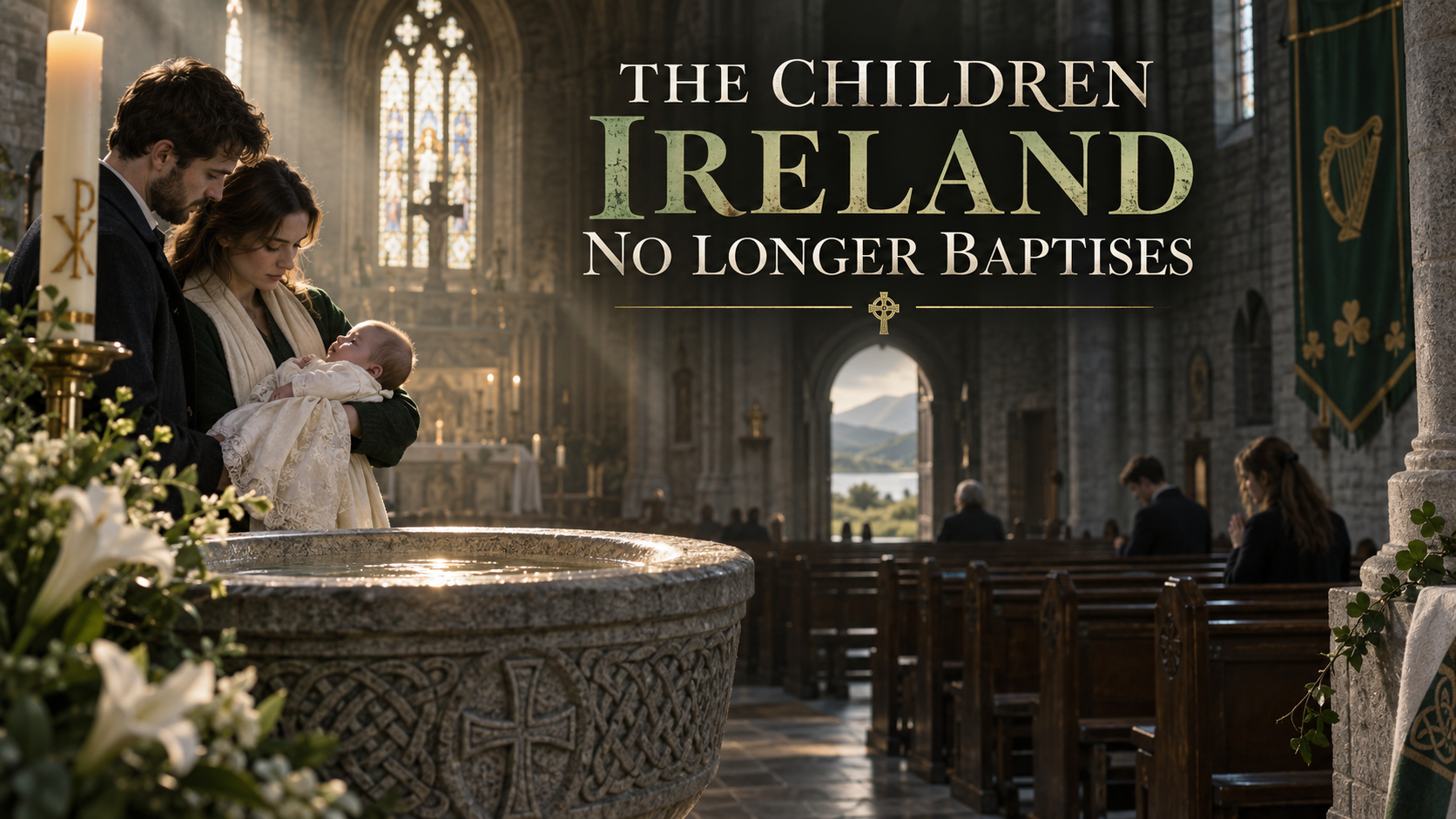
Catholic baptisms across the island of Ireland have fallen by almost 30 per cent in a decade. Falling births explain much of the decline, but not all of it. Catholic marriage has fallen faster still; the generation now entering parenthood is markedly less Catholic than the one before it; and the priests and religious who sustained the old parochial system are disappearing. Yet the newest evidence complicates any simple obituary, because religious affiliation and practice have recently risen among some younger adults. Ireland may be witnessing not merely the decline of Catholicism, but the end of an age in which Catholicism scarcely had to be chosen.
A baptismal register is a peculiar instrument with which to measure the passing of a civilisation. What it records is first of all supernatural: a human being washed from original sin, incorporated into Christ and His Mystical Body, and made an heir to eternal life. Yet place thousands of those entries beside one another and compare them across a decade and they disclose something else. They show whether a people is still handing on the Faith. They tell us whether parents continue to bring their children to the font and, ultimately, whether one generation still possesses something it intends the next generation to receive. By that measure, Ireland is changing profoundly.
Figures assembled by the Iona Institute from almost every Catholic diocese on the island show annual baptisms falling by about 30 per cent over the decade to 2025. Dublin recorded a fall of 39.9 per cent, Meath 40.8 per cent and Down and Connor 37.9 per cent. There are local exceptions — Elphin was effectively static and Achonry fell only slightly — and the underlying diocesan series is not perfectly uniform, but the movement is far too large and widespread to mistake. Ireland is baptising substantially fewer children than it was ten years ago.¹
The first reason is demographic and should be acknowledged before anything ecclesiastical is inferred from the figures. Ireland has fewer babies. Births across the island fell by 18.8 per cent during roughly the same period. In the Republic alone, registered births fell from 65,909 in 2015 to 54,125 in 2025, while the total fertility rate declined from 1.9 children per woman to 1.5. The Iona analysis estimates that falling births account for about three-fifths of the decline in baptisms. A substantial reduction would therefore have occurred even had the religious behaviour of parents remained unchanged. There is no virtue in turning demography into a Church statistic merely because the result makes a more dramatic headline.¹ ²
The problem is what remains after demography has done its work. Baptisms have fallen by considerably more than births. At the same time, the population from which Catholic parents emerge has itself become less Catholic. In the 2022 Census, 69 per cent of the Republic’s population identified as Roman Catholic, compared with 79 per cent in 2016, while more than 736,000 people reported having no religion. Among children aged four and under, 65 per cent were Roman Catholic and 16 per cent had no religion. Among 25–29-year-olds, an age group moving directly into marriage and parenthood, the Catholic proportion was only 53 per cent, while 26 per cent reported no religion. The CSO cautions that the wording of the religion question changed between the 2016 and 2022 censuses and may affect direct comparison, but the age profile within the 2022 figures is striking in its own right.³
There is a qualification which makes the baptism story more revealing rather than less. The Iona analysis notes that the proportion of mothers with young children who identify themselves as Catholic is remarkably close to the proportion of their children recorded as Catholic. Its inference is that mothers who continue to describe themselves as Catholic are, overwhelmingly, still having their children baptised. The immediate problem is therefore not primarily one of Catholic parents suddenly refusing baptism. There are fewer babies, certainly, but there are also fewer parents identifying themselves as Catholic in the first place. Cultural Catholicism still has enough life to carry many families to the font; what is disappearing is the much larger social world in which doing so was once taken almost entirely for granted.¹
Marriage gives us a clearer view of the change because here adults are choosing directly for themselves. There were 12,486 Roman Catholic marriages in the Republic in 2015. In 2025 there were 5,927, a fall of more than half in ten years. The total number of marriages fell by only 9.7 per cent over the same period. Among opposite-sex couples, the Catholic share declined from 56.7 per cent to 30.8 per cent, with civil ceremonies moving ahead.⁴ This cannot plausibly be explained by fertility or by saying that nobody marries any more. Irish people are still marrying. What has altered dramatically is the number choosing the Catholic sacrament.
Baptism may therefore be revealing religious change more slowly than marriage. A couple which does not marry in church, seldom attends Mass and possesses little catechetical knowledge may still want its child baptised. The grandparents expect it; the parents remember their own baptism, First Communion or school Masses; the church remains part of the family’s mental furniture even when doctrine and regular practice have largely disappeared. The font can retain its cultural pull after the altar has lost it. The difficulty is that such memory does not replenish itself. A child baptised because his parents remember that this is what their family does will have far less reason to repeat the act with his own children if nothing between those two baptisms teaches him what the sacrament was for.
Fr Brendan Kilcoyne described almost exactly this condition more than three years before the latest baptism figures appeared. In “The End Of Irish Catholicism ?”, a Fireside with Fathers discussion streamed live on the Servants HM Films YouTube channel on 15 May 2023, he argued that Irish Catholicism was “pretty much over” if by that expression one meant the surviving piece of Christendom in which the Faith inhabited the imagination of the people and consequently informed legislation, public policy and the ordinary assumptions of society. He was not announcing the disappearance of the Church. He was describing the disappearance of the culture in which the Church had once appeared to be the natural religious expression of the nation.⁵
The distinction is more important than the rhetoric. Ireland can retain Catholic schools, churches, baptisms, First Communions, Confirmations and funerals for a considerable period after the society which gave those practices coherence has begun to dissolve. Institutions have momentum. So do family customs. A church can still be packed for a First Communion by people who will not return the following Sunday. A young adult can retain “Catholic” on a census form while possessing little idea what Catholicism claims about God, grace, the Eucharist or the moral life. A family can instinctively telephone a priest when somebody dies although almost nobody in the family has been to Mass for years. None of this makes the sacraments unreal; it means that sacramental behaviour and interior Catholic conviction do not always disappear at the same speed.
Kilcoyne deliberately chose an ugly image for the resulting condition. He spoke of a kind of “zombie” Catholicism, the inherited Catholic body still moving when much of the social and religious life which animated it had gone. He pointed to continued large numbers at baptism, First Communion and Confirmation while Catholic marriage weakened and secular alternatives became more usual. He even welcomed, in a deliberately provocative sense, the point at which people who did not believe ceased maintaining appearances, because an honest religious decision was preferable to indefinitely mistaking cultural observance for faith.⁵ Three years later, the collapse in Catholic marriage gives his observation a weight which it did not require rhetoric to supply.
The institutional statistics tell the same story from another direction. Across the island, the number of diocesan priests fell from 3,673 in 1990 to 2,090 in 2024, a decline of 43.1 per cent. Religious priests fell by 52.9 per cent and women religious by 60.2 per cent. Even between 2015 and 2024 the number of diocesan priests fell from 2,621 to 2,090.⁶ Those percentages translate directly into the life of parishes: wider territories, fewer resident priests, churches served from another town, religious communities withdrawing from institutions they once staffed, and dioceses attempting to fit structures created in conditions of clerical abundance around a Church which no longer possesses the people required to maintain them.
Kilcoyne’s 2023 criticism was not that the Church lacked competent administrators. He explicitly thought the opposite. His anxiety was that good administration could itself become a means of postponing recognition of what had happened. Buildings could be redistributed, priests reassigned and parish groupings devised while the deeper question remained untouched. The Irish Church was not merely confronting a shortage of clergy within an otherwise unchanged Catholic society. The society for which much of the existing ecclesiastical machinery had been designed was itself disappearing.⁵
Archbishop ✠Dermot Farrell has approached the matter from a different ecclesial direction but has nevertheless used language which touches the same problem. He has warned against exhausting the Church in attempts to preserve “structures inherited from another time” which no longer answer the needs of present faith communities, placing the emphasis instead upon baptismal vocation, younger generations and mission.⁷ The convergence should not be forced too far, but it deserves notice. Administration is indispensable to ecclesial government; it simply cannot do what evangelisation and formation alone can do. A reorganisation can decide which priest covers three parishes. It cannot make a young man believe, teach parents to pray with their children or persuade somebody to give his life to the priesthood.
The 2023 Servants HM Films conversation also contains a harder question about the parish itself. The predicament is described of priests meeting large numbers of families chiefly at baptism, First Communion, Confirmation, marriage and funerals, while ordinary weekly participation becomes thinner. Kilcoyne wonders whether the inherited model of parish life, formed in a society which was geographically and culturally far more settled, has become increasingly inadequate as the sole means of sustaining believers in a highly mobile society.⁵ The suggestion is not that the territorial parish should disappear. It is that the old Irish parish did not work merely because canon law drew a boundary around it. Family, locality, school, priest, religious practice, neighbourhood identity and Sunday Mass reinforced one another. Preserve the boundary while those relationships unravel and one has preserved a map, not necessarily a community.
There is little value in pretending that any single ecclesiastical event explains this collapse. Ireland underwent one of the most rapid economic and cultural transformations in Western Europe. Prosperity, urbanisation, smaller families, mobility, mass higher education, the sexual revolution, consumer individualism, clerical scandal and the general weakening of inherited authority all belong to the story. Any account which simply writes “Vatican II” in the margin and considers the matter solved is inadequate to the history. The reverse evasion is no more persuasive. It is impossible to survey the religious results of the past sixty years and maintain that the pastoral accommodation of Catholicism to modernity succeeded in retaining a Catholic people.
Distinctive practices were reduced precisely as Irish society became less distinctively Catholic. Worship was progressively presented in more familiar and conversational forms; clerical language became more cautious; difficult moral teaching was frequently softened in its presentation or avoided; Catholic institutions became increasingly anxious to demonstrate that they could occupy an untroubled place within the developing social consensus. Many of these choices were defended as missionary necessities. Yet the expected missionary dividend is very difficult to locate in the figures. Ireland did not remain Catholic because Catholicism made itself less culturally abrasive.
Kilcoyne returned to that desire for acceptance in “The Wolf is Here. The State of Ireland”, another Fireside with Fathers discussion on the Servants HM Films YouTube channel, streamed live on 4 September 2026. “We want to be liked,” he said. “We want to find a place in this new culture.” His conclusion was more severe: “We don’t have a place in this new culture.”⁸ It would be easy to turn that into a caricature, as though Catholicism ought to cultivate social hostility for its own sake. His real point is simpler. A religion which makes definite claims about God, human nature, sex, marriage, life, death and salvation cannot make cultural acceptance the test of whether those claims may continue to be spoken.
In the same September discussion Kilcoyne questioned what can happen to episcopal teaching when the desire for a common conference voice becomes stronger than the distinctive voice of the diocesan bishop. He was careful not to indulge in indiscriminate criticism of bishops and spoke warmly of several whom he knew. His criticism was of a style: statements negotiated until every sharp edge is covered, every phrase safely diplomatic and every sentence unlikely to offend.⁸ Nuntiatoria has raised the same underlying concern in “Finding Faith: The Irish Synod’s Missed Opportunity to Renew”. Consultation and reorganisation may be necessary, but a Church experiencing a crisis of faith cannot cure it by perfecting the machinery through which the crisis is discussed.⁹
If the evidence ended there, one could write the rest of the Irish story without much difficulty. Baptisms down, marriages down, vocations down, clergy ageing, parish structures contracting, younger generations increasingly unaffiliated: a familiar European pattern proceeding towards its familiar conclusion. Yet the newest evidence is obstinately less convenient than that.
In March 2026 the Irish Catholic Bishops’ Conference published Turning the Tide? Recent Religious Trends on the Island of Ireland, by Emily Nelson and Professor Stephen Bullivant. Its long view offers no comfort to anyone hoping to deny Irish secularisation. Catholic affiliation and religious practice have fallen dramatically since the European Social Survey began in 2002/03. But the 2023/24 survey round produced an unexpected movement in the opposite direction, and that movement was strongest among younger adults. The authors themselves describe the latest data as showing a notable uptick in both affiliation and practice while warning, properly, that one survey round cannot establish a lasting reversal.¹⁰
Among 16–29-year-olds the proportion reporting no religion fell by ten percentage points between the latest survey rounds. Catholic identification rose by five points, while identification with other Christian bodies also increased. The practice figures are more arresting. Weekly-or-more attendance among all young adults rose from 9 to 14 per cent; among young Catholics it rose from 7 to 17 per cent. The same surge is not visible across the adult population as a whole.¹⁰ There is no warrant here for headlines announcing that Catholic Ireland has returned. Seventeen per cent weekly practice remains a fraction of what older generations knew, and 42 per cent of young adults in the latest data still identified with no religion. But neither is there warrant for ignoring the figures because they spoil the neatness of an uninterrupted decline narrative.
The result is particularly interesting beside Kilcoyne’s remarks in 2023 about “green shoots” which, as he put it, were “growing like weeds”. He described young people retrieving pieces of the Faith wherever they could find them, frequently without much of the inherited loyalty to ecclesiastical structures possessed by their grandparents.⁵ Three years later the bishops’ commissioned research is detecting something unusual among roughly the same generation. It does not prove Kilcoyne’s pastoral interpretation, but it does move the observation beyond anecdotes gathered from retreats and parish encounters.
Nelson and Bullivant suggest one reason why the disappearance of cultural Catholicism need not produce a perfectly linear disappearance of committed Catholicism. When identification ceases to be automatic, those with little belief have less reason to retain the name, while those who continue to identify may on average be more committed. The report explores this in terms of survivorship and of a “creative minority”, a religious group which can develop stronger internal coherence precisely because it no longer mistakes itself for the surrounding society.¹⁰ It is possible, therefore, for the Catholic proportion of the population to continue shrinking while the religious seriousness of some of those remaining increases.
There is no cause for triumphalism in that proposition. Millions of people ceasing to practise Catholicism do not become good news because the statistical remainder looks tidier. The Church exists for the salvation of all, not for the production of an impressively orthodox minority. But the distinction matters pastorally. A nominal Catholic inherited by the Church and a young adult who has deliberately adopted Catholicism in a largely secular peer culture may appear under the same census heading while representing very different realities.
This helps to make sense of another part of Kilcoyne’s 2023 discussion: the attraction of tradition. He observed that some young adults approaching Catholicism were looking for truth, beauty, seriousness and holiness, and that a notable number consequently found their way towards the traditional liturgy.⁵ One need not pretend that every young Catholic wants the old Mass, nor imagine that liturgical preference supplies a demographic solution to Irish decline. The more interesting point is that somebody who has already chosen to differ religiously from his contemporaries may have very little reason to demand that Christianity resemble everything else around him.
Nuntiatoria considered this more fully in “The Future is Tradition: The Young Are Passing Judgement on the Modern Church.” Nostalgia is a poor explanation for attachment to Catholic forms which the people concerned never knew in childhood. Most young adults attracted to the traditional liturgy have no personal memory of a pre-conciliar parish, no childhood recollection of a priest at the high altar and no lost 1950s Catholic culture to recover. Whatever their motives, they are not remembering their past. They are discovering an inheritance which in many cases stopped being transmitted before they were born.¹¹
Kilcoyne’s observation about grandparents belongs here too. Younger Irish people who possess almost no formal catechesis can sometimes retain a remarkable affection for the Catholic Faith because it belonged to a beloved grandmother or grandfather. A rosary, holy water, a pilgrimage to Knock or a promise made at a deathbed does not by itself constitute mature faith, but each can preserve a point of contact after formal transmission has failed. “Tradition isn’t a dead thing,” Kilcoyne remarked in 2023.⁵ The Church would be foolish to confuse residual affection with conversion, but more foolish still to despise the surviving threads by which conversion may remain possible.
What follows from all this is not a programme for recreating the Ireland of 1950. That world has gone, and attempts to reproduce its external forms without the society which sustained them would be historical theatre. Nor is the answer to keep every inherited post-war ecclesiastical structure operating until lack of priests, money or people finally makes the decision for us. Kilcoyne’s “Brendan Option”, explained in the 2023 programme, provides a more suggestive image. Drawing upon St Brendan’s voyage, he imagines Christians amid a cultural flood needing something which floats: communities strong enough to sustain their members, consciously directed towards God and Heaven, yet still able to move through the surrounding society and bring others aboard.⁵
The territorial parish remains indispensable wherever it genuinely functions as a parish, but the Ireland now emerging will require more than territorial administration. Shrines, religious houses, confraternities, serious Catholic schools, pilgrimages, traditional apostolates, youth communities, online networks and above all families will have to perform deliberately work which a Catholic culture once performed almost without anyone noticing it. The Church will need places where belief is not presumed but taught, where worship is not treated as another consumer preference, and where Catholics can form friendships, marriages and families strong enough to survive outside the assumptions which once made those things easier.
The September 2026 conversation returns repeatedly to formation. Kilcoyne argues that priests require serious formation, but insists that lay Catholics now require it too, because the wider society will no longer carry somebody who possesses only a thin inherited Catholic identity. A Catholic unable to explain what he believes, why the Church believes it and why it matters is being asked to withstand a culture for which he has never been prepared. His more dramatic statement that this is “a time for saints and martyrs” is easily quoted as rhetoric; its real significance is rather more domestic.⁸
The baptised child needs parents who pray with him. The First Communicant needs to return to Mass when there is no photographer, no white dress and no family party. The confirmed teenager needs to know what Confirmation is for. A Catholic man and woman need to understand why sacramental marriage differs from a convenient venue in which to celebrate their relationship. Parents need enough confidence in the Faith to teach what the surrounding culture may regard as strange, difficult or objectionable. Without that depth, the familiar sacramental sequence does not continue indefinitely. It becomes a chain of isolated ceremonies, each one remembered a little less clearly by the generation that follows.
The collapse in Catholic marriage and the recent movement among young practising Catholics therefore belong in the same story. The first shows how rapidly inherited behaviour can disappear once adults make a conscious choice without the pressure of an overwhelmingly Catholic culture. The second hints that conscious religious commitment can survive — and perhaps in some quarters strengthen — after religious convention has begun to die. Those processes are not opposites. They are what one might expect when a religion passes from social inheritance to minority conviction.
Ireland appears to be living through two changes at once. The larger and more obvious one is the dissolution of Catholicism as an inherited social order. Its churches remain, its schools remain, its saints and shrines remain, and the font still possesses a remarkable hold upon family memory; but the demographic, clerical and familial conditions which reproduced that world are weakening. Beside it, much smaller and too new to measure confidently, is another phenomenon: Catholics for whom belonging to the Church is no longer the easy thing to do and who must therefore seek, learn and choose what previous generations mostly received.
There is nothing providentially convenient about the loss of the first Ireland. The Church should never console herself for losing the many by admiring the seriousness of the few. Nor should the decline of nominal Catholicism be romanticised as though unbelief were a cleansing mechanism sent to improve ecclesiastical statistics. Souls have been lost to practice, families have ceased transmitting the Faith and generations have grown up knowing astonishingly little of the religion which formed their country. That is loss, not strategy.
Reality, however, is a condition of mission. The old Catholic Ireland cannot be evangelised as though it still existed, and its structures cannot simply be administered more efficiently until the missing belief somehow returns. The baptism figures reveal both the danger and the remaining opportunity. Large numbers of Irish families still bring their children to the font. The thread has not snapped. The question is whether the Church meets them there merely to provide a ceremony or whether baptism once again becomes the beginning of a life which parish, family, school and Catholic community consciously help to form.
The old Ireland could assume that eventually the child would arrive at the font because almost everything surrounding the family pushed gently in that direction. The Church now emerging can assume nothing of the sort. She will have to find the parents, teach them the Faith, give them reasons to live it when their neighbours do not, and surround them with communities capable of helping them hand it on. If that work is done, the baptismal register may one day tell another story. If it is not, the present figures are unlikely to mark the bottom.
¹ The Iona Institute, 18 August 2026, “Catholic baptisms in Ireland drop 30pc in ten years”.
² Central Statistics Office, 2 June 2026, “Vital Statistics Yearly Summary 2025”.
³ Central Statistics Office, 26 October 2023, “Census of Population 2022 Profile 5 — Diversity, Migration, Ethnicity, Irish Travellers & Religion”.
⁴ Central Statistics Office, “Marriages 2025 — Key Findings”; Central Statistics Office, “Marriages and Civil Partnerships 2015”.
⁵ Servants HM Films, Fireside with Fathers, “The End Of Irish Catholicism ?”, streamed live 15 May 2023, conversation with Fr Brendan Kilcoyne.
⁶ Irish Religious Stewardship / AMRI, “Religious Statistics for Ireland (Republic and Northern Ireland), 1990–2024”.
⁷ Archdiocese of Dublin, “Homily of Archbishop Dermot Farrell for Vocations Sunday”.
⁸ Servants HM Films, Fireside with Fathers, “The Wolf is Here. The State of Ireland”, streamed live 4 September 2026, conversation with Fr Brendan Kilcoyne.
⁹ Nuntiatoria, “Finding Faith: The Irish Synod’s Missed Opportunity to Renew”, 5 June 2026.
¹⁰ Emily Nelson and Stephen Bullivant, Turning the Tide? Recent Religious Trends on the Island of Ireland, Irish Catholic Bishops’ Conference, March 2026.
¹¹ Nuntiatoria, “The Future is Tradition: The Young Are Passing Judgement on the Modern Church”, 5 June 2026.






Leave a Reply