
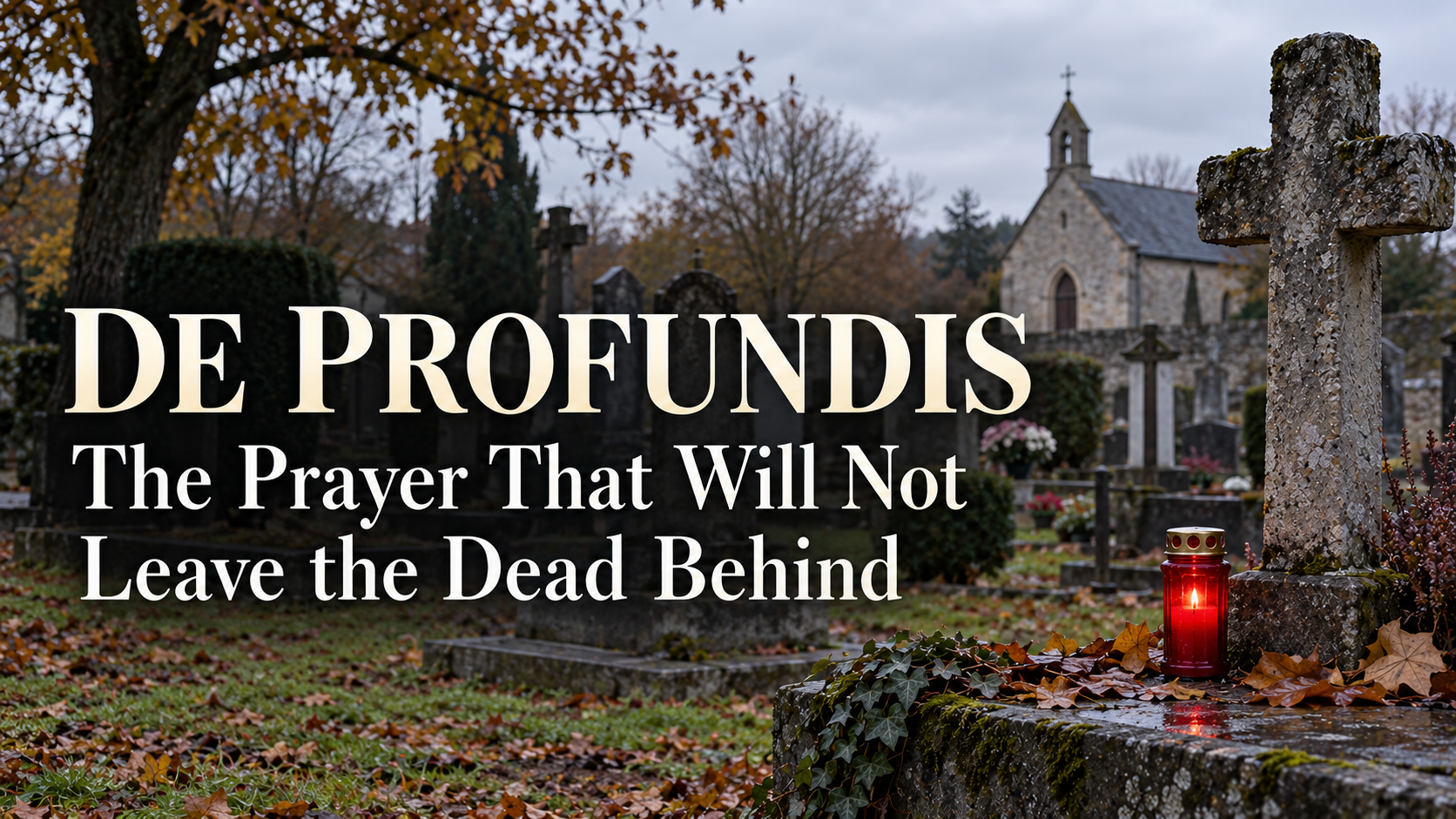
Prayed beside the dying, sung over the dead and heard at Christmas Vespers, the De Profundis teaches us to face sin honestly, trust Christ’s redemption and continue praying for those we have lost.
Before a coffin was carried from the house, the traditional Roman funeral rite put a sinner’s prayer upon the priest’s lips: De profundis clamavi ad te, Domine. Out of the depths, I have cried to Thee, O Lord. The Church approached the body with holy water and an appeal for mercy. Those left behind could no longer nurse the deceased, speak to him or set right an old misunderstanding. They could pray.¹
Nuntiatoria’s recent articles on All Souls and the Domestic Church have insisted upon that continuing duty. Have Masses offered for the departed. Remember their anniversaries. Teach children their names and include them in the family’s prayers. The De Profundis gives a household words it can learn and keep. Before we offer it for someone else, however, it asks us to acknowledge our own need of mercy.²

This is Psalm 129 in the traditional Vulgate and Douay–Rheims numbering, Psalm 130 in the Hebrew numbering followed by many modern Bibles. Both numbers identify the same eight-verse prayer, named from its opening in Latin. It begins with one person crying to be heard and ends by calling all Israel to hope in the Lord. By the end, the man who began by pleading for himself is calling others to trust in God.³
Neither its author nor its precise date is known. Traditional commentators often speak of David as the voice of the Psalter, but the biblical heading does not name him here. It places the prayer among the fifteen Songs of Ascents, or Gradual Psalms: Psalms 119–133 in the Vulgate, 120–134 in Hebrew numbering. Their association with pilgrimage to Jerusalem supplies a fitting setting. The distressed worshipper is still making his way towards God.⁴
Jewish communities continue to pray it. In a number of traditions it is added to morning worship during the Ten Days of Repentance between Rosh Hashanah and Yom Kippur. The Babylonian Talmud invokes its opening when teaching that prayer should be offered from a low place: bodily position should express humility. The Church received this appeal from Israel’s Scriptures, with its penitence and trust already joined.⁵
Christians numbered it sixth among the Seven Penitential Psalms: 6, 31, 37, 50, 101, 129 and 142. The group is attested in Cassiodorus’s sixth-century commentary and became familiar through medieval Books of Hours. A layperson unable to follow the full round of monastic worship could read these psalms, examine his conscience and ask forgiveness. Even the owner of a magnificently illuminated book had to recognise himself in the sinner’s words.⁶
Prayer for the departed long preceded the surviving medieval books which give the De Profundis its familiar place. St ✠Augustine’s account of St Monica’s death records her desire to be remembered at the Lord’s altar. By the ninth century, Amalarius was discussing an existing Office of the Dead. Its precise beginnings remain uncertain.⁷
An early eleventh-century manuscript supplies a definite witness to this psalm’s use. The Egilbert Pontifical from Freising, catalogued to 1005–1039, assigns it to the fourth place at Vespers of the Dead, with the antiphon Si iniquitates. It retains that position in the later Roman Office.⁸
At Cluny, the customs recorded by Ulrich of Zell in the early 1080s show a community gathering around a dying brother. Frederick Paxton’s reconstructive edition includes the De Profundis among the Seven Penitential Psalms accompanying the anointing. Prayer continued through death and burial into subsequent suffrages. The sick man’s frailty had become the concern of the whole monastery.⁹
Such intercession also entered the household. The late fourteenth-century Bohun Hours, now in Copenhagen’s Royal Danish Library, preserves the psalm in a separate devotion for the dead following the Marian Hours. A layperson’s prayer book provided words for a duty shared with monks and clergy: remembering the departed before God.¹⁰

The Roman Ritual published under Paul V in 1614 inherited centuries of such prayer. In the funeral order familiar from later editions, the priest recited the De Profundis beside the body before the procession to church; it was recited again on the return after burial. The journey began and ended in supplication. The Church was asking mercy for someone she continued to love.¹¹
The man who cries from the depths is still there when he begins to pray. He has no deliverance to report. He asks to be heard where he is. A Christian overwhelmed by shame, illness or bereavement need not wait until he feels composed before addressing God.
St ✠Augustine recalls Jonas praying inside the great fish. Neither its body nor the sea prevented his prayer from reaching God. The greater peril, Augustine observes, belongs to the sinner so accustomed to wrongdoing that he no longer thinks to pray. Recognising his misery may awaken him. The first cry breaks a silence in which he could otherwise remain lost.¹²
St ✠Robert Bellarmine distinguishes “the depth of misery and the depth of his heart”. Distress must reach sincere prayer. He identifies two things necessary for penitence: knowledge of our wretchedness and knowledge of God’s mercy. One makes us seek a remedy; the other gives us hope of receiving it. We can neglect either, excusing ourselves until change seems unnecessary or dwelling upon guilt until forgiveness seems impossible.¹³
St ✠John Fisher follows the stages of Jonas’s descent to examine how sin takes hold. Consent leads towards action; repeated action hardens into habit. He also distinguishes an unwanted temptation from consent to it. The person struggling against an intrusive thought should take that distinction seriously. Fisher’s warning concerns the surrender of the will, and the danger of allowing surrender to become a settled way of life.¹⁴
“If thou, O Lord, wilt mark iniquities: Lord, who shall stand it.” The third verse puts an end to comparison with a worse neighbour. Reputation, office and accomplishments offer no shelter from the God who knows the truth. Religious people especially need this prayer. We can become practised at exposing other people’s faults while postponing the confession of our own.³
Forgiveness follows immediately: Quia apud te propitiatio est. Augustine asks, “And what is this propitiation, except sacrifice?” Christian hope rests upon the sacrifice of Christ. The psalm’s final promise of redemption from iniquity finds its fulfilment in the Gospel’s explanation of His Holy Name: “For he shall save his people from their sins.” A penitent can acknowledge the full gravity of his offences and approach the sacrament of Penance because the Saviour has opened the way to reconciliation.¹⁵
Different translations give the middle verses a different emphasis. The older Latin Psalter speaks of waiting because of God’s law, and of hope from the morning watch until night. Translations following the Hebrew speak of forgiveness leading to reverence, and of waiting more eagerly than watchmen await daybreak. These renderings come from different textual traditions. Generations of Catholic prayer and commentary grew around the Latin wording reproduced below.¹⁶
Benedict XVI, commenting on the psalm in October 2005, explains why forgiveness awakens reverence. The person welcomed back into friendship has discovered the worth of what he was prepared to abandon. Mercy should make him more reluctant to offend again. Gratitude ought to change how he lives.¹⁷
Then comes waiting. A penitent may have received absolution and still feel ashamed. A bereaved wife may believe in the Resurrection and find the empty chair almost unbearable. Someone who has renounced an old vice may face another struggle tomorrow. The soul relies upon God’s word through all of this. His promise remains trustworthy while consolation is delayed.
Augustine reads the morning watch in the light of Easter. Christ has risen; His members await the resurrection of their own bodies. The hope expressed here reaches beyond relief from present troubles. It is large enough to face death without pretending that death is insignificant.¹²
The final verses call Israel to trust because with the Lord there is mercy and abundant redemption. Bellarmine connects that abundance with the infinite value of the Precious Blood. A sinner returning sincerely has not exhausted Christ’s power to forgive. He must be willing to abandon his sin; he need never suppose that his need has become too great for the Saviour.¹³

The liturgy returns to these words throughout the year. In the Roman weekly Psalter before the reform of St Pius X, the psalm belongs to Wednesday Vespers; it also appears in the ferial preces of Lauds and at Second Vespers of Christmas. The Christmas appointment is particularly revealing. The promise of abundant redemption belongs beside the birth of the Redeemer. The Child has come to save those who need mercy.¹⁸
In the traditional Roman Little Office of the Blessed Virgin Mary, it is the middle psalm at Compline, between Psalms 128 and 130. Those praying this Office encounter the De Profundis in ordinary night prayer. Long before it accompanies their burial, it teaches them to entrust the coming night to God.¹⁹
The older Ritual likewise provides for the Seven Penitential Psalms during Extreme Unction. Where circumstances permit, those present may recite them with the Litany of the Saints while the priest administers the sacrament. The household surrounds its sick member with an appeal to divine mercy.²⁰
As Nuntiatoria’s reflection on the Twenty-Second Sunday after Pentecost observed, that Sunday’s Introit takes up the question about the reckoning of iniquities, with the psalm’s opening as its verse. Worshippers hear the Gospel concerning Caesar’s claims having first acknowledged their own accountability to God. Anyone eager to discuss public obligations while neglecting his private sins has been given an uncomfortable preparation.²¹
On the Twenty-Third Sunday after Pentecost, the opening supplies both the Alleluia verse and the Offertory. The Gospel recounts the healing of the woman with the issue of blood and the raising of the ruler’s daughter. The cry from the depths approaches the Lord who heals and gives life. Even within an Alleluia, the Church can plead for help.²²
The Byzantine tradition includes the psalm in Vespers, among the evening psalms associated with incense and the singing of hymns called stichera. The later Roman Liturgy of the Hours retains it in Evening Prayer and at Wednesday Compline. Christians have needed its repentance and patient trust throughout life.²³
Composers have given those words an extraordinary musical inheritance. Orlando di Lasso included them in his Seven Penitential Psalms, preserved in the illuminated manuscript commissioned by Duke Albrecht V of Bavaria. For all the splendour of his book, the duke had to pray the same confession of need as any other sinner.²⁴
Lully’s De Profundis was heard with his Dies Irae at Queen Marie-Thérèse’s funeral at Saint-Denis in 1683. Royal ceremony gave voice to a supplication for mercy. Bach’s early cantata Aus der Tiefen rufe ich, Herr, zu dir, BWV 131, brings the German psalm together with penitential chorale verses. It dates from about 1707–08; its original occasion remains uncertain.²⁵

Arvo Pärt’s Latin setting of 1980 makes the prayer’s widening appeal audible. Successive pairs of verses introduce additional vocal parts until the four-part male choir sings the close. The solitary cry becomes shared prayer.²⁶
At Vespers of the Dead, the De Profundis is the fourth psalm, with the antiphon Si iniquitates. After the psalms, the usual Gloria Patri gives way to the petition for eternal rest and perpetual light. The congregation has gathered to intercede for souls who need its prayers.²⁷
A funeral dominated by assurances that the deceased is already enjoying heaven can leave his family with little reason to pray afterwards. The De Profundis keeps that obligation before us. We can thank God for someone’s virtues and implore mercy for his soul. We can also pray for a person whose faults we knew painfully well. Love has no need to manufacture a flattering obituary before it asks God to forgive.
Souls in Purgatory have died in God’s grace and are assured of salvation. Their purification prepares them for the full joy of heaven. The Council of Trent taught that they are assisted by the suffrages of the faithful, especially the Holy Sacrifice of the Mass. It required diligence in fulfilling obligations towards them and warned against uncertain stories and superstition. We owe them our prayers; their judgement belongs to God.²⁸

The psalm’s application to the Holy Souls rests upon its appeal to mercy, longing for deliverance and expectation of redemption. The original Hebrew poem does not set out the developed Catholic doctrine of Purgatory. The Church receives it within the whole of revelation and uses its words to intercede for those awaiting the vision of God.
St Catherine of Genoa writes that “the souls in purgatory are entirely conformed to the will of God”. Her Treatise on Purgatory describes suffering joined to love and peace in His will. The happiness towards which purification leads is certain. That certainty allows the Church to pray urgently and confidently for those undergoing it.²⁹
The teaching preserved in the Supplement to St Thomas Aquinas’s Summa explains how suffrage assists them. Within the communion established by Christ, the works of one member can benefit another; the prayers of the living help those undergoing purification. Charity still reaches people whom we can no longer assist through ordinary human care.³⁰
The daughter living abroad, the widower at home and the friend unable to visit the grave can all offer this psalm. Where the circumstances of a death cause particular anxiety, private supplication entrusts the departed to God. We can ask His mercy without claiming to know His judgement.
The evening De Profundis once gave that duty a public signal. The nineteenth-century Raccolta records Clement XII’s grant of indulgences in 1736 for its devout recitation, with the Eternal Rest, at the bell rung about an hour after the evening Ave Maria. Local variations were accommodated. In 1781 Pius VI extended the provision to people living where no such bell sounded. The living were called to interrupt their evening and pray for the dead.³¹
A household can keep the habit where the bell has fallen silent. The evening Angelus, the end of the Rosary or night prayers offers a convenient place for it, although the historical Roman observance had its own timing. Give the prayer a regular place, and remembrance will depend less upon whether the day has left us time to think.
Older books sometimes measure indulgences in days or years. These figures referred to the older measure associated with canonical penance; they were never a timetable of periods deducted from Purgatory. Paul VI abolished that numerical designation for partial indulgences in 1967. Such historical grants belong to their own period. The doctrine concerns the remission of temporal punishment for sins whose guilt has already been forgiven.³²
The 1999 Enchiridion Indulgentiarum includes the De Profundis among approved examples of penitential prayer in its grant concerning examination of conscience and acts of contrition. Its words prepare us well for confession: acknowledge sin, trust mercy, resolve to amend. A Catholic conscious of mortal sin remains bound to seek sacramental confession; reciting the psalm helps him prepare to do so.³³
For private prayer, name the person or intention before beginning and recite the whole psalm slowly. Keep its first-person wording when offering it for someone else. We acknowledge our own need while interceding for another. The traditional Latin reads:³
De profundis clamavi ad te, Domine: Domine, exaudi vocem meam. Fiant aures tuae intendentes in vocem deprecationis meae. Si iniquitates observaveris, Domine: Domine, quis sustinebit? Quia apud te propitiatio est: et propter legem tuam sustinui te, Domine. Sustinuit anima mea in verbo ejus: speravit anima mea in Domino. A custodia matutina usque ad noctem: speret Israel in Domino. Quia apud Dominum misericordia: et copiosa apud eum redemptio. Et ipse redimet Israel ex omnibus iniquitatibus ejus.
In the Douay–Rheims:³
Out of the depths I have cried to thee, O Lord: Lord, hear my voice. Let thy ears be attentive to the voice of my supplication. If thou, O Lord, wilt mark iniquities: Lord, who shall stand it. For with thee there is merciful forgiveness: and by reason of thy law, I have waited for thee, O Lord. My soul hath relied on his word: My soul hath hoped in the Lord. From the morning watch even until night, let Israel hope in the Lord. Because with the Lord there is mercy: and with him plentiful redemption. And he shall redeem Israel from all his iniquities.
When praying for the faithful departed, add the familiar suffrages: Requiem aeternam dona eis, Domine. Et lux perpetua luceat eis. Requiescant in pace. Amen. Eternal rest grant unto them, O Lord; and let perpetual light shine upon them. May they rest in peace. Amen. These petitions are added to the biblical psalm. Those following a liturgical Office should use the conclusion prescribed in their book.²⁷
A single verse may provide enough for meditation. Before confession, remain with the question about iniquities. In spiritual dryness, attend to the soul’s reliance upon God’s word. When your own troubles have absorbed every thought, follow the closing verses as they draw others into hope. Eight verses can sustain a lifetime’s prayer.
Children can learn them through family remembrance. Read the names of departed relatives and pray together. Include the grandmother they knew and the great-grandfather known only through stories. Praying for the dead will become part of how they remember their family. A cemetery visit or November evening offers a natural beginning; the habit can last through the year.
The Old Roman Apostolate’s Guild of Holy Souls gives this charity an organised expression. Approved in November 2022 by the Titular Archbishop of Selsey, it provides for monthly prayer and Requiem Masses, Chantry Books and practical assistance towards traditional Catholic burial where resources permit. Someone who dies far from home, or leaves relatives unfamiliar with the Faith, should still have fellow Catholics praying for him.³⁴
Begin this evening. Arrange a Mass intention where possible. Put the names of departed relatives beside the family’s prayer book and remember them aloud. Learn the De Profundis well enough to say it when a death is announced, when passing a cemetery, or when the house has grown quiet at night. One day others will stand beside our own coffin. Leave them this prayer, and the example of having used it.
¹ Rituale Romanum (1882), “Exsequiarum ordo,” tit. VI, chap. 3, no. 2, 154–55.
² Nuntiatoria, “Requiem Aeternam: The Church That Will Not Forget Her Dead”, 30 October 2026; “The Domestic Church: A Home with Room for Heaven”, 23 October 2026.
³ Psalm 129, Latin Vulgate and Douay–Rheims; Psalm 130, New American Bible, Revised Edition.
⁴ Frederick G. Holweck, “De Profundis”, The Catholic Encyclopedia, vol. 4 (New York: Robert Appleton Company, 1908).
⁵ Babylonian Talmud, Berakhot 10b; Chabad.org, “The Ten Days of Repentance”.
⁶ Morgan Library & Museum, “Hours of Henry VIII: Penitential Psalms and Litany,” MS H.8, fols. 108v–109r.
⁷ St Augustine, Confessions, book IX, chaps. 11–13; Fernand Cabrol, “Office of the Dead”, The Catholic Encyclopedia, vol. 11 (1911).
⁸ Pontificale Egilberti, Munich, Bayerische Staatsbibliothek, Clm 21587, fol. 177v; manuscript catalogue record, in Miklós István Földváry et al., USUARIUM: A Digital Library and Database for the Study of Latin Liturgical History, Eötvös Loránd University, Research Group of Liturgical History; Bayerische Staatsbibliothek, Liber ritualis, Clm 21587.
⁹ Ulrich of Zell, Antiquiores consuetudines Cluniacensis monasterii, book III, chaps. 28–29, in Frederick S. Paxton, ed., The Cluniac Death Ritual in the High Middle Ages: A Reconstructive Edition, Latin text, August 2002.
¹⁰ Bohun Hours, Copenhagen, Royal Danish Library, Thott 547 4°, fol. 31v, CHD transcription; Institut de recherche et d’histoire des textes, Bibale, “København, Det Kongelige Bibliotek, Thott 0547 4°”.
¹¹ Rituale Romanum Pauli V pontificis maximi iussu editum (Rome, 1614), USUARIUM; Rituale Romanum (1882), “Exsequiarum ordo”, 154–55; Herbert Thurston, “Christian Burial”, The Catholic Encyclopedia, vol. 3 (1908).
¹² St Augustine, Exposition on Psalm 130, secs. 1–8, trans. J. E. Tweed, Nicene and Post-Nicene Fathers, first series, vol. 8 (Buffalo, NY: Christian Literature Publishing Company, 1888).
¹³ St Robert Bellarmine, A Commentary on the Book of Psalms, Psalm 129, trans. John O’Sullivan (Dublin and London: James Duffy, 1866).
¹⁴ St John Fisher, “Exposition on the Sixth Penitential Psalm”.
¹⁵ St Augustine, Exposition on Psalm 130, sec. 3; Matthew 1:21, Douay–Rheims Bible.
¹⁶ Psalm 129, Latin Vulgate and Douay–Rheims; Psalm 130, New American Bible, Revised Edition.
¹⁷ Benedict XVI, “Psalm 130[129]: Lord, Hear My Voice!”, general audience, 19 October 2005.
¹⁸ Holweck, “De Profundis”.
¹⁹ Little Office of the Blessed Virgin Mary, Compline, traditional Roman form.
²⁰ Rituale Romanum, “Ordo ministrandi sacramentum extremae unctionis,” tit. V, chap. 2, no. 7.
²¹ Nuntiatoria, “The Image Caesar Cannot Claim: The Twenty-Second Sunday after Pentecost”, 23 October 2026.
²² Missale Romanum, Twenty-Third Sunday after Pentecost, Alleluia, Gospel and Offertory.
²³ Orthodox Church in America, The Lenten Office of Vespers, Psalm 129; Benedict XVI, general audience, 19 October 2005; Liturgy of the Hours, Wednesday Compline.
²⁴ Bayerische Staatsbibliothek, “Der Bußpsalmencodex Albrechts V.”.
²⁵ Centre de musique baroque de Versailles, Nouveautés 2025, Jean-Baptiste Lully, Dies Irae; Bibliothèque nationale de France, De profundis, LWV 62, Jean-Baptiste Lully; Netherlands Bach Society, “Aus der Tiefen rufe ich, Herr, zu dir,” BWV 131.
²⁶ Arvo Pärt Centre, “De profundis” (1980).
²⁷ Rituale Romanum (1882), “Officium defunctorum,” tit. VI, chap. 4, 165–70.
²⁸ Council of Trent, session XXV, “Decree concerning Purgatory”, 3–4 December 1563; Catechism of the Catholic Church, nos. 1030–32.
²⁹ St Catherine of Genoa, Treatise on Purgatory, chaps. 2, 5–6.
³⁰ St Thomas Aquinas, Summa Theologiae, Supplement, question 71, arts. 1–2, 6, 9.
³¹ The Raccolta (1857), no. 136, “The De Profundis at the First Hour after the Ave Maria”.
³² Paul VI, Indulgentiarum doctrina, 1 January 1967; William Kent, “Indulgences”, The Catholic Encyclopedia, vol. 7 (1910).
³³ Apostolic Penitentiary, Enchiridion Indulgentiarum, 4th ed., concession 9, 1999; Council of Trent, session XIV, “On the Most Holy Sacrament of Penance,” chaps. 4–5, 25 November 1551.
³⁴ Titular Archbishop of Selsey, “Guild of Holy Souls”, 21 November 2022.




Leave a Reply