
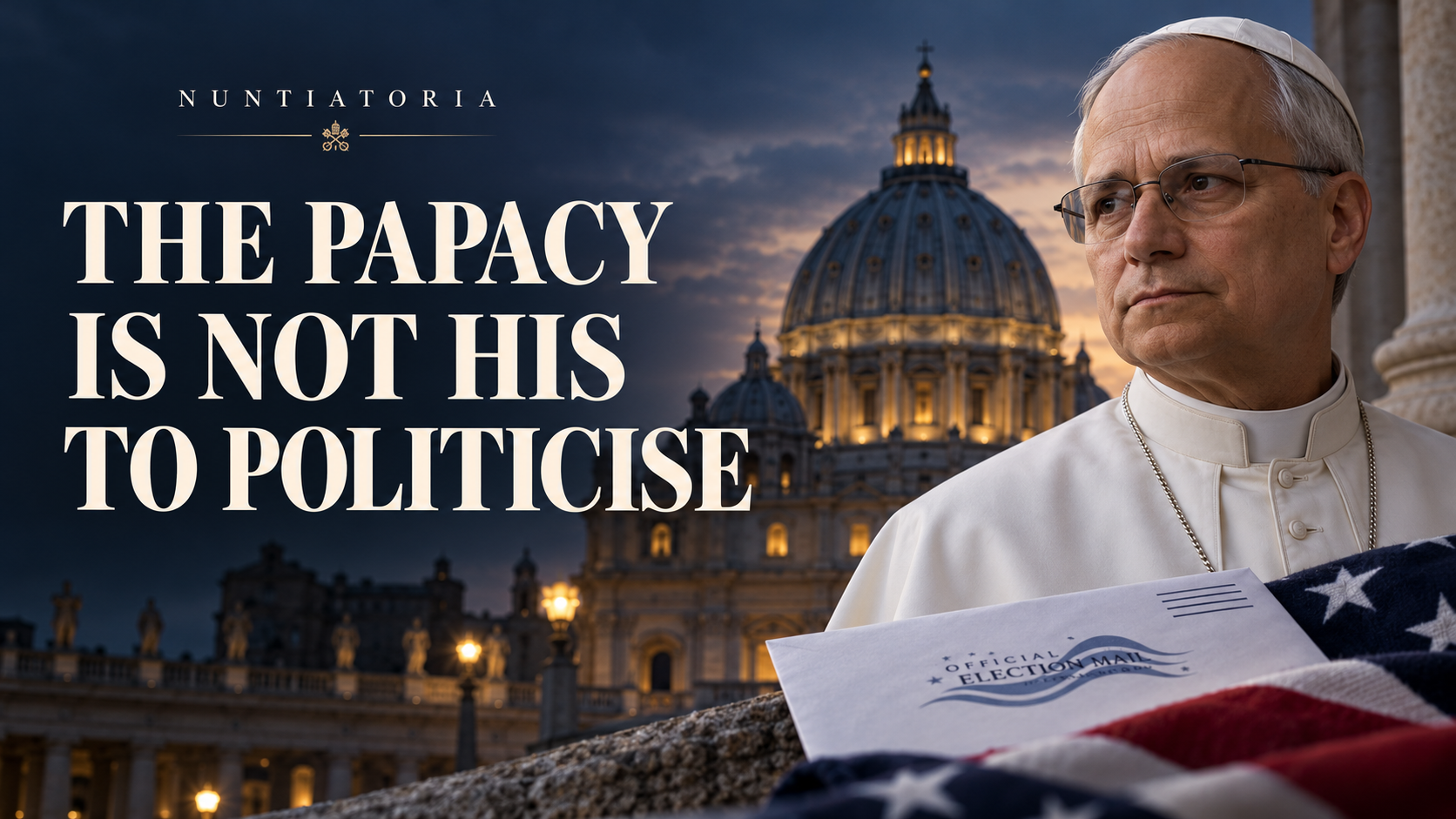
Leo XIV should have abstained from the American election. His vote puts the Church’s independence at risk and exposes a wider problem: the papal office is increasingly being made to fit the man, when the man should accept the demands of the office.
Leo XIV should not have voted in the American midterm elections. After publicly criticising the administration, he has personally entered the election affecting its party’s hold on power. He has given people a fresh reason to treat him as a political opponent. That is a serious failure of judgement by a man whose responsibility is to speak to the whole Church and reach those who do not yet belong to her.
The Vatican’s explanation invokes “the right and the duty of citizens to participate in democratic processes”.¹ But becoming pope changes what an American citizen’s actions mean. Robert Prevost’s ballot would once have been an ordinary private decision. Leo XIV’s ballot has become an international statement about the Pope’s place in American politics. Continuing a personal habit cannot be sufficient justification for taking that risk.
The secular coverage shows what has happened. The BBC announces, “Pope Leo XIV becomes first pontiff to vote in a US election”; Reuters, “Pope Leo becomes first pontiff to cast ballot in US election”; and The Guardian, “Pope Leo votes in US midterms in first known political ballot for any pontiff”. The Washington Post makes the political association explicit: “The Vatican announcement comes as President Donald Trump has sought to cast doubt on mail-in voting.”² Reports connect the ballot with Leo’s disputes with Trump over immigration and war. The Pope’s participation has already been absorbed into the argument between the administration and its critics.
Calling the decision historic does not make it wise. Earlier popes had reasons to abstain, and the Vatican ought to have considered those reasons before welcoming a departure. We do not know which candidates Leo supported. His decision deserves criticism without guessing. The problem is that his vote invites people to interpret his teaching through a presumed electoral preference.
He may be legally entitled to vote. Becoming a foreign sovereign does not automatically cancel American citizenship, and Illinois permits eligible citizens abroad to vote in federal elections.³ Legal eligibility, however, does not settle what a pope should do. He could have surrendered one ballot to protect confidence in the independence of his ministry. That was a small sacrifice for a considerable good.
His earlier interventions made restraint especially necessary. In September 2025, asked about a proposed honour for Senator Dick Durbin, who supports legalised abortion, Leo acknowledged limited familiarity with the case but urged consideration of “the overall work a senator has done”. He then questioned the consistency of people who oppose abortion while supporting capital punishment or accepting the inhumane treatment of immigrants.⁴ These were comments on a live American dispute involving a named politician, public honours and Catholic moral responsibility.
The faithful deserved greater clarity. A senator’s other achievements cannot cancel his responsibility for supporting abortion. Direct abortion is always gravely wrong. Detailed decisions about immigration also involve questions of law, resources and enforcement, within the binding duty to treat people justly. Grouping different subjects together beneath an appeal to the protection of life leaves crucial distinctions unexplained. Catholics need to know what the Church requires, what facts a judgement rests upon and where disagreement remains possible.
The Pope must condemn injustice, including injustice committed by an American administration. He should therefore preserve a clear distance from the contest to put its opponents in power. In April 2026, Leo himself said: “I am not a politician, and I do not want to enter into a debate with him.” He subsequently challenged interpretations of speeches prepared before his African journey as further answers to Trump.⁵ Voting in the election determining whether the President’s party retains control of Congress makes that distinction harder to defend.
This is why the error matters to the Church’s mission. Someone who thinks the Pope is campaigning against his party may stop listening before the moral argument begins. Someone on the other side may applaud papal teaching only when it is useful against an opponent. The administration gains an easy excuse to dismiss criticism it should answer. Leo cannot prevent every misuse of his words, but he should not supply an avoidable reason to misunderstand them.
Catholics also need to distinguish the Pope’s genuine authority from his personal political assessments. Agreement with his view of a particular policy is not automatically a test of fidelity to the Church. Disagreement cannot excuse rejection of her teaching either. By entering the electoral contest, Leo has made a necessary distinction more difficult for the faithful to maintain.
His predecessors understood the value of restraint. Before Germany’s September 2005 election, contemporary reporting recorded the Vatican’s explanation that Benedict XVI retained the right to vote but would abstain: “Popes do not vote.” The spokesman added that John Paul II had not voted either.⁶ Pius XII, meanwhile, had forcefully instructed Catholic voters about their responsibilities and the protection of religion.⁷ Abstention left a pope entirely free to teach. It helped distinguish the spiritual authority addressing a nation from the citizens choosing its government.
That distinction matters beyond America. Catholics in Cameroon, China and France need to recognise their spiritual father without repeatedly encountering him as a participant in his native country’s political quarrels. Washington’s actions deserve papal scrutiny. His American birth gives him no corresponding obligation to cast an American ballot.
The same question—whether the man is accepting the demands of his office—arises in the distribution of papal attention. Nuntiatoria has already examined Father Davide Pagliarani’s repeated requests for a personal audience. According to the SSPX’s published account, its Superior General first asked in August 2025. By the following spring he was still waiting. Asked whether he continued to hope for a meeting before the proposed episcopal consecrations, he replied: “Of course, this corresponds to my sincerest desire.” He reported “no personal reply or reaction from the Holy Father”.⁸
Pagliarani met Cardinal Fernández in February 2026, but that did not fulfil his request to speak personally to the Pope. An international dispute involving bishops, priests, sacramental provision and the danger of a lasting rupture was worsening. Hearing the Society’s superior should have been urgent. Leo needed to concede nothing in order to receive him. A meeting could have allowed direct questioning, a hearing of his concerns and a personal attempt to prevent the break. Warning people about disobedience cannot replace every effort to reach them.
Other engagements found room in the diary. On 15 November 2025, Leo received representatives of the film industry at the Apostolic Palace. Cate Blanchett, Spike Lee, Leslie Mann and Kenneth Lonergan were among those present; Vatican News described individual greetings and gifts.⁹ Cultural engagement may serve worthwhile purposes. Preserving the Church’s unity belongs to the Pope’s central duty. Catholics are entitled to ask why actors and filmmakers could be accommodated while a superior seeking to discuss an approaching ecclesiastical crisis remained without the requested audience.
The contrast is sharper with Emmanuel Macron, received privately on 10 April 2026. Macron had publicly advocated adding abortion rights to the European Union’s Charter of Fundamental Rights. France’s National Assembly documented his advocacy in its 2024 report.¹⁰ The Pope received a statesman working to entrench something Catholic doctrine condemns. The Catholic superior seeking a hearing remained without one.
Diplomacy explains why a pope speaks to rulers whose policies he opposes. It cannot explain why he failed to grant this other encounter. The two meetings were not mutually exclusive. Nor would receiving Pagliarani have approved the SSPX’s proposals, any more than receiving Macron approved his abortion policy.
We cannot establish the private reasons for the ungranted audience. The public result is plain: influential outsiders received attention while Catholics facing a crisis over their future saw their superior’s request remain unfulfilled. That looks like favouritism. It invites the suspicion that challenging the prevailing Church programme makes a personal hearing harder to obtain than opposing Catholic moral teaching in public life.
A pope must remain the father of Catholics whose arguments he rejects and whose conduct he condemns. That responsibility becomes more pressing when relations are strained. If his attention appears to depend upon sympathy with his outlook, the papacy begins to resemble the leadership of one group within the Church. The rest are left wondering whether their concerns count.
Francis’s residence at Santa Marta illustrates a related problem. Discussing changes in the Vatican in July 2013, he expressly included “what has to do with my own personality”. His explanation for remaining in the guesthouse was direct: “No, it was for psychological reasons”.¹¹ Yet the decision was widely presented as a lesson in papal humility and simplicity.
Francis himself acknowledged: “The papal apartment in the Apostolic Palace is not luxurious.” He explained his preference with the words, “I cannot live without people.”¹² His needs deserved consideration. They did not make earlier popes less humble for occupying the established residence. A man does not become extravagant simply by accepting accommodation provided for his office.
Nor did choosing a guesthouse remove the expense of housing a pope. Il Tempo reported that the Santa Marta arrangements expanded to include additional rooms, reception facilities and security, with costs approaching €200,000 a month towards the end of Francis’s pontificate. The roughly €29 million subsequently repeated as a total applies that late monthly figure across all twelve years; it is not a verified cumulative bill.¹³ Even without a confirmed total, the report challenges the assumption that the modest public image represented a saving. Others had to provide, maintain and secure the arrangements his preference required.
This is what personalising an office does: the organisation must adjust to the man, and his preferred way of living becomes a public lesson for everyone else. There can be considerable humility in accepting established arrangements and sparing others the task of rebuilding them around oneself. Papal residences, clothing and ceremonies also remind Catholics that the office preceded its present holder and will outlast him. The faithful should be able to recognise its authority without needing to admire his personality.
The deeper danger comes when each pontificate begins to resemble a new government with its own programme. Catholics wait to discover what the new Pope likes, whom he will favour and which decisions he will reverse. The Church’s public life turns upon the incumbent’s wishes. People become skilled at reading his gestures when they ought to be able to rely upon the faith he has received.
Vatican I explains why this is wrong. Pastor Aeternus teaches that the Holy Ghost was promised to Peter’s successors to help them guard and explain the faith handed down by the Apostles, rather than reveal new doctrine.¹⁴ A pope receives an inheritance he has a duty to protect. His authority does not make Catholicism his personal project, and a change of pope cannot be treated as a mandate to invent a different faith.
That distinction is essential to understanding synodality. In ordinary terms, the Church can listen to her members and consult them about her work. Their agreement cannot make a false teaching true or give Church leaders power Christ has not given them. Nor does the Pope acquire that power by approving the result.
Francis said in 2015 that “the Synod is not a parliament”.¹⁵ The warning identifies the real danger. Political consultations commonly ask what people want changed and build support for a programme. Consultation in the Church must remain governed by what she has received from Christ. When that boundary is left unclear, people can assume that sufficient support should eventually secure their preferred change. If it cannot, they blame the doctrine or accuse those defending it of refusing to listen. Expectations have been encouraged which the Church has no authority to fulfil.
Leo’s ballot does not turn a synod into a parliament. Its relevance is the example he gives of the papal office. He publicly asserts his place in a democratic contest while overseeing Church processes described through participation, listening and reform. In a papacy already shaped around personal choices, the distinction between seeking advice and gathering support for the leader’s programme becomes harder to see. He should be making that distinction unmistakable.
The audience controversy gives this concern substance. Rome asks Catholics to listen while an urgent request for a personal hearing remains unresolved. A listening process deserves trust only if it can accommodate serious objections. If those directing it determine which voices are welcome and which questions may be pursued, consultation can become a way of collecting approval for decisions they already favour.
The result is particularly damaging: people below expect democratic influence, while the leader at the top retains personal control. Catholics are pulled between two mistaken ideas—that sufficient support can change the faith, or that the Pope’s approval can make any proposed change legitimate. Vatican I permits neither. Both the faithful and their pastors remain bound by what Christ has given the Church.
These questions matter because people learn what an institution is partly by watching how its leaders behave. If Church government looks like competing groups, favoured insiders and a succession of personal programmes, outsiders will recognise another struggle for influence. Catholics may begin to behave accordingly. The Church’s claim to call everyone to conversion is weakened when her own public life appears governed by the habits of political competition.
Christ’s promises do not make every papal decision wise. A pope cannot abolish the Church’s divine constitution, but he can damage trust, confuse obedience and place obstacles before people who need the Gospel. Those are grave harms. They should not be excused as harmless differences of style.
Benedict XVI expressed the proper attitude at the beginning of his pontificate: “not to do my own will, not to pursue my own ideas”.¹⁶ Such restraint belongs to the exercise of authority. It protects the office from becoming an extension of the incumbent’s preferences.
Leo should say that he will abstain from future national elections. He should ensure that urgent requests concerning the Church’s unity receive personal attention, including requests from those whose arguments he rejects. And he should make clear, in the way he governs, that consultation serves the faith the Church has received.
The Pope’s task is demanding enough without adding an avoidable quarrel about his electoral loyalties. He was free to give up one ballot for the sake of the whole Church. He should have done so. The papacy was entrusted to him to serve the faithful; its independence was not his to put at risk for the continuation of a personal habit.
¹ Vatican News, “Pope Leo XIV Votes in US Midterm Elections via Mail-in Ballot”, 30 October 2026.
² Brandon Drenon, “Pope Leo XIV Becomes First Pontiff to Vote in a US Election”, BBC News, 30 October 2026; Reuters, “Pope Leo Becomes First Pontiff to Cast Ballot in US Election”, 30 October 2026; The Guardian, “Pope Leo Votes in US Midterms in First Known Political Ballot for Any Pontiff”, 30 October 2026; Anthony Faiola, “Pope Leo Becomes First Pontiff to Vote in U.S. Election”, The Washington Post, 30 October 2026.
³ US Department of State, “Accepting, Serving in, or Performing Duties of a Position with the Government of a Foreign State”; Illinois General Assembly, “10 ILCS 5/20-2.2”.
⁴ Vatican News, “Pope: Trump’s Gaza Peace Plan Realistic, Hopefully Hamas Will Accept”, 30 September 2025; John Paul II, Evangelium Vitae, 25 March 1995, §62.
⁵ Vatican News, “Pope on Board Plane to Algeria: ‘I Am Not a Politician, I Speak of the Gospel’”, 13 April 2026; Salvatore Cernuzio, “Pope: I Am in Africa to Encourage Catholics, Not to Debate with Trump”, Vatican News, April 2026.
⁶ La Gaceta, “Los papas no votan y Ratzinger tampoco, dijo el Vaticano”, 17 September 2005.
⁷ Vatican News, “Dal referendum del 1946 agli incontri al Quirinale, il 2 giugno dei Papi”, June 2026.
⁸ General House of the Society of Saint Pius X, “Communiqué”, 2 February 2026; “Communiqué: Meeting in Rome”, 12 February 2026; Nuntiatoria, “Still Waiting at Rome’s Door”, 26 June 2026; “When Proximity Becomes Compromise: Maura Healey, the Vatican, and the Cost of Blurred Catholic Boundaries”, 18 August 2026.
⁹ Leo XIV, “Encounter with the World of Cinema”, 15 November 2025; Kielce Gussie, “Hollywood to the Vatican: Cate Blanchett, Spike Lee Meet Pope”, Vatican News, 15 November 2025.
¹⁰ Vatican News, “Pope Leo Meets French President Macron”, 10 April 2026; Assemblée nationale, “Rapport no. 2468 sur la proposition de résolution européenne visant à garantir le droit à l’avortement dans la Charte des droits fondamentaux de l’Union européenne”, 10 April 2024.
¹¹ Francis, “Press Conference during the Return Flight from Brazil”, 28 July 2013.
¹² Francis, “Interview with Fr Antonio Spadaro”, September 2013.
¹³ Francesco Capozza, “Vaticano, Santa Marta è troppo cara. Papa Leone torna al Palazzo Apostolico”, Il Tempo, 25 May 2025; InfoVaticana, “El capricho de Francisco de vivir en Santa Marta costó al Vaticano casi 30 millones de euros”, 25 May 2025; Nuntiatoria, “The Restoration of the Papal Household: Leo XIV and the Reoccupation of the Apostolic Palace”, 18 March 2026.
¹⁴ First Vatican Council, Pastor Aeternus, 18 July 1870, chapters 3–4. vatican.va
¹⁵ Francis, “Introductory Remarks at the First General Congregation of the Synod of Bishops”, 5 October 2015. vatican.va
¹⁶ Benedict XVI, “Homily for the Inauguration of the Pontificate”, 24 April 2005.




Leave a Reply