
The Restoration of the Papal Household: Leo XIV and the Reoccupation of the Apostolic Palace
A Return Not of Preference but of Principle
The formal occupation of the Apostolic Palace by Pope Leo XIV marks more than the conclusion of renovation works or the settling of domestic arrangements. It represents a restoration of order—liturgical, institutional, and symbolic—after a pontificate that consciously displaced the traditional locus of papal life.
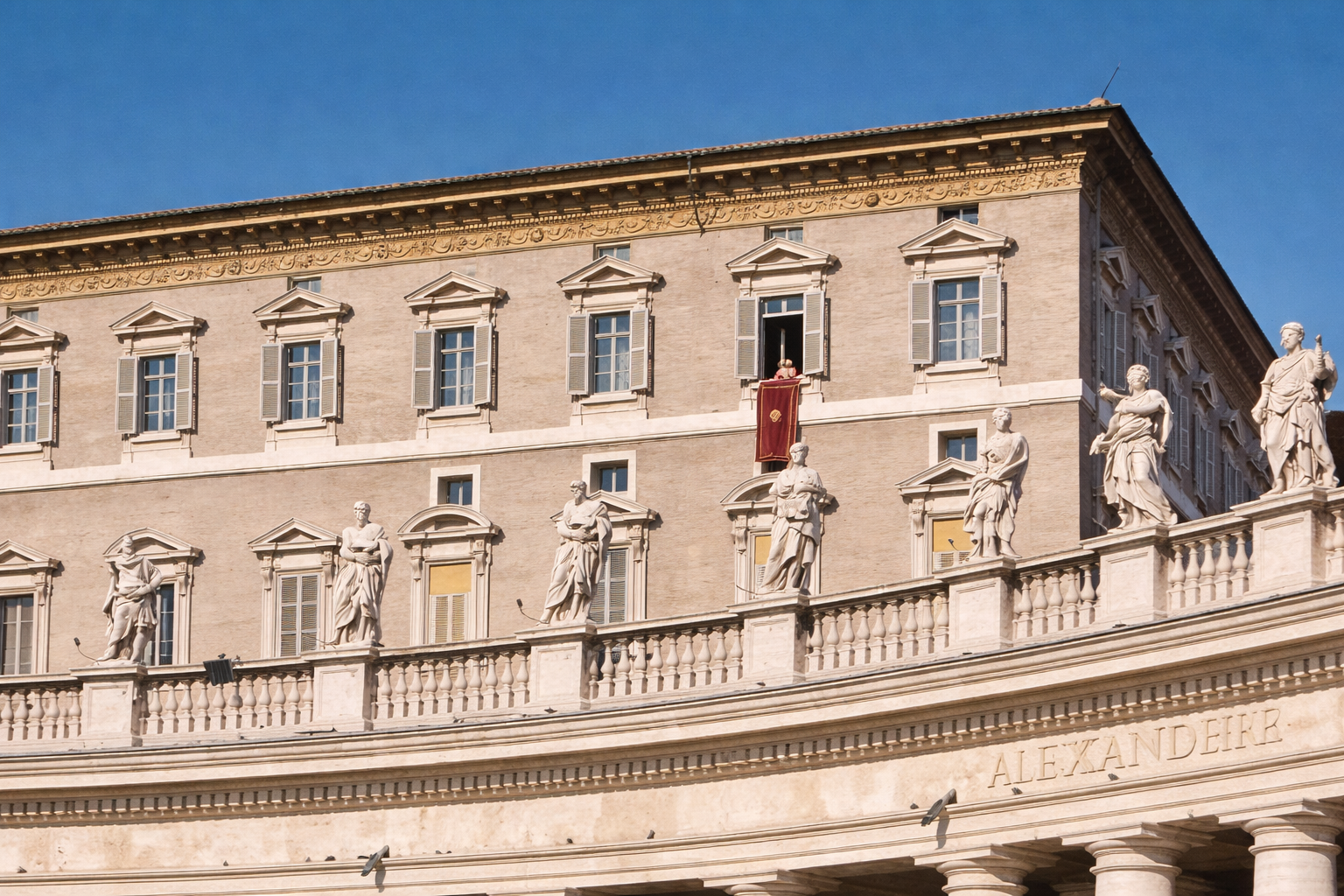
On Saturday afternoon, confirmed by the Holy See Press Office under Matteo Bruni, Leo XIV took possession of the papal apartment situated on the third loggia of the Apostolic Palace, overlooking St Peter’s Square. This act, while outwardly procedural, carries an unmistakable theological grammar: the Roman Pontiff returns to the place historically conformed to his office.
The papal apartment is not merely residential. It is juridical space, liturgical space, and representational space. Its study is the seat of governance; its chapel, the axis of sacerdotal identity; its window, the interface between the Successor of Peter and the universal Church. To inhabit it is to situate the papacy once more within its visible and historical form.
The Interrupted Continuity
The decision must be read against the precedent established by Pope Francis, who declined residence in the Apostolic Palace in favour of the Domus Sanctae Marthae. Presented as a gesture of humility and collegial proximity, that decision nevertheless effected a structural dislocation. The symbolic centre of the papacy remained in the Palace; the lived reality was transferred elsewhere.
This bifurcation produced consequences not merely aesthetic but ecclesiological. The papacy, long embodied in a visible continuity of place, became functionally de-centred. The Apostolic Palace—once the nerve centre of governance—was rendered dormant, while a guesthouse assumed quasi-curial significance.
Leo XIV’s return therefore restores not a custom, but a coherence. The papal office once again inhabits its proper architectural expression.
Historical and Architectural Continuity
The third loggia apartment, first established as the principal papal residence under Pope Pius X in 1903, represents the culmination of centuries of papal domestic evolution. The Apostolic Palace itself, a complex developed between the fifteenth and seventeenth centuries, integrates Renaissance statecraft with ecclesiastical symbolism.¹
Substantial modifications were undertaken under Pope Paul VI in 1964, adapting the apartment to the modern papal office while preserving its essential configuration.² Successive pontiffs—Pope John Paul II and Pope Benedict XVI—retained this structure, reinforcing the continuity of the papal domestic and administrative life within the same physical locus.
The Angelus window, perhaps the most recognisable feature of the apartment, is not incidental ornamentation. It is a liturgical-pastoral instrument, framing the weekly rhythm of papal teaching and presence. Its consistent use across pontificates has functioned as a visual catechesis in continuity.
The Ritual of Possession and the End of a Pontificate
The reopening of the apartment earlier in the year—when Leo XIV removed the seals placed upon it following the death of Pope Francis—was itself an act rich in canonical and symbolic meaning. The sealing of the papal apartments at the death of a pontiff is a longstanding practice, intended both to secure documents and to mark the juridical cessation of a reign.³
The breaking of those seals does not merely grant access; it signifies succession. The apartment passes not as private property, but as an office-bearing space, tied intrinsically to the munus Petrinum.
Thus, Leo XIV’s entry into the apartment completes a process that is as juridical as it is ceremonial: the assumption not only of authority, but of its visible habitation.
The Papal Household Reconstituted
Equally instructive is the composition of the papal household accompanying Leo XIV into the Palace. The presence of Mgr Edgard Iván Rimaycuna Inga as private secretary, Fr Edward Daniang Daleng as vice-regent, and experienced lay officials such as Anton Kappler and Piergiorgio Zanetti reflects a deliberate structuring of the immediate papal environment.
This is not the informal domesticity of Santa Marta, but a recognisable curial microcosm—ordered, hierarchical, and functional. It reflects a model of governance in which access, administration, and proximity are mediated through defined roles rather than personal spontaneity.
Such an arrangement, while modest in scale, signals a return to institutional clarity. The papal household is not merely a support structure; it is an extension of governance itself.
Against the Myth of Isolation
One of the principal justifications offered for the abandonment of the Apostolic Palace in the previous pontificate was its alleged “isolation.” Yet this claim has always been more rhetorical than factual. The Palace is not a cloister but a hub—integrated into the Curia, proximate to the Secretariat of State, and structurally embedded within the daily operations of the Holy See.
Moreover, the alternative—Casa Santa Marta—necessitated the effective privatisation of significant portions of a guesthouse, reducing its capacity for its intended purpose.⁴ The supposed gain in communal life was thus offset by a functional reconfiguration of Vatican hospitality.
The Cost of “Simplicity”: Financial and Operational Implications
What emerges with greater clarity, particularly in retrospect, is that the relocation of the papal residence to Casa Santa Marta entailed not only symbolic consequences but measurable financial ones. The Domus Sanctae Marthae—constructed in 1996 primarily to house clergy and cardinal electors during conclaves—was never designed to function as the permanent residence of the Roman Pontiff.⁵
Its adaptation required structural modification and operational expansion. Early reports suggest that approximately €1 million was expended in reconfiguring portions of the building—especially the second floor—to accommodate papal living, reception, and security needs.⁶ Yet the more significant costs were not capital but ongoing.
The effective reservation of an entire floor, alongside associated service areas, removed a substantial proportion of the Vatican’s principal guesthouse from normal use, necessitating compensatory arrangements for visiting clergy and officials.⁷ This spatial reallocation alone constituted a hidden but real cost to Vatican operations.
More striking still are estimates of ongoing expenditure. By the later years of the pontificate, maintaining the papal residence within Santa Marta—including enhanced security, dedicated staffing, logistical duplication, and medical provision—was reported to approach €200,000 per month.⁸ This implies an annual operational cost in the region of €2–2.5 million.
Such figures underscore a structural paradox. The Apostolic Palace already integrates residential, administrative, liturgical, and security functions within a single, purpose-built complex. To abandon it did not eliminate cost but rather redistributed and, in certain respects, increased it—requiring the duplication of functions across separate locations.
In this light, the return of Pope Leo XIV to the Apostolic Palace is not only symbolically coherent but operationally rational. It restores a model in which governance, residence, and representation are once again unified within their historic architectural framework.
Form, Office, and the Theology of Space
Catholicism is not indifferent to form. The Church’s theology is incarnational; it is expressed through visible realities—architecture, ritual, vesture, and place. The Apostolic Palace is one such reality. It embodies a theology of office: stability, continuity, and the objective character of authority.
To reside there is to affirm that the papacy is not an improvisation, but an inheritance. The Pope does not create his office; he receives it, along with the forms that give it expression.
In this sense, Leo XIV’s move is not conservative in a merely aesthetic sense. It is doctrinal in implication. It reasserts that the visible structures of the Church are not accidental, but integral to her identity.
Conclusion: A Gesture That Clarifies
The reoccupation of the Apostolic Palace will not, in itself, resolve the deeper crises that have marked the postconciliar Church. Yet it is a gesture that clarifies direction. It signals a pontificate attentive to form, conscious of continuity, and willing to restore coherence where it has been obscured.
In an age inclined toward informality and rupture, such clarity is not insignificant. The Pope has returned to the window. The question that remains is whether the life of the Church will follow.
¹ Christoph Luitpold Frommel, The Architecture of the Italian Renaissance (London: Thames & Hudson, 2007), pp. 198–205.
² Yves Chiron, Paul VI: The Divided Pope (Kansas City: Angelico Press, 2020), pp. 312–315.
³ Apostolic Constitution Universi Dominici Gregis (1996), §§17–18.
⁴ Vatican Press Office briefings (2013–2020) regarding Domus Sanctae Marthae usage and papal residence arrangements.
⁵ Vatican City State, Domus Sanctae Marthae: Historical and Functional Overview (1996 construction records and subsequent Vatican documentation).
⁶ Catholic World Report, “Pope Leo XIV expected to live in traditional papal apartment unused by Pope Francis,” 2025.
⁷ Rorate Caeli, “The High Cost of Frugal Living,” 2014 (analysis of Santa Marta occupancy and restrictions).
⁸ Catholic Culture, reporting on Vatican operational costs associated with Santa Marta papal residence (2025 estimates).
RELATED ARTICLES


Latest ARTICLES
- Today’s homily: St Nicholas TolentinoThe reflection celebrates Saint Nicholas of Tolentino, emphasising that holiness is achieved not through personal efforts but through grace. It highlights his life of service, prayer, and self-discipline, suggesting that his true sanctity stems from dependence on God. The message reinforces the importance of a single-hearted focus on God in one’s spiritual journey.
- Today’s Mass: September 10 St Nicholas of TolentinoSaint Nicholas of Tolentino, born around 1246 in Italy, became a devout Augustinian hermit known for his piety and dedication to preaching. He spent his later years in Tolentino, promoting virtue, and maintaining his chastity until his death in 1306. Canonised in 1446, his tomb is revered by the faithful.
- Today’s Mass: September 09 Day II in the Octave of The Nativity of the Blessed Virgin MaryThe feast of Our Lady’s Nativity, of ancient Eastern origin and established at Rome by the time of Pope St Sergius I, celebrates Mary as the immaculate New Eve and the dawn of salvation, the chosen tabernacle from whom the Redeemer would take His flesh. Today the Church also commemorates St Gorgonius, an officer of the imperial household at Nicomedia who, with his companion Dorotheus, embraced the Faith and suffered martyrdom under Diocletian in A.D. 303; his relics were later translated to Rome.
- NOMEN MANET, RES DEEST ~ The Name Remains; the Reality Is Lacking: Spiritual Conference for Nuntiatoria CXXIIThe content emphasises the disconnect between the names associated with Catholicism and the actual practices of faith. It highlights the importance of embodying belief through genuine actions, urging self-examination rather than mere external observance. Ultimately, it advocates for a restoration of sincerity in faith, calling individuals to authentically reflect their beliefs through their lives and worship.
- Mary Is Co-Redemptrix: Cardinal Burke Reopens Rome’s Marian ControversyCardinal Raymond Leo Burke has declared the Virgin Mary as “Co-Redemptrix” amidst controversy over the Vatican’s restriction on this title. The debate revolves around the appropriateness of certain theological language and whether terminology historically used can still accurately express Marian cooperation in Redemption without compromising Christ’s unique role.




Leave a Reply