
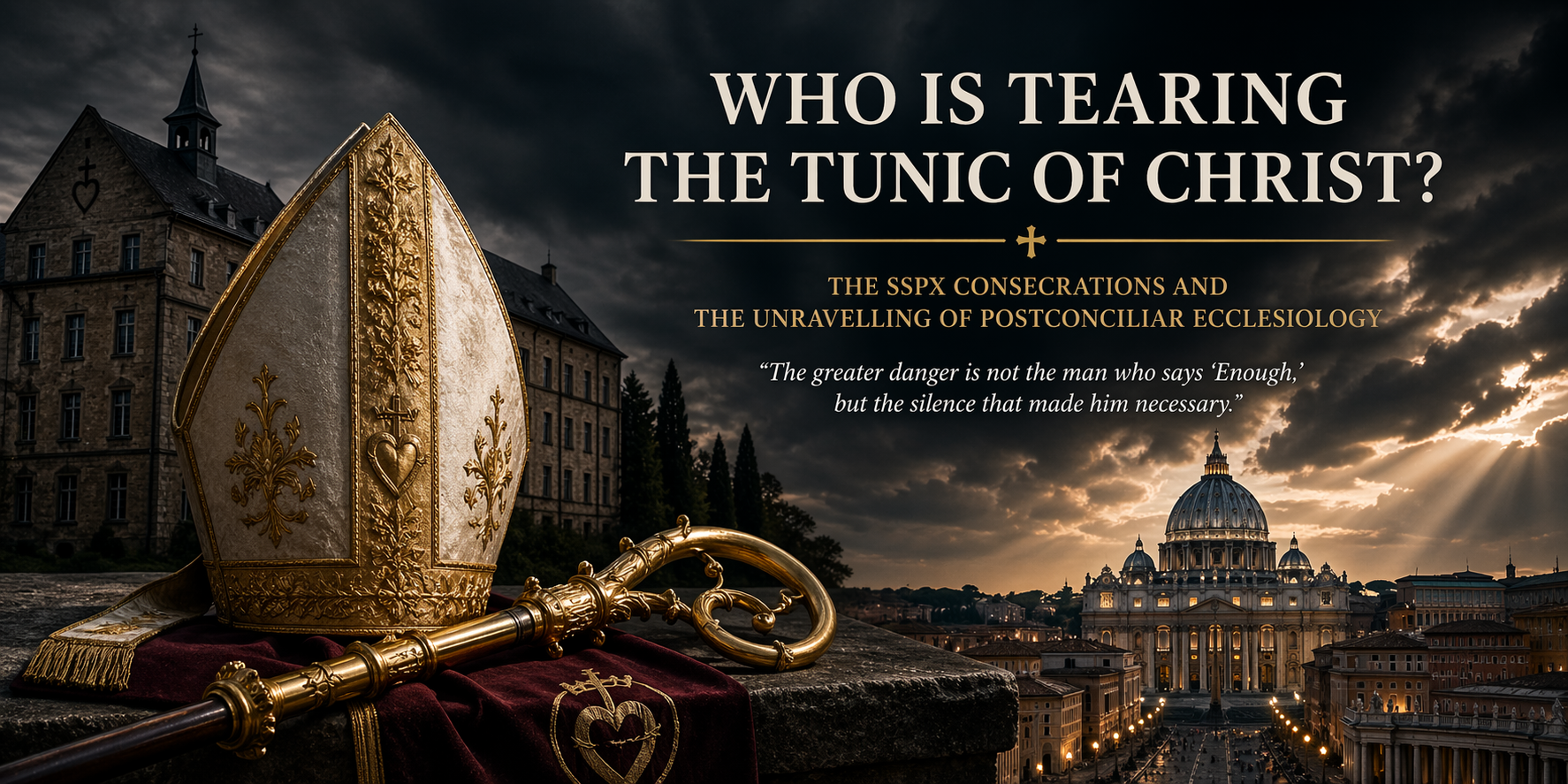
“Who Is Tearing the Tunic?”: The SSPX Consecrations and the Unravelling of Postconciliar Ecclesiology

The planned episcopal consecrations of 1 July 2026 at Écône are not merely another episode in a long and familiar dispute. They constitute a moment of decision—one that the Church has, for decades, deferred but can no longer avoid. For in this act, the Society of Saint Pius X does not simply act against a law; it acts upon a judgment: that the present crisis in the Church has reached such a depth that the ordinary structures of authority can no longer be relied upon, without qualification, to safeguard the Faith itself.
The interview granted by Fr. Davide Pagliarani—published under the title “Who Is Tearing the Tunic of Christ?”—makes this claim explicit. “The rupture does not come from the Society of Saint Pius X,” he states, “but from the flagrant divergence of official teachings from Tradition and the constant Magisterium of the Church.”¹ This is not a defensive posture. It is an inversion. The burden of explanation is shifted: no longer must the Society justify its actions alone; the postconciliar settlement itself is placed under scrutiny.
A Crisis Not Merely Observed, But Judged
Pagliarani does not argue for the existence of a crisis. That premise he assumes as already evident to any attentive observer. What he contests is its interpretation. The language of “abuse,” long employed to explain the disorder of recent decades, is rejected as inadequate. It addresses symptoms while leaving causes untouched. “One must have the courage to go further,” he insists, “and to recognize that this crisis has its origin in official teachings… often ambiguous and sometimes clearly breaking with Tradition.”¹
Here the argument passes from commentary to indictment. If the crisis touches the level of teaching itself—not the Magisterium properly so called, but the broader body of authoritative discourse that shapes the life of the Church—then it cannot be resolved by administrative correction or pastoral recalibration. It demands theological clarification at the highest level. Until such clarification is given, the tension remains structural, not accidental.
This is why Pagliarani insists, with striking directness:
“What is at stake today is not an opinion… but the Faith and morals that a Catholic must know, profess, and practise in order to save his soul.”¹
The stakes are thus not institutional but eternal. It is no longer a question of governance alone, but of salvation—no longer of prudence, but of truth.
It is here that the voice of Tradition itself must be heard. St Vincent of Lérins, writing against the confusions of his own age, laid down the principle that what is to be held is that which has been believed “everywhere, always, and by all.”² The force of Pagliarani’s argument is that this canon is no longer simply obscured at the margins, but endangered in its transmission. Whether one accepts that judgment or not, one cannot deny its gravity.
Faith and Law: A Hierarchy Restored
From this diagnosis follows a principle that lies at the heart of the Society’s justification: the primacy of the Faith over juridical order. Pagliarani identifies a “deeper and typically modern malaise”—the separation of Faith and law into parallel and competing obligations. Many within the Church, he observes, “place these two demands side by side, in a Cartesian fashion, and find themselves crushed or overwhelmed by the apparent contradiction.”¹
Against this, he reasserts a classical hierarchy: “The purity and profession of the Faith precede all other considerations.”¹ Law exists to safeguard the Faith; it cannot be invoked to obstruct its preservation. This is no novelty. The Church has long held that salus animarum suprema lex—the salvation of souls is the supreme law.³ Yet what has been rare in the past is the claim that such a principle must be invoked not at the periphery, but in relation to the centre.
Here again, the controversy sharpens. For if such a claim is justified, then the crisis is indeed grave. If it is not, then the appeal to necessity collapses. The question cannot be resolved by rhetorical dismissal. It demands demonstration.
From Debate to Action: The End of Delay
A recurring theme of the interview is the inadequacy of prolonged debate. “When people talk and debate without respite… everything is relativized.”¹ Discussion, once necessary, has become a mechanism of delay. The mind becomes accustomed to contradiction; the will grows hesitant; zeal diminishes.
This is not a new phenomenon. Pope Pius X, diagnosing the rise of modernism, warned that error advances not only by assertion, but by infiltration—by the gradual erosion of clarity, the slow dulling of the intellect’s assent to truth.⁴ In such a climate, ambiguity becomes a solvent, dissolving certainties without ever directly confronting them.
Hence the insistence that the moment for analysis alone has passed. “Chatter, dissertations, and dialogue must yield to reality.”¹ The consecrations are presented as precisely such a yielding: not an argument to be considered, but an action to be judged. “In this tragic context, someone must be able to say: ‘Enough!’ Not only in words, but above all through practical actions.”¹
The word is decisive because the delay has been prolonged. The act is decisive because the argument has been made.
A “Sign of Contradiction” in an Age of Elasticity
Pagliarani situates the Society as “a sign of contradiction… a thorn in the side of the reformers.”¹ This is not triumphalism, but diagnosis. The existence of the Society, and the persistence of the tensions it embodies, reveals something unresolved within the Church’s postconciliar articulation of herself.
Central to this is the concept of “partial communion,” which Pagliarani rejects. Either one is in communion with the Church or one is not; intermediate categories obscure reality. This position challenges a significant strand of contemporary ecclesiology, one that has sought to describe unity in more graduated and analogical terms.
Yet here the question presses: does elasticity clarify, or does it conceal? Does it express a deeper unity, or does it defer a necessary distinction? The Society’s challenge is not that such categories exist, but that they have become substitutes for resolution.
From Francis to Leo XIV: Authority at the Threshold
The transition from Pope Francis to Pope Leo XIV brings this question to a point. Pagliarani’s assessment of Francis is notably complex: doctrinally critical, yet personally acknowledging a certain pastoral openness.¹ That openness produced an unprecedented situation—practical recognition without canonical resolution.
That situation cannot endure indefinitely. It must either be clarified or collapse under its own weight.
For Pope Leo XIV, this is not an inherited inconvenience. It is a defining test. Authority, to be credible, must be coherent. Law, to bind, must be intelligible. Silence, in such a moment, is not neutral; it is itself a position, and one that will be interpreted.
A Judgment That Returns to Rome
It would be a grave error to see the events of Écône as an isolated rupture. They are, rather, a mirror. They reflect back to the Church a question she has not fully answered: what is the relationship between Tradition and the structures that claim to serve it?
If the Society is wrong, it must be shown to be wrong—not by force alone, but by clarity. If it is right, even in part, then the implications are profound. For then the crisis is not peripheral, but central.
The Church has always known how to resolve such moments—but only by facing them. The Arian crisis was not ended by ambiguity, but by definition. The errors of modernism were not overcome by accommodation, but by exposure. Truth does not fear scrutiny; it demands it.
Pagliarani invokes the promise of Christ: “the gates of hell shall not prevail against it.”¹ This promise stands. But it is fulfilled not in the avoidance of crisis, but in its resolution.
And so the question remains—no longer rhetorical, no longer deferrable: Who is tearing the tunic of Christ?
The answer will not be given in slogans. It will not be preserved in silence. It will not be secured by ambiguity.
It will be given in truth.
For the Church does not divide because truth is spoken.
She divides when truth is obscured.
And in every age, the greater danger is not the man who says “Enough,”
but the silence that made him necessary.
- Fr. Davide Pagliarani, Who Is Tearing the Tunic of Christ?, SSPX Interview, 19 April 2026, https://sspx.org/en/publications/who-tearing-tunic-christ-interview-superior-general-society-saint-pius-x-58695
- St Vincent of Lérins, Commonitorium, ch. 2.
- Codex Iuris Canonici (1983), can. 1752.
- Pius X, Pascendi Dominici Gregis (1907).
related articles


Latest articles
- Today’s homily: Our Lady of WalsinghamThe Mass reflects on the significance of Walsingham, Loreto, and the Christian soul as “Holy Houses” that embody the connection between heaven and earth. It highlights Mary’s central role in the Incarnation and emphasises the importance of inner conversion by inviting believers to reflect on their own hearts as dwelling places for God.
- Today’s Mass: September 24 Our Lady of WalsinghamThe Feast of Our Lady of Walsingham commemorates the vision of Mary that inspired Richeldis de Faverches to build a replica of her house in Nazareth in 1061. This shrine became a significant pilgrimage site, attracting royal visits until its destruction in 1538. The revival of pilgrimage in the 20th century reaffirmed its spiritual importance.
- Sermon for Blessed Virgin Mary of RansomToday, we commemorate the feast of the Blessed Virgin Mary of Ransom, which honours the Mercedarians, a religious order founded in 1218 to free Christian captives from the Moors in Spain. Their mission persists today, highlighting the ongoing relevance of ransoming captives amidst contemporary persecution, combining spiritual redemption with social responsibility.
- OUR LADY OF RANSOM: THE MOTHER OF THE REDEEMER AND THE BREAKING OF CHAINSThe Feast of Our Lady of Ransom, celebrated on 24 September, commemorates the Mercedarian Order’s mission to redeem Christian captives, embodying the concept of liberation from sin through Christ’s sacrifice. This day’s significance links historical devotion with England’s Catholic restoration, connecting the feast to both the Incarnation and personal spiritual freedom.
- Today’s Mass: September 23 Pope Saint Linus, MartyrPope Saint Linus, a nobleman from Tuscany, became an early Christian leader, first in Gaul and then as the Pope after Saint Peter. He was martyred for his faith, noted for his role in baptising and appointing bishops. Saint Thecla, inspired by Saint Paul, chose virginity and endured persecution, ultimately receiving martyrdom.





Leave a Reply