
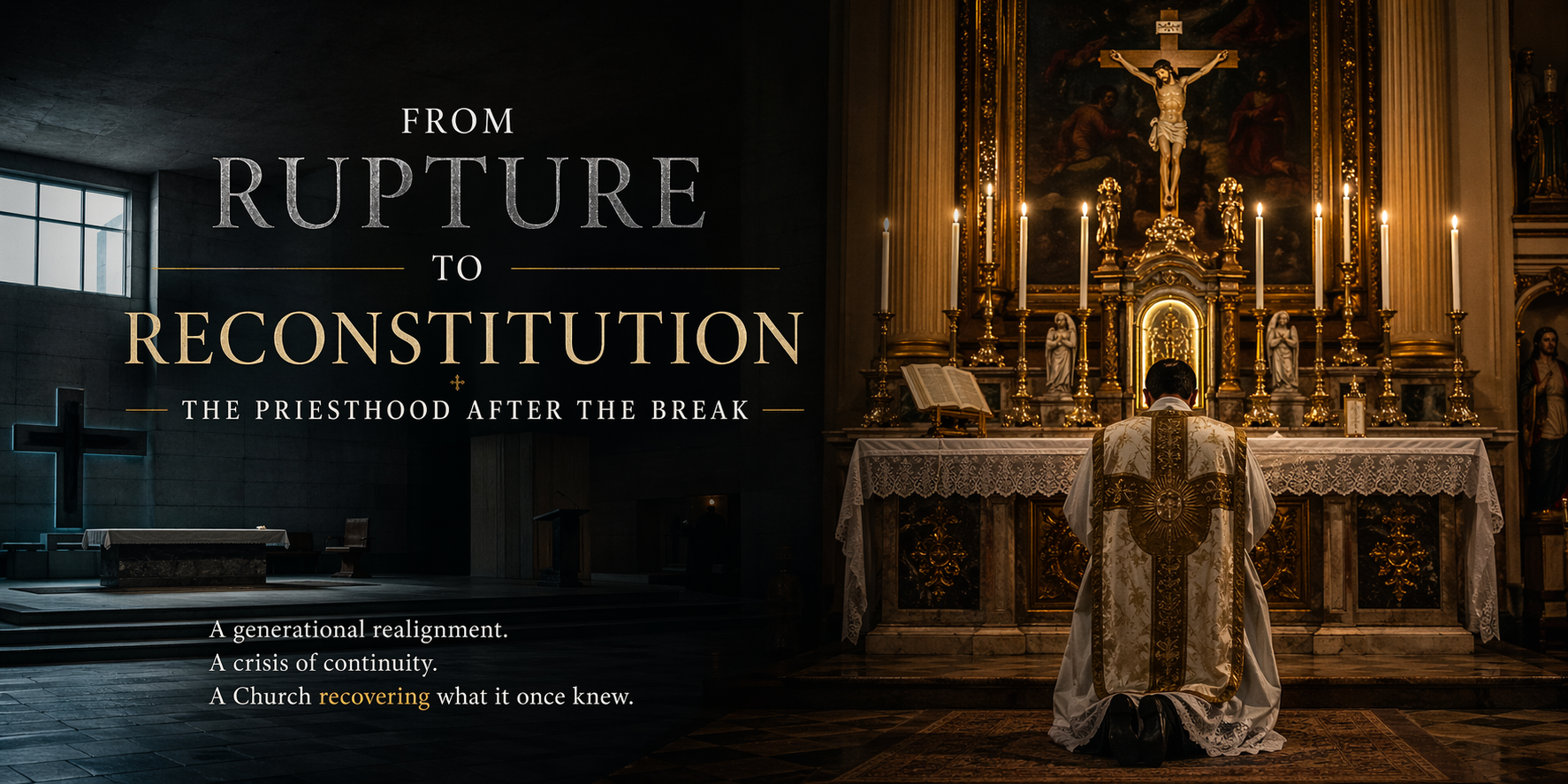
From Rupture to Reconstitution: The Priesthood After the Break of Vatican II

The Catholic priesthood in the West is not merely changing—it is being reconstituted within living memory, under the pressure of forces both internal and external, and at a moment when its continuity can no longer be assumed but must be consciously recovered. Data from the National Study of Catholic Priests (2022) reveals a stark generational divergence: among priests ordained in the late 1960s, roughly 68% identify their theological outlook as “progressive,” while only 16% describe it as “conservative.” Among those ordained in the past decade, the proportions are effectively reversed.¹ This is not a fluctuation of opinion but the statistical trace of a rupture, and more importantly, of the Church’s attempt—under pressure, and not without cost—to repair what was fractured.
The Moment of Discontinuity
The decisive break emerges in the years surrounding the Second Vatican Council. Although the Council itself did not legislate doctrinal rupture, its immediate aftermath witnessed precisely such a rupture in practice, as the interpretive authority of the Church became contested within the very institutions tasked with safeguarding it. When Humanae Vitae reaffirmed the Church’s perennial teaching on contraception, organised dissent followed almost immediately, most visibly in the public opposition led by Charles Curran and others, who asserted that “the encyclical is not infallible teaching” and therefore did not command definitive assent.² This was not merely an academic disagreement conducted within the bounds of theological method; it constituted a direct and public refusal of magisterial authority, one that carried profound implications for the formation of future clergy.
In the wake of this dissent, many seminaries across Europe and North America entered a period of doctrinal instability that cannot be reduced to isolated excesses or localised misjudgments. The transmission of doctrine increasingly gave way to its interrogation, while the metaphysical clarity that had long undergirded Catholic theology—especially in its Thomistic expression—was displaced by historicist and experiential approaches. Moral theology, once grounded in objective norms and teleological reasoning, was frequently reframed through proportionalist or situational lenses, and the ascetical discipline that had traditionally shaped priestly identity was often treated as anachronistic.³ As Pascendi Dominici Gregis warned, modernism would reduce dogma to “a mere symbol of the religious sentiment,” dissolving its objective content into subjective experience.⁴ What had been cautioned as a danger became, in many places, an operating assumption.
This development stands in stark contrast to the principle articulated by St Vincent of Lérins, who insisted that authentic doctrinal development must occur in continuity—ut annis consolidetur, dilatetur tempore, sublimetur aetate—so that the faith might be strengthened, expanded, and elevated without ever being altered in its substance.⁵ What occurred in this period did not meet that criterion, for it did not consolidate what had been received but instead displaced it with competing frameworks of interpretation.
The Measurable Collapse
The consequences of this rupture were neither abstract nor confined to theological faculties; they manifested concretely in the life of the Church. Between 1965 and 1985, the number of active priests in the United States declined significantly, even as the Catholic population increased, creating a widening gap between pastoral need and clerical presence.⁶ At the same time, seminary enrolment collapsed with remarkable speed, falling from over 49,000 seminarians in 1965 to fewer than 10,000 within two decades.⁷ Comparable patterns could be observed across Western Europe, where vocations declined and institutional confidence waned.⁸
Such figures do not merely indicate organisational strain; they point to a deeper failure of continuity. The priesthood had long been sustained by a dense and cohesive Catholic culture in which the faith was transmitted organically through family, parish, and school. When that culture weakened, and when the structures responsible for formation no longer functioned reliably, the vocation itself was exposed to forces it had not previously needed to resist. What had once been inherited now had to be chosen, and where it was not chosen, it faded.
Selection Under Pressure
The priesthood that emerges from such a contraction is necessarily different in character from the one that preceded it, not because its essence has changed, but because the conditions under which it is embraced have altered dramatically. When a system contracts under stress, it does not do so evenly; rather, it retains those most deeply committed to its defining principles. In this context, the contemporary seminarian is not the product of cultural momentum but of deliberate adherence, often formed in opposition to the prevailing assumptions of the wider society.
This shift has significant sociological implications. The priesthood has moved from being a broadly representative institution within Catholic culture to becoming a confessional minority sustained by conviction rather than convention.⁹ The language of “conservatism” used in contemporary surveys captures only part of this reality, for what is often being described is not a political stance but a theological refusal to treat doctrine as negotiable. The insistence upon clarity, continuity, and coherence is less an ideological posture than a recognition that without such elements, the priesthood cannot sustain its own identity or mission.
The Recovery of Form
Within this emerging generation, one observes a renewed attentiveness to elements of Catholic life that had, in previous decades, been marginalised or reinterpreted. There is a noticeable return to doctrinal precision, to the objective structure of moral theology, to the integrity of sacramental theology, and to the continuity of liturgical practice. This is frequently accompanied by a rediscovery of the classical theological tradition, particularly the synthesis articulated by St Thomas Aquinas, whose work once provided the intellectual architecture for priestly formation.
In this regard, the teaching of Aeterni Patris assumes renewed importance. Leo XIII did not commend Thomistic philosophy as a matter of historical preference, but as a necessary foundation for theological clarity, precisely because it orders reason and revelation in a way that preserves both their distinction and their harmony. He insisted that the Angelic Doctor’s method secures theology against error because it “distinguishes, as is right, reason from faith, while uniting them in bonds of friendship.”¹⁰ When that order is abandoned, theology does not become more accessible or relevant; rather, it loses its coherence and, with it, its capacity to form minds and souls.
The recovery of form, therefore, must be understood not as an aesthetic preference or a nostalgic impulse, but as a structural necessity. It represents an effort to restore the intelligibility of the faith itself, so that what is believed, taught, and lived may once again correspond to what the Church has received. As St Irenaeus observed in his confrontation with the Gnostics, the Church’s task is not to innovate upon the apostolic deposit but to preserve it faithfully across time and place, maintaining “one and the same faith” throughout the world.¹¹
The Cost of Amnesia
The rupture in priestly formation has had consequences that extend far beyond the walls of seminaries, shaping the religious life of the faithful in ways that are both visible and profound. The decline in Mass attendance across Western nations—from widespread weekly participation in the mid-20th century to significantly reduced levels in the present day—cannot be attributed solely to external secularisation, however powerful that force may be.¹² It also reflects an internal failure to transmit the faith in a manner that is coherent, compelling, and continuous.
Where priests are uncertain of doctrine, their teaching lacks authority; where they are detached from liturgical continuity, their ministry loses its symbolic depth; where ascetical discipline is neglected, spiritual leadership becomes difficult to sustain. The result is not a dynamic adaptation to modern conditions but a gradual attenuation of identity, in which the distinctive features of Catholic life are softened, obscured, or lost.
Such attenuation carries a cost that is not immediately apparent but becomes evident over time. When memory falters, identity becomes unstable, and when identity is unstable, the capacity to hand on the faith is compromised. The crisis, therefore, is not merely one of numbers or practices, but of transmission at the most fundamental level.
Reconstitution, Not Reaction
The generational shift now visible within the priesthood must therefore be interpreted with care, for it is often mischaracterised as a simple ideological reaction against the excesses of the past. In reality, it represents something more substantial: the gradual reassertion of doctrinal and sacramental reality after a period in which that reality was obscured or contested.
This reconstitution is not the product of a coordinated programme or a unified strategy; rather, it emerges organically from the conditions in which the Church now finds herself. Faced with diminished numbers, increased scrutiny, and a secular environment often indifferent or hostile to religious claims, the priesthood is being forced to rediscover the elements that are essential to its identity. Clarity is no longer optional, for ambiguity cannot sustain a vocation that already stands in tension with the surrounding culture.
At the same time, this process remains incomplete and contested. The structures, assumptions, and habits formed during the period of rupture continue to exert influence, and the path toward coherence is neither linear nor assured. Nevertheless, the direction is discernible. A priesthood formed in clarity is emerging, not because it has been imposed from above, but because it has become necessary for survival.
Conclusion: The Law of Continuity
The history of the Church allows for development, but it does not permit contradiction. Where contradiction is introduced, it cannot endure indefinitely; it must either be resolved or it will undermine the structures that sustain it. The generational realignment of the priesthood can thus be read as the visible sign of a deeper process of resolution, in which the tensions introduced by discontinuity are gradually being addressed.
The Church does not sustain herself by accommodating every age, but by remaining faithful across them, handing on what she has received rather than redefining it according to shifting circumstances. The data, therefore, should not be read merely as an indicator of changing attitudes, but as evidence of a more fundamental reality: that the priesthood, deprived of continuity, cannot remain what it is.
What is now emerging—tentatively, unevenly, but unmistakably—is a recognition of that fact, and with it, a renewed commitment to the transmission of the faith in its integrity. Continuity is not a preference within Catholicism; it is the condition of its survival.
¹ The Catholic Project, National Study of Catholic Priests 2022 (Washington, DC: Catholic University of America, 2022).
² “Priests Assail Pope’s Birth Control Ban,” New York Times, 30 July 1968; Charles E. Curran archival statements, Catholic University of America.
³ Dean R. Hoge, The First Five Years of the Priesthood (Collegeville: Liturgical Press, 2002), pp. 23–45; Donald B. Cozzens, The Changing Face of the Priesthood (Collegeville: Liturgical Press, 2000), pp. 54–78.
⁴ Pius X, Pascendi Dominici Gregis (1907), §13.
⁵ Vincent of Lérins, Commonitorium, ch. 23.
⁶ Center for Applied Research in the Apostolate (CARA), Georgetown University, Catholic Ministry Formation Directory and priesthood datasets (1965–1985).
⁷ United States Conference of Catholic Bishops, Priestly Vocations Statistics; CARA, Frequently Requested Church Statistics.
⁸ Stephen Bullivant, Mass Exodus: Catholic Disaffiliation in Britain and America since Vatican II (Oxford: Oxford University Press, 2019), pp. 45–67.
⁹ Christian Smith et al., Young Catholic America (Oxford: Oxford University Press, 2014), pp. 112–130.
¹⁰ Leo XIII, Aeterni Patris (1879), §23.
¹¹ Irenaeus of Lyons, Adversus Haereses, I.10.2.
¹² Pew Research Center, “In U.S., Decline of Christianity Continues at Rapid Pace” (2019); European Social Survey (2002–2018).
RELATED ARTICLES


LATEST ARTICLES
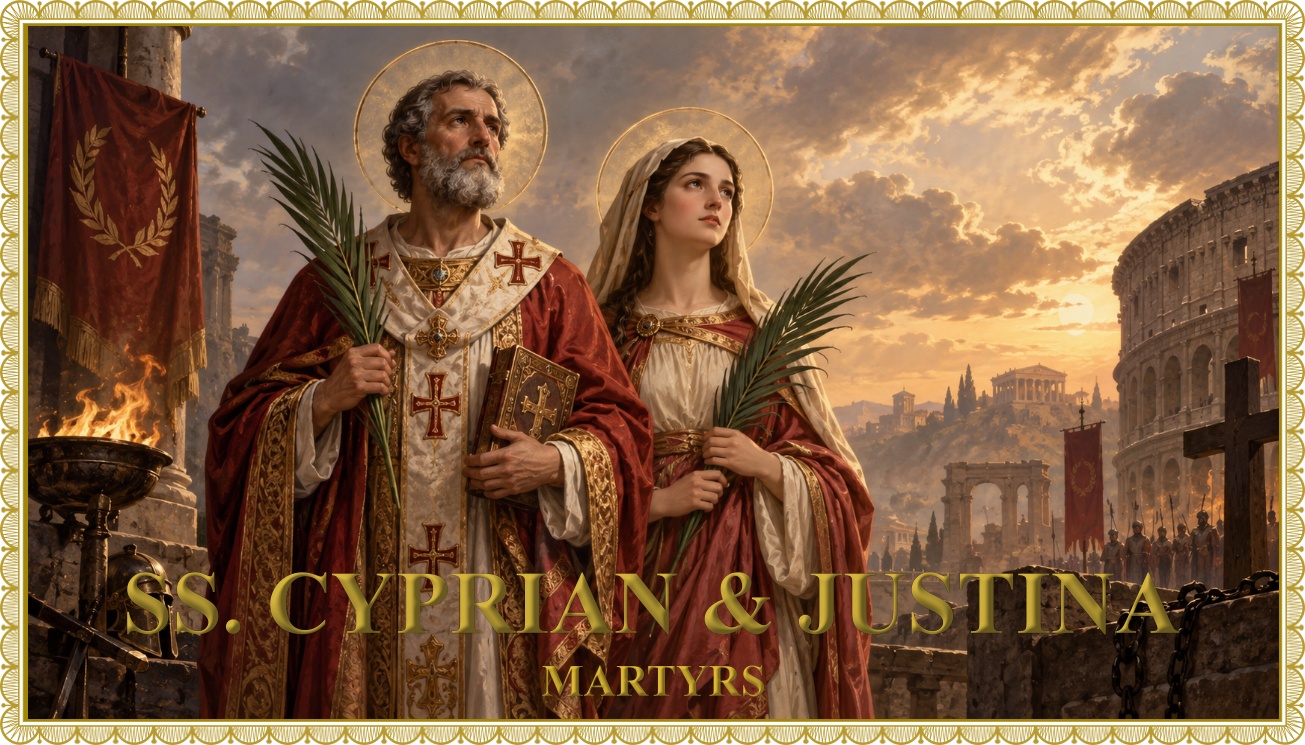
- Today’s Mass: September 26 SS. Cyprian and Justina, MartyrsThe persecution of Diocletian broke out at that time, and Cyprian and Justina were seized and presented to Diocletian himself, who judged them. Justina was scourged and Cyprian was torn with iron hooks. After this they were both sent back to Diocletian in chains. He commanded that their heads be cut off, and they died; martyrs for the Faith!
- 27.09.26 Nuntiatoria CXXV: VERITAS NON MUTATUR CONSENSUThis edition emphasises that truth remains constant, regardless of institutional consensus. It explores how authority should serve existing realities rather than define them, stressing the importance of preserving the Church’s traditions and teachings. The Church’s role is to guard and transmit truth, not to create it through agreement or procedure.
- ORDO w/c 27.09.26The week begins with the Eighteenth Sunday after Pentecost, honouring various saints, culminating in the feast of St Francis of Assisi. Key celebrations include St Wenceslaus, St Michael the Archangel, St Jerome, and St Thérèse of the Child Jesus. The period highlights the call to surrender worldly attachments in devotion to God.
- Rupnik’s accusers appeal to Leo XIV: the women are still outside the doorThe text explores the concept of “spiritual denial” within the Catholic Church regarding serious allegations against church leaders. It argues that this denial, often perceived as loyalty, leads to evasion of uncomfortable truths. The piece emphasises that acknowledging these failures does not undermine the Church’s integrity, urging faithful confrontation of wrongdoing while maintaining justice for all involved.
- TRADITIONIS CUSTODES BY THE NUMBERS: WHAT ROME’S 2025 DECREE REGISTER ACTUALLY SHOWSThe Vatican’s 2025 decree register clarifies the status of the Traditional Roman Mass, detailing 34 decrees concerning 33 jurisdictions and 55 parish churches. While 41 locations have renewed permissions, this system requires repeated authorisation from Rome, indicating administrative dependency on continuous approval for traditional practices rather than expanding opportunities.





Leave a Reply