
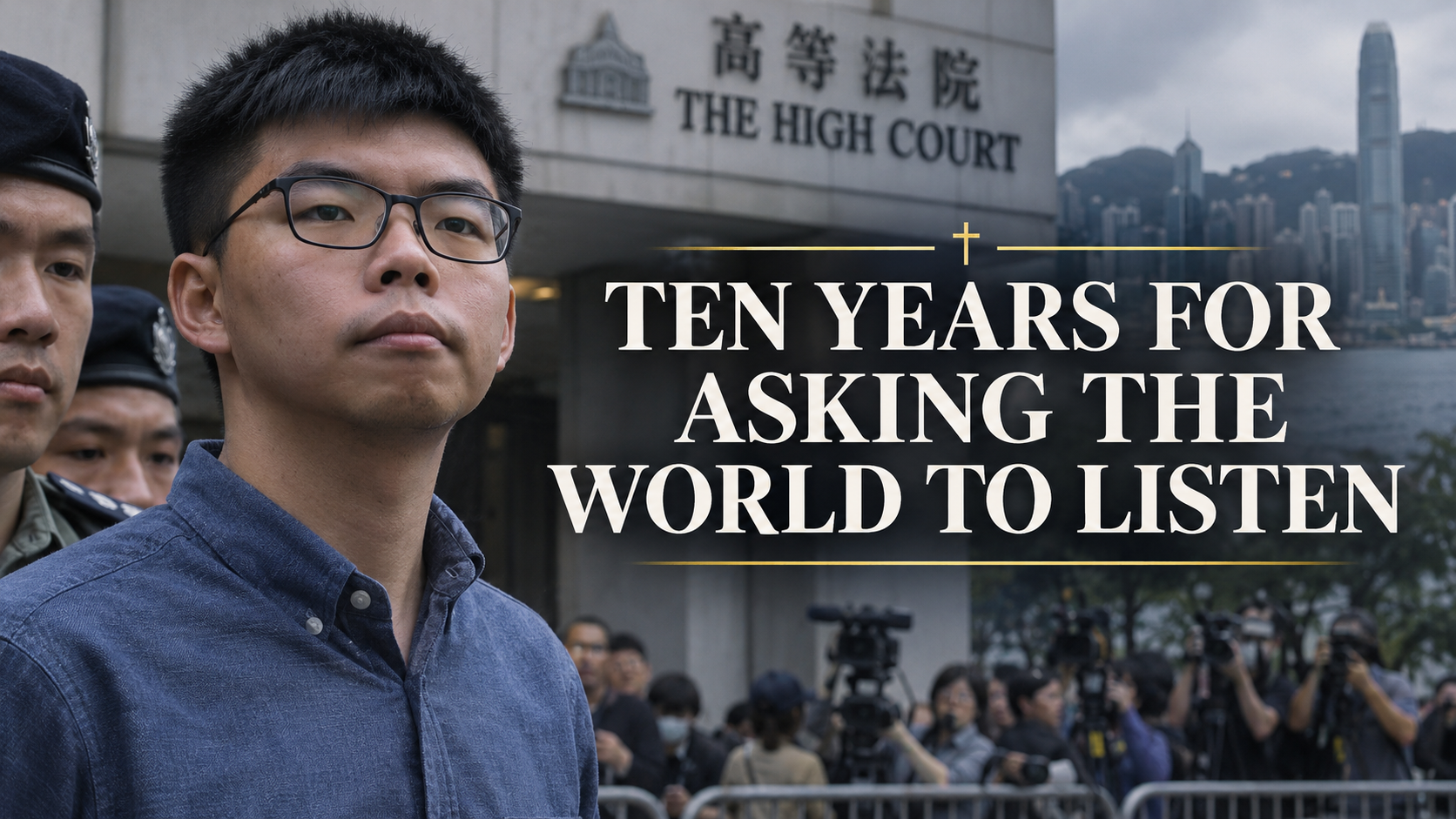
Joshua Wong’s imprisonment exposes the consequences of Beijing’s national security laws for Hong Kong’s promised freedoms. With Jimmy Lai already serving twenty years, the convictions raise questions which extend beyond the treatment of individual dissidents to the authority of international treaties, the moral limits of government and Britain’s continuing obligations towards the people of its former colony.
Joshua Wong turned thirty last month. He has spent almost six years in prison and, following Thursday’s judgment in Hong Kong, faces the prospect of remaining there until he is forty. High Court Judge William Tam sentenced him to ten years’ imprisonment for conspiring to collude with foreign forces, principally through seeking international sanctions against China and Hong Kong. The judge began with a term of thirteen years, reducing it by three in recognition of Wong’s guilty plea and other mitigating circumstances. The resulting decade was the statutory minimum for an offence classified as grave under the National Security Law. Two months and two days will run concurrently with his existing sentence. For the remainder, a young man whose political activities began while he was still at school must contemplate another prolonged period of imprisonment.¹
The proceedings have attracted considerable international attention, although the sentence itself was scarcely unexpected. Since Beijing imposed its National Security Law upon Hong Kong in June 2020, the prosecution of political opposition has become an established feature of the territory’s public life. The authorities regard these convictions as evidence that constitutional order has been restored following the disturbances of 2019. Those who remember the liberties formerly enjoyed in Hong Kong may reasonably interpret the same developments rather differently. What was once an internationally recognised centre of comparatively free political expression has become a place where opposition to the government, particularly when accompanied by appeals for foreign assistance, carries consequences which would have been difficult to imagine at the time of the handover.
Wong’s conviction requires some care in its treatment. He pleaded guilty in September to a conspiracy involving the exiled activist Nathan Law and others, directed towards obtaining foreign sanctions, blockades or other hostile measures against the Chinese and Hong Kong authorities. The prosecution maintained that these activities continued after the National Security Law entered into force on 30 June 2020, with those remaining in Hong Kong adapting their methods to support campaigns conducted overseas. Judge Tam regarded Wong and Law as principal organisers and concluded that Wong would probably have persisted had he not been remanded in custody in November 2020. These were findings made in criminal proceedings concerning a specific offence, and the circumstances should not be confused with the earlier peaceful demonstrations for which Wong first became internationally known.²
Neither should the political conduct involved be treated as incapable of legitimate criticism. International sanctions frequently impose burdens upon people who have little influence over the decisions of their governments. Economic pressure may be an appropriate response to grave misconduct, but its consequences require examination, and the mere assertion of democratic objectives does not establish the wisdom of every measure proposed in their name. Governments also possess a legitimate responsibility to safeguard public security. Hong Kong experienced serious disorder during the 2019 protests, including incidents of violence which ought neither to be excused nor dismissed because they occurred within a wider movement advocating democratic reform.
Such considerations, however, make the severity of Wong’s punishment more difficult to justify. The conduct underlying the present conviction concerned political advocacy and efforts to persuade foreign governments to adopt punitive measures. The publicly reported findings do not establish that Wong organised terrorist violence or participated in espionage. Article 29 of the National Security Law encompasses several forms of foreign collusion, including the solicitation of sanctions, within an offence carrying exceptionally severe penalties. The decision to place such conduct within this statutory framework was itself a political and legislative choice. A court applying that law may act in accordance with its provisions while leaving unanswered the more fundamental question of whether those provisions satisfy the requirements of justice.³
The distinction has particular importance in Hong Kong because the territory’s political and legal freedoms were expressly guaranteed before sovereignty passed from Britain to China. The Sino-British Joint Declaration, signed on 19 December 1984 and registered with the United Nations the following June, established the arrangements under which Hong Kong would return to Chinese sovereignty in 1997. China undertook to preserve the territory’s high degree of autonomy, independent judicial power and existing rights and freedoms for fifty years. Those provisions included freedom of speech, of the press, of assembly and of association. Their inclusion was central to the agreement, intended to reassure a population accustomed to institutions and liberties markedly different from those prevailing on the Chinese mainland.⁴
The agreement did not promise independence, nor did it deny Chinese sovereignty over Hong Kong. Its purpose was to determine the conditions under which that sovereignty would be exercised. Beijing may legitimately insist upon the former while remaining answerable for the latter. Indeed, the distinctive character of Hong Kong was sufficiently important to both governments that its preservation was embodied in a binding international instrument. The people of the territory were assured that their existing way of life would continue substantially unchanged until 2047. Many of those now facing prosecution were children, or had not yet been born, when these undertakings were made.
There is consequently a serious difficulty when the authorities prosecute citizens for soliciting the intervention of foreign governments over the alleged violation of internationally guaranteed liberties. The Joint Declaration necessarily involved another sovereign state, Britain, and its provisions were matters of international obligation. Yet appeals to foreign governments concerning the conduct of the Chinese and Hong Kong authorities may now constitute evidence of criminal collusion. This creates an extraordinary predicament for those who consider that the terms of the handover have been breached. They may invoke the promises made to them, but encouraging international action over their alleged violation can attract the severest sanctions of the criminal law.
Nobody could reasonably maintain that every appeal for sanctions must therefore be protected, irrespective of its purpose or consequences. Equally, the existence of a prohibition does not settle the legitimacy of what has been prohibited. Political authority cannot be its own exclusive measure of justice. The Catholic understanding of law has never recognised an unlimited sovereignty in which whatever a legislature commands becomes morally right merely through enactment. St Thomas Aquinas, whose treatment of law remains fundamental to Catholic moral theology, defines it as an ordinance of reason directed towards the common good and promulgated by one entrusted with the care of the community. He subsequently distinguishes just laws from those which impose burdens contrary to the common good, exceed legitimate competence or conflict with divine law. Such enactments may retain coercive force, but their moral authority is defective.⁵
Aquinas was concerned with principles considerably more enduring than the fortunes of any particular political movement. Government exists because human society requires authority, public order and the administration of justice. These are genuine goods, and their preservation may necessitate the restraint and punishment of those who threaten them. Yet the common good encompasses the well-being of persons and communities rather than simply the security of those exercising political power. A government which so restricts lawful participation that citizens fear expressing disagreement has misunderstood an important part of its own purpose. It may secure outward conformity while diminishing the habits of responsibility, candour and mutual confidence upon which a healthy political society depends.
The Church’s teaching concerning obedience also deserves attention, particularly because appeals to established authority can appear superficially persuasive when expressed in the language of order and legality. Catholics are obliged to respect legitimate civil authority and to obey just laws. This obligation is neither a licence for political agitation nor an invitation to treat private conscience as superior to every public duty. Conscience itself must be formed according to truth and the moral law. Nevertheless, the obligation of obedience presupposes that authority remains within its proper limits. The Catechism of the Catholic Church recognises circumstances in which citizens are obliged in conscience to refuse directives contrary to the moral order, fundamental human rights or the teachings of the Gospel. The state possesses considerable authority over external conduct, but it cannot claim an unlimited jurisdiction over the moral judgment of those subject to it.⁶
The implications for Hong Kong extend well beyond the fate of prominent political activists. In its latest six-monthly report, published on 22 October, the British Foreign, Commonwealth and Development Office described the expanding application of national security legislation and its effects upon freedom of expression, assembly, association and the press. The report also documented restrictions upon the commemoration of the Tiananmen Square massacre, proceedings against former opposition figures and the pursuit of dissidents living overseas. By June 2026, Hong Kong police had issued thirty-four arrest warrants for individuals abroad in connection with national security offences. The reach of the legislation has consequently become a matter of concern even for people who have left the territory.⁷
The report contains details which deserve more attention than the imprisonment of internationally recognised figures ordinarily receives. Victoria Park, once the site of immense annual gatherings commemorating the victims of the 1989 Tiananmen Square crackdown, has not hosted such a vigil since 2019. In June this year, individuals engaging in comparatively modest commemorative activities were stopped or temporarily detained. Separate proceedings concerning the sale or display of publications regarded as seditious likewise illustrate how national security concerns have entered ordinary civic life. The consequences are experienced by booksellers, students, teachers and families who must now consider whether previously unremarkable activities might attract official attention.
One woman who attended Wong’s sentencing described the uncertainty felt by residents about what they may safely say, write or draw. Her observation deserves serious consideration because the effects of restrictive legislation cannot be measured simply by counting convictions. The knowledge that others have been punished may discourage conduct which is lawful, while uncertainty over the interpretation of broadly expressed offences can make citizens reluctant to exercise rights they technically retain. The result is a society in which the apparent absence of opposition may tell us very little about the opinions of its inhabitants.
Earlier this year, Nuntiatoria examined the imprisonment of Jimmy Lai, the Catholic newspaper proprietor and founder of Apple Daily, concentrating particularly upon conscience, religious liberty and the limitations of Vatican diplomacy towards China. That examination considered the questions raised by Benedict Rogers concerning the relationship between Lai’s suffering and the theology of martyrdom, while distinguishing the established facts of his prosecution from theological conclusions which could not responsibly be assumed. It also examined the representations made by Cardinal Joseph Zen, Bishop Emeritus of Hong Kong, and the absence of comparable public intervention from the Vatican Secretariat of State. Lai’s subsequent sentence of twenty years, imposed on 9 February, has given those concerns a still greater urgency.⁸
Wong’s circumstances differ in important respects. His political programme and methods need not be regarded as identical with Lai’s, while his imprisonment cannot be described as religious persecution merely because Catholic principles provide grounds for questioning its justice. His case concerns the wider moral environment in which the faithful, together with their fellow citizens, must exercise conscience and participate in public life. Religious liberty is hardly secure when political association and public expression are subjected to increasingly intrusive controls. The same civil authority which can determine the permitted boundaries of political criticism may also possess the means to restrict religious institutions whenever their teaching or public witness becomes inconvenient.
This has particular relevance to the relationship between the Holy See and Beijing. In previous Nuntiatoria commentary, including our examination of the Vatican–China agreement and the responsibilities of Pope Leo XIV, we have argued that episcopal appointments cannot exhaust the Church’s concern for the faithful living under Communist government. The provisional agreement concerns a defined ecclesiastical question; it cannot reasonably be treated as a comprehensive settlement of religious liberty in China. The condition of Hong Kong, including the treatment of Lai and the wider restrictions upon civic freedom, belongs to the political and moral setting in which that agreement operates. An assessment of Vatican diplomacy which confines itself to the appointment of bishops while neglecting those circumstances would be seriously incomplete.⁹
Nor should Britain be permitted to regard the subject as primarily a question for ecclesiastical diplomacy. The Joint Declaration is a treaty to which the United Kingdom remains a party, and successive British governments have continued to acknowledge its binding character. The October report concluded that China remains in ongoing non-compliance with its provisions. That is an unusually serious finding, although repetition has perhaps made it sound almost routine. The report also records that trade between Britain and Hong Kong reached £32.3 billion in the four quarters ending in March 2026, an increase of twenty-four per cent over the preceding equivalent period. Commercial relations have evidently not been suspended by the deterioration in political freedom.¹⁰
There is nothing inherently objectionable about continued trade with Hong Kong, whose inhabitants would scarcely benefit from the indiscriminate destruction of their economic livelihood. Diplomacy likewise requires engagement with governments whose conduct one may have good reason to condemn. Yet these practical considerations cannot relieve Britain of the responsibility to pursue the observance of commitments which it helped establish. The British National (Overseas) visa arrangements provide an important means of refuge for eligible Hong Kong residents, but the opportunity to leave one’s home is a poor substitute for the liberties which were promised there. Nor does offering sanctuary to those able to depart resolve the circumstances of people imprisoned or otherwise prevented from leaving.
British policy must consequently be judged by what it achieves in defending those obligations, including the representations made concerning individual prisoners, the protection afforded to Hong Kong residents living in Britain, and the consistency with which violations are raised in dealings with Beijing. There are legitimate questions about the effectiveness of sanctions, diplomatic pressure and other measures; these require careful evaluation rather than gestures intended merely to demonstrate displeasure. Yet an international treaty cannot become optional because one of its signatories has acquired sufficient economic and political influence to make enforcement inconvenient.
Hong Kong’s courts continue to administer a recognisable legal system, retaining many of the procedures and institutions inherited from British rule. Judges deliver reasoned decisions, advocates make submissions and defendants may seek to mitigate their sentences. These institutions retain importance, and their continued operation should not be disregarded. The difficulty arises when the legislation which judges must administer progressively excludes conduct formerly regarded as part of ordinary political life. Judicial regularity cannot alone establish that the underlying law is just. A sentence may be correctly calculated under statute while remaining open to grave criticism concerning the nature of the offence and the proportionality of the punishment.
Joshua Wong has admitted conduct which the present law of Hong Kong criminalises. Judge Tam has explained the sentence imposed upon him, and the evidence relied upon by the prosecution must be taken seriously. Even allowing for these matters, ten years’ imprisonment for political activity centred upon international advocacy represents an extraordinary exercise of state power. It deserves examination according to the requirements of justice and the purposes for which political authority exists, rather than unquestioning acceptance because the necessary legal machinery has operated.
The promise made to Hong Kong in 1984 was intended to preserve its distinctive liberties until 2047. Less than thirty years have elapsed since the handover. Wong’s imprisonment, Lai’s twenty-year sentence and the steadily widening application of national security legislation leave Britain facing a question for which another expression of concern will scarcely suffice: how does a government intend to uphold a solemn international undertaking when the people for whose protection it was made may themselves be imprisoned for appealing to the international community?
¹ Radio Television Hong Kong, Joshua Wong Jailed 10 Years for Foreign Collusion, 5 November 2026; Reuters, Hong Kong Activist Joshua Wong Gets 10 Years in Jail on National Security Charge, 5 November 2026.
² Radio Television Hong Kong, Joshua Wong Jailed 10 Years for Foreign Collusion, updated 5 November 2026.
³ National People’s Congress of the People’s Republic of China, Law on Safeguarding National Security in the Hong Kong Special Administrative Region, Article 29, 30 June 2020; Reuters, Hong Kong’s Joshua Wong: From Teenage Protest Leader to a Decade Behind Bars, 5 November 2026.
⁴ Governments of the United Kingdom and People’s Republic of China, Sino-British Joint Declaration, 19 December 1984, reproduced in House of Commons Library, Hong Kong: The Joint Declaration, 5 July 2019; Foreign and Commonwealth Office, Sino-British Joint Declaration: Foreign Secretary’s Statement on the 35th Anniversary, 19 December 2019.
⁵ St Thomas Aquinas, Summa Theologiae, I–II, q. 90, a. 4; I–II, q. 96, a. 4.
⁶ Catechism of the Catholic Church, The Authorities in Civil Society, §§2238–2243; Acts 5:29.
⁷ Foreign, Commonwealth and Development Office, Six-Monthly Report on Hong Kong: 1 January to 30 June 2026, 22 October 2026.
⁸ Nuntiatoria, Jimmy Lai, Conscience, and the Limits of Vatican Diplomacy, 2 January 2026; Foreign, Commonwealth and Development Office, Six-Monthly Report on Hong Kong: 1 January to 30 June 2026, 22 October 2026.
⁹ Nuntiatoria, A Lion Must Roar: Why Pope Leo XIV Must Break Rome’s China Pact, 3 October 2025; Nuntiatoria, Jimmy Lai, Conscience, and the Limits of Vatican Diplomacy, 2 January 2026.
¹⁰ Foreign, Commonwealth and Development Office, Six-Monthly Report on Hong Kong: 1 January to 30 June 2026, sections on trade, investment and implementation of the Joint Declaration, 22 October 2026.




Leave a Reply