
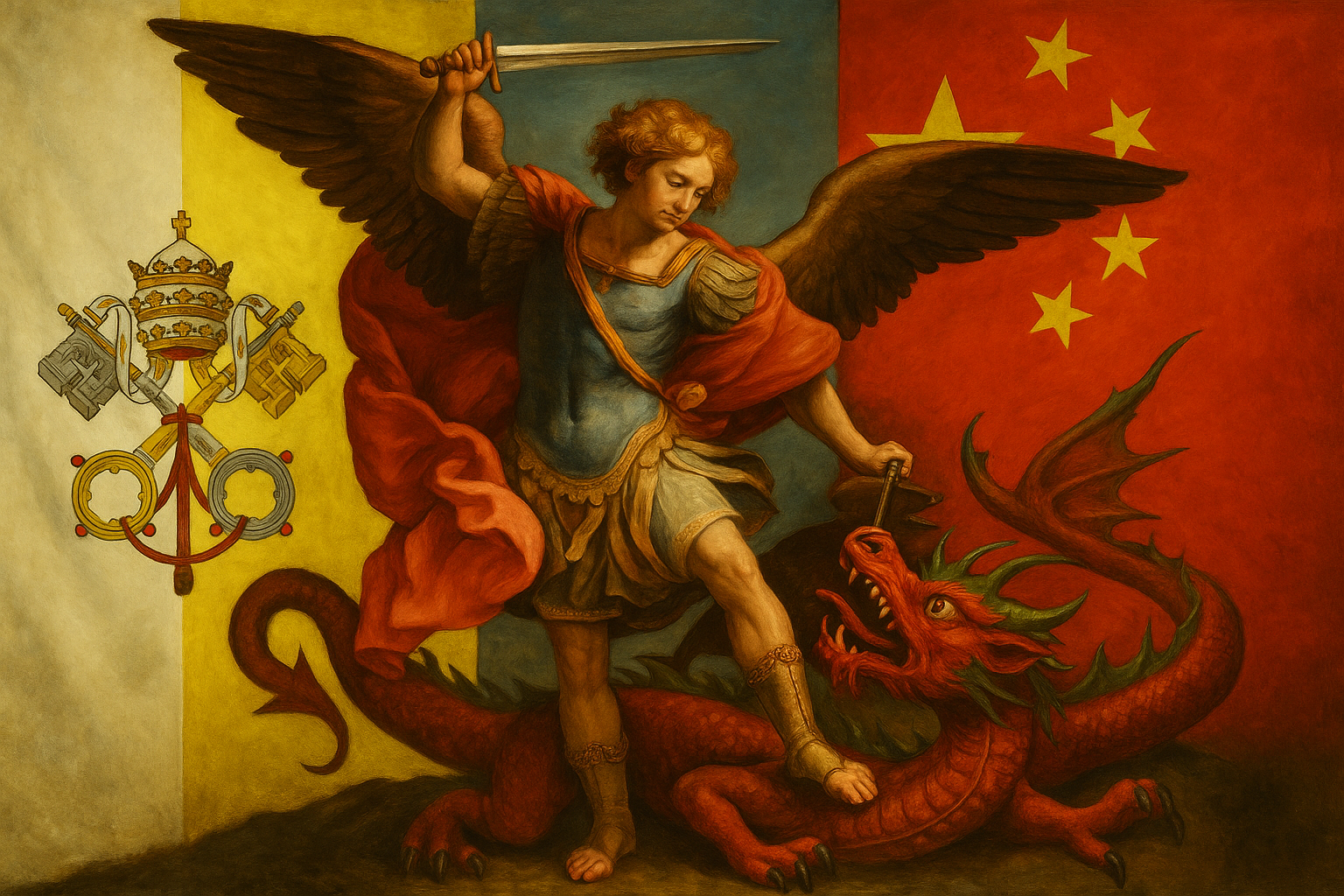
Civil recognition and silent chains: Bishop Zhang Weizhu and the capitulation of Rome in China
The Holy See has announced, with evident satisfaction, that Bishop Joseph Zhang Weizhu of Xinxiang has been granted civil recognition by the authorities of the People’s Republic of China. On the same day, a new bishop, Francis Li Jianlin, was consecrated for the Apostolic Prefecture of Xinxiang “within the framework of the Provisional Agreement between the Holy See and the People’s Republic of China,” and the Pope accepted the resignation of Bishop Zhang, now styled “bishop emeritus.”¹ ²
Yet Bishop Zhang did not attend the ordination of his successor. He could not. According to multiple witnesses and underground-Church sources, he remains under strict surveillance, effectively under house arrest, deprived of freedom, and inaccessible even to his own family.³ The same state apparatus that persecuted him for decades now “recognises” his episcopal dignity, while continuing to conceal his person.
Meanwhile, the official website of the Chinese Catholic Patriotic Association (CCPA), a direct organ of the Chinese Communist Party (CCP), has published a statement supposedly from Bishop Zhang, affirming the need to “adhere to patriotism and love for religion, adhere to the principle of independent and self-governing Churches, follow the trend of the sinicisation of Catholicism in our country, and contribute to the construction of a modern socialist country and the great rebirth of the Chinese nation.”³
Anyone familiar with the language of Party propaganda will recognise in these phrases the standard ideological formulae applied to all “patriotic” religions in China. Anyone familiar with the life and witness of Bishop Zhang will have serious difficulty believing these words are truly his.
The Holy See assures us that all this has taken place under the rubric of the secret 2018 Provisional Agreement with Beijing, renewed again in 2024.¹ ⁴ From the vantage point of the underground Church, however, the Xinxiang settlement looks less like “a new and important step in communion” and more like a public capitulation of Rome before the Party-state.
This article attempts to set out the facts of the case as they are currently known, to place them against the broader background of the Sino-Vatican agreement, and to listen attentively to the voices—too often disregarded—of Chinese Catholics who have suffered for decades to remain faithful to the papacy, only to find the papacy apparently bargaining away their sacrifices.
Bishop Zhang Weizhu: a pastor rendered invisible
Joseph Zhang Weizhu was secretly ordained bishop of Xinxiang in 1991, never recognised by the Chinese authorities and repeatedly persecuted for refusing to join the CCPA.³ For years he served as an “underground” bishop, exercising pastoral care in a grey zone of tolerated illegality.
In May 2021, he was arrested with several priests and seminarians during a raid on an underground formation house. International Catholic reporting documented that he subsequently “disappeared” into various forms of detention and surveillance, a fate shared by other underground bishops such as Augustine Cui Tai and Peter Shao Zhumin.⁴ ⁵ Human Rights Watch (HRW) has repeatedly listed Zhang among forcibly disappeared or detained Catholic bishops whose release it is urging the Holy See to demand as a non-negotiable element of any agreement with Beijing.⁴ ⁶
Against this background, the events of early December 2025 are profoundly revealing. On 5 December, Bishop Li Jianlin was ordained in a ceremony presented in official Chinese and Vatican statements as a solemn, harmonious act under the Provisional Agreement.¹ ² ⁷ The underground bishop of the territory is mentioned only in passing as having resigned.²
Yet, as AsiaNews reports from sources within Henan’s underground community, Bishop Zhang “is still under strict surveillance, deprived of freedom; his family cannot even see him or receive a sign of his safety,” and he “was unable to participate in his own ceremony” as the Church of Xinxiang welcomed a new ordinary.³
What should be a joyful moment in the life of a local Church—its bishop handing on pastoral governance to a successor in a visible sign of apostolic continuity—has been transformed into an act in which the legitimate pastor is erased, physically absent, and politically silenced.

The choreography of the “agreement”
The official choreography on both sides is telling.
From the Vatican side, we have two terse interventions: the Resignations and Appointments note announcing the episcopal ordination of Bishop Li and acceptance of Bishop Zhang’s resignation, and the statement of the Press Office Director the following day expressing “pleasure” at the civil recognition of Bishop Emeritus Zhang and describing it as “a new and important step in the journey of communion.”¹ ² ⁸
From the Chinese side, we have the CCPA’s detailed display of the ordination ceremony, emphasising the presence of the state-approved episcopal hierarchy, and then the subsequent ceremony in which Bishop Zhang’s “civil recognition” is announced, accompanied by a speech attributed to him that reads like a textbook of Xi Jinping’s religious policy: patriotism, independence from foreign influence, sinicisation, and service to the “great rebirth of the Chinese nation.”³
AsiaNews notes, with studied understatement, that it is “highly unlikely that Bishop Zhang is the author of these words,” and underground priests quoted by the agency speak of the “silencing, humiliation, and invisibility” imposed upon their bishop.³
In effect, the state has been allowed to script both the “exit” of the underground bishop and the “entry” of his successor, with Rome providing the canonical rubber stamp and a language of “communion” that almost entirely elides the reality of coercion. This is precisely the pattern that critical observers of the 2018 agreement had warned against: an asymmetric negotiation in which the Party controls the facts on the ground while the Holy See supplies sacramental and moral legitimacy.³ ⁴ ⁶ ⁸
The Provisional Agreement in context
The 2018 Provisional Agreement between the Holy See and the People’s Republic of China—never published in full—was presented as a means of overcoming the long-standing division between the official “patriotic” Church and the underground communities loyal to Rome. In broad outline, it gives the Party a decisive role in proposing episcopal candidates, with the Pope retaining a theoretical right of veto.⁴ ⁹
From the beginning, the agreement was controversial among Catholics familiar with China. Cardinal Joseph Zen of Hong Kong, long a courageous advocate for the underground Church, denounced it as a “betrayal” of confessors of the faith who had endured prison and harassment rather than accept the CCPA’s “independent Church” ideology.¹⁰
Subsequent years have not eased those concerns. Analysts note that religious freedom has deteriorated in China since 2018, with intensified efforts at “sinicisation” of all religions, the tightening of controls over clergy, demolition of churches and crosses, restrictions on minors entering churches, and the proliferation of surveillance.⁴ ⁶ ⁹ HRW has documented the continued persecution of Catholics who refuse CCPA registration, including detention, surveillance, and forced re-education, and it has repeatedly called the agreement “disgraceful” and urged that it either be radically revised or allowed to lapse.⁴ ⁶
Crucially, the agreement has not prevented Beijing from acting unilaterally. At least twice, bishops were appointed or transferred to major sees without prior papal consent, prompting formal expressions of “surprise and regret” from the Holy See but no real consequences.⁹ ¹¹ In April 2025, during the sede vacante, the CCPA proceeded to “elect” bishops in Shanghai and Xinxiang, in blatant disregard of the agreement and of the vacant papal office—a move commentators described as an early test of Pope Leo XIV’s resolve.¹²
Against this history, the Xinxiang settlement appears not as an unfortunate anomaly but as the logical fruit of a policy that consistently prioritises diplomatic engagement and institutional “unity” over a forthright defence of persecuted Catholics.
The language of sinicisation versus the Catholic doctrine of the Church
One of the most disturbing aspects of the statement attributed to Bishop Zhang is the unapologetic repetition of Party slogans: “independent and self-governing Churches,” “sinicisation,” and service to the “great socialist modernisation” of the nation.³ These phrases are not neutral cultural expressions; they are the ideological code of a political project that insists all religious bodies must ultimately submit to the CCP and subordinate their teaching and governance to Party goals.⁴ ⁶
From a Catholic theological perspective, this is incompatible with the nature of the Church. Pope Pius XII, writing specifically to Chinese Catholics in Ad Sinarum Gentem (1954), explicitly rejected the notion of a “national” Catholic Church independent of the Roman Pontiff, warning that such an arrangement would “destroy the unity of the Church” and violate the divine constitution of the Mystical Body.¹³
He recognised the legitimate desire of Catholics to love and serve their homeland, but insisted that this could never be expressed by severing or attenuating communion with the Apostolic See.
That principle applies with particular force where “independence” means not merely canonical separation from Rome but positive submission to an atheistic Party-state that openly claims the right to “reshape” religions. To require clergy to endorse the “sinicisation” formula as a condition of legality is to demand that they assent to a programme that views Catholic doctrine as something to be gradually reinterpreted in line with “socialist core values.”⁶ ⁹
When such language is placed in the mouth of an elderly underground bishop who has allegedly “resigned” while still under surveillance, the moral problem becomes acute. Even if the text did not originate from his hand, Rome’s silence about its coercive nature risks giving the impression that the Holy See can tolerate, or even tacitly accept, state-authored doctrinal statements from captive bishops in order to keep the diplomatic process alive.
“Reconciliation” experienced as erasure
It is essential to listen carefully to the voices emerging from the underground communities themselves. AsiaNews has published a powerful testimony by a priest from an underground community in China, reflecting on the Xinxiang events.³
He notes that while the official statements speak of a “solemn celebration” and a “new step in communion,” the local reality is one of exclusion and fear: Bishop Zhang is absent, underground priests and religious are not invited, some lay leaders are pre-emptively detained, and the ceremony itself is tightly controlled. What should be the gathering of an entire diocesan family becomes a small, curated spectacle.³
The priest writes that Bishop Zhang, when pressed to submit his resignation, reportedly set one condition: that the status of underground priests and religious be regularised in a dignified way. Instead, they have been left unprovided for, uninformed, and effectively re-“undergrounded.”³
In his words, this is not the healing of old wounds but the opening of new ones. The official narrative of reconciliation is experienced by many underground Catholics as a demand to disappear.
This perception is echoed in broader testimonies gathered by HRW, Fortify Rights, and other observers. Underground Catholics speak of being “betrayed by the very Rome to which they pledged their allegiance,” of being pressured to accept bishops imposed under Party supervision, and of witnessing those who endured prison for loyalty to the papacy being asked by Rome itself to retire in favour of Beijing-approved successors.⁴ ⁵ ⁶
A Foreign Policy / Fortify Rights analysis notes that “several underground Catholic bishops who had spent years in prison for their loyalty to the Vatican were asked by Rome to retire in favor of Beijing-appointed bishops,” and lists Bishop Zhang among those arrested or detained despite the agreement.⁵ The Vatican, it observes, has remained largely silent about these arrests, even as it continues to renew the Provisional Agreement.⁵
A unilateral surrender of moral leverage
Defenders of the agreement argue that it is a “long game”: a painful but necessary adjustment to secure the presence of bishops in as many dioceses as possible and to avoid an open schism between the patriotic and underground communities.⁹ ¹¹
They point to cases where previously underground bishops have been recognised simultaneously by Rome and Beijing, or where new appointments appear to stabilise ecclesial life in certain regions.¹¹ ²
Yet even on pragmatic grounds, the Xinxiang case reveals the depth of the asymmetry. Beijing is able to keep an underground bishop under house arrest, exclude him from the life of his own Church, and publish politicised statements in his name, while the Holy See responds with public praise for his “civil recognition” and acceptance of his resignation.³ ⁸
HRW and other human-rights advocates argue that by renewing and applying the agreement in this manner, the Vatican has squandered its moral leverage. Instead of making the release of detained bishops like Zhang a precondition for any new appointments, it has allowed the regime to separate the “recognition” of episcopal dignity from the actual freedom of the person, thereby giving tacit blessing to a system in which bishops may be honoured on paper while remaining in chains.⁴ ⁶
More fundamentally, by treating persecuted underground bishops as elements to be moved or removed in a geopolitical negotiation, the Holy See risks communicating that the sufferings of confessors are bargaining chips rather than honoured sacrifices offered for the Church. This is particularly painful for Chinese Catholics who have long believed that fidelity to the papacy would be the one thing for which Rome could never reproach them.
The witness of Bishop Zhang and the call to solidarity
Yet even amid this bleakness, the witness of Bishop Zhang himself remains luminous. Underground priests describe him as “the lamb led to the slaughter,” silent, meek, and obedient under the cross, excluded from his own church yet continuing to accept his humiliation in union with Christ.³
Whatever political arrangements may be imposed upon his diocese, the true apostolic succession in Xinxiang passes through his suffering. Long after officials and agreements have been forgotten, the memory of a bishop who endured persecution rather than surrender the liberty of the Church will remain a living seed of grace.
For Catholics outside China, the Xinxiang settlement is therefore not merely a piece of unfortunate diplomacy; it is a test of our own ecclesial conscience. Will we comfort ourselves with narratives of “unity” and “dialogue,” or will we listen to the underground voices telling us that, on the ground, unity is being purchased at the price of their erasure?
At a minimum, solidarity with the persecuted Church in China today must include:
– Prayer for Bishop Emeritus Joseph Zhang Weizhu, that he may be freed, reunited with his family, and consoled in his trial.
– Prayer and practical support for underground priests, religious, and laity who refuse to subordinate the Church to the Party.
– A frank demand that the Holy See make the terms of the Provisional Agreement public, subject it to serious moral scrutiny, and insist on the unconditional release of detained bishops as a non-negotiable requirement of any future cooperation.⁴ ⁶
– A renewed reading of magisterial teaching—such as Pius XII’s Ad Sinarum Gentem—to recover a clear doctrine on the independence of the Church’s spiritual authority from political control.¹³
Above all, it requires that we refuse to become accustomed to the spectacle of bishops in chains being presented as “steps forward.” The Church cannot preach Christ crucified while quietly accepting that some of her pastors be crucified for the convenience of her diplomacy.
To pray for the persecuted Church in China, then, is to pray also for Rome: that she may find the courage to speak plainly, to prefer truth to appearances, and to remember that every agreement which forgets the suffering members of Christ’s Body is already, in a deeper sense, a failure.
¹ Holy See Press Office, “Resignations and Appointments”, 5 December 2025.
² Vatican News, “China: Francis Li Jianlin consecrated Bishop of the Apostolic Prefecture of Xinxiang”, 5 December 2025.
³ AsiaNews, “Xinxiang: Bishop Zhang and other Catholics silenced”, 6 December 2025.
⁴ Human Rights Watch, “Holy See: Agreement with China Should Promote Rights”, October 2024.
⁵ Foreign Policy / Fortify Rights, “Pope Francis’s China Deal Was a Moral Catastrophe”, 28 April 2025.
⁶ Human Rights Watch, “The Vatican’s Disgraceful China Deal Ought to End”, September 2024.
⁷ AsiaNews, “Henan gets a new bishop while churches remain off-limits to children”, 5 December 2025.
⁸ Holy See Press Office, “Declaration of the Director of the Holy See Press Office, Matteo Bruni”, 6 December 2025.
⁹ Le Monde, “Pope Francis long extended a hand to China, which never took it”, 21 April 2025.
¹⁰ Associated Press, “Hong Kong allows outspoken Cardinal Joseph Zen to attend Pope Francis’ funeral”, 24 April 2025.
¹¹ Le Monde, “On China, Leo XIV follows in the footsteps of Pope Francis”, 14 June 2025.
¹² The Times, “Pope Leo XIV faces his first diplomatic test – from China”, 29 April 2025.
¹³ Pius XII, Ad Sinarum Gentem, Encyclical Letter, 7 October 1954.
RELATED ARTICLES


LATEST ARTICLES
- Today’s Mass: September 19 St. Januarius, Bishop and Companion MartyrsSt. Januarius and companion martyrs were martyred during the persecution under Diocletian. St. Januarius, patron of the city of Naples and bishop of Beneventum, was beheaded with his deacons and some others.
- Sermon for St. Januarius and his CompanionsToday we celebrate the feast of St. Januarius and his companions. About St. Januarius little is known except that he was among the many martyrs during the great persecution under the Emperor Diocletian.
- 20.09.26 Nuntiatoria CXXIV: QUOD ACCEPIMUS, CUSTODIMUS ET TRADIMUSThe editorial emphasises the importance of understanding our inheritance as custodians rather than owners. It highlights the obligation to preserve and transmit the Christian Faith, sacraments, and traditions to future generations. Through gratitude and fidelity, those who receive must ensure that what has been entrusted does not end with them.
- ONE LORD, ONE FAITH, ONE BAPTISM: The Seventeenth Sunday after PentecostThe Seventeenth Sunday after Pentecost emphasises the love of God and neighbour, rooted in divine justice. The Mass articulates the necessity of one faith and baptism, ensuring charity is not sentimental but deeply theological. The Gospel challenges believers to recognise Christ’s dual nature as both David’s son and Lord, reinforcing true Christian charity.
- AN AWARD IS NOT A MEETINGLambeth Palace has withdrawn the Hubert Walter Award given to Hafiz Tahir Ashrafi for reconciliation, citing previously unknown controversial comments. This raised questions about the vetting process prior to the award. While Ashrafi has defended his record of protecting minority rights, the Palace must clarify why such issues were overlooked initially.




Leave a Reply