
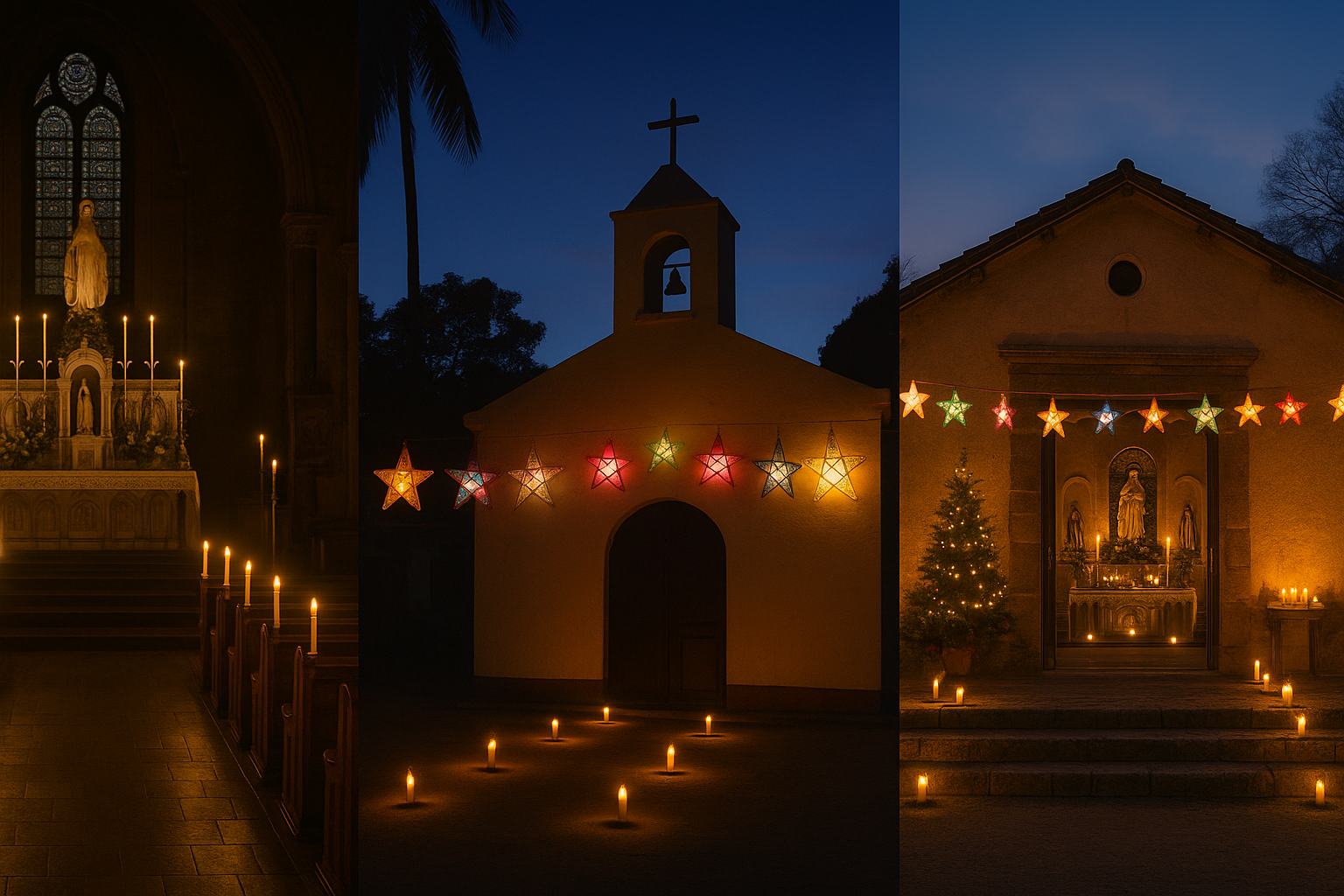
Rorate caeli and the Advent of Light: global dawn Mass traditions
The universality of Advent longing
Across the Catholic world, the season of Advent has inspired traditions of rising before dawn to honour the Blessed Virgin Mary and to await the coming of the Redeemer. The most renowned in the Roman Rite is the Rorate Caeli Mass, celebrated by candlelight in the pre-dawn darkness. Yet many nations share analogous practices: in the Philippines, Simbang Gabi; in Latin America, Las Misas de Aguinaldo; in parts of Spain, Mexico, and Central America, the Misa de Gallo; and in regions of Central Europe, extended sequences of early-morning Marian votive Masses. Each tradition, though culturally distinct, expresses the same theological instinct: the world is in darkness, yet the Light is near.
Rorate Caeli: Advent before the dawn
The Rorate Mass derives its name from the Introit, “Roráte, cæli, désuper, et nubes plúant jústum”—“Drop down dew, ye heavens, from above, and let the clouds rain the Just One.”¹ Celebrated on Advent ferias as a Votive Mass of the Blessed Virgin Mary, it surrounds the faithful with darkness illumined only by candles. The slow entrance of natural dawn during the liturgy forms a living icon: Mary as the dawn, Christ as the rising Sun of Justice.² The Fathers consistently interpret Mary as the “morning star,” the threshold of the Incarnation—“the morning that precedes the great light,” in the words of St Ephrem.³
Simbang Gabi: the Filipino vigil of joyful expectation
In the Philippines, the nine-day sequence of pre-dawn Masses known as Simbang Gabi (or Misa de Aguinaldo in older Spanish usage) dates to the late sixteenth century, established by missionaries responding to the needs of agricultural workers who began their labour before daylight.⁴ Traditionally beginning on 16 December and concluding on Christmas Eve, these Masses form a novena of Marian devotion and preparation for the Nativity. They are marked by festive yet penitential character: churches illuminated before sunrise, parols (lanterns) symbolising the star of Bethlehem, and hymns expressing both longing and hope. Filipino theologians note that Simbang Gabi embodies the vigilance of the poor, echoing the shepherds who first received the angelic proclamation.⁵ While culturally rich, its theological structure mirrors that of the Rorate tradition: a people waiting in darkness, guided by the Mother of the Lord toward the dawn of salvation.
Las Misas de Aguinaldo: Hispanic votive Masses of the Virgin
Throughout the Spanish-speaking world—especially in Puerto Rico, Venezuela, and parts of Central America—Las Misas de Aguinaldo are celebrated as early-morning votive Masses in honour of the Blessed Virgin during the days preceding Christmas.⁶ They are distinct from Simbang Gabi yet sprung from the same missionary roots. Granted by indults from Spanish bishops and later confirmed by the Holy See, these Masses historically permitted the recitation of the Gloria as an expression of joyful expectation.⁷ Their melodies, dances, and villancicos reflect local piety without diminishing their theological heart: Mary preparing her people to receive the Word made flesh.
Misa de Gallo and other Iberian traditions
The Misa de Gallo—literally, the “Mass of the Rooster”—is most commonly associated with Midnight Mass on Christmas, but in several older Iberian and Latin American regions it also referred to pre-dawn Advent votive Masses. The name recalls the ancient belief that Christ would come at dawn, when the rooster announces the breaking day.⁸ Similar pre-dawn Masses survive in rural Spain and Portugal, where Advent was once marked by prolonged sequences of Marian votivas anticipating the Rorate theme.
The European heritage of dawn Masses
The Rorate Caeli tradition has deep roots in central Europe. In Austria, Bavaria, Hungary, Poland, Slovakia, and the Czech lands, extended schedules of Rorate Masses—sometimes every day of Advent—were historically common.⁹ Villagers processed before sunrise carrying lanterns through winter darkness. In Polish and Slovak practice, Roraty formed a communal novena especially beloved by children, often centred on a candle symbolising the pure heart of Mary.¹⁰ Across these regions, the dawn liturgy signifies both waiting and awakening: Advent not as passive sentimentality but as moral and spiritual preparation.
A shared theological centre
Despite their cultural variety, these dawn Mass traditions converge on three perennial truths of the Christian faith:
- The world lies in darkness, a spiritual night intensified in times of moral confusion, war, and cultural disarray (Isaiah 60:2).
- Mary is the dawn, in whom the first light of redemption appears, the living Ark and the model of expectant fidelity.¹¹
- Christ is the rising Sun, whose coming scatters darkness and restores creation (Malachi 4:2).
By rising early, keeping vigil, and entering candlelit sanctuaries, the faithful enact bodily what the soul must do spiritually: watch, pray, repent, and welcome the Light who alone dispels the world’s shadows.
The contemporary rediscovery of dawn liturgy
In an age marked by artificial light, relentless distraction, and the erosion of silence, these traditions have seen a global resurgence. Young Catholics, families, and traditional communities increasingly seek liturgies that restore the mystery and intentionality of worship. The pre-dawn votive Masses answer this hunger. They require effort; they demand sacrifice; they invite contemplation. Yet precisely for this reason they bear fruit. As Pope Pius XII taught, *“The liturgy educates by immersing the faithful in the mysteries of Christ.”*¹² Dawn Masses immerse the faithful in the mystery of Advent: the humble waiting of Mary, the vigilance of the poor, and the slow conquest of light over darkness.
The invitation of the global dawn
Whether in a candlelit European chapel, a Filipino barangay, a Venezuelan village, or an Old Roman Apostolate mission chapel, these pre-dawn liturgies proclaim the same truth: Christ comes. He comes quietly. He comes to the waiting. He comes to the poor in spirit. He comes most readily to those who rise in darkness and look for Him.
Advent dawn Masses are not merely customs; they are catechisms in motion, teaching the faithful to hope when the world prefers despair, to watch when the world sleeps, and to believe that even a single flame is enough to illumine the path to Bethlehem.
- Missale Romanum (1920), Introit of the Votive Mass of the Blessed Virgin Mary in Advent.
- Malachi 4:2; cf. Pope Pius XII, Mediator Dei (1947), §142.
- St Ephrem the Syrian, Hymns on the Nativity, XI.
- Jaime C. Laya, Philippine Folk Literature and Faith (Manila, 2002), pp. 77–81.
- José de Mesa, And God Said, “Bahala Na!”: The Filipino Experience of God (Manila, 1987), p. 54.
- Rubén Vargas Ugarte, Historia de la Iglesia en el Perú, vol. III (Lima, 1951), pp. 312–315.
- Indult of the Archbishop of San Juan, Puerto Rico (1737), confirmed by the Sacred Congregation of Rites; cf. Analecta Juris Pontificii (1858), pp. 241–243.
- Celsus Kelly, OFM, ed., Calendar of Documents: Spanish Voyages (London, 1965), notes on early Spanish liturgical customs, p. 98.
- Josef Andreas Jungmann, The Mass of the Roman Rite, vol. I, pp. 183–184.
- Stanisław Hołodok, Adwentowe Zwyczaje w Polsce (Lublin, 1998), pp. 41–47.
- St Ambrose of Milan, Expositio Evangelii secundum Lucam, II.7.
- Pope Pius XII, Mediator Dei (1947), §23.
RELATED ARTICLES


LATEST ARTICLES
- Mary Is Co-Redemptrix: Cardinal Burke Reopens Rome’s Marian ControversyCardinal Raymond Leo Burke has declared the Virgin Mary as “Co-Redemptrix” amidst controversy over the Vatican’s restriction on this title. The debate revolves around the appropriateness of certain theological language and whether terminology historically used can still accurately express Marian cooperation in Redemption without compromising Christ’s unique role.
- When Politics Defines Doctrine: Edmund Waldstein, Integralism and the New Boundary at HeiligenkreuzThe ongoing exclusion of Father Edmund Waldstein from teaching at Heiligenkreuz has sparked debate on the limits of acceptable Catholic thought, particularly regarding integralism and its relationship to Church doctrine. Critics argue that Waldstein and similar positions challenge both Catholic teachings and democratic values, raising questions about the intersection of faith and politics.
- Christianity Is Right ~ Not Right WingThe article discusses the distinction between Catholic orthodoxy and modern political ideologies, particularly the Right and Christian nationalism. It argues that Catholic beliefs about family, morality, and authority predate contemporary political classifications and should not be conflated with right-wing politics. The ordo amoris framework is presented as a guiding principle for evaluating political alliances while maintaining a focus on the common good and the Social Kingship of Christ.
- Today’s homily: The Nativity of the Blessed Virgin MaryThe Nativity of the Blessed Virgin Mary marks a significant moment in salvation history, representing the dawn of the Incarnation. Mary’s birth, unnoticed by the world, was part of God’s providential plan leading to Christ. This feast invites reflection on humility, obedience, and trust in God’s will, emphasising Mary’s role as the Mother of the Redeemer.
- Today’s Mass: September 08 The Nativity of the Blessed Virgin MaryThe Nativity of the Blessed Virgin Mary celebrates her birth, symbolising a new beginning tied to salvation. Originating in the East, it gained recognition in Rome under Pope Sergius I. Additionally, the feast commemorates Saint Hadrian, a martyr who converted to Christianity, underscoring themes of faith and redemption.



Leave a Reply