
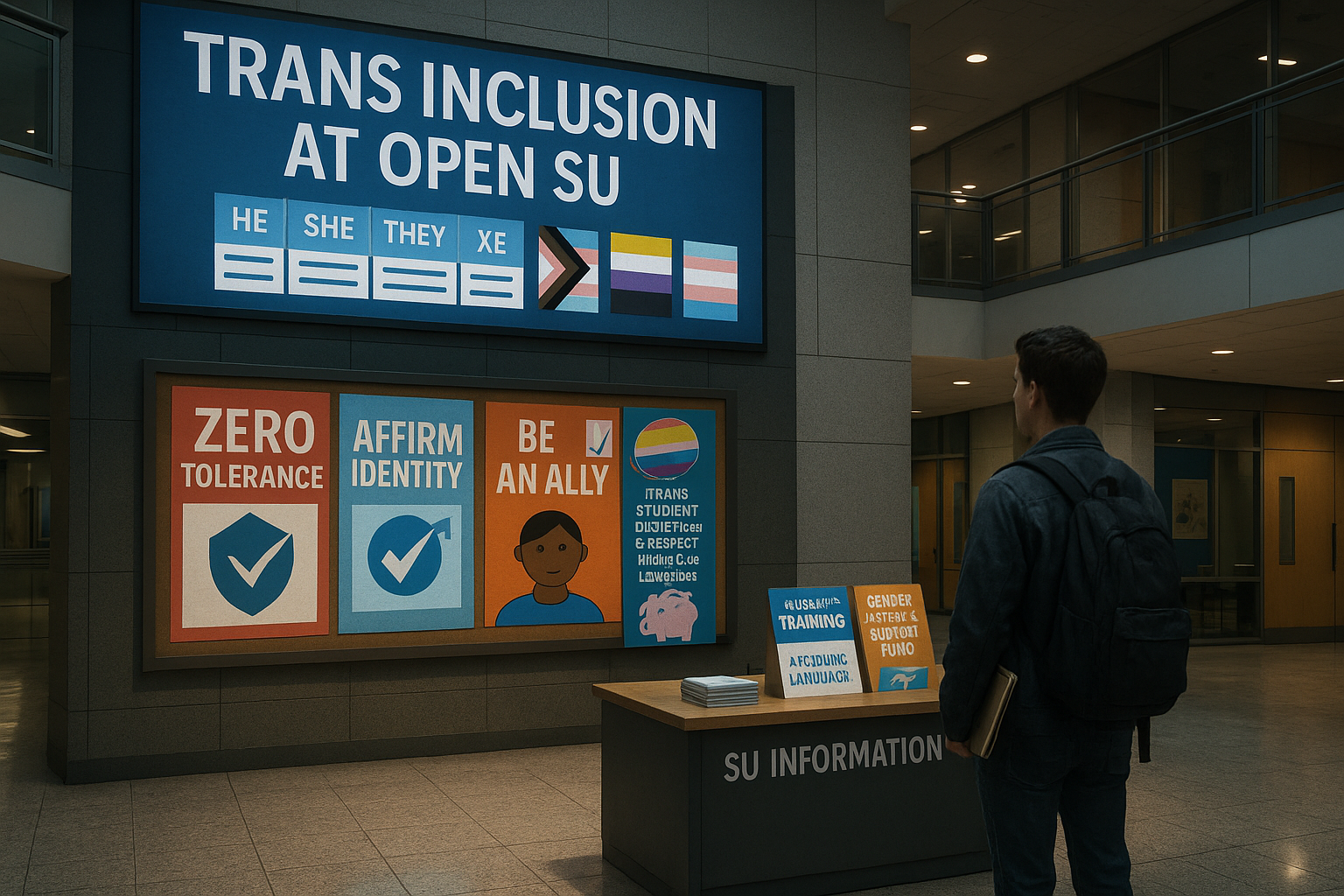
Compulsion at Open University Student Union
Inside the Students’ Union blueprint that redefines speech, reshapes governance, and installs a gender-identity orthodoxy at the heart of the Open University
The Open University Students’ Union’s new Trans Action Plan and Transgender and Gender-diverse Inclusion Statement mark a watershed moment in the internal culture of one of Britain’s largest higher-education communities. Ostensibly framed as measures to support a vulnerable minority, the documents in fact amount to a comprehensive ideological settlement: they prescribe the language staff and students must use, the beliefs they are expected to affirm, the kinds of events that must be funded, and the way in which debate itself is to be structured, constrained, and policed.²
The transformation represented by these documents is not superficial. It is not merely a shift in tone, emphasis, or rhetorical posture. It is a structural reconstitution of how the Students’ Union understands its mission, its authority, and its relationship to law. The SU does not present these policies as proposals or considerations, but as normative imperatives—rules for how thousands of students must speak, behave, and think in any SU-governed context. The architecture is comprehensive, the language confident, and the assumptions unexamined.
In recent years, senior lawyers and commentators have warned about what has been called “Stonewall law” – the habit of treating guidance issued by campaigning organisations as if it were binding legislation.¹ What once began as well-intentioned workplace equality schemes gradually hardened into shadow regulatory structures: handbooks, training packs and HR templates that were adopted as if they carried the weight of statute. The explicit structures and mechanisms set out in these Open SU documents make clear that the Students’ Union has not merely drifted in that direction; it has consciously imported this model into its own internal constitution, with profound implications for academic freedom, equality law, safeguarding, and charity governance.
What the SU presents as “inclusion” is, in substance, a coercive framework: a system in which one contested anthropology of sex and gender is elevated to the status of institutional dogma, and dissenting convictions are pathologised as “phobia”, monitored as “impact”, and managed as a disciplinary risk. The rhetoric of “safety” obscures a deeper truth: the documents seek to police the boundaries of permissible thought, not simply protect vulnerable groups. This analysis sets the documents alongside Stonewall-derived practices elsewhere in the public sector and examines their compatibility with the Equality Act 2010, the Higher Education (Freedom of Speech) Act 2023, the Charity Commission’s guidance on political neutrality, and the emerging evidence base on gender-distressed young people from the Cass Review.²⁻¹⁰
The Plan and Its Reach
The Trans Action Plan is a 24-page operational blueprint extending across education, administration, communications, leadership, community, policy and finance.² Its manner of presentation resembles not a pastoral or welfare document but a strategic reorientation of institutional culture. The length, scope and granularity of its instructions—pronoun protocols, training frameworks, oversight committees, resource allocations—are the markers of a regulatory regime.
The accompanying Inclusion Statement is the ideological charter that sets out the normative premises the Plan then operationalises.²¹ Its vocabulary—“affirm”, “validate”, “respect gender identity”, “zero tolerance”—is not neutral. It is the language of doctrinal enforcement, positioning the SU as an arbiter of moral truth in one of the most contested areas of contemporary public debate.
Together they function not as guidance but as a quasi-theological text and implementation manual: one sets the creed, the other the canon law.
The key pillars are compulsory affirmation of self-declared gender identity; mandatory allyship and inclusive practice training; structural empowerment of OU Pride and external trans organisations; creation of trans-only infrastructures; the reconceptualisation of free speech as a threat; and a zero-tolerance regime which collapses lawful disagreement into disciplinary territory. These are not the features of an inclusion strategy but the building blocks of a worldview.
Administrative Compulsion and Ideological Formation
At the administrative level, the Plan directs the SU to “revise and enhance procedures for documenting student names and pronouns” and impose uniform compliance across operations.³ What appears to be simple courtesy is, in reality, a mandatory speech code. Once encoded into databases, systems and staff training, pronoun usage ceases to be a matter of interpersonal respect and becomes a matter of policy compliance, with inevitable disciplinary implications for dissent.
It is precisely this blurring of courtesy and compulsion that the courts have addressed. In Forstater v CGD Europe, the Tribunal held that gender-critical beliefs—including the conviction that sex is immutable—are protected.⁴ In Meriwether v Hartop, compulsory pronoun use was found to violate free-speech and religious rights.⁵ These rulings make one thing clear: institutions cannot punish people for declining to express ideological propositions.
Yet the SU seeks to do exactly this by embedding pronoun affirmation into its administrative infrastructure. Once a system mandates pronoun usage, dissenters are not merely disagreeing; they are violating procedure.
The regulatory position strengthens this point. The Office for Students, in Regulatory Advice 24 (June 2025), explicitly warns that a blanket rule requiring preferred-pronoun usage is likely unlawful. It gives this as a worked example, noting that such rules chill protected beliefs and breach the statutory duty to secure free speech. That this warning directly matches the SU’s model is striking: the SU’s position is not merely questionable, but precisely the type of unlawful policy now explicitly identified by the national regulator.
Training intensifies this problem. Staff are to receive compulsory “trans allyship” training delivered by external activist organisations.⁶ No safeguards ensure neutrality or evidence-based content. This repeats the structural failures that led public institutions and regulators to withdraw from Stonewall’s schemes, where advice was found to be misleading, partisan, and inconsistent with equality law.⁶⁷ The University of Essex’s independent review similarly concluded that Stonewall guidance on trans issues was in places inaccurate, ideologically driven, and legally problematic. Open SU is re-entrenching a model now widely abandoned across the public sector.
Community Structures, Safeguarding, and the Creation of Echo Chambers
The Plan outlines a network of identity-specific infrastructures: long-term funding for OU Pride;¹⁰ affirmation-focused messaging embedded from Welcome Week;¹¹ identity-based peer programmes;¹² closed online spaces moderated by staff; and a trans consultation group with agenda-setting authority.¹³
The effect is centrifugal: students are sorted into identity blocs, each with its own supports, norms, expectations, and quasi-governance structures. Instead of a common institutional life, the SU creates ideological microclimates.
The safeguarding risks are substantial. The Cass Review warns that young people in closed, identity-based environments may experience intensified social contagion, peer pressure and identity solidification.¹⁰ Safeguarding requires adult oversight rooted in neutrality and evidence, not ideological enthusiasm.
Government guidance on gender-questioning children echoes this caution. The DfE stresses that “affirmation” should not be the automatic first response; that sex-based boundaries must be maintained; and that schools must safeguard all pupils, not only those identifying as trans. The SU’s approach, by contrast, is predicated entirely on affirmation and expansion of identity-labeled spaces—with no consideration of safeguarding impacts on trans or non-trans students.
Communications, Leadership and the Institutionalisation of an Orthodoxy
The Plan’s leadership directives transform SU officers into ideological emissaries. The President and VP EDI must “communicate dedication” to trans inclusion;¹⁴ visibility campaigns must be prioritised; and inclusion statements “cascaded across channels”.¹⁵ This is not a strategy for representation but for indoctrination.
Communications teams must audit websites, update content to reflect activist-aligned language, establish toolkits on pronouns and identity categories, and signpost to activist organisations.¹⁶¹⁷ The SU’s communications thus become a mechanism for amplifying one worldview.
This is unprecedented. Students’ unions traditionally provide pluralistic forums for debate; Open SU seeks instead to centralise and sanctify one ideological position.
Policy, Finance, and Structural Entrenchment
The Plan requires a comprehensive review of all SU policies to ensure compliance with “best practice in trans inclusion”.¹⁸ But “best practice” here is undefined—other than by reference to activist preferences.
It then introduces identity-based funds: a Trans Student Fund¹⁹ and a Gender Expression Fund²⁰. These schemes create financial benefits contingent on adopting or claiming a contested identity label.
This is where charity law becomes crucial. As a registered charity,²¹ Open SU must remain politically neutral and treat beneficiaries equitably. Charity Commission guidance is explicit: charities may not promote contested political ideologies as if they were uncontested truth.⁸
The SU documents do exactly that. They transform contested identity categories into determinants of financial eligibility and reshape the SU’s fiduciary responsibilities around a belief system.
Legal, Academic and Institutional Conflicts
Across multiple legal domains, the SU’s model conflicts with statutory duties.
Under the Equality Act, gender-critical beliefs must be respected.⁴
Under the Freedom of Speech Act, free expression must be promoted.⁹¹¹
Under charity law, neutrality is mandatory.⁸
Under safeguarding guidance, evidence-based caution is essential.¹⁰
EHRC clarification that “sex” in the Equality Act means biological sex strengthens the case: institutions must maintain sex-based boundaries where justified. Open SU’s documents erase such boundaries altogether.
The regulatory risk is not theoretical. In 2024, the Office for Students formally sanctioned the University of Sussex, finding that its trans-equality framework and handling of protests in the Kathleen Stock affair created a “chilling effect” on lawful speech and breached its legal duties. The parallels with Open SU’s model—policies, messaging, and campus climate—are unmistakable.
The Wider Pattern and Its Consequences
Across the public sector, bodies have withdrawn from Stonewall-style frameworks after legal reviews revealed inaccuracies and ideological overreach.⁶⁷¹²¹⁵ NHS Trusts, police forces, councils, and government departments have re-evaluated their partnerships and reversed policies. The trend is away from activist influence, not towards it.
Yet Open SU is adopting this model precisely at the moment it is being dismantled elsewhere.
Government guidance is turning towards sex-based clarity; regulators are enforcing free-speech duties; courts are recognising gender-critical rights; and safeguarding bodies are warning of ideological risks. Open SU’s proposals run against the national tide.
Conclusion
The Trans Action Plan and Inclusion Statement constitute an ideological constitution for Open SU. They reshape governance, redefine rights, empower activist organisations, and suppress dissent. They replace pluralism with orthodoxy and transform a representative body into an ideological enforcer.
A students’ union should represent all students. It should foster debate, uphold neutrality, and ensure that no worldview is imposed by administrative force. Open SU instead seeks to police belief and mandate assent to a contested creed.
The issue is not compassion for trans-identified students. It is whether compassion justifies violating equality law, suppressing academic freedom, undermining safeguarding, and commandeering charitable governance for ideological ends.
On the evidence of these documents, Open SU has chosen to pay that price—and to demand that its members pay it too.
¹ Suella Braverman, “Stonewall doesn’t decide the law,” The Times, 10 October 2021.
² Trans Action Plan OU, full document.
³ Trans Action Plan OU, Education section: revision of procedures for names and pronouns.
⁴ Forstater v CGD Europe [2021] UKEAT 0105_20_1006.
⁵ Meriwether v Hartop, 992 F.3d 492 (6th Cir. 2021).
⁶ Trans Action Plan OU, requirement to work with external trans organisations for allyship training.
⁷ Equality and Human Rights Commission, Statement on withdrawal from Stonewall Diversity Champions, 2021.
⁸ Charity Commission, Speaking out: Guidance on campaigning and political activity by charities, CC9 (2022).
⁹ Office for Students, Free Speech and Academic Freedom: Regulatory Requirements, 2024.
¹⁰ Hilary Cass, Independent Review of Gender Identity Services for Children and Young People (NHS England, 2024).
¹¹ Helen Lewis, The New Authoritarians: Conformity and the New Politics of Identity (London, 2019).
¹² Kathleen Stock, Material Girls: Why Reality Matters for Feminism (Fleet, 2021).
¹³ Media reporting on government departments leaving Stonewall schemes, e.g., “Government quits Stonewall scheme,” BBC News, 10 June 2021.
¹⁴ Trans Action Plan OU, Community section: financial support for OU Pride.
¹⁵ Janice Turner, “How gender ideology captured our institutions,” The Times, 2022.
¹⁶ Trans Action Plan OU, Communications section: audit of equality webpages.
¹⁷ Trans Action Plan OU, Communications section: toolkits on language and support.
¹⁸ Trans Action Plan OU, Policy section: review of all policies.
¹⁹ Trans Action Plan OU, Policy section: proposal for a Trans Student Fund.
²⁰ Trans Action Plan OU, Policy section: proposal for a Gender Expression Fund.
²¹ Transgender Inclusion Policy OU, cover page: charity details.
²² Transgender Inclusion Policy OU, definition of transphobia.
²³ Transgender Inclusion Policy OU, affirmation of gender identity and advocacy commitments.
²⁴ Transgender Inclusion Policy OU, zero-tolerance policy on discrimination.
²⁵ Trans Action Plan OU, Leadership section: guidance on freedom of speech debates.
related articles


latest articles
- Mary Is Co-Redemptrix: Cardinal Burke Reopens Rome’s Marian ControversyCardinal Raymond Leo Burke has declared the Virgin Mary as “Co-Redemptrix” amidst controversy over the Vatican’s restriction on this title. The debate revolves around the appropriateness of certain theological language and whether terminology historically used can still accurately express Marian cooperation in Redemption without compromising Christ’s unique role.
- When Politics Defines Doctrine: Edmund Waldstein, Integralism and the New Boundary at HeiligenkreuzThe ongoing exclusion of Father Edmund Waldstein from teaching at Heiligenkreuz has sparked debate on the limits of acceptable Catholic thought, particularly regarding integralism and its relationship to Church doctrine. Critics argue that Waldstein and similar positions challenge both Catholic teachings and democratic values, raising questions about the intersection of faith and politics.
- Christianity Is Right ~ Not Right WingThe article discusses the distinction between Catholic orthodoxy and modern political ideologies, particularly the Right and Christian nationalism. It argues that Catholic beliefs about family, morality, and authority predate contemporary political classifications and should not be conflated with right-wing politics. The ordo amoris framework is presented as a guiding principle for evaluating political alliances while maintaining a focus on the common good and the Social Kingship of Christ.
- Today’s homily: The Nativity of the Blessed Virgin MaryThe Nativity of the Blessed Virgin Mary marks a significant moment in salvation history, representing the dawn of the Incarnation. Mary’s birth, unnoticed by the world, was part of God’s providential plan leading to Christ. This feast invites reflection on humility, obedience, and trust in God’s will, emphasising Mary’s role as the Mother of the Redeemer.
- Today’s Mass: September 08 The Nativity of the Blessed Virgin MaryThe Nativity of the Blessed Virgin Mary celebrates her birth, symbolising a new beginning tied to salvation. Originating in the East, it gained recognition in Rome under Pope Sergius I. Additionally, the feast commemorates Saint Hadrian, a martyr who converted to Christianity, underscoring themes of faith and redemption.





Leave a Reply